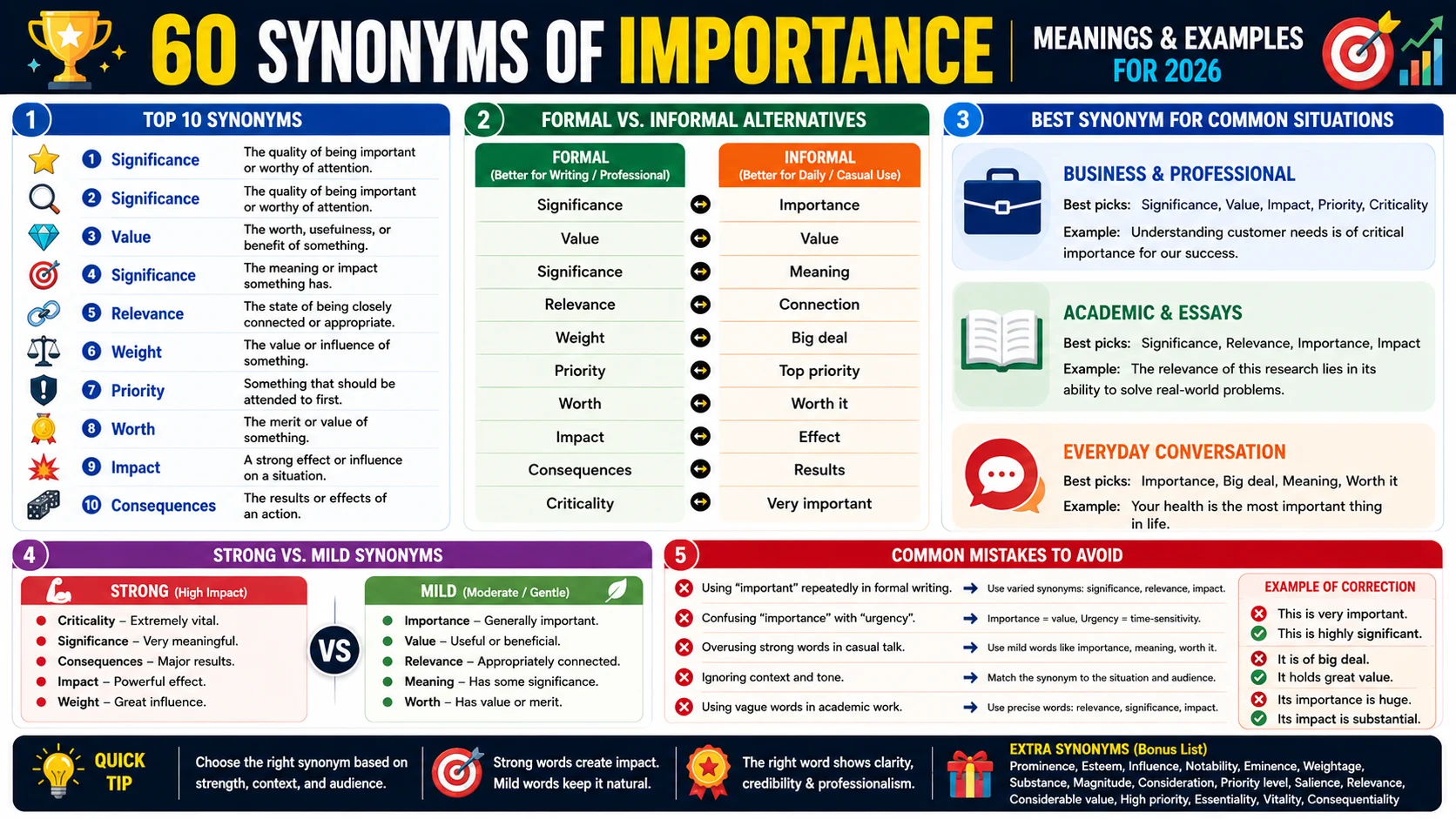
Importance” means the quality of being significant, valuable, or worthy of attention. The best synonyms are significance, value, weight, consequence, and relevance. “Significance” is the most common natural alternative. Each synonym has a slightly different meaning and context where it fits best.
Top 10 Synonyms
- Significance
- Value
- Weight
- Consequence
- Relevance
- Substance
- Gravity
- Moment
- Note
- Priority
“Importance” is a word we use constantly. We talk about important decisions, important people, important events, and important ideas. But using it too often can make your English feel repetitive and uninspired.
Think about it. You can describe the importance of education, the importance of family, the importance of health, or the importance of honesty. Each situation might need a different word that captures the specific type of significance.
In this guide, you’ll learn 35 powerful synonyms for “importance.” You’ll discover exactly when to use each one, how formal they are, and what common mistakes to avoid. Let’s begin!
What Does “Importance” Mean?
Definition
Importance” means the quality of being significant, valuable, or worthy of attention. When something has importance, it matters. It can be important because it’s valuable, because it affects many people, or because it has serious consequences.
Pronunciation
| Feature | Value |
|---|---|
| US IPA | /ɪmˈpɔrtəns/ |
| UK IPA | /ɪmˈpɔːtəns/ |
| Syllables | 3 (im-por-tance) |
| Tip | Stress the second syllable: “im-POR-tens” |
Grammar
| Grammar Feature | Information |
|---|---|
| Part of Speech | Noun |
| Common Position | Subject or object |
| Typical Pattern | Importance + of + something / Importance + to + someone |
Examples:
- “The importance of education cannot be overstated.” (of + noun)
- “This matter is of great importance.” (be + of)
- “The importance to the community is clear.” (to + someone)
Grammar Note: “Importance” is usually uncountable. We don’t say “importances” except in very rare contexts.
Word Family
| Word | Part of Speech | Meaning |
|---|---|---|
| Importance | Noun | The quality of being important |
| Important | Adjective | Having great significance |
| Importantly | Adverb | In an important way |
| Unimportant | Adjective | Not important |
| Self-importance | Noun | Thinking too highly of oneself |
15 Synonyms of “Importance”
Significance
Meaning: The quality of being meaningful, important, or having a special meaning.
Best Used For: Research, discoveries, events, symbols.
Formality: Formal
Tone: Meaningful, Profound
Frequency: ⭐⭐⭐⭐⭐ (Very Common)
CEFR Level: B2
Example Sentence 1: “The discovery has great significance for medical science.”
Example Sentence 2: “Do you understand the significance of this decision?”
Usage Tip: “Significance” is the most direct synonym. Use it for things that have deep meaning or impact.
Common Confusion: Significance vs Importance. “Significance” often suggests deeper meaning. “Importance” is more about value or consequence.
Value
Meaning: The worth, usefulness, or importance of something.
Best Used For: Products, skills, experiences, relationships.
Formality: Neutral
Tone: Practical, Positive
Frequency: ⭐⭐⭐⭐⭐ (Very Common)
CEFR Level: A2
Example Sentence 1: “She understands the value of hard work.”
Example Sentence 2: “The value of this advice cannot be measured.”
Usage Tip: “Value” emphasizes worth and usefulness. Use it for practical, tangible, or personal worth.
Weight
Meaning: The importance or seriousness of something.
Best Used For: Arguments, decisions, responsibilities.
Formality: Formal
Tone: Serious, Heavy
Frequency: ⭐⭐⭐⭐ (Common)
CEFR Level: B2
Example Sentence 1: “The weight of this decision rests on your shoulders.”
Example Sentence 2: “His opinion carries a lot of weight.
Usage Tip: “Weight” suggests burden and seriousness. Use it for heavy responsibilities or influential opinions.
Consequence
Meaning: The importance or significance of something, especially in terms of its effects.
Best Used For: Actions, decisions, events.
Formality: Formal
Tone: Serious, Significant
Frequency: ⭐⭐⭐⭐ (Common)
CEFR Level: B2
Example Sentence 1: “This is a matter of great consequence.”
Example Sentence 2: “He didn’t understand the consequence of his actions.”
Usage Tip: “Consequence” emphasizes the effects or results of something. Use it for actions and decisions.
Relevance
Meaning: The quality of being closely connected to or important to the current situation.
Best Used For: Information, arguments, topics.
Formality: Formal
Tone: Connected, Applicable
Frequency: ⭐⭐⭐⭐ (Common)
CEFR Level: B2
Example Sentence 1: “The relevance of this evidence is questionable.”
Example Sentence 2: “I fail to see the relevance of your comment.”
Usage Tip: “Relevance” emphasizes being connected and applicable. Use it for information and arguments.
Substance
Meaning: The important, meaningful, or solid part of something.
Best Used For: Arguments, discussions, content.
Formality: Formal
Tone: Solid, Meaningful
Frequency: ⭐⭐⭐ (Moderate)
CEFR Level: C1
Example Sentence 1: “Her argument lacked substance.”
Example Sentence 2: “We need to add more substance to this proposal.”
Usage Tip: “Substance” emphasizes meaningful content. Use it when something has real depth.
Gravity
Meaning: The seriousness or importance of a situation.
Best Used For: Situations, decisions, problems.
Formality: Formal
Tone: Serious, Grave
Frequency: ⭐⭐⭐ (Moderate)
CEFR Level: C1
Example Sentence 1: “He didn’t appreciate the gravity of the situation.”
Example Sentence 2: “We must recognize the gravity of these allegations.”
Usage Tip: “Gravity” suggests very serious importance. Use it for serious situations.
Moment
Meaning: The importance or significance of a particular time or event.
Best Used For: Decisions, events, achievements.
Formality: Formal
Tone: Significant, Pivotal
Frequency: ⭐⭐⭐ (Moderate)
CEFR Level: B2
Example Sentence 1: “This is a moment of great importance for the nation.”
Example Sentence 2: “She has a sense of the moment.”
Usage Tip: “Moment” can refer to a specific time that is important. It’s often used for pivotal events.
Note
Meaning: Notice, attention, or importance.
Best Used For: Things worth noticing, people.
Formality: Neutral
Tone: Notable, Worthy
Frequency: ⭐⭐⭐ (Moderate)
CEFR Level: B2
Example Sentence 1: “He is a person of some note in the community.”
Example Sentence 2: “The speech was worthy of note.”
Usage Tip: “Note” suggests something is worth paying attention to. Use it for notable people or events.
Priority
Meaning: The state of being more important than other things.
Best Used For: Tasks, decisions, time management.
Formality: Neutral
Tone: Focused, Urgent
Frequency: ⭐⭐⭐⭐⭐ (Very Common)
CEFR Level: B2
Example Sentence 1: “Safety is our top priority.”
Example Sentence 2: “We need to prioritize our work.”
Usage Tip: “Priority” emphasizes relative importance. Use it for ranking importance.
Merit
Meaning: The quality of being good and important.
Best Used For: Ideas, proposals, achievements.
Formality: Formal
Tone: Deserving, Worthy
Frequency: ⭐⭐⭐ (Moderate)
CEFR Level: C1
Example Sentence 1: “The proposal has some merit.”
Example Sentence 2: “She’s a person of great merit.”
Usage Tip: “Merit” suggests being deserving of attention or reward. Use it for worthy things.
Significance
Meaning: The quality of being meaningful or having a special meaning.
Best Used For: Events, symbols, discoveries.
Formality: Formal
Tone: Meaningful, Profound
Frequency: ⭐⭐⭐⭐⭐ (Very Common)
CEFR Level: B2
Example Sentence 1: “The historical significance of the site is undeniable.”
Example Sentence 2: “This discovery has profound significance.”
Usage Tip: “Significance” suggests deep meaning or importance. It’s very similar to “importance.”
Magnitude
Meaning: The great size, extent, or importance of something.
Best Used For: Disasters, achievements, problems.
Formality: Formal
Tone: Large, Significant
Frequency: ⭐⭐⭐ (Moderate)
CEFR Level: C1
Example Sentence 1: “He didn’t understand the magnitude of the crisis.”
Example Sentence 2: “The magnitude of her achievement is impressive.”
Usage Tip: “Magnitude” emphasizes the great scale of importance. Use it for large-scale significance.
Prominence
Meaning: The state of being important, well-known, or noticeable.
Best Used For: People, places, events.
Formality: Formal
Tone: Notable, Leading
Frequency: ⭐⭐⭐ (Moderate)
CEFR Level: C1
Example Sentence 1: “He rose to prominence in the field of science.
Example Sentence 2: “The city’s prominence has grown in recent years.”
Usage Tip: “Prominence” emphasizes being widely recognized. Use it for well-known people or places.
Precedence
Meaning: The condition of being considered more important than something else.
Best Used For: Rules, protocols, priorities.
Formality: Formal
Tone: Official, Priority
Frequency: ⭐⭐ (Rare)
CEFR Level: C1
Example Sentence 1: “Safety takes precedence over everything else.”
Example Sentence 2: “The matter has precedence over others.”
Usage Tip: “Precedence” is about priority and order. Use it in official contexts.
Synonyms Comparison Table
| Synonym | Best Context | Formality | Tone | Frequency |
|---|---|---|---|---|
| Significance | Deep meaning | Formal | Meaningful | ⭐⭐⭐⭐⭐ |
| Value | Worth, usefulness | Neutral | Practical | ⭐⭐⭐⭐⭐ |
| Priority | Ranking importance | Neutral | Focused | ⭐⭐⭐⭐⭐ |
| Weight | Seriousness | Formal | Heavy | ⭐⭐⭐⭐ |
| Consequence | Effects | Formal | Significant | ⭐⭐⭐⭐ |
| Relevance | Connection | Formal | Applicable | ⭐⭐⭐⭐ |
| Gravity | Serious situations | Formal | Grave | ⭐⭐⭐ |
| Substance | Meaningful content | Formal | Solid | ⭐⭐⭐ |
| Magnitude | Scale of importance | Formal | Large | ⭐⭐⭐ |
Best Synonyms by Situation
| Situation | Best Synonym | Why It Works |
|---|---|---|
| Daily Conversation | Importance | Natural and common |
| Business Email | Significance | Professional and clear |
| Academic Writing | Significance | Formal and precise |
| School Assignment | Importance | Clear and simple |
| Professional Meeting | Priority | Sounds focused |
| Presentation | Significance | Clear and professional |
| Creative Writing | Gravity | Adds literary depth |
| Social Media | Importance | Casual and relatable |
| Scientific Paper | Significance | Formal and appropriate |
Formal vs Informal Synonyms
Formal Alternatives
| Synonym | Best Used For |
|---|---|
| Significance | Academic, research contexts |
| Consequence | Actions, decisions |
| Gravity | Serious situations |
| Magnitude | Large-scale importance |
| Prominence | Well-known people, places |
Neutral Alternatives
| Synonym | Best Used For |
|---|---|
| Importance | Most general situations |
| Value | Worth, usefulness |
| Priority | Ranking importance |
| Relevance | Connection to topic |
Informal Alternatives
| Synonym | Best Used For |
|---|---|
| Weight | Serious matters |
| Note | Notable things |
| Substance | Meaningful content |
Choosing the Right Level: Use “significance” and “consequence” for formal writing. Use “importance” and “value” for most situations.
Strong vs Mild Synonyms
Mild
Suitable for everyday situations with less intensity.
- Importance
- Value
- Note
Moderate
More serious or specific alternatives.
- Significance
- Weight
- Relevance
- Substance
Strong
High-intensity alternatives suggesting grave or profound importance.
- Gravity (grave seriousness)
- Magnitude (large scale)
- Consequence (significant effects)
- Prominence (widely recognized)
How Intensity Changes Meaning: “This has importance” is mild. “This has profound significance” is much stronger. Choose stronger words when you want to emphasize the gravity of the matter.
Real-Life Examples
School: “The importance of education cannot be ignored.”
Office: “We need to discuss the priority of this project.”
Business Email: “Please understand the significance of this matter.”
Meetings: “The gravity of the situation is clear.”
Presentations: “We must recognize the magnitude of this opportunity.”
Daily Conversations: “This is a matter of great importance.”
Social Media: “The importance of mental health is undeniable.”
Academic Writing: “The significance of these findings is profound.”
Common Collocations
| Common Phrase | Better Alternative |
|---|---|
| Great importance | Great significance |
| Of importance | Of consequence |
| Importance of education | Significance of education |
| Key importance | Key significance |
| Vital importance | Vital significance |
Common Phrases
Matter of importance: Something important. (e.g., “This is a matter of importance.”)
Carry weight: To be important. (e.g., “His opinion carries a lot of weight.”)
Cut and dried: Clearly important. (e.g., “The decision is cut and dried.”)
Of note: Important or notable. (e.g., “The meeting is of note.”)
Nothing to sneeze at: Something important. (e.g., “That salary is nothing to sneeze at.”)
Context Guide
| Situation | Best Synonym | Reason |
|---|---|---|
| Essay | Significance | Academic and formal |
| Speech | Importance | Clear and inspiring |
| Business Email | Priority | Professional and clear |
| Novel | Gravity | Adds literary depth |
| Presentation | Significance | Clear and professional |
| Conversation | Importance | Natural and relatable |
| Academic Writing | Significance | Precise and formal |
| Marketing Copy | Value | Engaging and convincing |
Related Words
Near Synonyms
- Stature: Reputation and importance.
- Prestige: Respect and importance.
- Standing: Rank or importance.
- Worth: Value and importance.
- Distinction: Excellence and importance.
Antonyms
- Unimportance: Lack of importance.
- Triviality: Lack of significance.
- Insignificance: Lack of importance.
- Irrelevance: Not connected.
- Meaninglessness: Without meaning.
Related Adjectives
- Important: Having great significance.
- Significant: Meaningful and important.
- Valuable: Worth a lot.
- Essential: Absolutely necessary.
- Crucial: Extremely important.
Related Nouns
- Significance: The quality of being meaningful.
- Value: The worth of something.
- Priority: Relative importance.
- Weight: Seriousness.
- Consequence: Importance in terms of effects.
Related Verbs
- Matter: To be important.
- Count: To have importance.
- Signify: To mean or indicate.
- Value: To consider important.
- Prioritize: To rank by importance.
Frequently Asked Questions
What is another word for importance?
Common synonyms include significance, value, weight, consequence, and relevance. “Significance” is the most common and direct alternative.
Which synonym sounds the most professional?
Significance and consequence sound very professional. “Gravity” is excellent for formal, serious contexts.
What is the strongest synonym for importance?
Gravity and magnitude are among the strongest synonyms. “Gravity” suggests grave seriousness. “Magnitude” suggests large-scale importance.
Which synonym is best for essays?
Significance is the best choice for academic essays. It’s formal and precise.
What’s the difference between importance and significance?
Significance” often suggests deeper meaning or symbolism. “Importance” is more about value or consequence.
Which synonym is most common in everyday English?
“Importance” itself is most common. “Value” and “priority” are also frequently used.
What is the opposite of importance?
Common opposites include unimportance, insignificance, triviality, and irrelevance.
Conclusion
“Importance” is a fundamental word, but now you have 35 fantastic alternatives. Each synonym adds a different shade of meaning to your language.
Remember, the key is understanding the context. Use “significance” for deep meaning. Use “value” for practical worth. Use “priority” for ranking importance. Use “gravity” for serious situations.
The best way to improve is practice. Try using one or two new synonyms each day. Listen for these words in conversations and books. Your vocabulary will become richer and more impressive with time.
