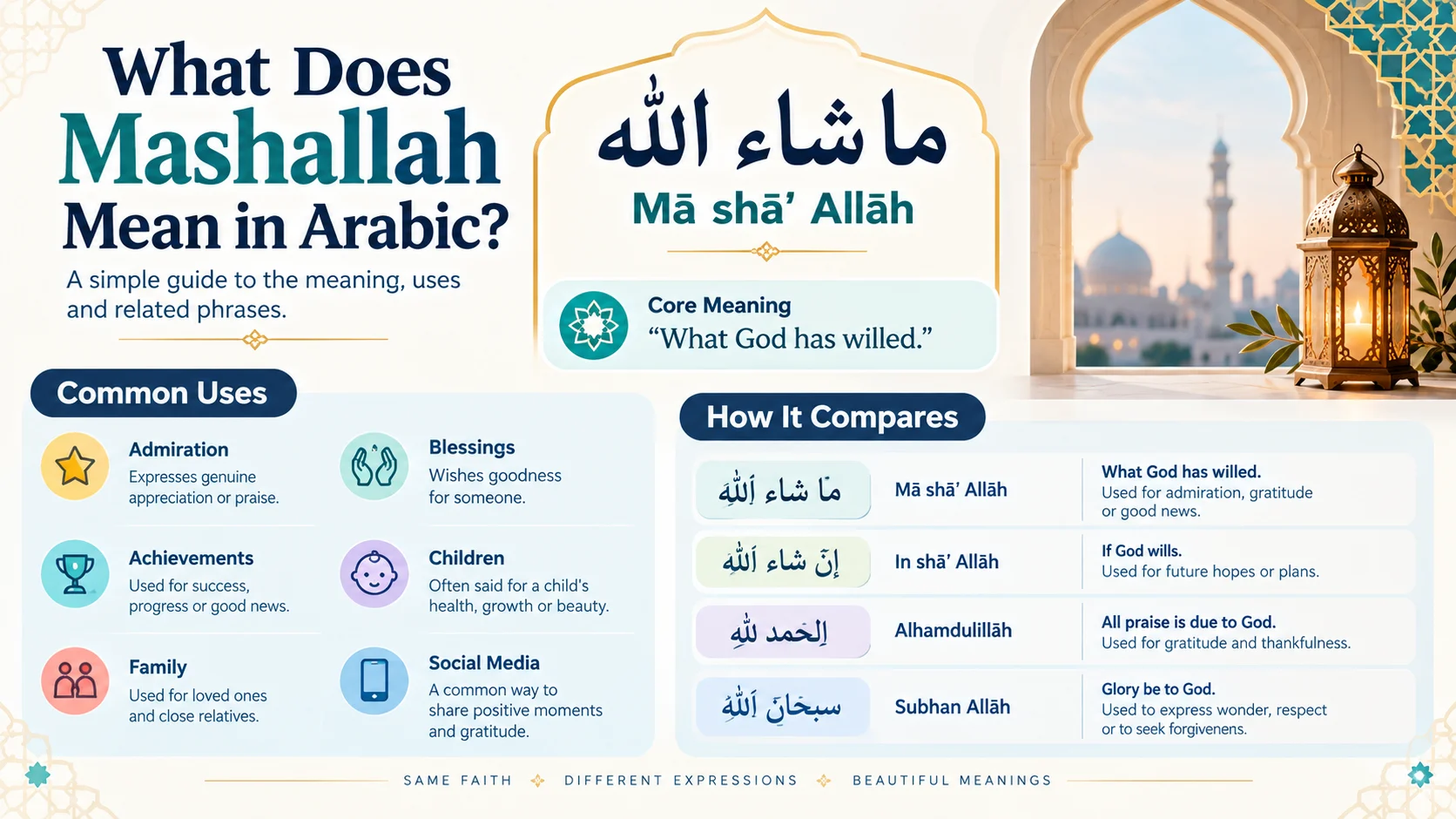
Mashallah means “what God has willed” or “what Allah has willed.” People commonly say it when admiring something good, beautiful, impressive, or fortunate. It can express appreciation, gratitude, praise, or recognition that something happens by God’s will.
What does mashallah mean in Arabic is a question that often comes up when English speakers encounter the phrase online, in conversation, or in Muslim communities. The expression appears in Arabic speech, Islamic contexts, family conversations, social media captions, and everyday messages.
At its core, Mashallah comes from the Arabic phrase مَا شَاءَ ٱللَّٰهُ, commonly transliterated as mā shāʾ Allāh. It literally refers to what God has willed. However, its practical meaning depends on the situation.
For example, someone might say it after seeing a beautiful baby, hearing good news, admiring someone’s achievement, or complimenting a home. In those situations, the phrase can communicate sincere admiration while recognizing God as the source of the blessing.
Importantly, Mashallah does not simply mean “wow.” It carries cultural and religious meaning that an English translation cannot fully capture. Therefore, understanding the context helps you use it naturally and respectfully.
QUICK ANSWER BOX
| Meaning | Context | Primary Platforms | Example | Tone |
| “What God has willed” | Admiration, praise, blessings | Instagram, TikTok, Snapchat, texting | “Your daughter is so grown up, Mashallah.” | Warm and appreciative |
| “God has willed it” | Recognition of a positive outcome | Conversations and messages | “You got the promotion, Mashallah.” | Positive and respectful |
| Recognition of a blessing | Family, achievements, appearance | Social media and everyday speech | “Mashallah, your new house is beautiful.” | Admiring |
| Religious expression | Islamic conversations | Prayer, speech, writing | “Mashallah, may Allah bless you.” | Reverent |
What does mashallah mean in Arabic?
The Arabic expression مَا شَاءَ ٱللَّٰهُ is commonly transliterated as Mā shāʾ Allāh. A close literal translation is “what Allah has willed” or “what God has willed.”
The phrase contains three important elements. Mā can mean “what.” Shāʾa means “willed” or “wanted.” Allah means God. Therefore, the expression points toward something that exists or happens according to divine will.
However, literal translation does not explain everyday usage. In real conversation, Mashallah often functions as an expression of admiration.
Someone may see a beautiful child and say, “Mashallah.” They may see an impressive achievement and use the same phrase. Likewise, someone might compliment a person’s new home, family, appearance, business, or academic success.
The Arabic spelling and pronunciation
The standard Arabic spelling is:
ما شاء الله
A common transliteration is:
Mā shāʾ Allāh
English speakers also write it in several informal ways:
| Common spelling | Notes |
| Mashallah | Very common in English |
| MashaAllah | Makes the word Allah more visible |
| Masha Allah | Separates the Arabic words |
| Ma Sha Allah | Informal spacing |
| ما شاء الله | Arabic script |
| Mā shāʾ Allāh | More academic transliteration |
These spellings generally refer to the same Arabic expression. However, transliteration varies because Arabic sounds do not always map neatly onto English letters.
Is Mashallah religious or cultural?
It is both religious and cultural. The phrase has clear Islamic roots and appears in Islamic texts and traditions. At the same time, Arabic speaking communities may use it in everyday conversation as a familiar expression of admiration.
Consequently, hearing the phrase does not always mean that the speaker is making a formal religious statement. Context matters.
For example, a family member may say it after seeing a child’s excellent grades. A friend may write it under an Instagram photograph. Someone may say it after hearing about a successful business launch.
In each case, the phrase can acknowledge something positive while connecting that blessing with God’s will.
Mashallah and the idea of blessings
The expression is also closely associated with barakah, an Arabic and Islamic concept often translated as blessing or divine blessing.
Therefore, saying Mashallah can carry more meaning than simply complimenting someone. It can communicate admiration while recognizing that the good thing being praised ultimately comes from God.
This explains why the phrase frequently appears around children, family milestones, achievements, beauty, wealth, health, homes, and other blessings.
Contextual Dynamics and Nuances of the Term
Understanding the phrase requires more than memorizing one English translation. The same expression can communicate slightly different ideas depending on the situation, speaker, and relationship.
Admiration
One of the most common uses involves admiration.
Imagine that a friend shows you photographs of their new home. You might hear:
“Mashallah, your house is beautiful.”
Here, the speaker expresses genuine appreciation. The phrase does not literally mean “your house is beautiful.” Instead, it accompanies the compliment.
Appreciation of a child
The expression commonly appears when people compliment children.
For example:
“Mashallah, your son has grown so much.”
This usage can signal affection and admiration. It can also reflect the cultural preference for recognizing a child’s blessings without treating the compliment as merely personal praise.
Celebrating achievement
People can also use the expression after academic, professional, or personal accomplishments.
For example:
“Mashallah, you graduated with honors.”
The statement recognizes the achievement while acknowledging God’s will.
Responding to good news
Someone might use Mashallah when hearing positive news.
For example:
“I finally opened my own business.”
A friend might respond:
“Mashallah! Congratulations.”
The expression adds warmth and cultural meaning to the congratulations.
Protection from the evil eye
A major cultural association involves the evil eye, often called al ʿayn in Arabic.
In many Muslim communities, people use expressions such as Mashallah when admiring blessings. This practice can be connected with the belief that excessive admiration or envy may expose blessings to harm through the evil eye.
However, beliefs and customs differ among individuals and communities. Therefore, it is better to describe this association as a widespread cultural and religious practice rather than assume that every Arabic speaker uses the phrase for exactly the same reason.
Is it always a compliment?
Usually, the expression appears in positive situations. However, context determines the exact emotional effect.
A sincere “Mashallah” can sound warm and affectionate. A sarcastic delivery can change the meaning completely. Online, written text also removes vocal cues, so surrounding words become important.
Real Life Conversation Examples Using what does mashallah mean in arabic
The best way to understand the expression is to see how people actually use it.
Scenario 1: Complimenting a child
Aisha: “Here’s a picture of my daughter on her first day of school.”
Sara: “Mashallah, she looks so grown up!”
Aisha: “I know! I can’t believe how fast she’s growing.”
In this conversation, the expression communicates admiration and affection. It does not replace the compliment. Instead, it adds cultural and religious meaning.
Scenario 2: Celebrating an achievement
Omar: “I finally finished my master’s degree.”
Bilal: “Mashallah! Congratulations, brother.”
Omar: “Thank you! It took a lot of work.”
Here, Mashallah recognizes a positive achievement. The speaker then adds a direct congratulations.
Scenario 3: Complimenting a home
Friend: “Come inside and check out the new place.”
Guest: “Wow, Mashallah. This living room looks amazing.”
Friend: “Thanks! We spent months renovating it.”
The phrase works naturally alongside an English compliment. This combination is especially common in multilingual conversations.
Scenario 4: Responding to family news
Nadia: “My parents are celebrating their 40th anniversary this weekend.”
Hana: “Mashallah, 40 years! That’s beautiful.”
Nadia: “Yes, the whole family is getting together.”
Here, the expression communicates admiration for a long lasting family milestone.
Scenario 5: Social media conversation
Commenter: “Mashallah, congratulations on the new baby!”
Parent: “Thank you so much!”
This example shows why the phrase appears frequently in comments. It combines congratulations, admiration, and recognition of a blessing in a short expression.
Platform Specific Breakdown
Modern internet culture has expanded how people encounter Arabic expressions. Social media users may see the phrase in captions, comments, usernames, videos, memes, and private messages.
However, the underlying meaning remains connected to its Arabic and religious roots.
How It Is Used on Snapchat
Snapchat encourages quick, informal communication. Therefore, users may type “Mashallah” as a short reaction to a friend’s story.
For example:
“Mashallah 🔥”
A person might send this after seeing a graduation photo, new car, family picture, vacation view, or personal achievement.
Another example could be:
“Mashallah, you look great!”
The phrase does not require a long explanation. In many conversations, the recipient already understands the cultural meaning.
However, non Arabic speakers should avoid treating it as generic internet slang. It is still a meaningful expression.
The Role of what does mashallah mean in arabic on TikTok
TikTok has made Arabic expressions more visible to global audiences. Users may encounter Mashallah in comments beneath videos featuring achievements, beauty, children, sports, travel, or lifestyle content.
A comment might say:
“Mashallah, what an incredible performance.”
Another user might write:
“MashaAllah, congratulations!”
TikTok also creates cross cultural situations. Someone who does not speak Arabic may copy the phrase after seeing it repeatedly in comments.
That can be appropriate when the person understands its basic meaning. However, using it randomly can make the expression feel disconnected from its cultural context.
Instagram and Texting Dynamics
Instagram provides several common settings for the phrase. These include comments, captions, direct messages, Stories, and family posts.
For example:
“Mashallah ❤️”
can function as a short affectionate reaction.
A longer message might say:
“Mashallah, your family has grown so much. Congratulations!”
Texting creates similar patterns. Friends may combine Arabic expressions with English:
“Mashallah bro, you really did it!”
This code switching is common in multilingual communities. It also demonstrates how expressions can retain their original cultural meaning while functioning naturally inside English sentences.
Why social media changes perception
Online platforms can make a culturally specific expression appear like ordinary slang. However, that interpretation can be misleading.
Mashallah is not simply an abbreviation or trendy reaction. It comes from a meaningful Arabic expression with religious significance.
Therefore, users should understand the basic meaning before adopting it online.
Alternative Meanings and NLP Variations of the Phrase
Search engines may show several English interpretations for the same Arabic expression. These variations can look different while referring to the same underlying phrase.
“What God has willed”
This is one of the closest literal translations.
It emphasizes God’s will and explains the grammatical structure of the Arabic phrase.
“God has willed it”
This version sounds more natural in some English contexts.
It focuses on the completed result rather than the grammatical structure of the original Arabic.
“As God has willed”
This translation can work when explaining the phrase in a formal or theological context.
However, everyday English speakers may find “what God has willed” easier to understand.
“God has blessed it”
This is sometimes used as an interpretive explanation. Nevertheless, it is not a direct word for word translation.
The phrase can accompany recognition of a blessing, but “God has blessed it” describes an implication rather than the literal Arabic wording.
Mashallah versus Inshallah
These two expressions are often confused because both contain Allah and frequently appear in Muslim conversations.
Mashallah commonly reacts to something that exists, happened, or is being admired.
Inshallah means “if God wills” and commonly refers to something expected or hoped for in the future.
| Expression | Basic meaning | Common use |
| Mashallah | What God has willed | Admiration or recognition |
| Inshallah | If God wills | Future hopes or plans |
| Alhamdulillah | Praise belongs to God | Gratitude or thanks |
| Subhanallah | Glory be to God | Amazement, praise, or reflection |
These expressions can sometimes appear together. However, they are not interchangeable.
Mashallah versus Alhamdulillah
Alhamdulillah generally expresses praise or gratitude to God.
For example:
“I passed my exam, Alhamdulillah.”
A person could then hear:
“Mashallah, congratulations!”
The first expression emphasizes gratitude. The second can emphasize admiration or recognition of the achievement.
Mashallah versus Subhanallah
Subhanallah literally relates to declaring God’s perfection or transcendence. In everyday speech, it can also express amazement.
Mashallah, by contrast, often accompanies admiration for a specific blessing or positive situation.
Context remains essential because everyday usage can vary between communities.
Misinterpretations: When NOT to Use what does mashallah mean in arabic
Using a culturally meaningful expression becomes easier when you know where it may sound inappropriate or confusing.
Do not treat it as a universal synonym for “good”
Mashallah does not simply mean “good,” “cool,” or “nice.”
It can accompany those reactions, but its meaning includes recognition of God’s will.
Therefore, using it on every positive statement can make the phrase sound mechanical.
Do not use it sarcastically unless the context clearly supports it
Sarcasm can easily distort religious expressions.
For example:
“Mashallah, another traffic ticket.”
Some friends may use this humorously. However, the phrase could sound disrespectful in another setting.
Therefore, avoid sarcastic use unless you understand the audience and cultural context.
Do not assume every Arabic speaker uses it identically
Arabic is spoken across many countries and communities. Religious practice also varies between individuals.
Consequently, usage patterns can differ by family, region, religious background, and personal preference.
Do not confuse admiration with ownership
The expression does not mean “this belongs to God” in the simple conversational sense.
Instead, it recognizes something as existing or occurring by God’s will.
Do not force the expression into every compliment
If you are learning Arabic, natural usage matters more than frequency.
A simple “beautiful,” “congratulations,” or “that is wonderful” may be enough in an English conversation.
Use Mashallah when the cultural or religious context makes it appropriate.
How to Respond in Chat Comfortably
You do not need to be Muslim or speak Arabic fluently to respond politely when someone says Mashallah to you.
Your response should match the relationship and context.
Simple responses
If someone says:
“Mashallah, your new house is beautiful.”
You could reply:
“Thank you!”
Or:
“Thank you, I really appreciate that.”
These responses work in almost any situation.
Religious or culturally familiar responses
In a Muslim context, someone may respond with another familiar expression.
For example:
“JazakAllahu khayran.”
This generally means “May Allah reward you with goodness.”
However, you do not need to use Arabic if you are unfamiliar with the expression.
Responding to a compliment about your child
If someone says:
“Mashallah, your son is adorable.”
You could say:
“Thank you so much.”
Or:
“Thank you. He means the world to us.”
The important point is sincerity. You do not need to create a complicated response.
Responding online
On Instagram or TikTok, a simple response can work well:
“Thank you ❤️”
Or:
“Thank you so much!”
If the conversation takes place in a Muslim community, you may also see Arabic or Islamic expressions used naturally in the response.
Can you say Mashallah back?
Yes, depending on the situation.
For example:
Person A: “Mashallah, your baby is beautiful.”
Person B: “Thank you! Mashallah, your family is beautiful too.”
The second use functions as a reciprocal expression of appreciation.
Still, beginners should focus on understanding the phrase rather than trying to insert it into every conversation.
FAQs
1. What does mashallah mean in Arabic?
The expression means approximately “what God has willed” or “what Allah has willed.” People commonly use it when admiring a blessing, achievement, person, object, or positive event.
2. Is Mashallah Arabic or Islamic?
It is an Arabic expression with strong Islamic religious significance. The phrase appears in Islamic contexts and is also widely used in everyday Arabic speaking communities.
3. What does Mashallah mean in English?
The closest common translations are “what God has willed” and “what Allah has willed.” In conversation, it often communicates admiration, appreciation, or recognition of a blessing.
4. Can non Muslims say Mashallah?
Yes, a non Muslim can use the expression respectfully. However, understanding its religious and cultural meaning matters. It should not be treated merely as a trendy word.
5. When should you say Mashallah?
People commonly say it when admiring something positive. Examples include a beautiful child, successful achievement, attractive home, family milestone, or other blessing.
6. What is the difference between Mashallah and Inshallah?
Mashallah commonly recognizes something that exists or has happened. Inshallah means “if God wills” and commonly relates to future events, hopes, or plans.
7. Is Mashallah a compliment?
It can accompany a compliment, but it is not itself equivalent to words such as “beautiful” or “excellent.” Instead, it expresses recognition and admiration connected with God’s will.
8. Why do people say Mashallah when looking at babies?
Many people use the expression when admiring babies because children are viewed as blessings. In some Muslim cultures, saying it also relates to customs surrounding admiration and the evil eye.
9. Is Mashallah used on social media?
Yes. People frequently use it in captions, comments, stories, direct messages, and replies. Social platforms have also introduced the expression to audiences outside Arabic speaking and Muslim communities.
10. How do you spell Mashallah in English?
Common spellings include Mashallah, MashaAllah, Masha Allah, and Ma Sha Allah. These variations reflect different transliteration and spacing preferences.
| Element | Recommendation |
| Image topic | Meaning and usage of Mashallah |
| Suggested file name | what does mashallah mean in arabic infographic.webp |
| Suggested alt text | What does Mashallah mean in Arabic with Arabic spelling and English meaning |
| Suggested title | Mashallah meaning in Arabic |
| Image format | WebP |
| Main text | ما شاء الله |
| Supporting text | What God has willed |
| Search intent | Informational |
Conclusion:
What does mashallah mean in Arabic is ultimately a question about language, religion, culture, and context. The phrase comes from مَا شَاءَ ٱللَّٰهُ, meaning approximately “what God has willed.”
In everyday use, people often say it when admiring something positive. They may use it for children, achievements, family milestones, homes, appearance, or other blessings. Furthermore, social media has expanded its visibility far beyond traditional Arabic speaking communities.
However, the expression remains more meaningful than ordinary internet slang. Its religious background shapes how many people understand and use it.
The phrase also demonstrates how language changes across platforms. On Instagram, it may appear as a short comment. On Snapchat, it may become a quick reaction. On TikTok, it may appear under achievement or lifestyle videos. In private messages, it can become part of natural Arabic English code switching.
Most importantly, context determines appropriate usage. A respectful speaker does not need to use the phrase constantly. Instead, understanding its meaning makes it easier to recognize when it fits naturally.
For English speakers, the simplest takeaway is clear: Mashallah is an Arabic expression that recognizes something admirable or blessed while acknowledging God’s will. That meaning explains both its traditional use and its continued presence in modern digital communication.
