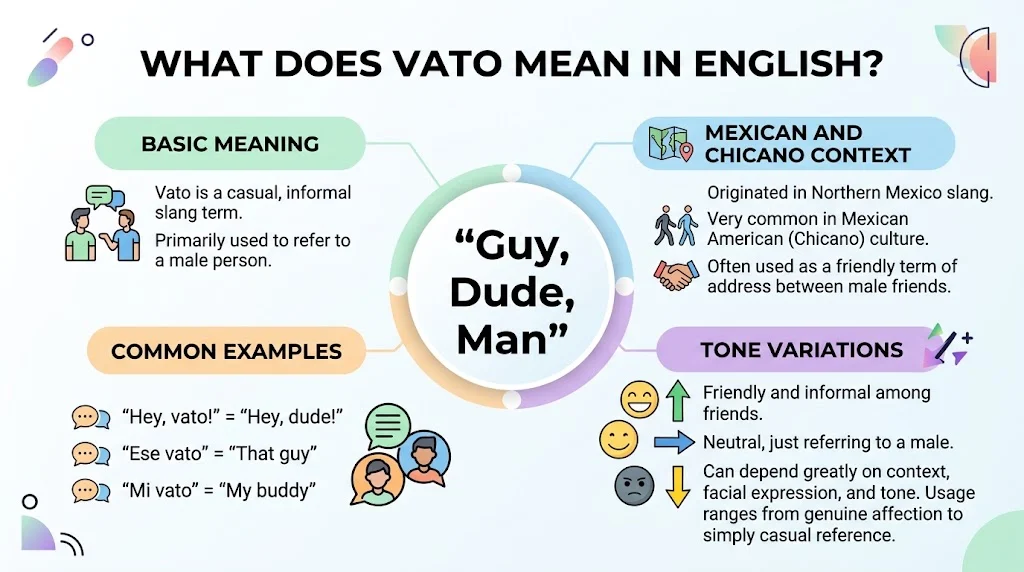
Vato is an informal Spanish slang term that usually means “guy,” “dude,” or “man” in English. It appears especially in Mexican and Chicano vocabulary. Depending on context, it can sound friendly, casual, tough, or culturally specific.
What does vato mean in English is a common question when someone encounters the word in a text, song, movie, comment, or casual conversation. The simplest translation is “guy” or “dude.” However, the word carries more cultural context than a direct dictionary translation suggests.
Vato is associated with informal Spanish, particularly Mexican and Chicano speech. Cambridge describes it as a US slang term for a man, especially in Chicano vocabulary. SpanishDictionary likewise identifies it as a colloquial regional term meaning “dude” or “guy.”
The tone depends heavily on who says it, who hears it, and what surrounds the word. For example, “Hey, vato!” can function much like “Hey, dude!” In another situation, “that vato” can simply mean “that guy.”
Therefore, translating the word correctly requires more than replacing it with one English equivalent. You also need to understand register, regional identity, conversational tone, and cultural context.
QUICK ANSWER BOX
| Meaning | Context | Primary Platforms | Example | Tone |
| Guy | Casual reference to a man | Texting, social media | “That vato is my friend.” | Casual |
| Dude | Informal address | Chats, comments | “Hey, vato!” | Friendly |
| Man | Familiar conversation | Speech, messages | “Listen, vato.” | Casual |
| Homie | Close social context | Music, social posts | “My vato came through.” | Familiar |
| Fellow or guy | General informal reference | Everyday conversation | “Some vato called me.” | Neutral to casual |
What does vato mean in English?
At its most basic level, vato means “guy,” “dude,” or “man.” The exact English choice depends on the sentence.
For example:
“¿Qué onda, vato?” can naturally become “What’s up, dude?”
“Ese vato es mi amigo” can become “That guy is my friend.”
“Órale, vato” may be rendered as “Come on, dude” or “All right, man,” depending on the surrounding conversation. SpanishDictionary lists several expressions using vato with English equivalents such as “dude,” “guy,” and “homey.”
The word is masculine. In Spanish-language usage, it normally refers to a male person. Sources also document forms such as vata, although the everyday English translation depends on the specific community and context.
Is it Spanish or English slang?
Vato is fundamentally a Spanish slang term that has also become recognizable in English-language conversations, particularly through Mexican-American and Chicano culture.
English speakers may use the word without speaking Spanish fluently. This happens because slang often crosses language boundaries through music, film, television, neighborhoods, friendships, and online communication.
Still, that does not make it a standard English word. In an English sentence, it usually functions as a borrowed slang expression.
How do you pronounce vato?
Vato is generally pronounced approximately BAH-toh.
SpanishDictionary gives the pronunciation as “bah-toh,” while Cambridge provides an English pronunciation close to VAH-toh.
The first syllable receives the main stress. The final o has the clear vowel sound associated with Spanish.
Where did the word come from?
The history of vato is more complicated than a simple one-line translation.
The Asociación de Academias de la Lengua Española records vato as a slang noun meaning a young man, individual, or man in several varieties of Spanish, including Mexico and parts of Central America.
Cambridge notes that bato is the standard spelling in some contexts and that vato is a common spelling with a v.
Wiktionary traces the Spanish slang form to regional usage and reports an etymological connection to chivato. It also cites Mexican-American writer Luis Alberto Urrea’s account connecting the term with Pachuco slang.
Because slang develops organically, its history should not be reduced to one universally accepted origin story. Different dictionaries and linguistic sources emphasize different stages of its development.
Why does Chicano culture matter?
The word has an important connection with Chicano vocabulary in the United States.
“Chicano” generally refers to people of Mexican heritage in the United States, although individual usage and identity can vary. Cambridge specifically describes vato as part of Chicano vocabulary.
Consequently, the word can carry cultural meaning beyond its literal translation. Someone may use it naturally within a community where the expression has a long history.
That is why context matters when an outsider uses it. A dictionary definition tells you what the word can mean. It does not automatically tell you how every speaker will perceive it.
Contextual Dynamics & Nuances of the Term
A major part of understanding slang involves recognizing that the same word can change tone without changing its basic definition.
Vato can be friendly. It can be neutral. It can sound confrontational. In some contexts, it may also evoke street or gang-related language. Those associations do not apply to every use.
Friendly use
Among friends, vato can work much like “dude,” “bro,” or “man.”
For example:
“Vato, you have to see this video.”
Here, the speaker is probably addressing a friend or acquaintance casually.
The closest natural English equivalent may be “Dude, you have to see this video.”
Neutral reference
The word can also identify an unknown or known male person.
“That vato was waiting outside.”
In English, the natural translation could be:
“That guy was waiting outside.”
In this construction, the word does not necessarily express affection or hostility. The surrounding words determine the tone.
Stronger or confrontational use
Tone can change sharply during an argument.
“Listen, vato. Back up.”
The translation could be “Listen, man. Back up,” but the English version still needs the speaker’s tone to convey the intended force.
Therefore, you should never assume that slang words always have a fixed emotional meaning.
Cultural familiarity
Some expressions become strongly associated with particular communities. Vato is one example.
Using a culturally specific expression naturally requires familiarity with how speakers actually use it. Simply inserting the word into English sentences because it sounds informal can produce an unnatural result.
For that reason, language learners should focus on comprehension first. Learn what the word means, recognize common constructions, and then decide whether using it personally makes sense.
Does vato always mean “friend”?
No.
This is one of the most common mistakes in interpreting the term.
A person can use vato to mean “guy” without indicating friendship. SpanishDictionary examples include constructions equivalent to “that dude” and “the guy.”
So the safest general definition is guy or dude, rather than “friend.”
Real Life Conversation Examples Using what does vato mean in english
The following examples show how the meaning changes according to context. These are illustrative conversations rather than claims that every speaker or community uses the term identically.
Example 1: Friendly greeting
Alex: Hey, vato! What’s up?
Marco: Not much. I’m just heading home.
Alex: Want to grab something to eat?
Here, vato functions much like “dude” or “man.”
The conversation is relaxed. Nothing suggests hostility.
Example 2: Talking about another person
Jordan: Who was that guy outside?
Luis: That vato? That’s my cousin.
Jordan: Oh, I didn’t know he was here.
In this situation, vato refers to a male person. It does not necessarily mean “friend.”
The natural English translation is simply “guy.”
Example 3: Surprise
Chris: Vato, you actually finished the whole project?
Daniel: Yep. Stayed up all night.
- That’s unbelievable
Here, the word adds an informal conversational flavor. “Dude” would be a natural English equivalent.
Example 4: Mild frustration
Sam: Vato, you forgot the keys again.
Mike: Seriously?
Sam: Yeah. Check your backpack.
The term does not automatically make the statement aggressive. The frustration comes from the situation and the rest of the sentence.
Example 5: Music and cultural language
Jay: What does vato mean in this song?
Elena: It basically means “dude” or “guy.”
Jay: So it isn’t necessarily an insult?
Elena: Right. The context matters.
This example demonstrates an important principle. Slang in music may reflect a particular cultural or artistic voice. Listeners should interpret the term within the lyrics, genre, speaker, and surrounding language.
Platform Specific Breakdown
Online platforms can spread slang quickly. However, a word does not necessarily acquire a new dictionary meaning simply because users post it on a particular platform.
Vato can appear in social posts, comments, captions, memes, videos, and private messages. Its interpretation still depends on context.
How It Is Used on Snapchat
Snapchat conversations tend to be informal. Users often communicate through short messages, captions, photos, and videos.
If someone writes:
“Yo vato 😂”
the word may simply function like “dude” or “bro.”
Likewise:
“What are you doing, vato?”
could be understood as an informal greeting or question.
However, Snapchat does not create a separate meaning for the word. The platform mainly provides another environment where informal language can circulate.
A useful clue is the surrounding text. Emojis, punctuation, previous messages, and the relationship between the speakers can all affect interpretation.
For example:
“Vato, no way 😂”
usually reads as a playful surprise.
By contrast:
“Listen, vato.”
could sound more serious.
The Role of what does vato mean in english on TikTok
TikTok can expose viewers to regional slang through music, comedy, storytelling, skits, and comments.
A viewer might encounter vato in a video and search for its English meaning immediately afterward.
In a TikTok caption, the word may simply preserve the creator’s conversational voice. In a comment, it could be part of a joke or quotation.
Context remains essential.
If a creator says:
“That vato really thought he could win.”
The likely meaning is “that guy.”
If someone says:
“What’s up, vato?”
the likely meaning is closer to “What’s up, dude?”
Therefore, TikTok can increase exposure to the term without changing its core meaning.
Instagram and Texting Dynamics
Instagram captions, comments, direct messages, and group chats provide similar environments.
For example:
“My vato finally showed up 😂”
might translate naturally as:
“My guy finally showed up 😂”
However, English speakers should not assume that “my vato” always means “my boyfriend.” Some dictionaries document meanings connected with a boyfriend or significant other, but ordinary context can point to broader meanings.
Texting also removes some pronunciation and tone clues. Consequently, the same written phrase can feel friendlier or harsher depending on the conversation.
When interpreting slang in a message, examine:
- Who sent it?
- Who received it?
- What came before it.
- Whether emojis are present.
- Whether the sender usually uses Spanish slang.
- Whether the conversation is playful, serious, or confrontational.
These clues often matter more than the isolated word.
Alternative Meanings & NLP Variations of the Phrase
Search engines may show several forms of the same language question.
Common variations include:
| Search Variation | Likely Intent |
| what does vato mean in english | Basic translation |
| vato meaning | Dictionary definition |
| what does vato mean | General explanation |
| vato Spanish meaning | Language-learning intent |
| vato slang meaning | Informal usage |
| vato meaning in text | Messaging context |
| vato meaning in slang | Slang definition |
| vatos meaning | Plural form |
| what does vato mean in Spanish | Spanish-language definition |
| vato definition | Dictionary intent |
These queries largely point toward the same semantic concept.
Vato versus bato
One important variation is bato.
Cambridge identifies bato as the standard Spanish spelling in some contexts and explains that vato is commonly used as an alternative spelling.
Dictionary.com also discusses bato and vato together while noting differences in connotation across uses.
Therefore, seeing “bato” instead of “vato” does not automatically mean the speaker intended a completely different concept.
Vato versus dude
“Dude” is often the closest English equivalent.
However, the words are not culturally identical.
“Dude” is widespread throughout contemporary American English. Vato carries a more specific Spanish and Mexican-American cultural background.
Therefore:
vato = dude
is useful for translation, but it should not be interpreted as saying that the two words have exactly the same cultural history.
Vato versus guy
“Guy” works particularly well when the word refers to another male person.
For example:
“Ese vato es mi vecino.”
can naturally become:
“That guy is my neighbor.”
This translation sounds less slangy than “that dude,” but it may better fit a neutral English sentence.
Vato versus homie
“Homie” can work in some contexts involving friendship or close social relationships.
However, vato does not automatically mean “homie.”
The safest translation depends on context. If the speaker is simply identifying a man, “guy” may be better. If the speaker is addressing a close friend, “dude” may sound more natural.
Misinterpretations:
Understanding slang also means understanding when not to use it.
Do not treat it as formal Spanish
Vato is informal slang. It does not belong in formal business writing, academic papers, professional reports, or official correspondence.
Instead, use standard terms such as hombre, persona, or an appropriate formal expression in Spanish.
Do not assume every Spanish speaker uses it
Spanish varies significantly by country and region.
ASALE’s dictionary records vato in specific regional varieties rather than presenting it as a universal everyday term across all Spanish-speaking communities.
Consequently, avoid assuming that someone from Spain, Argentina, Colombia, or another Spanish-speaking region uses the word in exactly the same way as a speaker from Mexico or a Mexican-American community.
Do not assume it is always friendly
Some sources document potentially derogatory or gang-associated uses in particular contexts.
That does not mean every occurrence has that meaning.
Instead, evaluate the entire conversation.
Do not use it to imitate a culture
A slang word can sound unnatural when someone inserts it into speech solely to imitate a cultural stereotype.
Language works best when used naturally and respectfully.
If you are learning Spanish, understanding a term is valuable even when you decide not to use it yourself.
Do not translate every occurrence identically
A rigid translation can make a sentence sound awkward.
Depending on context, vato may become:
- guy
- dude
- man
- fellow
- homie
- boyfriend
- male person
The surrounding sentence determines which option sounds most natural.
How to Respond in Chat Comfortably
If someone sends you vato in a message, you usually do not need to overthink the word.
Start with the simplest interpretation.
If someone says:
“What’s up, vato?”
you can respond normally:
“Not much! What’s up with you?”
You do not need to repeat the slang.
If you understand the expression
You can respond naturally in English.
Them: “Vato, you coming tonight?”
You: “Yeah, I’ll be there around eight.”
This keeps the conversation flowing without forcing additional slang.
If you want to mirror the tone
You can use another informal expression that already feels natural to you.
Them: “Hey, vato!”
You: “Hey, dude! How’s it going?”
That approach acknowledges the casual tone without pretending to have cultural familiarity you do not possess.
If you are unsure about the meaning
Ask directly.
“When you say vato, do you mean dude or guy?”
That is often the clearest option.
If the conversation feels confrontational
Do not focus only on the slang.
Look at the complete message.
For example:
“Back up, vato.”
The word itself does not determine the entire meaning. The imperative “back up” signals a stronger tone.
Consequently, respond to the situation rather than the vocabulary alone.
10 FAQs
1. What does vato mean in English?
The most common English equivalents are “guy,” “dude,” and “man.” The best translation depends on context. Cambridge describes it as US slang for a man and specifically connects it with Chicano vocabulary.
2. Is vato a bad word?
Not automatically. It is slang, not inherently an insult. However, particular contexts can give it a tougher, derogatory, or gang-associated tone. Context and speaker identity matter.
3. Is vato Mexican slang?
Yes. Dictionaries identify it as slang used in Mexico and in US Spanish. It also has a strong association with Chicano vocabulary in the United States.
4. Does vato mean “friend”?
Not necessarily.
It can refer to a friend, but it can also simply mean “guy” or “man.” The surrounding sentence determines whether friendship is implied.
5. What is the plural of vato?
The commonly documented plural is vatos. The basic meaning becomes “guys,” “dudes,” or “men,” depending on context.
6. What does “hey vato” mean?
“Hey vato” is generally comparable to “Hey dude,” “Hey man,” or “Hey guy.” It functions as an informal form of address.
7. What does “ese vato” mean?
“Ese vato” generally means “that guy” or “that dude.” SpanishDictionary provides “ese vato” among common expressions involving the term.
8. Is vato used in English?
It can appear in English-language conversations, especially where speakers use Mexican-American or Chicano slang. However, it remains a culturally specific borrowed slang term rather than standard formal English.
9. Is vato the same as dude?
They can be equivalent in many informal translations. Still, they have different linguistic and cultural histories. “Dude” is mainstream American English slang, while vato comes from Spanish slang traditions associated with Mexico and Mexican-American communities.
10. Should English speakers use the word?
Understanding the word is useful. Using it personally depends on context, familiarity, and the social setting. It is generally better to use slang naturally rather than imitate a community or acc
Conclusion:
The clearest answer to what vato means in English is “guy,” “dude,” or “man.” However, that translation only captures the basic dictionary meaning.
The term has deeper linguistic and cultural associations. It appears in Mexican Spanish and has a significant place in Chicano vocabulary in the United States. Major language references document its informal meaning and regional usage.
Context remains the most important factor.
A friendly “Hey, vato!” may sound similar to “Hey, dude!” A sentence about “that vato” may simply mean “that guy.” A tense conversation can give the same word a much stronger feeling.
Online platforms have also helped people encounter regional slang outside the communities where it developed. Snapchat, TikTok, Instagram, music, movies, and messaging can all introduce users to expressions they might not otherwise hear.
Yet exposure does not erase cultural context.
The most accurate approach is therefore simple: learn the literal meaning, understand the regional background, examine the surrounding conversation, and avoid assuming that one translation works in every situation.
In everyday English, “dude” is often the closest casual equivalent. “Guy” works when the sentence is more neutral. “Man” can fit when the word functions as a direct address.
Ultimately, slang is not just vocabulary. It reflects history, community, identity, relationships, and tone. Understanding those layers leads to a much more accurate interpretation than relying on a one-word translation alone.
