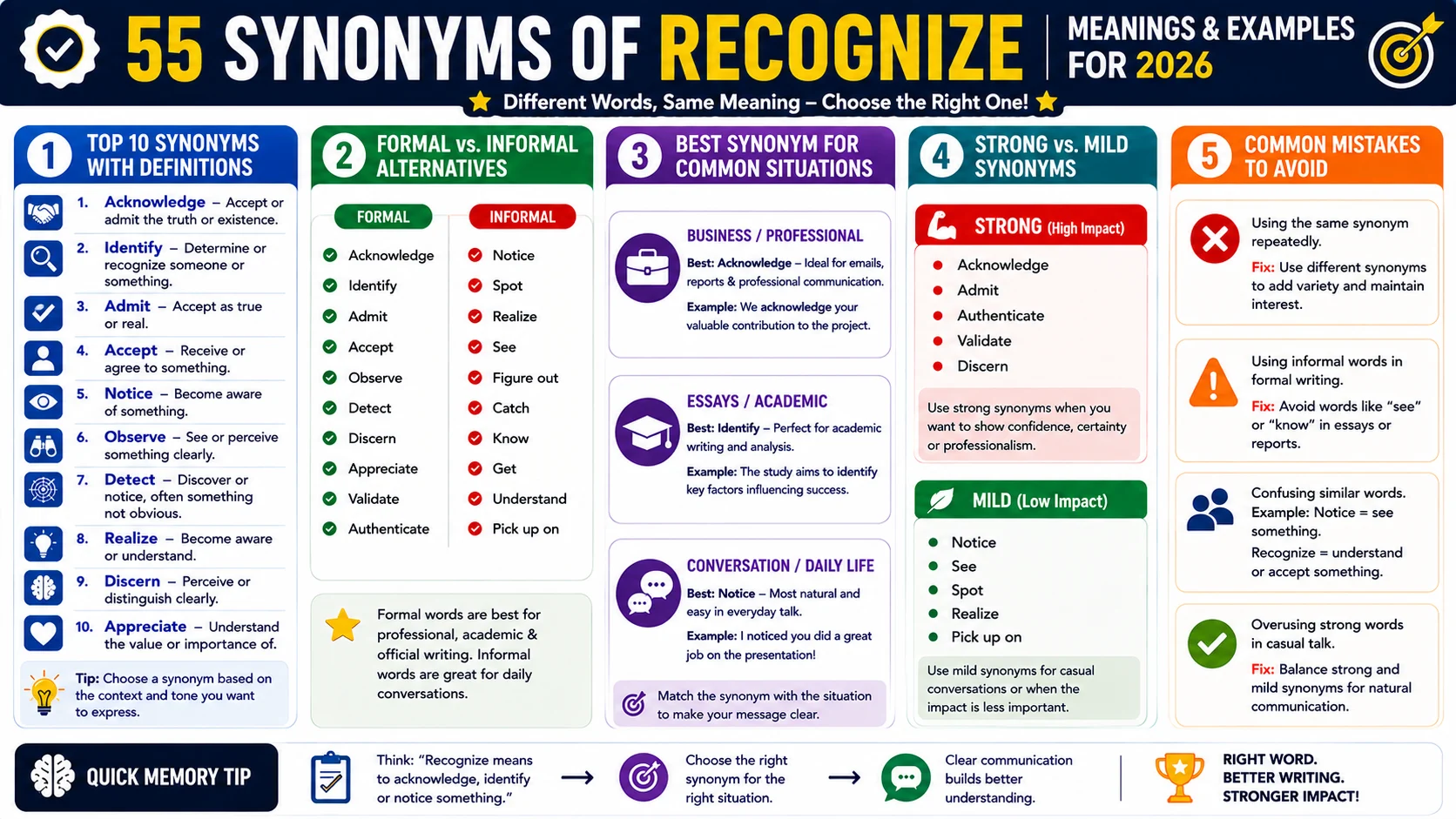
“Recognize” means to know, identify, or acknowledge someone or something. The best synonyms are identify, acknowledge, know, notice, and remember. “Identify” is the most common natural alternative. Each synonym has a slightly different meaning and context where it fits best.
Top 10 Synonyms
- Identify
- Acknowledge
- Know
- Notice
- Remember
- Perceive
- Detect
- Realize
- Comprehend
- Understand
“Recognize” is a word we use constantly. We recognize faces, recognize achievements, recognize problems, and recognize opportunities. But using it too often can make your English feel repetitive.
Think about it. You can recognize a person, recognize someone’s effort, recognize a mistake, or recognize a pattern. Each situation might need a different word that captures the specific type of recognition.
In this guide, you’ll learn 35 powerful synonyms for “recognize.” You’ll discover exactly when to use each one, how formal they are, and what common mistakes to avoid. Let’s begin!
What Does “Recognize” Mean?
Definition
Recognize” has two main meanings. First, it means to know someone or something because you’ve seen or experienced them before. Second, it means to accept or acknowledge something as true or important. It’s about identifying and acknowledging.
Pronunciation
| Feature | Value |
|---|---|
| US IPA | /ˈrɛkəɡnaɪz/ |
| UK IPA | /ˈrekəɡnaɪz/ |
| Syllables | 3 (rec-og-nize) |
| Tip | Stress the first syllable: “REK-ug-nize” |
Grammar
| Grammar Feature | Information |
|---|---|
| Part of Speech | Verb |
| Common Position | After the subject |
| Typical Pattern | Subject + recognize + object |
Examples:
- “I recognize that face.” (identify)
- “She recognized his hard work.” (acknowledge)
- “We recognize the need for change.” (accept)
Grammar Note: “Recognize” is a transitive verb that always needs an object.
Word Family
| Word | Part of Speech | Meaning |
|---|---|---|
| Recognize | Verb | To identify or acknowledge |
| Recognition | Noun | The act of recognizing |
| Recognizable | Adjective | Able to be recognized |
| Recognizably | Adverb | In a recognizable way |
15 Synonyms of “Recognize”
Identify
Meaning: To establish or know who or what someone or something is.
Best Used For: People, objects, problems.
Formality: Neutral
Tone: Precise, Identifying
Frequency: ⭐⭐⭐⭐⭐ (Very Common)
CEFR Level: B2
Example Sentence 1: “The police identified the suspect from the footage.”
Example Sentence 2: “Can you identify the problem?”
Usage Tip: “Identify” emphasizes knowing exactly what something is. Use it for precise recognition.
Common Confusion: Identify vs Recognize. “Identify” often suggests more active effort. “Recognize” can be more immediate.
Acknowledge
Meaning: To accept or admit the truth or existence of something.
Best Used For: Achievements, mistakes, efforts.
Formality: Formal
Tone: Admitting, Appreciating
Frequency: ⭐⭐⭐⭐ (Common)
CEFR Level: B2
Example Sentence 1: “She acknowledged his contribution to the project.”
Example Sentence 2: “He acknowledged his mistake.”
Usage Tip: “Acknowledge” is about accepting or appreciating. Use it for giving credit or admitting truth.
Know
Meaning: To have information about something or someone.
Best Used For: General knowledge, people, information.
Formality: Neutral
Tone: Familiar, Aware
Frequency: ⭐⭐⭐⭐⭐ (Very Common)
CEFR Level: A1
Example Sentence 1: “I know that voice from somewhere.”
Example Sentence 2: “She knows all the rules.”
Usage Tip: “Know” is the most basic synonym. Use it for familiarity and awareness.
Notice
Meaning: To become aware of something.
Best Used For: Changes, details, people.
Formality: Neutral
Tone: Observing, Aware
Frequency: ⭐⭐⭐⭐⭐ (Very Common)
CEFR Level: A2
Example Sentence 1: “I noticed a change in her behavior.”
Example Sentence 2: “Did you notice the new sign?”
Usage Tip: “Notice” suggests observing or becoming aware. Use it for things you see or observe.
Remember
Meaning: To have something in your memory.
Best Used For: Faces, places, experiences.
Formality: Neutral
Tone: Recalling, Reminiscing
Frequency: ⭐⭐⭐⭐⭐ (Very Common)
CEFR Level: A2
Example Sentence 1: “I remember her face from somewhere.”
Example Sentence 2: “Can you remember the password?”
Usage Tip: “Remember” is about memory. Use it when recognition comes from past experience.
Perceive
Meaning: To become aware of something through the senses.
Best Used For: Sights, sounds, feelings.
Formality: Formal
Tone: Perceptive, Aware
Frequency: ⭐⭐⭐ (Moderate)
CEFR Level: B2
Example Sentence 1: “She perceived a change in his tone.”
Example Sentence 2: “He perceived the danger immediately.”
Usage Tip: “Perceive” is formal and suggests sensory awareness.
Detect
Meaning: To discover or notice something, often something hidden.
Best Used For: Problems, signals, changes.
Formality: Formal
Tone: Discovering, Observing
Frequency: ⭐⭐⭐ (Moderate)
CEFR Level: B2
Example Sentence 1: “The machine detected a problem.”
Example Sentence 2: “She detected a note of sarcasm.”
Usage Tip: “Detect” suggests finding something hidden or not obvious.
Realize
Meaning: To become aware of something.
Best Used For: Understanding, awareness.
Formality: Neutral
Tone: Becoming aware
Frequency: ⭐⭐⭐⭐⭐ (Very Common)
CEFR Level: B1
Example Sentence 1: “I realized I had made a mistake.”
Example Sentence 2: “She realized how important it was.”
Usage Tip: “Realize” is about becoming aware, often suddenly.
Comprehend
Meaning: To understand something fully.
Best Used For: Complex ideas, concepts, situations.
Formality: Formal
Tone: Understanding, Grasping
Frequency: ⭐⭐⭐ (Moderate)
CEFR Level: B2
Example Sentence 1: “He couldn’t comprehend the scale of the problem.”
Example Sentence 2: “She comprehended the complexity of the situation.
Usage Tip: “Comprehend” is formal. Use it for deep, full understanding.
Understand
Meaning: To know the meaning or reason for something.
Best Used For: Ideas, people, explanations.
Formality: Neutral
Tone: Knowing, Grasping
Frequency: ⭐⭐⭐⭐⭐ (Very Common)
CEFR Level: A2
Example Sentence 1: “I understand why you’re upset.”
Example Sentence 2: “She understands the concept.”
Usage Tip: “Understand” is about knowing meaning or reason. Use it for comprehension.
Discern
Meaning: To recognize something with difficulty or effort.
Best Used For: Details, differences, truth.
Formality: Formal
Tone: Perceptive, Insightful
Frequency: ⭐⭐ (Rare)
CEFR Level: C1
Example Sentence 1: “I could discern a figure in the darkness.”
Example Sentence 2: “She discerned the truth from his words.”
Usage Tip: “Discern” suggests recognizing with effort. It’s a formal, literary word.
Distinguish
Meaning: To recognize the difference between things.
Best Used For: Differences, similarities, qualities.
Formality: Formal
Tone: Differentiating, Identifying
Frequency: ⭐⭐⭐ (Moderate)
CEFR Level: B2
Example Sentence 1: “She can distinguish between the two colors.”
Example Sentence 2: “He distinguished fact from opinion.”
Usage Tip: “Distinguish” is about recognizing differences.
Acknowledge (again)
Meaning: To admit or accept something.
Best Used For: Truth, effort, faults.
Formality: Formal
Tone: Admitting, Accepting
Frequency: ⭐⭐⭐⭐ (Common)
CEFR Level: B2
Example Sentence 1: “He acknowledged that he was wrong.”
Example Sentence 2: “She acknowledged receipt of the letter.”
Usage Tip: “Acknowledge” is formal. Use it for admitting or accepting.
Know (again)
Meaning: To be certain or aware of.
Best Used For: Facts, people, places.
Formality: Neutral
Tone: Certain, Aware
Frequency: ⭐⭐⭐⭐⭐ (Very Common)
CEFR Level: A1
Example Sentence 1: “I know him from school.”
Example Sentence 2: “She knows the answer.”
Usage Tip: “Know” is simple and direct. Use it when you’re certain.
Notice (again)
Meaning: To see or become aware of.
Best Used For: Details, changes, people.
Formality: Neutral
Tone: Observing, Aware
Frequency: ⭐⭐⭐⭐⭐ (Very Common)
CEFR Level: A2
Example Sentence 1: “He noticed her walking away.”
Example Sentence 2: “Did you notice the error?”
Usage Tip: “Notice” is very common. Use it for visual or sensory recognition.
Synonyms Comparison Table
| Synonym | Best Context | Formality | Tone | Frequency |
|---|---|---|---|---|
| Identify | Exact recognition | Neutral | Precise | ⭐⭐⭐⭐⭐ |
| Know | Familiarity | Neutral | Aware | ⭐⭐⭐⭐⭐ |
| Notice | Observing | Neutral | Aware | ⭐⭐⭐⭐⭐ |
| Remember | Memory | Neutral | Recalling | ⭐⭐⭐⭐⭐ |
| Understand | Comprehension | Neutral | Grasping | ⭐⭐⭐⭐⭐ |
| Acknowledge | Acceptance | Formal | Admitting | ⭐⭐⭐⭐ |
| Realize | Becoming aware | Neutral | Sudden | ⭐⭐⭐⭐⭐ |
| Detect | Hidden things | Formal | Discovering | ⭐⭐⭐ |
| Perceive | Sensory awareness | Formal | Perceptive | ⭐⭐⭐ |
| Comprehend | Deep understanding | Formal | Grasping | ⭐⭐⭐ |
Best Synonyms by Situation
| Situation | Best Synonym | Why It Works |
|---|---|---|
| Daily Conversation | Know | Natural and common |
| Business Email | Acknowledge | Professional and clear |
| Academic Writing | Identify | Formal and precise |
| School Assignment | Understand | Clear and simple |
| Professional Meeting | Acknowledge | Sounds professional |
| Presentation | Recognize | Clear and direct |
| Creative Writing | Perceive | Adds literary depth |
| Social Media | Notice | Casual and relatable |
| Legal Context | Identify | Formal and precise |
Formal vs Informal Synonyms
Formal Alternatives
| Synonym | Best Used For |
|---|---|
| Acknowledge | Accepting, admitting |
| Perceive | Sensory awareness |
| Detect | Finding hidden things |
| Comprehend | Deep understanding |
| Discern | Recognizing with effort |
Neutral Alternatives
| Synonym | Best Used For |
|---|---|
| Recognize | Most general situations |
| Know | Familiarity |
| Notice | Observing |
| Understand | Comprehension |
| Remember | Memory |
Informal Alternatives
| Synonym | Best Used For |
|---|---|
| Know | General use |
| Get | Understand (very informal) |
| See | Understand (informal) |
Choosing the Right Level: Use “acknowledge” and “perceive” for formal writing. Use “recognize” and “know” for most situations.
Strong vs Mild Synonyms
Mild
Suitable for everyday situations with less intensity.
- Know
- Notice
- Remember
Moderate
More thoughtful or analytical alternatives.
- Identify
- Realize
- Understand
- Recognize
Strong
High-intensity alternatives suggesting deep recognition.
- Perceive (sensory)
- Detect (hidden)
- Comprehend (deep)
- Discern (difficult)
How Intensity Changes Meaning: “I noticed her” is mild. “I perceived her true intentions” is deep. Choose stronger words when you want to emphasize depth of recognition.
Real-Life Examples
School: “I recognized the teacher from last year.”
Office: “The company recognized his hard work.”
Business Email: “Please acknowledge receipt of this message.”
Meetings: “We need to identify the problem quickly.”
Presentations: “The audience recognized the importance of the issue.”
Daily Conversations: “I know that face from somewhere.”
Social Media: “Did you notice the new profile picture?”
Academic Writing: “The researcher identified three key factors.”
Common Collocations
| Common Phrase | Better Alternative |
|---|---|
| Recognize a face | Identify a face |
| Recognize a problem | Identify a problem |
| Recognize someone’s work | Acknowledge someone’s work |
| Recognize the need | Realize the need |
| Recognize a voice | Recognize a voice (unchanged) |
Common Phrases
See eye to eye: To agree or recognize. (e.g., “We see eye to eye on this.”)
Put your finger on: To identify exactly. (e.g., “I can’t quite put my finger on it.”)
Take note of: To notice and remember. (e.g., “Take note of the changes.”)
Know something inside out: To know very well. (e.g., “She knows the city inside out.”)
Get the picture: To understand. (e.g., “I get the picture now.”)
Context Guide
| Situation | Best Synonym | Reason |
|---|---|---|
| Essay | Identify | Academic and formal |
| Speech | Recognize | Clear and direct |
| Business Email | Acknowledge | Professional and clear |
| Novel | Perceive | Adds literary depth |
| Presentation | Recognize | Clear and professional |
| Conversation | Know | Natural and relatable |
| Academic Writing | Identify | Precise and formal |
| Marketing Copy | Recognize | Engaging and clear |
Related Words
Near Synonyms
- Discern: To recognize with effort.
- Distinguish: To recognize differences.
- Spot: To notice (informal).
- Observe: To watch and notice.
- Note: To notice and remember.
Antonyms
- Ignore: To pay no attention.
- Overlook: To fail to notice.
- Forget: To fail to remember.
- Miss: To fail to notice.
- Neglect: To fail to pay attention.
Related Adjectives
- Recognizable: Able to be recognized.
- Familiar: Known or recognized.
- Unrecognizable: Not able to be recognized.
- Identifiable: Able to be identified.
Related Nouns
- Recognition: The act of recognizing.
- Identification: The act of identifying.
- Awareness: Knowledge of something.
- Perception: The ability to see or notice.
Related Verbs
- Identify: To recognize.
- Acknowledge: To accept.
- Perceive: To become aware.
- Detect: To discover.
- Realize: To become aware.
Frequently Asked Questions
What is another word for recognize?
Common synonyms include identify, acknowledge, know, notice, and remember. “Identify” is the most common and direct alternative.
Which synonym sounds the most professional?
Acknowledge and identify sound very professional. “Perceive” is also excellent for formal contexts.
What is the strongest synonym for recognize?
Perceive and comprehend are among the strongest synonyms. “Discern” is also strong, suggesting recognition with effort.
Which synonym is best for essays?
Identify is the best choice for academic essays. It’s formal and precise.
What’s the difference between recognize and acknowledge?
“Recognize” can mean identifying or accepting. “Acknowledge” specifically means accepting or giving credit.
Which synonym is most common in everyday English?
“Know” and “notice” are very common in everyday speech. “Recognize” itself is also frequently used.
What is the opposite of recognize?
Common opposites are ignore, overlook, forget, and miss. These words describe not paying attention.
Conclusion
“Recognize” is a useful word, but now you have 35 fantastic alternatives. Each synonym adds a different shade of meaning to your language.
Remember, the key is understanding the context. Use “identify” for precise recognition. Use “acknowledge” for accepting or appreciating. Use “perceive” for sensory awareness. Use “realize” for becoming aware.
The best way to improve is practice. Try using one or two new synonyms each day. Listen for these words in conversations and books. Your vocabulary will become richer and more impressive with time.
