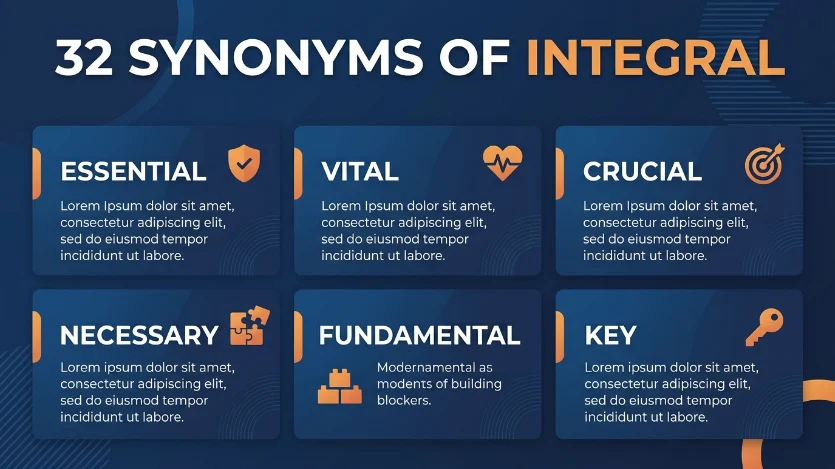
Integral means necessary and essential for something to be complete or work properly. The best synonyms are essential, vital, crucial, necessary, and fundamental. “Essential” is the most common and natural choice. Each synonym has a slightly different tone, intensity, and context where it fits best.
Top 10 Synonyms
- Essential
- Vital
- Crucial
- Necessary
- Fundamental
- Indispensable
- Key
- Important
- Critical
- Requisite
Do you ever feel like you use the same words over and over when describing something important? Many English learners struggle with this. The word “integral” is useful, but using it too often can make your speaking and writing feel repetitive and formal.
Learning different ways to say “integral” helps you express yourself more clearly. It also helps you show the exact level of importance something has. Is it just helpful? Or is it absolutely necessary? Having the right word makes a huge difference.
In this guide, you will learn 30 powerful alternatives. You will discover when to use each one, how formal they are, and common mistakes to avoid. Let’s get started!
What Does “Integral” Mean?
Definition
Integral means something is absolutely necessary and forms a vital part of a whole. When something is integral, the whole thing cannot function, exist, or be complete without it. For example, the engine is an integral part of a car. Without it, the car cannot move.
Pronunciation
| Feature | Value |
|---|---|
| US IPA | /ˈɪntəɡrəl/ |
| UK IPA | /ˈɪntɪɡrəl/ |
| Syllables | 3 (in-te-gral) |
| Tip | Stress the first syllable: “IN-tuh-grull” |
H3: Grammar
| Grammar Feature | Information |
|---|---|
| Part of Speech | Adjective |
| Common Position | Before a noun or after a linking verb |
| Typical Pattern | integral + to + noun / integral + part + of + noun |
Examples:
- “Trust is integral to a healthy relationship.”
- “The keyboard is an integral part of the computer.”
- “Her role is integral to the team’s success.”
Grammar Note: You will often see “integral to” or “an integral part of.” These are the most common patterns. You don’t say “integral for” in this context.
Word Family
| Word | Part of Speech | Meaning |
|---|---|---|
| Integral | Adjective | Necessary and essential for completeness |
| Integrate | Verb | To combine or bring together into a whole |
| Integration | Noun | The act of combining things into a whole |
| Integrity | Noun | The quality of being honest and having strong moral principles |
15 Synonyms of “Integral”
Essential
Meaning: Extremely important and absolutely necessary for something to exist or work.
Best Used For: Daily conversation, business writing, academic contexts.
Formality: Neutral
Tone: Direct, Clear
Frequency: ⭐⭐⭐⭐⭐ (Very Common)
CEFR Level: B1
Example Sentence 1: “Water is essential for human survival.”
Example Sentence 2: “Good communication is essential in any workplace.
Usage Tip: “Essential” is the most common and natural alternative to “integral.” It works in almost every situation. It is safe, clear, and widely understood.
Common Confusion: Essential vs Necessary. Essential” means something is absolutely required and cannot be done without. Necessary” can sometimes mean just helpful or required for a specific purpose, but not always vital.
Vital
Meaning: Absolutely necessary and of great importance for life, success, or existence.
Best Used For: Health, business, emotional contexts.
Formality: Neutral
Tone: Strong, Emotional
Frequency: ⭐⭐⭐⭐⭐ (Very Common)
CEFR Level: B1
Example Sentence 1: “Oxygen is vital for all living things.”
Example Sentence 2: “Her support was vital to the project’s success.”
Usage Tip: “Vital” is a bit stronger than “essential.” It often connects to life or survival, either literally or figuratively. It is a very common and powerful word.
Crucial
Meaning: Extremely important and decisive. Something that will determine success or failure.
Best Used For: Business, decision-making, important moments.
Formality: Neutral
Tone: Serious, Decisive
Frequency: ⭐⭐⭐⭐⭐ (Very Common)
CEFR Level: B1
Example Sentence 1: “This is a crucial moment for our company.”
Example Sentence 2: “Getting enough sleep is crucial for your health.”
Usage Tip: “Crucial” means that without it, success is impossible. It suggests a turning point or a make-or-break situation.
Common Confusion: Crucial vs Critical. They are very similar. “Critical” often suggests a dangerous or urgent situation, while “crucial” suggests a decisive moment for success.
Necessary
Meaning: Required to be done, achieved, or present. Something you cannot avoid or do without.
Best Used For: Daily conversation, formal writing, factual contexts.
Formality: Neutral
Tone: Practical, Direct
Frequency: ⭐⭐⭐⭐⭐ (Very Common)
CEFR Level: A2
Example Sentence 1: “It is necessary to arrive on time.”
Example Sentence 2: “Food and water are necessary for life.”
Usage Tip: “Necessary” is the most basic and common word for required things. It is less strong than “essential” or “vital.” Use it for things that are required, but not always life-or-death.
Fundamental
Meaning: Forming the basic, most important, and necessary part of something.
Best Used For: Academic writing, philosophy, explaining basic principles.
Formality: Formal
Tone: Academic, Serious
Frequency: ⭐⭐⭐⭐ (Common)
CEFR Level: B2
Example Sentence 1: “Honesty is a fundamental value in our society.”
Example Sentence 2: “The fundamental principles of math are easy to learn.”
Usage Tip: “Fundamental” refers to the base or core of something. It suggests that everything else depends on this basic foundation.
Common Confusion: Fundamental vs Essential. “Fundamental” is about being basic and at the core. “Essential” is about being absolutely necessary.
Indispensable
Meaning: Absolutely necessary and impossible to do without.
Best Used For: Formal writing, professional contexts, emphasizing extreme importance.
Formality: Formal
Tone: Strong, Emphatic
Frequency: ⭐⭐⭐ (Moderate)
CEFR Level: B2
Example Sentence 1: “A good dictionary is indispensable for language learners.”
Example Sentence 2: “She became an indispensable member of the team.”
Usage Tip: “Indispensable” is a very strong word. Use it only when something is truly impossible to replace or do without. It sounds very professional.
Key
Meaning: Of crucial importance. Having a fundamental role in something.
Best Used For: Business, everyday conversation, explaining roles.
Formality: Informal/Neutral
Tone: Clear, Modern
Frequency: ⭐⭐⭐⭐⭐ (Very Common)
CEFR Level: B1
Example Sentence 1: “Communication is the key to a successful relationship.”
Example Sentence 2: “He plays a key role in the company.
Usage Tip: “Key” is a very common and natural word. It sounds modern and direct. It is great for talking about roles, factors, or ingredients.
Important
Meaning: Having great value, influence, or effect. Something you should pay attention to.
Best Used For: Daily conversation, all writing contexts.
Formality: Neutral
Tone: Neutral, General
Frequency: ⭐⭐⭐⭐⭐ (Very Common)
CEFR Level: A2
Example Sentence 1: “It is important to eat a balanced diet.”
Example Sentence 2: “She had an important meeting this morning.”
Usage Tip: “Important” is the most general word. It is a safe choice, but it doesn’t carry the same weight as “essential” or “vital.” Use it when you just want to say something matters.
Critical
Meaning: Of decisive importance, especially in a situation with serious consequences.
Best Used For: Business, healthcare, decision-making, urgent situations.
Formality: Neutral
Tone: Serious, Urgent
Frequency: ⭐⭐⭐⭐⭐ (Very Common)
CEFR Level: B1
Example Sentence 1: “The doctor said the situation is critical.”
Example Sentence 2: “Your decision will be critical to our success.”
Usage Tip: “Critical” often suggests a serious or urgent situation. It is stronger than “important” and similar to “crucial,” but with a hint of danger or urgency.
Requisite
Meaning: Made necessary by a particular situation or rule. Required for a specific purpose.
Best Used For: Official documents, formal writing, academic contexts.
Formality: Formal
Tone: Official, Technical
Frequency: ⭐⭐ (Rare)
CEFR Level: B2
Example Sentence 1: “She has the requisite qualifications for the job.”
Example Sentence 2: “Please ensure you have the requisite documents.”
Usage Tip: “Requisite” is a formal word. It is often used in official contexts like job descriptions or academic requirements. It can also be a noun.
Paramount
Meaning: More important than anything else. Supreme or highest in importance.
Best Used For: Formal writing, speeches, emphasizing priority.
Formality: Formal
Tone: Very Strong, Prioritizing
Frequency: ⭐⭐⭐ (Moderate)
CEFR Level: B2
Example Sentence 1: “Safety is paramount in this industry.”
Example Sentence 2: “Getting a good education is paramount for your future.”
Usage Tip: “Paramount” means something is the most important thing above all others. Use it when you want to put something at the very top of the priority list.
Pivotal
Meaning: Of crucial importance because other things depend on it.
Best Used For: History, storytelling, business, describing turning points.
Formality: Neutral
Tone: Significant, Descriptive
Frequency: ⭐⭐⭐ (Moderate)
CEFR Level: B2
Example Sentence 1: “The invention of the internet was a pivotal moment in history.”
Example Sentence 2: “She played a pivotal role in the negotiations.”
Usage Tip: “Pivotal” is often used for moments, roles, or events that change everything. It comes from the word “pivot” – a central point on which something turns.
Imperative
Meaning: Absolutely necessary and urgent.
Best Used For: Formal writing, official recommendations, strong advice.
Formality: Formal
Tone: Urgent, Commanding
Frequency: ⭐⭐⭐ (Moderate)
CEFR Level: B2
Example Sentence 1: “It is imperative that we act now.”
Example Sentence 2: “Regular exercise is imperative for good health.”
Usage Tip: “Imperative” is very strong. It suggests not just necessity, but urgency. It is often used in formal reports or official statements.
Inherent
Meaning: Existing in something as a permanent, essential, or characteristic attribute.
Best Used For: Academic writing, describing natural qualities, formal contexts.
Formality: Formal
Tone: Analytical, Descriptive
Frequency: ⭐⭐⭐ (Moderate)
CEFR Level: B2
Example Sentence 1: “Risk is inherent in any investment.
Example Sentence 2: “Creativity is inherent in children.”
Usage Tip: “Inherent” is a bit different. It means something is a natural part of something else. It is not exactly the same as “essential,” but it often overlaps.
Integral
Meaning: Necessary and essential for completeness.
Best Used For: Formal contexts, describing parts that complete a whole.
Formality: Formal
Tone: Analytical, Precise
Frequency: ⭐⭐⭐ (Moderate)
CEFR Level: B2
Example Sentence 1: “The heart is an integral part of the body.”
Example Sentence 2: “Teamwork is integral to our company culture.”
Usage Tip: This is the original word. It is a good, formal choice when you want to stress that something completes a whole. Use it in formal writing.
Synonyms Comparison Table
| Synonym | Best Context | Formality | Tone | Frequency |
|---|---|---|---|---|
| Necessary | General use | Neutral | Practical | ⭐⭐⭐⭐⭐ |
| Important | General use | Neutral | General | ⭐⭐⭐⭐⭐ |
| Essential | Almost all contexts | Neutral | Direct | ⭐⭐⭐⭐⭐ |
| Vital | Health, success | Neutral | Strong | ⭐⭐⭐⭐⭐ |
| Crucial | Decisions, success | Neutral | Serious | ⭐⭐⭐⭐⭐ |
| Key | Roles, factors | Neutral | Modern | ⭐⭐⭐⭐⭐ |
| Critical | Urgent situations | Neutral | Urgent | ⭐⭐⭐⭐⭐ |
| Fundamental | Core principles | Formal | Academic | ⭐⭐⭐⭐ |
| Indispensable | Professional | Formal | Emphatic | ⭐⭐⭐ |
| Paramount | Priority | Formal | Very Strong | ⭐⭐⭐ |
| Pivotal | Turning points | Neutral | Significant | ⭐⭐⭐ |
| Imperative | Urgent | Formal | Urgent | ⭐⭐⭐ |
| Requisite | Official, formal | Formal | Official | ⭐⭐ |
| Inherent | Natural qualities | Formal | Analytical | ⭐⭐⭐ |
Best Synonyms by Situation
| Situation | Best Synonym | Why It Works |
|---|---|---|
| Daily Conversation | Essential / Necessary | These are common and easy to understand . |
| Business Email | Critical / Key | They sound professional and direct. |
| Academic Writing | Fundamental / Inherent | They show depth and academic tone. |
| School Assignment | Essential / Important | They are clear and appropriate. |
| Professional Meeting | Pivotal / Critical | These emphasize importance and impact. |
| Presentation | Vital / Crucial | They are strong and engaging . |
| Creative Writing | Paramount / Inherent | They add depth and variety. |
| Social Media | Key / Essential | They are modern and concise. |
Formal vs Informal Synonyms
Formal Alternatives
| Synonym | Best Used For |
|---|---|
| Fundamental | Academic papers, core principles . |
| Indispensable | Professional writing, emphasizing necessity. |
| Paramount | Speeches, prioritizing importance . |
| Imperative | Official recommendations, urgent matters. |
| Requisite | Official documents, qualifications. |
| Inherent | Describing natural, permanent qualities. |
Neutral Alternatives
| Synonym | Best Used For |
|---|---|
| Essential | Almost any situation . |
| Necessary | General statements of requirement . |
| Important | General importance. |
| Crucial | Decisive moments. |
| Vital | Life or success-related importance. |
| Key | Describing roles or factors. |
| Pivotal | Describing turning points. |
| Critical | Urgent or decisive situations. |
Informal Alternatives
There are no truly informal synonyms for “integral.” All synonyms are at least neutral. However, “key” and “important” are the most casual options.
Choosing the Right Level: In formal writing, prefer “fundamental,” “indispensable,” or “paramount.” In everyday life, “essential,” “vital,” and “key” are the best and most natural choices.
Strong vs Mild Synonyms
Mild
These are suitable for everyday situations and don’t carry extreme urgency.
- Important
- Necessary
- Key
Moderate
These are more expressive and used in most professional and general contexts.
- Essential
- Vital
- Crucial
- Fundamental
- Pivotal
Strong
High-intensity alternatives that suggest urgency, irreplaceability, or ultimate priority.
- Indispensable (impossible to do without)
- Paramount (of highest importance)
- Imperative (urgently necessary)
- Critical (serious and urgent)
How Intensity Changes Meaning: Using a mild word like “important” means something matters. Using a strong word like “indispensable” means it is absolutely essential and cannot be replaced. Think about the level of necessity you want to convey.
Real-Life Examples
School: “Attending class is essential for understanding the material.”
Office: “She plays a key role in our marketing department.”
Business Email: “Your feedback is critical to the success of this project.”
Meetings: “The next quarter will be a pivotal time for our company.”
Presentations: “Customer satisfaction is paramount in our business strategy.”
Books: “Honesty and integrity are fundamental to the hero’s character.”
Movies: “The director’s vision was integral to the film’s success.”
Daily Conversations: “A good night’s sleep is vital for your energy.”
Social Media: “Consistency is key to growing your audience.”
Academic Writing: “Free speech is inherent to democratic societies.”
Common Collocations
| Common Phrase | Better Alternative |
|---|---|
| Very important | Essential / Vital |
| Really necessary | Indispensable / Crucial |
| Main part | Fundamental / Integral part |
| Most important | Paramount |
| Very important role | Pivotal / Key role |
Common Phrases
The key to: The most important thing for achieving something. (e.g., “Patience is the key to success.”)
Make or break: Something that will determine success or failure. (e.g., “This meeting is make or break for our project.”)
At the heart of: The central or most important part. (e.g., “Creativity is at the heart of our business.”)
Of the utmost importance: Extremely important. (e.g., “Safety is of the utmost importance.”)
Context Guide
| Situation | Best Synonym | Reason |
|---|---|---|
| Essay | Fundamental | Shows academic depth . |
| Speech | Paramount | Emphasizes priority effectively. |
| Business Email | Critical / Key | Professional and direct. |
| Novel | Integral / Inherent | Adds literary quality . |
| Presentation | Vital / Crucial | Engaging and strong. |
| Conversation | Essential / Necessary | Easy to understand. |
| Academic Writing | Inherent / Fundamental | Precise and intellectual. |
| Marketing Copy | Essential / Key | Clear and persuasive. |
Related Words
Near Synonyms
- Prerequisite: Something required before something else can happen or exist. (e.g., “A degree is a prerequisite for this job.”)
- Imperative: Urgently necessary. (e.g., “It is imperative that we finish this.”)
- Compulsory: Required by law or rules. (e.g., “Attendance is compulsory.”)
Antonyms
- Unnecessary: Not needed.
- Optional: Available as a choice, not required.
- Nonessential: Not absolutely necessary.
- Dispensable: Able to be done without.
- Superfluous: Unnecessary, extra.
Related Adjectives
- Essential: Extremely necessary.
- Vital: Necessary for life or success.
- Crucial: Decisively important.
- Fundamental: Basic and necessary.
- Indispensable: Impossible to do without.
Related Nouns
- Necessity: Something that is required.
- Essential: A necessary thing. (e.g., “Food is a necessity.”)
- Requirement: Something that is needed.
- Prerequisite: Something required before.
- Core: The central, most important part.
Frequently Asked Questions
What is another word for integral?
Common synonyms are essential, vital, crucial, necessary, and fundamental. “Essential” is the most common and natural choice for most contexts.
Which synonym sounds the most professional?
Fundamental, indispensable, and paramount sound the most professional. They are formal and carry weight in business and academic settings.
What is the strongest synonym for integral?
Indispensable and paramount are the strongest. “Indispensable” means something cannot be done without. “Paramount” means it is the most important of all.
Which synonym is best for essays?
Fundamental is the best choice for essays. It shows a formal, academic vocabulary and suggests you are discussing core principles.
What’s the difference between integral and essential?
They are very similar. “Integral” often suggests something is a part of a whole. “Essential” is more general and means absolutely necessary. “Trust is integral to a relationship” means it is part of the relationship. “Trust is essential” means you cannot have a relationship without it.
Which synonym is most common in everyday English?
Essential is the most common everyday synonym. You will also hear “key” and “vital” very frequently in daily conversation.
What is the opposite of integral?
The most common opposites are unnecessary, optional, and nonessential. If something is not integral, it can be done without.
Conclusion
Learning these synonyms for “integral” will make your English much richer and more precise. The key is to understand the difference in strength and context.
For everyday conversation, “essential,” “key,” and “vital” are your best friends. For academic writing, use “fundamental” and “inherent.” For formal business contexts, “paramount” and “indispensable” will impress. And when a situation is urgent, “critical” and “imperative” are perfect.
The best way to improve is to practice. Try using one new synonym each day. Notice how native speakers use these words in movies, news, and conversations. Before you know it, you will choose the perfect word for every situation without even thinking about it.
