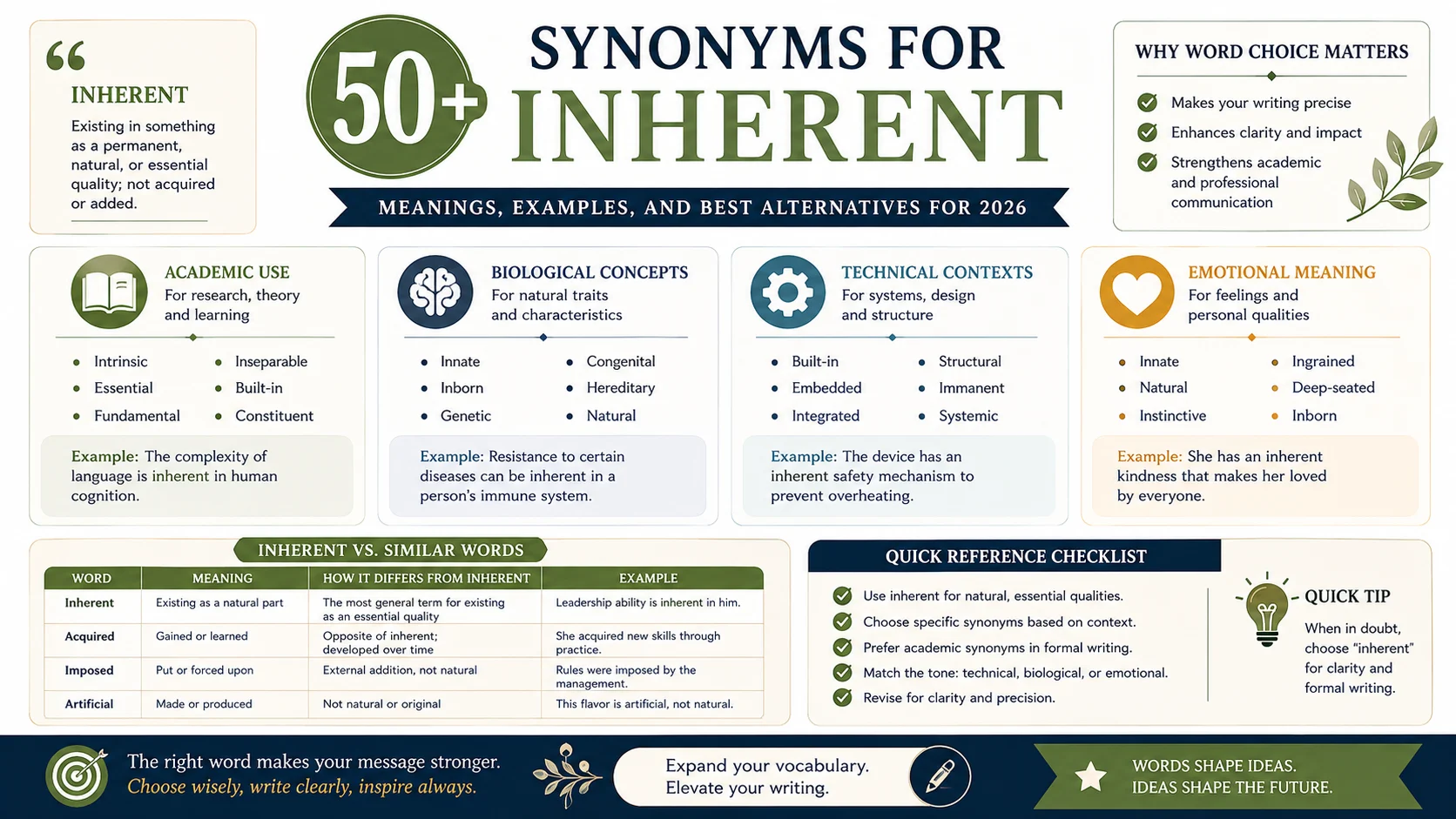
Inherent means existing as a natural and permanent part of something. The best synonym depends on context: use intrinsic for essential qualities, innate for natural abilities, essential for core components, ingrained for deeply established traits, and fundamental for basic principles.
Have you ever struggled to describe something that simply belongs to a person, object, or idea by its very nature?
You know the feeling. You are writing an essay about human rights, composing a performance review, or drafting a product description, and you need a word that captures the idea of something being built in, natural, or inseparable.
“Inherent” is the perfect word for these situations. But using it repeatedly makes your writing feel repetitive and uninspired.
Consider a scientist explaining the properties of water. Saying “water has inherent properties” works, but saying “water has intrinsic properties” or “essential characteristics” adds variety and precision.
This guide will transform how you express natural qualities, essential characteristics, and built in features. You will learn exactly when to use intrinsic versus innate, when essential works better than fundamental, and how to choose the perfect synonym for every situation.
Meaning, Tone and Context
Simple Definition
Inherent means existing in something as a permanent, essential, or characteristic attribute. It describes qualities that belong naturally to a person, thing, or situation.
Part of Speech
Inherent is an adjective. It is often followed by the preposition “in” to indicate what something belongs to.
Tone
Neutral to positive. Inherent carries a factual, objective tone when describing characteristics. It can take on a slightly positive tone when describing desirable natural qualities or gifts.
Formality Level
Inherent is formal to moderately formal. It appears frequently in academic writing, professional reports, legal documents, and intellectual discussions. It is less common in casual conversation.
Common Use Cases
- Describing natural characteristics: “The inherent risk of investment.”
- Discussing essential qualities: “The inherent beauty of nature.”
- Explaining built in features: “Inherent design flaws.”
- Describing natural abilities: “Her inherent talent for music.”
- Discussing unavoidable aspects: “The inherent challenges of leadership.”
Important Word Forms
- Adjective: inherent
- Adverb: inherently (in a natural or essential way)
- Noun: inherence (the state of being inherent)
- Related noun: heritage (sometimes confused but different)
When and How to Use “Inherent”
Use inherent when you want to emphasize that a quality belongs naturally to something and cannot be separated from it. The word works best for describing permanent, essential characteristics rather than temporary or learned traits.
Professional example:
“Data security has inherent risks that every organization must address proactively.”
Personal example:
“There is an inherent joy in watching children discover the world around them.”
Academic example:
“The study examines the inherent limitations of qualitative research methods.”
Emotional example:
“He possessed an inherent kindness that made everyone feel welcome.”
Creative example:
“The forest held an inherent mystery that no map could capture completely.”
Social media example:
“Understanding the inherent value of your work changes how you approach every task.”
Resume example:
“Demonstrated inherent leadership qualities that inspired team members to excel.”
Casual example:
“There is an inherent comfort in returning to your hometown after years away.”
Another Word for “Inherent”
The best single replacement depends on your specific context and what you want to emphasize.
- Professional writing: Intrinsic
- Academic writing: Fundamental, Essential
- Casual conversation: Built in
- Emotional writing: Innate
- Creative writing: Deep rooted
- Resume or workplace: Natural, Instinctive
- Social media captions: True, Pure
- Stronger meaning: Ingrained, Ineradicable
- Softer meaning: Characteristic, Typical
When Not to Use “Inherent”
Inherent sounds inappropriate when describing temporary conditions, learned behaviors, or acquired characteristics.
Too formal: “I have an inherent love for pizza.”
More natural: “I naturally love pizza.”
Incorrect: “She has an inherent habit of checking her phone.”
Better: “She has a persistent habit of checking her phone.”
Too academic: “The cookies have an inherent deliciousness.”
Better: “The cookies are naturally delicious.”
Overly dramatic: “Your inherent lateness frustrates me.”
More precise: “Your consistent lateness frustrates me.”
Misused: “He has an inherent skill in Excel.”
Better: “He has advanced skills in Excel.” (Skills are learned, not inherent)
Words Commonly Confused With “Inherent”
Inherent vs. Intrinsic
These are very close synonyms, but subtle differences exist. Inherent often describes characteristics that are inseparable from the whole. Intrinsic emphasizes the inner nature and real value of something. Inherent risk is part of investing, but intrinsic value is the true worth of an asset.
Inherent vs. Innate
Innate specifically describes qualities present from birth. Inherent is broader and can describe qualities acquired early or built into systems. Innate talent exists from birth, while inherent challenges exist within a situation.
Inherent vs. Essential
Essential describes what is absolutely necessary for something to exist or function. Inherent describes what naturally belongs to something. Oxygen is essential for life, but curiosity is inherent to human nature.
Inherent vs. Fundamental
Fundamental refers to basic underlying principles or structures. Inherent describes natural characteristics. Math skills are fundamental to engineering, but creativity is inherent to artistic expression.
Inherent vs. Ingrained
Ingrained suggests something that has become deeply established through repetition or time. Inherent suggests something that exists naturally from the start. Good manners can become ingrained, but kindness can be inherent.
Inherent vs. Natural
Natural is broader and more casual. It describes anything not artificial or manufactured. Inherent is more precise and suggests something cannot be separated from its source. Natural beauty exists in nature, but inherent worth exists in every person.
Best Synonym by Context for “Inherent”
| Context | Best Synonym | Why It Works | Example |
|---|---|---|---|
| Formal writing | Intrinsic | Precise and academically respected | The intrinsic value of education transcends monetary measures. |
| Academic writing | Fundamental | Establishes basic principles clearly | This represents a fundamental principle of economic theory. |
| Professional use | Built in | Clear and accessible in business contexts | The software has built in security features. |
| Resume writing | Natural | Shows authentic personal qualities | Natural leadership ability guided team success. |
| Casual conversation | Part of | Simple and completely natural | Patience is just part of being a good teacher. |
| Creative writing | Deep rooted | Adds imagery and emotional depth | Her deep rooted optimism never wavered. |
| Emotional tone | Innate | Expresses born with qualities | His innate compassion showed in every action. |
| Strong intensity | Ingrained | Suggests deeply fixed characteristics | Prejudice remains ingrained in many institutions. |
| Soft tone | Characteristic | Gentle way to describe normal qualities | This behavior is characteristic of young children. |
| Social media | True | Modern and relatable | Stay true to your authentic self. |
| US usage | Built in | Common in American business English | The system has built in redundancies. |
| UK usage | Intrinsic | Used broadly in British academic writing | The intrinsic merits of the proposal are clear. |
Which Synonym Should You Choose?
Choosing the right synonym for inherent depends on four key factors.
First, consider your meaning. Are you describing a natural quality, an essential component, or a deep seated characteristic? Intrinsic works for value, innate for born traits, and ingrained for established patterns.
Second, think about formality. Academic and professional writing benefits from intrinsic, fundamental, and essential. Casual conversation welcomes built in, part of, and natural.
Third, evaluate the source of the quality. Did the quality exist from birth? Use innate. Did it develop over time? Consider ingrained. Is it inseparable from the thing itself? Intrinsic fits best.
Fourth, consider your audience. Business stakeholders appreciate built in and essential. Academic readers expect intrinsic and fundamental. General audiences connect with natural and true.
Remember the simple rule: when in doubt, intrinsic is the safest academic choice, and natural is the best casual alternative.
Real Life Examples of “Inherent” in Sentences
School Context
“Mathematics has an inherent logic that becomes clearer with practice. Students must understand the inherent structure of mathematical proofs to succeed in advanced courses.”
Workplace Context
“Leadership carries inherent responsibilities that go beyond managing daily tasks. Effective managers recognize the inherent challenges of team dynamics and address them proactively.”
Writing Context
“Good storytelling has an inherent rhythm that keeps readers engaged. Writers understand the inherent tension between showing and telling in narrative prose.”
Conversation Context
“There is an inherent trust between close friends that cannot be forced. I appreciate the inherent honesty in our relationship.”
Social Media Context
“Embrace the inherent messiness of the creative process. There is an inherent beauty in things that are handmade and imperfect.”
Email Context
“The proposal has inherent strengths that make it worth considering. Please review the inherent risks before making a final decision.”
Storytelling Context
“The old house held an inherent sadness that visitors could feel immediately. Generations of memories were inherent in every creaking floorboard and faded photograph.”
25 Synonyms for “Inherent”
| Synonym | Simple Meaning | Best Used For | Example Sentence |
|---|---|---|---|
| Intrinsic | Belonging naturally to something | Academic, professional, formal | The intrinsic value of art lies in its meaning. |
| Innate | Present from birth | Emotional, personal, biological | She has an innate ability to make people smile. |
| Essential | Absolutely necessary | Academic, professional, serious | Patience is essential for teaching young children. |
| Fundamental | Basic and important | Academic, formal, professional | Honesty is fundamental to any healthy relationship. |
| Built in | Made as a permanent part | Casual, professional, technical | The car has built in navigation features. |
| Natural | Existing in nature or from birth | General, casual, all contexts | He has natural talent for public speaking. |
| Ingrained | Deeply established | Emotional, social, critical | Good habits become ingrained through practice. |
| Native | Belonging naturally to a person | Emotional, cultural, personal | Her native curiosity drives her research. |
| Deep rooted | Firmly established | Creative, emotional, literary | His deep rooted beliefs guided his decisions. |
| Characteristic | Typical of a person or thing | Neutral, descriptive, objective | This behavior is characteristic of the species. |
| Constitutional | Part of the basic makeup | Formal, legal, medical | Exercise is constitutional to good health. |
| Integral | Necessary to make something complete | Professional, academic, formal | Trust is integral to team success. |
| Implicit | Understood but not stated | Formal, academic, professional | The contract has implicit conditions. |
| Instinctive | Based on natural impulse | Emotional, psychological, casual | Her instinctive reaction showed her true feelings. |
| Organic | Developing naturally | Creative, professional, modern | The company values organic growth over rapid expansion. |
| Inborn | Existing from birth | Biological, emotional, personal | His inborn musicality surprised everyone. |
| Hardwired | Genetically or biologically fixed | Technical, scientific, modern | Humans are hardwired for social connection. |
| Unavoidable | Impossible to prevent | Practical, professional, realistic | Some risks are unavoidable in business. |
| Necessary | Required for a purpose | Practical, professional, clear | Preparation is necessary for success. |
| Proper | Belonging distinctly to something | Formal, descriptive, academic | Respect is proper to human relationships. |
| Inseparable | Cannot be separated | Emotional, descriptive, personal | Creativity is inseparable from her personality. |
| Deep seated | Firmly established at a deep level | Emotional, psychological, critical | His deep seated fears affected his decisions. |
| Structural | Related to basic structure | Technical, academic, professional | The report highlights structural inequalities. |
| Underlying | Beneath the surface | Academic, analytical, professional | The underlying principles remain consistent. |
| Hereditary | Passed down through families | Biological, medical, personal | Musical ability can be hereditary. |
Synonym Groups and Usage Differences
Professional vs. Personal Synonyms
Professional contexts favor intrinsic, fundamental, built in, and essential. These words sound competent and analytical in business and technical settings. Personal contexts welcome innate, natural, deep rooted, and instinctive, which create warmth and emotional connection.
Formal vs. Conversational Synonyms
Formal writing uses intrinsic, fundamental, constitutional, and implicit. These words appear in reports, essays, speeches, and legal documents. Conversational contexts use built in, natural, part of, and just the way something is for texts, emails, and everyday speech.
Academic Synonyms
Academic writing benefits from intrinsic, fundamental, essential, and implicit. These words show intellectual rigor and precise thinking in research papers, essays, and scholarly articles. They project authority and careful reasoning.
Professional and Business Synonyms
Business communication favors intrinsic, fundamental, built in, and structural. These words appear in emails, presentations, reports, and strategic documents. They convey analytical clarity and professional competence.
Creative or Literary Synonyms
Creative writing uses deep rooted, organic, deep seated, and inseparable. These words add imagery, emotional depth, and descriptive richness to narratives, poetry, and creative nonfiction. They bring characters and themes to life.
Slang or Modern Synonyms
Built in and hardwired work in modern, casual contexts. These terms appear in technology discussions and everyday conversations. They remain too casual for academic essays and formal reports.
Strongest vs. Weaker Synonyms
Mild: Characteristic, typical, proper (gentle and descriptive)
Moderate: Intrinsic, essential, fundamental (standard and reliable)
Strong: Ingrained, deep seated, ingrained (showing fixed qualities)
Intense: Ineradicable, inseparable, constitutional (deeply permanent)
Emotional vs. Neutral Synonyms
Emotional: Innate, deep rooted, instinctive, inborn (express personal qualities and human nature)
Neutral: Intrinsic, fundamental, essential, structural (factual, analytical, and professional)
Antonyms of “Inherent”
| Antonym | Meaning | Example Sentence |
|---|---|---|
| Acquired | Learned or gained over time | Leadership skills are acquired, not inherent. |
| Accidental | Happening by chance | The discovery was accidental, not inherent to the research. |
| Learned | Developed through experience | Patience is learned, not inherent to young children. |
| Temporary | Lasting only for a time | The solution offers temporary, not inherent, improvements. |
| Superficial | Existing on the surface | The changes are superficial rather than inherent. |
| Extrinsic | Coming from outside | Extrinsic motivation differs from inherent drive. |
| External | Outside the thing itself | The issues are external, not inherent to the design. |
| Imposed | Forced from outside | The rules are imposed, not inherent to the process. |
| Foreign | Not naturally belonging | The concepts were foreign to his previous experience. |
| Unnatural | Not normal or natural | The arrangement seemed unnatural and forced. |
| Artificial | Made by humans | The artificial colors contrasted with inherent beauty. |
| Peripheral | Unimportant and secondary | These are peripheral details, not inherent features. |
| Contingent | Dependent on other factors | Success is contingent, not inherent. |
| Conditional | Depending on circumstances | The offer is conditional, not inherent. |
| Optional | Available but not required | The features are optional, not inherent. |
Comparison: Inherent vs. Similar Words
Inherent vs. Intrinsic
Main difference: Inherent often describes characteristics inseparable from the whole, while intrinsic emphasizes inner nature and real worth.
Which is stronger: Intrinsic is slightly stronger when describing value or worth.
Which is more formal: Intrinsic is more formal and appears frequently in philosophy and economics.
Example with inherent: “Risk is inherent in all investments.”
Example with intrinsic: “The intrinsic value of the painting is immeasurable.”
Inherent vs. Innate
Main difference: Innate specifically means existing from birth. Inherent is broader and can apply to systems, ideas, and objects.
Which is stronger: Innate is stronger for personal, biological characteristics.
Which is more formal: Both are formal, but innate appears more in psychology and biology.
Example with inherent: “The system has inherent flaws.”
Example with innate: “She has innate artistic ability.”
Inherent vs. Essential
Main difference: Essential suggests something is absolutely necessary for existence. Inherent suggests something naturally belongs.
Which is stronger: Essential is stronger when describing requirements.
Which is more formal: Essential is more formal and practical.
Example with inherent: “Curiosity is inherent to childhood.”
Example with essential: “Water is essential for survival.”
Inherent vs. Fundamental
Main difference: Fundamental refers to basic underlying principles. Inherent describes natural characteristics.
Which is stronger: Fundamental is stronger for establishing core truths.
Which is more formal: Both are equally formal and academic.
Example with inherent: “Uncertainty is inherent to scientific discovery.”
Example with fundamental: “This is a fundamental principle of physics.”
Inherent vs. Ingrained
Main difference: Ingrained suggests something established through time or repetition. Inherent suggests natural presence from the start.
Which is stronger: Ingrained is stronger for habits and social patterns.
Which is more formal: Ingrained is slightly less formal and more descriptive.
Example with inherent: “Competition is inherent to sports.”
Example with ingrained: “Her etiquette was so ingrained she didn’t think about it.”
Inherent vs. Natural
Main difference: Natural is much broader and more casual. Inherent is more precise and formal.
Which is stronger: Inherent is stronger for academic and professional precision.
Which is more formal: Inherent is more formal.
Example with inherent: “The inherent complexity of the problem requires careful study.”
Example with natural: “She has a natural gift for languages.”
Common Phrases and Expressions with “Inherent”
1. Inherent risk
Meaning: A risk that is naturally part of an activity or situation.
Example: “Investors must understand the inherent risks before committing capital.”
2. Inherent nature
Meaning: The essential character or quality of something.
Example: “The inherent nature of democracy requires active citizen participation.”
3. Inherent worth
Meaning: Value that exists naturally without being added.
Example: “Every human being has inherent worth and dignity.”
4. Inherent flaw
Meaning: A weakness that exists by nature in something.
Example: “The design has an inherent flaw that causes instability.”
5. Inherent right
Meaning: A right that exists by nature, not given by law.
Example: “Human rights are inherent to all people, regardless of nationality.”
6. Inherent conflict
Meaning: A natural or unavoidable disagreement.
Example: “There is an inherent conflict between speed and quality.”
7. Inherent beauty
Meaning: Beauty that exists naturally without artificial enhancement.
Example: “The landscape has an inherent beauty that photographs cannot capture.”
Common Mistakes to Avoid
1. Using inherent for temporary or learned qualities
Inherent describes permanent, natural characteristics. Using it for temporary conditions is incorrect.
Mistake: “His inherent tiredness affected his performance.”
Better: “His tiredness affected his performance.”
2. Confusing inherent with inherited
Inherent means naturally belonging to something. Inherited means passed down from family.
Mistake: “She has inherent musical ability from her parents.”
Better: “She has inherited musical ability from her parents.”
3. Overusing inherent in casual writing
Inherent sounds academic and formal. Use more casual alternatives for everyday contexts.
Mistake: “Pizza has inherent deliciousness.”
Better: “Pizza is naturally delicious.”
4. Using inherent without a proper preposition
Inherent is typically followed by “in” to connect to what it belongs to.
Mistake: “The problem is inherent the system.”
Better: “The problem is inherent in the system.”
5. Choosing an overly formal synonym for simple situations
Using intrinsic or fundamental for ordinary characteristics sounds pretentious.
Mistake: “She has an intrinsic love for tacos.”
Better: “She naturally loves tacos.”
6. Using inherent to describe individual choices
Inherent describes qualities, not voluntary decisions.
Mistake: “His inherent decision to leave surprised everyone.”
Better: “His decision to leave surprised everyone.”
7. Using inherent interchangeably with essential
Essential means absolutely needed. Inherent means naturally belongs. They are not always interchangeable.
Mistake: “Oxygen is inherent to human life.” (Incorrect)
Better: “Oxygen is essential to human life.”
FAQs
1. What is the best synonym for inherent?
The best synonym for inherent is intrinsic. It captures the same meaning of natural, essential qualities and works in academic, professional, and formal contexts.
2. What is a formal synonym for inherent?
A formal synonym for inherent is intrinsic or fundamental. These words appear in academic writing, legal documents, and scholarly discussions.
3. What is an informal synonym for inherent?
An informal synonym for inherent is built in or natural. These words work well in casual conversation, social media, and everyday communication.
4. What is another word for inherent in professional writing?
Another word for inherent in professional writing is intrinsic or built in. These words sound competent and clear in business contexts.
5. What is the difference between inherent and intrinsic?
Inherent describes characteristics inseparable from the whole, while intrinsic emphasizes inner nature and real value. Inherent risk vs. intrinsic value illustrates the distinction.
6. What is the opposite of inherent?
The opposite of inherent is acquired, temporary, or extrinsic. These words describe qualities that come from outside or develop over time.
Conclusion
Inherent is a precise and valuable word for describing natural, permanent, and essential qualities. Its true power emerges when you select the right synonym for your specific context.
Use intrinsic for academic and professional writing, innate for personal and emotional expression, and essential for practical necessity. Choose natural and built in for casual conversation and modern communication.
Understanding the nuances between inherent, intrinsic, innate, and essential transforms your writing from adequate to excellent. A precise synonym makes your meaning clear and your message memorable.
The next time you need to describe something that naturally belongs to a person, thing, or idea, pause and consider which alternative serves your purpose best. You might choose intrinsic for its precision, innate for its humanity, or essential for its clarity.
Your readers will appreciate the variety, and your writing will gain the sophistication of a skilled vocabulary user. Start applying these synonyms today.
