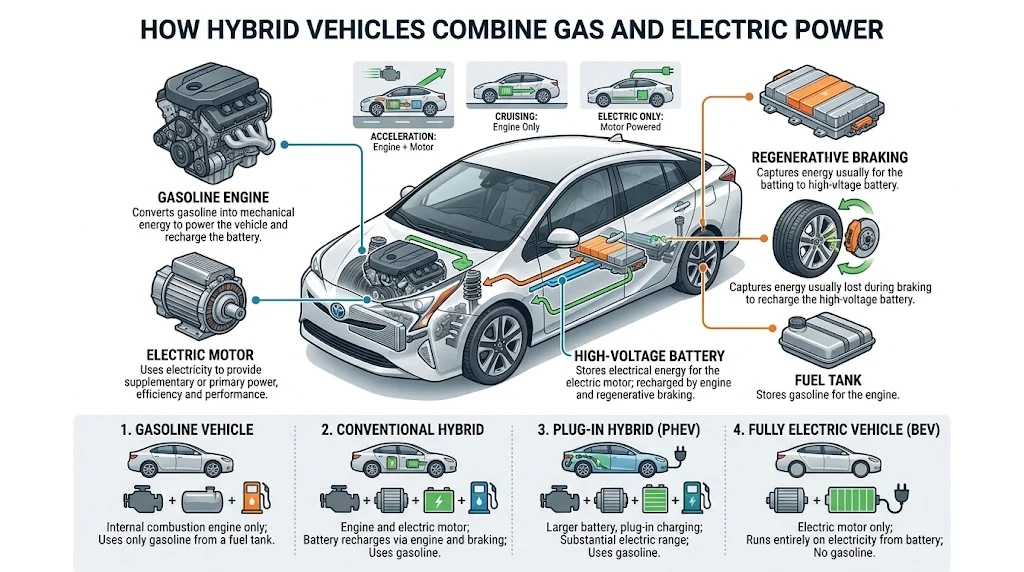
A hybrid vehicle combines a gasoline engine with one or more electric motors and a battery. The system can use either power source or both, improving efficiency while retaining the range and convenience of a conventional fuel powered vehicle.
What does hybrid mean in a vehicle is a common question for shoppers comparing gasoline cars, electric vehicles, and newer powertrain technologies. In simple terms, a hybrid uses both a gasoline engine and electric propulsion.
However, the technology can work in several ways. Some hybrids use electric power mainly at low speeds. Others can drive longer distances using electricity alone. Plug in hybrids add another option because drivers can recharge their larger battery from an external power source.
The important point is that a hybrid does not simply mean “a car with a battery.” Modern gasoline vehicles already use batteries for starting, electronics, and other systems. Instead, a hybrid powertrain actively combines an internal combustion engine with electric motor technology.
Furthermore, the vehicle controls this combination automatically in most situations. The system may turn the engine off at a stop, recover energy during braking, or use electric assistance when accelerating.
As a result, hybrid technology can reduce fuel consumption without requiring the driver to operate the vehicle like a fully electric car.
Quick Answer Box
| Category | Answer |
| Meaning | A vehicle that combines a gasoline engine with electric motor propulsion |
| Context | Automotive technology, fuel efficiency, vehicle shopping |
| Primary Platforms | Cars, SUVs, trucks, crossovers, plug in hybrid vehicles |
| Example | A hybrid SUV may use electric power at low speeds and gasoline power during higher demand |
| Tone | Technical but easy to understand |
What does hybrid mean in a vehicle?
The phrase asks for the basic definition of hybrid automotive technology. A hybrid vehicle combines two propulsion systems, typically a gasoline engine and an electric motor.
The electric motor receives energy from a high voltage battery. The gasoline engine burns fuel to create mechanical power. Depending on the hybrid design, both systems can propel the vehicle directly or work together.
For example, a hybrid sedan may start moving using electric power. Later, the gasoline engine may activate as speed or power demand increases. During acceleration, the electric motor can assist the engine.
The vehicle’s computer manages these transitions. Therefore, drivers usually do not need to choose manually between gasoline and electric operation.
The basic components
Most modern hybrid systems include several important components.
| Component | Main Function |
| Gasoline engine | Produces mechanical power using fuel |
| Electric motor | Provides electric propulsion or acceleration assistance |
| High voltage battery | Stores electrical energy for the motor |
| Inverter or power electronics | Controls electrical energy between components |
| Regenerative braking system | Recovers some kinetic energy during deceleration |
| Transmission or power split system | Transfers power to the wheels |
| Control computer | Decides how the power sources operate |
Not every hybrid uses exactly the same architecture. Automakers use different engineering approaches.
For instance, a mild hybrid may provide electrical assistance without driving the vehicle entirely through the electric motor. A full hybrid can usually operate electrically for short periods. A plug in hybrid generally has a larger battery and an external charging connection.
Why manufacturers use hybrid technology
Hybrid systems aim to improve efficiency while preserving the practical advantages of gasoline propulsion.
A gasoline engine can waste energy during braking and while operating inefficiently at certain loads. Hybrid technology addresses some of these losses.
Regenerative braking is one important example. Instead of allowing all braking energy to disappear as heat through the brakes, the electric motor can operate as a generator. The system then stores some of that energy in the battery.
Furthermore, the engine can shut down when its operation is unnecessary. At a traffic light, for example, the gasoline engine may stop temporarily.
When the driver releases the brake or presses the accelerator, the system can restart the engine smoothly.
Hybrid versus gasoline
A conventional gasoline vehicle normally relies on its internal combustion engine for propulsion. It still has a small electrical system, but that system does not normally provide meaningful propulsion.
A hybrid adds electric propulsion capability.
| Feature | Gasoline Vehicle | Hybrid Vehicle |
| Gasoline engine | Yes | Yes |
| Electric propulsion | Usually no | Yes |
| High voltage battery | No | Yes |
| Regenerative braking | Usually no | Yes |
| External charging | No | Usually no, unless it is a plug in hybrid |
| Fuel use | Depends on vehicle | Often lower under suitable driving conditions |
The actual fuel economy advantage varies by vehicle, driving conditions, weather, speed, terrain, and driving style.
Hybrid versus electric vehicle
A fully electric vehicle does not use a gasoline engine for propulsion. Instead, it relies on electric motors powered by a rechargeable battery.
A conventional hybrid still carries a gasoline engine and uses liquid fuel.
This distinction matters when shopping for a vehicle.
An EV requires access to charging. A typical non plug-in hybrid does not require external charging because its system can recharge the battery through regenerative braking and engine operation.
A plug in hybrid sits between these categories. It combines a gasoline engine and electric propulsion while allowing the driver to recharge the larger battery from an external source.
Contextual Dynamics & Nuances of the Term
Understanding the definition becomes easier when you look at how hybrid systems behave in everyday driving.
The term can describe several different technologies. Therefore, two vehicles labeled “hybrid” may deliver noticeably different driving experiences.
Mild hybrids
A mild hybrid uses a relatively small electric system to support the gasoline engine.
It may help with engine starting, acceleration, or stop start operation. However, many mild hybrids cannot propel the vehicle using electric power alone.
Consequently, shoppers should not assume that every hybrid can drive silently without the gasoline engine.
Full hybrids
A full hybrid has a stronger electric propulsion system. Depending on the design, it can sometimes move the vehicle using electric power alone.
Toyota’s Hybrid Synergy Drive is a well known example of a full hybrid architecture. Other manufacturers use different system designs.
The exact operating strategy varies by model.
Plug in hybrids
A plug-in hybrid, often abbreviated PHEV, has a larger battery than a conventional hybrid.
Drivers can connect the vehicle to an external charger. After charging, the vehicle may complete part of a trip using primarily electric energy.
Once the available electric energy becomes depleted, the gasoline engine can provide propulsion.
This design can suit drivers who want electric driving for shorter daily trips while retaining gasoline capability for longer journeys.
Does a hybrid need charging?
Usually, a conventional hybrid does not need to be plugged into an outlet.
Its battery receives energy from regenerative braking and, depending on the system, from the gasoline engine.
A plug in hybrid does require external charging if the owner wants to take full advantage of its larger battery.
Therefore, the word “hybrid” alone does not tell you whether charging is required.
How to explain what does hybrid mean in a vehicle in simple language
A simple explanation works well:
“It is a car that uses both a gasoline engine and an electric motor. The car’s computer decides how to combine them to improve efficiency.”
That answer works for most everyday conversations.
For a more technical audience, you can explain that the system uses a high voltage battery, electric motor generators, power electronics, regenerative braking, and an engine control strategy.
Real Life Conversation Examples Using what does hybrid mean in a vehicle
People rarely ask automotive questions using textbook language. They often ask while shopping, comparing cars, or watching a vehicle review.
Here are five realistic conversations.
Conversation 1: Buying a first hybrid
Alex: I’m looking at this Toyota. What does hybrid mean in a vehicle?
Jordan: It means the car combines a gasoline engine with an electric motor.
Alex: So do I have to plug it in?
Jordan: Not if it is a regular hybrid. It can recharge its battery while driving and braking.
Alex: That’s easier than I expected.
This conversation highlights a common misconception. Regular hybrids and plug in hybrids operate differently.
Conversation 2: Comparing a hybrid with an EV
Maya: Is a hybrid basically an electric car?
Chris: Not exactly. It still has a gasoline engine.
Maya: So what’s the electric part for?
Chris: The electric motor can help move the car and assist the engine. It can also recover energy during braking.
Maya: Got it. So it uses both systems.
Exactly. A hybrid sits between traditional gasoline propulsion and fully electric propulsion in terms of its powertrain design.
Conversation 3: Understanding fuel savings
Sam: Why does this SUV have better fuel economy than the regular version?
Taylor: The hybrid system can use electric assistance and recover energy during braking.
Sam: Does that mean it always runs on electricity?
Taylor: No. The gasoline engine still plays an important role.
This distinction prevents another common misunderstanding. Hybrid efficiency does not mean permanent electric operation.
Conversation 4: Asking about charging
Nina: What does hybrid mean in a vehicle? Do I need a charger at home?
Ryan: It depends on the type.
Nina: What types are there?
Ryan: A normal hybrid usually does not need external charging. A plug in hybrid can charge from an outlet and has a larger battery.
Nina: So I should check whether the model is a PHEV.
Correct. The abbreviation PHEV stands for plug-in hybrid electric vehicle.
Conversation 5: Explaining it to a new driver
Leo: Why did the engine turn off at the red light?
Emma: That’s normal for many hybrids.
Leo: Isn’t the car still on?
Emma: Yes. The vehicle can stop the gasoline engine while other systems remain active.
Leo: Then how does it move again?
Emma: The electric system can restart the engine or help move the vehicle when you accelerate.
This behavior can feel unusual at first. However, it is a normal part of hybrid operation.
Platform Specific Breakdown
Automotive terminology appears across search engines, video platforms, social networks, forums, and messaging apps. The underlying definition remains the same, but people phrase their questions differently.
How It Is Used on Snapchat
On Snapchat, people may use short questions when discussing a friend’s new car, a dealership listing, or a vehicle seen in a story.
For example:
“Is that a hybrid?”
“What does hybrid mean?”
“Does your car run on gas and electric?”
The platform does not create a special automotive meaning for the word. Instead, users usually want a quick explanation.
Because Snapchat conversations move quickly, a short answer works best:
“It uses a gas engine and an electric motor. A regular hybrid usually doesn’t need to be plugged in.”
That response gives the essential information without unnecessary technical detail.
The Role of what does hybrid mean in a vehicle on TikTok
TikTok automotive content often compresses technical concepts into short videos. Creators may discuss fuel economy, acceleration, ownership costs, battery systems, or differences between hybrid models.
However, short videos can leave out important details.
For example, a creator might say that a hybrid “runs on electric power.” That statement may describe a specific driving situation, but it does not describe every hybrid all the time.
Similarly, the phrase “self charging hybrid” can confuse new shoppers. A conventional hybrid does recover energy internally, but that does not mean the battery creates energy from nothing.
When evaluating a TikTok explanation, check the vehicle’s official specifications and owner’s documentation.
Instagram and Texting Dynamics
Instagram discussions tend to use compact language.
A user might comment:
“Is this a hybrid?”
Another person might respond:
“Yep, gas plus electricity.”
That short explanation is usually enough for casual conversation.
Texting follows the same pattern. People may ask about fuel savings, charging, battery replacement, or performance.
The context matters.
If someone asks, “Does it need gas?” they may not be asking for a technical definition. They may simply want to know whether the vehicle still uses gasoline.
A useful response should answer the actual concern rather than reciting an engineering definition.
YouTube and automotive forums
Longer platforms encourage deeper questions.
A YouTube viewer might ask whether a hybrid performs differently on highways. A forum participant might ask about battery longevity or maintenance.
These questions require more nuance.
For example, hybrid fuel economy can vary significantly between city and highway driving. Regenerative braking often provides more opportunities for energy recovery in stop and go traffic.
Highway driving can still be efficient, but the advantage may differ from urban driving.
Alternative Meanings & NLP Variations of the Phrase
The phrase itself is not really slang. It is an ordinary automotive question.
Still, search engines and conversational AI may encounter many variations.
| Search Variation | Intended Meaning |
| What is a hybrid car? | Basic definition |
| What does hybrid mean on a car? | Meaning of the vehicle label |
| What is a hybrid vehicle? | Automotive definition |
| How does a hybrid car work? | Technical explanation |
| Are hybrids electric cars? | Comparison with EVs |
| Do hybrid cars need charging? | Charging question |
| What is a PHEV? | Plug in hybrid definition |
| How does hybrid braking work? | Regenerative braking question |
| Is it a hybrid gas or electric? | Powertrain clarification |
| What does HEV stand for? | Hybrid terminology |
Search intent also changes depending on the wording.
“What is a hybrid car?” usually signals informational intent.
“Best hybrid SUV” signals commercial research intent.
“Hybrid battery replacement cost” signals ownership or transactional research intent.
“Hybrid versus EV” signals comparison intent.
Therefore, content should address the broader semantic topic rather than repeat one exact phrase.
Important automotive abbreviations
Several abbreviations appear frequently in hybrid discussions.
HEV means hybrid electric vehicle.
PHEV means plug-in hybrid electric vehicle.
EV means electric vehicle.
ICE means internal combustion engine.
MPG means miles per gallon.
These terms help readers understand vehicle specifications and reviews.
Misinterpretations:
The phrase works when someone wants a definition. However, it does not answer every hybrid related question.
For example, someone asking “How much does a hybrid battery cost?” needs pricing information.
Someone asked “How long does a hybrid battery last?” needs durability information.
Someone asked “Should I buy a hybrid?” needs a comparison based on driving habits, vehicle prices, fuel costs, charging access, and ownership expectations.
Therefore, do not use a basic definition as a substitute for a purchasing analysis.
Misinterpretation: Every hybrid drives electrically
This is incorrect.
Some hybrids can drive using electric power alone for limited periods. Others mainly use the electric system for assistance.
The operating behavior depends on the powertrain architecture.
Misinterpretation: Every hybrid must be plugged in
This is also incorrect.
Conventional hybrids generally recharge their batteries through regenerative braking and other onboard processes.
Plug in hybrids can use external charging.
Misinterpretation: Hybrid means slow
Hybrid technology does not automatically determine vehicle performance.
Electric motors can deliver strong torque from low speeds. Some hybrid vehicles therefore provide brisk acceleration.
Performance depends on the complete powertrain, vehicle weight, software calibration, battery output, and other engineering factors.
Misinterpretation: A hybrid never uses the brakes
Hybrid vehicles still use conventional friction brakes.
Regenerative braking can recover energy during deceleration. However, friction brakes remain important for stopping power, low speed operation, emergency braking, and situations where regeneration cannot provide enough braking force.
How to Respond in Chat Comfortably
A good chat response should match the person’s knowledge level.
If someone asks a basic question, avoid overwhelming them with engineering terminology.
Short response
“A hybrid uses both a gasoline engine and an electric motor. Most regular hybrids recharge themselves while driving, so you usually don’t need to plug them in.”
Friendly response
“It basically means the car uses gas and electric power together. The electric system helps the engine and can recover energy when you brake.”
Technical response
“A hybrid combines an internal combustion engine with electric motor generators and a high voltage battery. The control system manages power between them to improve efficiency and performance.”
If someone asks about charging
“If it is a regular hybrid, you normally don’t plug it in. If it is a plug in hybrid, you can charge the larger battery externally.”
If someone asks whether it is an EV
“Not exactly. A regular hybrid still has a gasoline engine. A fully electric vehicle relies on electric propulsion instead.”
These responses work because they answer the question directly. Furthermore, they avoid making claims that apply only to one type of hybrid.
FAQs
1. What does hybrid mean in a vehicle?
It means the vehicle combines gasoline propulsion with electric motor technology. The system can use the engine, electric motor, or both depending on the vehicle’s design and driving conditions.
2. Is a hybrid car electric or gas?
A conventional hybrid is both. It uses gasoline and electricity as part of its propulsion system.
However, a hybrid is different from a fully electric vehicle because it retains a gasoline engine.
3. Do hybrid cars need to be plugged in?
Most conventional hybrids do not require external charging.
Their batteries can receive energy through regenerative braking and engine operation.
Plug in hybrids can connect to external charging equipment and typically have larger batteries.
4. Can a hybrid run without gasoline?
A conventional hybrid is designed around a gasoline engine and fuel system. Some models can operate electrically for limited periods, but they are not equivalent to fully electric vehicles.
A plug in hybrid can generally travel farther on electric power before the gasoline engine becomes necessary.
5. How does a hybrid battery recharge?
The system can recover energy during braking. The vehicle may also use the gasoline engine to provide energy to the battery.
The exact strategy varies by manufacturer and powertrain architecture.
6. What does hybrid mean in a vehicle when the engine turns off?
It can mean that the hybrid control system has temporarily stopped the gasoline engine.
The vehicle may still have electrical systems operating. Depending on the situation, electric propulsion can move the vehicle or restart the engine.
7. Are hybrid cars expensive to maintain?
Maintenance depends on the specific vehicle.
Hybrid systems add components such as high voltage batteries, electric motors, and power electronics. At the same time, some hybrid designs can reduce wear on certain components through regenerative braking and other operating strategies.
Always check the manufacturer’s maintenance schedule for the exact model.
8. Are hybrid cars good for highway driving?
They can be efficient on highways, but results vary by model and driving conditions.
Speed, aerodynamics, vehicle weight, terrain, weather, tire pressure, and driving style all affect fuel consumption.
Therefore, compare official fuel economy ratings with real world reviews for the specific vehicle.
9. What is the difference between HEV and PHEV?
An HEV is a hybrid electric vehicle that normally does not require external charging.
A PHEV is a plug-in hybrid electric vehicle with a larger battery that can be charged from an external power source.
Both use gasoline engines and electric propulsion.
10. Why do people choose hybrid vehicles?
Drivers may choose hybrids for several reasons.
They may want lower fuel consumption. They may also prefer the convenience of gasoline refueling while gaining electric assistance.
Some buyers choose plug in hybrids because they want electric driving for shorter trips without giving up a gasoline engine for longer journeys.
Image SEO Architecture
| Image | SEO Purpose | Suggested Alt Text |
| Hybrid powertrain diagram | Explain technology | Hybrid gasoline engine and electric motor powertrain |
| Regenerative braking illustration | Explain energy recovery | Hybrid regenerative braking energy recovery diagram |
| Hybrid versus EV comparison | Clarify terminology | Hybrid car versus electric vehicle comparison |
| Plug in hybrid charging image | Explain PHEV technology | Plug in hybrid vehicle charging at home |
| Hybrid dashboard image | Show real world operation | Hybrid vehicle dashboard showing energy flow |
Conclusion:
What does hybrid mean in a vehicle ultimately asks a straightforward automotive question: how does a vehicle combine gasoline and electric propulsion?
The answer becomes more nuanced when you examine the different hybrid architectures.
A mild hybrid primarily supports the gasoline engine. A full hybrid can provide meaningful electric propulsion. A plug in hybrid adds external charging and a larger battery.
However, all of these systems share the central idea of combining different forms of propulsion.
The terminology can seem confusing because manufacturers describe their systems in different ways. Furthermore, social media often compresses complicated engineering concepts into short explanations.
That is why context matters.
If someone asks whether a hybrid needs charging, explain the difference between conventional hybrids and plug in hybrids. If they ask whether a hybrid is an EV, explain the role of the gasoline engine. If they ask about fuel economy, discuss the specific vehicle and driving conditions.
In other words, the simplest accurate explanation remains the most useful: a hybrid vehicle combines gasoline and electric technology to provide propulsion.
Once that distinction is clear, related terms such as HEV, PHEV, regenerative braking, electric motor, high voltage battery, and plug in charging become much easier to understand.
