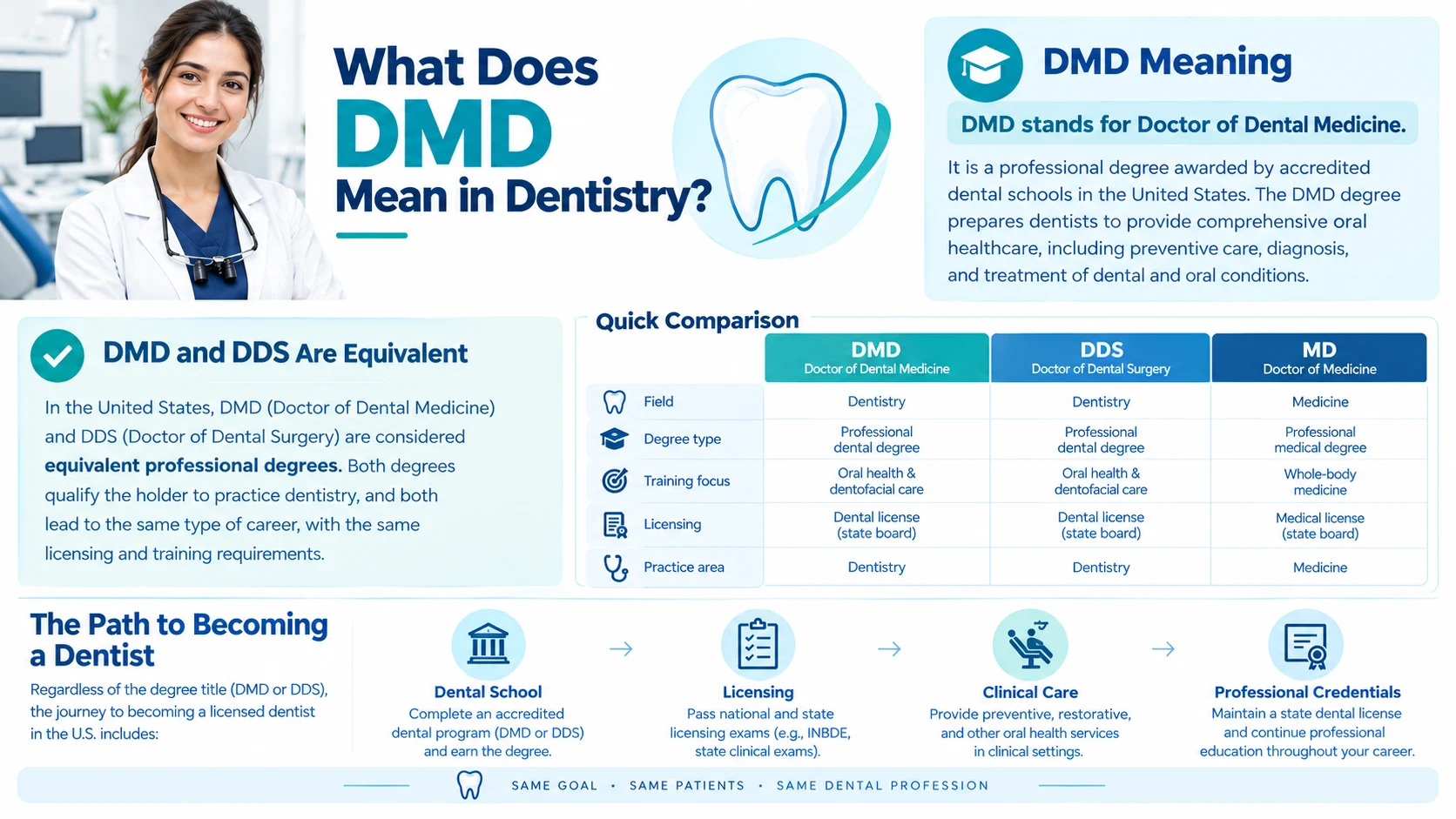
DMD means Doctor of Medicine in Dentistry. It is a professional dental degree that qualifies graduates to practice dentistry after completing required education, clinical training, and state licensing requirements in the United States.
INTRODUCTION
What does dmd mean in dentistry is a common question for patients who see the letters DMD after a dentist’s name. In the United States, DMD stands for Doctor of Medicine in Dentistry. However, the degree represents the same level of professional dental education as DDS, or Doctor of Dental Surgery.
The difference usually comes from the dental school’s degree tradition. Therefore, seeing DMD instead of DDS does not automatically mean a dentist has different training or performs different procedures.
For example, a general dentist with a DMD can provide preventive care, fillings, crowns, bridges, dental examinations, and many other routine services. Depending on additional education and licensing, dentists can also pursue specialties such as orthodontics, periodontics, endodontics, oral surgery, or pediatric dentistry.
The terminology can seem confusing because the letters look different. However, the practical distinction is much smaller than many patients expect.
This guide explains the meaning, history, education, professional context, and everyday use of DMD. It also explains how DMD compares with DDS and what patients should consider when choosing a dentist.
QUICK ANSWER BOX
| Meaning | Context | Primary Platforms | Example | Tone |
| Doctor of Medicine in Dentistry | Professional dental degree | Dental offices, provider profiles, insurance directories, websites | Dr. Jane Smith, DMD | Professional |
| Equivalent degree title to DDS | United States dental education | Dental schools, licensing records, medical forms | DMD dentist | Formal |
| Indicates a licensed dental professional when paired with appropriate credentials | Patient care and professional practice | Dental records, appointments, referrals | “My dentist is a DMD.” | Neutral |
What does dmd mean in dentistry?
The phrase what does dmd mean in dentistry refers to the meaning of the professional letters “DMD” used after a dentist’s name.
DMD stands for Doctor of Medicine in Dentistry. Some institutions describe the degree as Doctor of Dental Medicine. Both descriptions refer to the same abbreviation.
In the United States, DMD is one of two primary degree titles awarded to dentists. The other is DDS, which means Doctor of Dental Surgery.
Importantly, DMD and DDS are generally equivalent professional degrees. Both prepare graduates for dental practice. Both require extensive academic education and supervised clinical training. Both also require graduates to meet applicable state licensing requirements before practicing independently.
Why does the degree have two names?
The two titles exist because of historical differences between dental schools.
Harvard University played an important role in the development of the DMD title. Harvard chose Doctor of Dental Medicine because the Latin naming tradition associated with its degree structure did not support the existing DDS terminology in the same way.
Other dental schools continued using Doctor of Dental Surgery.
As a result, American dental education developed two established degree names.
The distinction is therefore largely historical and institutional. It does not mean that a DMD dentist practices “medical dentistry” while a DDS dentist practices “surgical dentistry.”
Both degrees represent professional dental education.
Is DMD a medical degree?
DMD is a professional doctoral degree in dentistry. It is not the same degree as an MD, which means Doctor of Medicine.
Nevertheless, dentists receive substantial education in human anatomy, physiology, pathology, pharmacology, microbiology, and other biomedical subjects. They also study oral diseases and their relationship to overall health.
Therefore, the word “Medicine” in DMD does not make a dentist an MD physician.
A DMD is trained and licensed to practice dentistry within the scope established by the relevant jurisdiction.
What does DMD tell you about a dentist?
The credential tells you that the dentist earned a recognized dental degree and completed the education required for that professional qualification.
However, the letters alone do not tell you everything about a dentist’s career.
For example, DMD does not automatically indicate:
- Years of professional experience
- Dental specialty
- Advanced postgraduate training
- Specific clinical interests
- Professional memberships
- Particular technology or equipment used
- Quality of an individual dental practice
Consequently, patients should consider the complete professional profile rather than focusing only on the letters after a name.
Contextual Dynamics & Nuances of the Term
Understanding what does dmd mean in dentistry becomes easier when you consider where the abbreviation appears.
You may see DMD on a dental office website, appointment reminder, insurance directory, prescription, referral, treatment plan, or business card.
The meaning remains essentially the same in each setting.
DMD on a dental office website
Dental practices commonly place DMD or DDS after a dentist’s name.
For example:
Dr. Sarah Williams, DMD
This format identifies the dentist’s professional degree.
A practice may also include other credentials. These can include a specialty certificate, fellowship, professional organization membership, or additional postgraduate qualification.
DMD on an insurance directory
Insurance websites may list dentists using DMD or DDS.
The abbreviation itself generally does not determine whether the dentist accepts your insurance. Instead, the directory uses provider information to identify the professional.
Therefore, patients should verify network status directly with the dental office and their insurance provider when coverage matters.
DMD on medical or dental paperwork
Dental records can use professional credentials after a provider’s name.
You might see a format such as:
Michael Brown, DMD
The letters identify the provider’s degree. They are not a diagnosis, procedure code, insurance code, or dental condition.
DMD versus MD
The abbreviations can look similar because both represent doctoral degrees.
However, they refer to different professional fields.
| Credential | Full name | Primary professional field |
| DMD | Doctor of Medicine in Dentistry | Dentistry |
| DDS | Doctor of Dental Surgery | Dentistry |
| MD | Doctor of Medicine | Medicine |
A DMD does not mean that the person is an MD. Likewise, an MD does not automatically mean that the person is a dentist.
DMD versus dental specialty credentials
A DMD identifies the foundational professional dental degree.
Specialists may have additional education.
For example, an orthodontist may complete advanced training after dental school. A periodontist receives specialized education focused on the gums and supporting structures around teeth.
Consequently, the letters after a dentist’s name may contain more information than DMD alone.
Real Life Conversation Examples Using what does dmd mean in dentistry
People usually encounter the abbreviation in practical situations rather than academic discussions. These examples show how the question can arise naturally.
Conversation 1: Seeing DMD on a website
Patient: I was looking at the dentist’s website. It says DMD after her name.
Friend: DMD means Doctor of Medicine in Dentistry.
Patient: Is that different from DDS?
Friend: They are generally equivalent dental degrees in the United States. The school determines which title it awards.
Patient: So DMD does not mean she is a medical doctor?
Friend: Right. She is a dentist with a professional dental degree.
Conversation 2: Choosing between two dentists
Patient: One dentist has DDS after his name, and another has DMD. Which credential should I look for?
Receptionist: Both are recognized dental degrees. You can also compare their experience, services, training, availability, and whether they accept your insurance.
Patient: So the letters alone do not tell me which dentist is better?
Receptionist: Correct. They mainly identify the dental degree.
Conversation 3: Reading an appointment reminder
Patient: My appointment reminder says “Dr. Lee, DMD.” What does that mean?
Family member: It means Dr. Lee has a Doctor of Dental Medicine degree.
Patient: Is that a specialist?
Family member: Not necessarily. DMD identifies the dental degree. You would need to check the dentist’s specialty or practice information to know more.
Conversation 4: Comparing American dental degrees
Student: Why do some dentists have DMD and others have DDS?
Advisor: American dental schools use two main degree titles. Some award DMD, while others award DDS.
Student: Does one require more training?
Advisor: Generally, no. The degree titles are considered equivalent professional dental degrees.
Conversation 5: Asking about a referral
Patient: My dentist referred me to a periodontist. The referral says DMD after the dentist’s name.
Family member: That identifies the dentist’s degree.
Patient: Does it explain why I was referred?
Family member: No. The reason for the referral would usually appear elsewhere in the referral or treatment information.
Platform Specific Breakdown
Digital platforms use dental credentials differently from social slang. Therefore, context matters when you see DMD online.
How It Is Used on Snapchat
Snapchat does not give DMD a special universal meaning related to dentistry.
If someone posts a screenshot of a dentist’s profile and writes DMD, the abbreviation may simply identify the professional’s degree.
For example:
“My new dentist is Dr. Taylor, DMD.”
In that sentence, DMD retains its professional meaning.
However, casual social media posts can create confusion because abbreviations often have multiple meanings. If someone uses DMD without mentioning dentistry, you should not automatically assume the dental definition.
Context remains the strongest clue.
The Role of what does dmd mean in dentistry on TikTok
TikTok content can introduce dental terminology to a broad audience.
Dentists and dental educators may use DMD while discussing topics such as:
- Dental school
- Tooth decay
- Cosmetic dentistry
- Dental implants
- Orthodontic treatment
- Oral hygiene
- Dental careers
- Professional credentials
A TikTok caption might say:
“What I wish I knew before dental school, from a DMD.”
Here, the abbreviation identifies the speaker as a dentist with a DMD degree.
However, TikTok also encourages shortened language. Therefore, viewers should consider the surrounding video before assigning a meaning to an unfamiliar abbreviation.
Instagram and Texting Dynamics
Instagram profiles often display professional credentials in biographies.
A dentist might write:
Dr. Alex Morgan, DMD
A dental practice might also use the credential in educational posts.
Text messages can be more ambiguous.
For example:
“I need to call my DMD.”
The intended meaning may be obvious to the sender and recipient, but an unfamiliar reader could interpret the abbreviation differently.
For professional communication, writing “dentist” can be clearer than relying on an abbreviation.
Alternative Meanings & NLP Variations of the Phrase
Search engines and AI systems may encounter several versions of the same question.
Common variations include:
- What does DMD stand for in dentistry?
- What is a DMD dentist?
- What does DMD mean after a dentist’s name?
- Is DMD the same as DDS?
- What is the difference between DMD and DDS?
- Does DMD mean doctor?
- Is a DMD a dentist?
- What degree does DMD represent?
- What does Doctor of Dental Medicine mean?
- Are DMD and DDS equivalent?
These phrases have closely related search intent.
The central answer remains consistent: DMD identifies a professional dental degree.
Linguistic variations
Natural language does not always preserve the same word order.
Someone may ask:
“What is DMD in dentistry?”
Another person may ask:
“What does DMD stand for?”
A third person may type:
“DMD dentist meaning.”
Search engines can generally connect these expressions because they share the same underlying topic.
Semantic entities connected with DMD
The topic connects with several important dental entities.
| Entity | Relationship to DMD |
| Dentist | Professional who may hold a DMD |
| DDS | Equivalent dental degree title |
| Dental school | Institution that awards the professional degree |
| State dental board | Licensing authority |
| General dentistry | Common area of dental practice |
| Orthodontics | Dental specialty requiring additional training |
| Periodontics | Specialty focused on supporting tissues |
| Endodontics | Specialty focused largely on the dental pulp and root canals |
| Prosthodontics | Specialty involving tooth replacement and restoration |
| Pediatric dentistry | Specialty focused on children and adolescents |
These relationships help explain why the abbreviation appears in many different dental contexts.
Misinterpretations: When NOT to Use what does dmd mean in dentistry
The abbreviation is useful when the audience understands the context. However, it can create confusion when used without explanation.
Do not confuse DMD with MD
DMD and MD are different professional degrees.
A dentist with a DMD is not automatically a physician with an MD.
The distinction matters when discussing professional roles and scopes of practice.
Do not assume DMD means specialist
A DMD can practice general dentistry. The credential itself does not establish a dental specialty.
Therefore, if you need an orthodontist, periodontist, endodontist, or another specialist, check the provider’s specialty credentials.
Do not assume DMD means a dentist is more experienced
A degree abbreviation does not communicate how long someone has practiced.
Two dentists may both hold DMD degrees while having very different career histories.
Do not assume DDS is an inferior credential
DDS and DMD represent the two major dental degree titles used in the United States.
The different names reflect institutional and historical traditions. They do not establish a simple hierarchy between the two.
Do not interpret DMD as a treatment recommendation
The abbreviation describes a professional credential.
It does not tell you whether you need a filling, crown, extraction, implant, root canal, or another procedure.
Those decisions depend on an individual clinical evaluation and professional judgment.
When should you spell it out?
For general audiences, spelling out “Doctor of Dental Medicine” the first time can improve clarity.
After that, DMD usually works well.
This approach is especially useful for educational articles, patient guides, school assignments, and professional communications.
How to Respond in Chat Comfortably
If someone asks you what DMD means, a short answer usually works.
You can say:
“DMD stands for Doctor of Dental Medicine. It’s a professional dental degree, similar to DDS.”
If the person asks whether DMD and DDS differ, you can add:
“They are generally equivalent dental degrees. The main difference is the degree title used by the dental school.”
If someone asks whether a DMD is a medical doctor, you can clarify:
“A DMD is a dentist, not an MD physician. DMD and MD are different professional degrees.”
Casual response
“DMD means Doctor of Dental Medicine. Basically, it’s one of the standard dental degrees in the U.S.”
Professional response
“DMD stands for Doctor of Dental Medicine. It is a professional dental degree and is generally equivalent to the DDS degree.”
Very short response
“DMD means Doctor of Dental Medicine, a professional dental degree.”
Response when someone asks about DDS
“DMD and DDS are generally equivalent dental degrees in the U.S. The difference mainly comes from which title the dental school awards.”
Response when someone sees DMD after a name
“The DMD after the dentist’s name identifies their professional dental degree.”
FAQs
1. What does dmd mean in dentistry?
DMD means Doctor of Dental Medicine. It is a professional dental degree awarded by dental schools in the United States and some other educational systems.
2. Is DMD the same as DDS?
Generally, yes. DMD and DDS are equivalent professional dental degree titles in the United States. The difference usually reflects the terminology selected by the dental school.
3. Is a DMD a dentist?
Yes. A person who earns a DMD and meets applicable licensing requirements can practice dentistry within the scope permitted by the relevant jurisdiction.
4. What does DMD stand for after a dentist’s name?
DMD identifies the dentist’s professional degree. It stands for Doctor of Dental Medicine, although the exact expansion can vary slightly in wording.
5. Does DMD mean the dentist is a specialist?
No. DMD identifies the foundational dental degree. A dentist needs additional specialty education and appropriate credentials to practice in a recognized dental specialty.
6. Is DMD higher than DDS?
The two degrees are generally considered equivalent professional dental degrees in the United States. Neither title automatically indicates a higher level of education.
7. Can a DMD perform surgery?
Dentists can perform dental surgical procedures within the scope of their education, training, licensure, and applicable laws. The specific procedures a dentist provides depend on their training and practice.
8. What is the difference between a DMD and an MD?
A DMD is a dental degree, while an MD is a medical degree. They prepare professionals for different areas of healthcare practice.
9. Why do some dentists have DMD instead of DDS?
Dental schools choose which professional degree title they award. Some use DMD, while others use DDS. Historical and institutional traditions explain much of this difference.
10. Should I choose a dentist based on DMD or DDS?
The degree title alone does not provide enough information to evaluate a dentist. Patients can also consider licensing, specialty training, experience, services, office accessibility, insurance participation, and their specific dental needs.
Conclusion:
The question what does dmd mean in dentistry has a straightforward answer: DMD stands for Doctor of Dental Medicine and identifies a professional dental degree.
The abbreviation can look confusing because dentistry uses both DMD and DDS. However, the two degree titles are generally equivalent in the United States.
The distinction largely reflects the history and naming traditions of individual dental schools.
When you see DMD after a dentist’s name, you can generally understand it as a professional dental credential. It does not automatically indicate a specialty, additional postgraduate training, years of experience, or a particular treatment approach.
The same principle applies when researching a dentist online. Look beyond the letters after the name. Check the provider’s professional information, licensing status, specialty training, services, and the type of care you need.
In everyday communication, context also matters. A dental website, appointment reminder, provider directory, or professional biography gives DMD a clear dental meaning. On social platforms, abbreviations can be less predictable, so surrounding text provides useful clues.
Ultimately, what does dmd mean in dentistry is less complicated than it first appears. It identifies a recognized dental degree, while the dentist’s broader education, licensing, training, and professional profile provide the additional context patients need.
