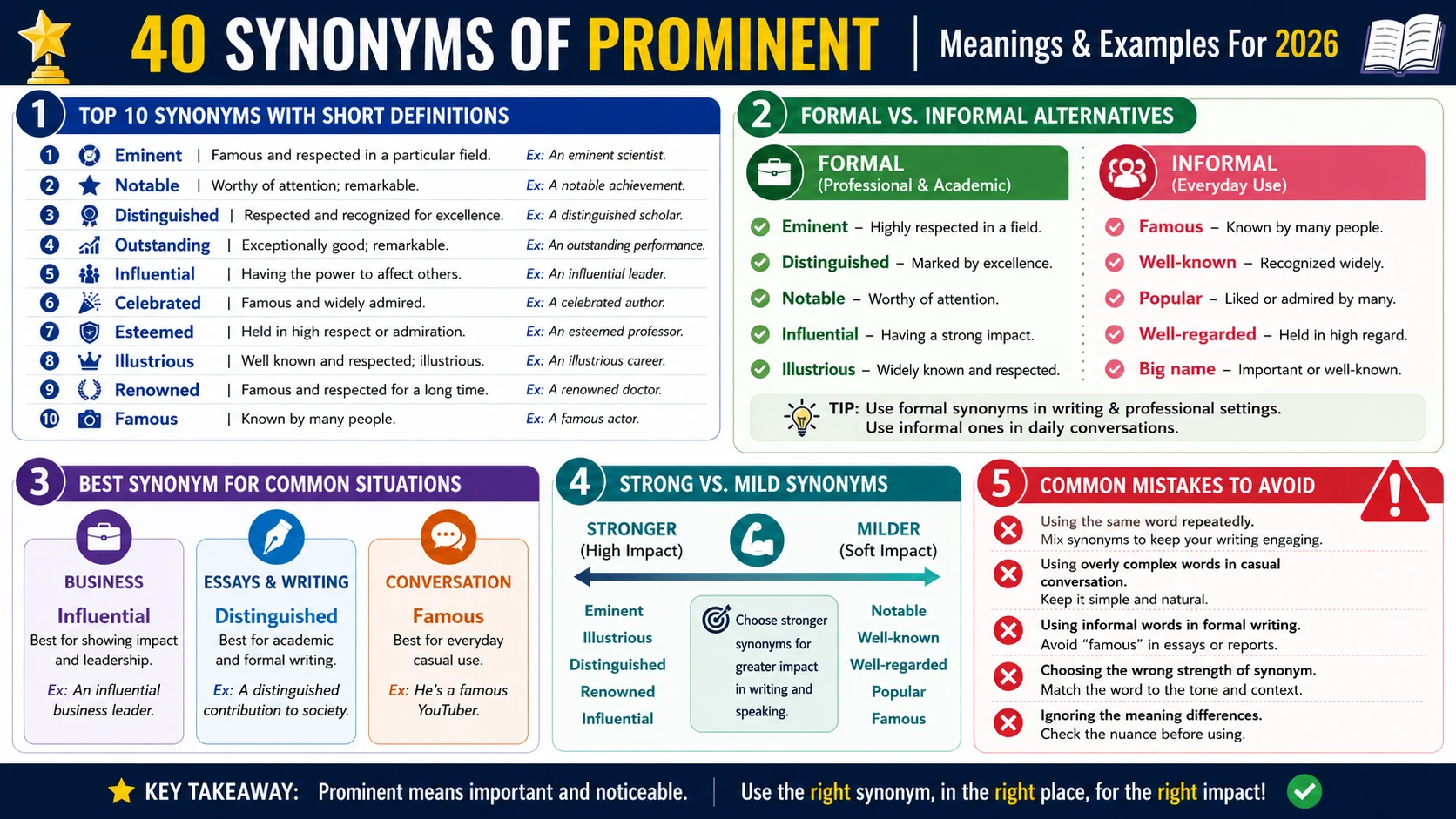
“Prominent” means important, well-known, or easily seen. The best synonyms are famous, well-known, distinguished, eminent, and notable. “Famous” is the most common alternative. Each synonym works best in different contexts and tones.
Top 10 Synonyms
- Famous
- Well-known
- Distinguished
- Eminent
- Notable
- Outstanding
- Renowned
- Celebrated
- Illustrious
- Preeminent
“Prominent” is a wonderful word. It describes people, places, or things that stand out. But using it too often can make your English sound repetitive.
Think about it. You can have a prominent politician, a prominent building, or a prominent feature on your face. Each situation might need a different word that captures the meaning more precisely.
The good news is that English has many fantastic alternatives. Some words emphasize fame, others emphasize importance, and some describe physical visibility.
In this guide, you’ll learn 35 powerful synonyms for “prominent.” You’ll discover exactly when to use each one, how formal they are, and what common mistakes to avoid.
What Does “Prominent” Mean?
Definition
Prominent” means standing out or being easily noticed. It can describe someone who is famous or important in their field. It can also describe something physical that is easy to see, like a prominent nose or a prominent building. When something is prominent, it catches your attention.
Pronunciation
| Feature | Value |
|---|---|
| US IPA | /ˈprɑmənənt/ |
| UK IPA | /ˈprɒmɪnənt/ |
| Syllables | 3 (prom-i-nent) |
| Tip | Stress the first syllable: “PROM-in-ent” |
Grammar
| Grammar Feature | Information |
|---|---|
| Part of Speech | Adjective |
| Common Position | Before a noun or after a linking verb |
| Typical Pattern | Prominent + noun / be + prominent |
Examples:
- “She is a prominent doctor in the city.”
- “The prominent building stood out among the others.”
- “His role became prominent after the election.”
Grammar Note: “Prominent” can describe people (famous), things (visible), or features (noticeable). It works equally well in all these contexts.
Word Family
| Word | Part of Speech | Meaning |
|---|---|---|
| Prominence | Noun | The state of being prominent |
| Prominently | Adverb | In a prominent way |
| Prominent | Adjective | Important, visible, well-known |
15 Synonyms of “Prominent”
Famous
Meaning: Known by many people.
Best Used For: Celebrities, historical figures, well-known places.
Formality: Neutral
Tone: Popular, Recognizable
Frequency: ⭐⭐⭐⭐⭐ (Very Common)
CEFR Level: A2
Example Sentence 1: “She is a famous actress who has appeared in many movies.”
Example Sentence 2: “The Eiffel Tower is one of the most famous landmarks in the world.”
Usage Tip: “Famous” is the most common and direct alternative. Use it when someone or something is known by many people.
Common Confusion: Famous vs Prominent. Famous” means known by many. Prominent” can mean important, famous, or physically noticeable.
Well-known
Meaning: Known by a lot of people.
Best Used For: People, places, ideas that are widely recognized.
Formality: Neutral
Tone: Familiar, Recognized
Frequency: ⭐⭐⭐⭐⭐ (Very Common)
CEFR Level: A2
Example Sentence 1: “He is a well-known author in the fantasy genre.
Example Sentence 2: “This restaurant is well-known for its delicious pizza.”
Usage Tip: “Well-known” is almost identical to “famous” but slightly less strong. It’s a very natural and common alternative.
Distinguished
Meaning: Very respected and admired, often for achievements.
Best Used For: Professionals, academics, people with awards.
Formality: Formal
Tone: Respectful, Admiring
Frequency: ⭐⭐⭐⭐ (Common)
CEFR Level: B2
Example Sentence 1: “She is a distinguished professor at the university.”
Example Sentence 2: “He received a distinguished award for his service.”
Usage Tip: “Distinguished” emphasizes respect and achievement. It’s perfect for professionals and academics.
Eminent
Meaning: Famous and respected within a specific field.
Best Used For: Scientists, scholars, experts, professionals.
Formality: Formal
Tone: Academic, Professional
Frequency: ⭐⭐⭐ (Moderate)
CEFR Level: B2
Example Sentence 1: “The eminent scientist won the Nobel Prize.”
Example Sentence 2: “She is an eminent scholar in the field of history.”
Usage Tip: “Eminent” is used for people who are highly respected in their profession. It’s more formal than “famous.”
Common Confusion: Eminent vs Prominent. “Eminent” always implies respect and achievement. “Prominent” can just mean visible or noticeable.
Notable
Meaning: Deserving attention because of being interesting or important.
Best Used For: Achievements, events, features, people.
Formality: Neutral
Tone: Significant, Worth Mentioning
Frequency: ⭐⭐⭐⭐ (Common)
CEFR Level: B1
Example Sentence 1: “The city has several notable landmarks.”
Example Sentence 2: “He made a notable contribution to the project.”
Usage Tip: “Notable” means worth noticing or mentioning. It works for people, events, and features.
Outstanding
Meaning: Exceptionally good or very noticeable.
Best Used For: Achievements, performances, students, quality.
Formality: Neutral
Tone: Excellent, Impressive
Frequency: ⭐⭐⭐⭐ (Common)
CEFR Level: B1
Example Sentence 1: “She is an outstanding student in her class.”
Example Sentence 2: “The team did an outstanding job on the project.”
Usage Tip: “Outstanding” emphasizes excellence. It’s often used when something is much better than average.
Renowned
Meaning: Known or talked about by many people.
Best Used For: Experts, artists, well-known places.
Formality: Formal
Tone: Respected, Celebrated
Frequency: ⭐⭐⭐ (Moderate)
CEFR Level: B2
Example Sentence 1: “The museum is renowned for its art collection.”
Example Sentence 2: “He is a renowned expert in ancient history.”
Usage Tip: “Renowned” means widely known and respected. It’s very similar to “famous” but more formal.
Celebrated
Meaning: Famous and admired.
Best Used For: Artists, musicians, historical figures.
Formality: Neutral
Tone: Admired, Praised
Frequency: ⭐⭐⭐ (Moderate)
CEFR Level: B2
Example Sentence 1: “She is a celebrated author with millions of readers.”
Example Sentence 2: “The celebrated singer performed at the concert.”
Usage Tip: “Celebrated” suggests public praise and admiration. It’s often used for creative professionals.
Illustrious
Meaning: Very famous and admired in a particular field.
Best Used For: Highly respected people, careers, history.
Formality: Formal
Tone: Grand, Respectful
Frequency: ⭐⭐ (Rare)
CEFR Level: C1
Example Sentence 1: “She had an illustrious career as a diplomat.
Example Sentence 2: “He comes from an illustrious family.”
Usage Tip: “Illustrious” is a very formal word for people who are extremely respected. It’s used for major achievements.
Preeminent
Meaning: More important or better than others; outstanding.
Best Used For: The very best in a field.
Formality: Formal
Tone: Superior, Best
Frequency: ⭐⭐ (Rare)
CEFR Level: C1
Example Sentence 1: “He is the preeminent expert in his field.”
Example Sentence 2: “The university is preeminent in scientific research.”
Usage Tip: “Preeminent” means the best or most important among all others. It suggests you are number one in your field.
Noticeable
Meaning: Easy to see or recognize.
Best Used For: Physical features, differences, changes.
Formality: Neutral
Tone: Observant, Visible
Frequency: ⭐⭐⭐⭐ (Common)
CEFR Level: B1
Example Sentence 1: “There was a noticeable difference in her attitude.”
Example Sentence 2: “The scar on his face was very noticeable.”
Usage Tip: “Noticeable” focuses on physical visibility or being easy to perceive. It’s not about fame.
Visible
Meaning: Able to be seen.
Best Used For: Physical objects, features, changes.
Formality: Neutral
Tone: Clear, Obvious
Frequency: ⭐⭐⭐⭐ (Common)
CEFR Level: A2
Example Sentence 1: “The stars are visible on a clear night.”
Example Sentence 2: “The problem became visible after the test.”
Usage Tip: “Visible” is about being able to see something. It’s direct and simple.
Conspicuous
Meaning: Very noticeable or easy to see.
Best Used For: Physical things that stand out, sometimes in a bad way.
Formality: Formal
Tone: Obvious, Standout
Frequency: ⭐⭐⭐ (Moderate)
CEFR Level: B2
Example Sentence 1: “His bright jacket was conspicuous in the crowd.”
Example Sentence 2: “She made a conspicuous effort to help.”
Usage Tip: “Conspicuous” means very noticeable and easy to see. It can sometimes mean standing out in a way that’s awkward.
Standout
Meaning: Exceptionally good or noticeable.
Best Used For: Achievements, people, performances.
Formality: Informal
Tone: Impressive, Excellent
Frequency: ⭐⭐⭐ (Moderate)
CEFR Level: B1
Example Sentence 1: “She was the standout performer in the show.”
Example Sentence 2: “The standout feature of the house is the garden.”
Usage Tip: “Standout” is an informal word for something or someone that is clearly better or more noticeable than others.
High-profile
Meaning: Attracting a lot of public attention.
Best Used For: People, events, cases that get media attention.
Formality: Neutral
Tone: Public, Attention-getting
Frequency: ⭐⭐⭐ (Moderate)
CEFR Level: B2
Example Sentence 1: “The trial was a high-profile case in the media.”
Example Sentence 2: “She is a high-profile business leader.”
Usage Tip: “High-profile” is used for things that attract lots of public and media attention.
Synonyms Comparison Table
| Synonym | Best Context | Formality | Tone | Frequency |
|---|---|---|---|---|
| Famous | Celebrities, places | Neutral | Popular | ⭐⭐⭐⭐⭐ |
| Well-known | General recognition | Neutral | Familiar | ⭐⭐⭐⭐⭐ |
| Distinguished | Professionals | Formal | Respectful | ⭐⭐⭐⭐ |
| Eminent | Academics, experts | Formal | Professional | ⭐⭐⭐ |
| Notable | Achievements, events | Neutral | Significant | ⭐⭐⭐⭐ |
| Outstanding | Excellence | Neutral | Impressive | ⭐⭐⭐⭐ |
| Renowned | Experts, artists | Formal | Respected | ⭐⭐⭐ |
| Celebrated | Artists, musicians | Neutral | Admired | ⭐⭐⭐ |
| Noticeable | Physical features | Neutral | Visible | ⭐⭐⭐⭐ |
Best Synonyms by Situation
| Situation | Best Synonym | Why It Works |
|---|---|---|
| Daily Conversation | Famous / Well-known | Natural and common |
| Business Email | Distinguished | Professional and respectful |
| Academic Writing | Eminent / Renowned | Formal and academic |
| School Assignment | Notable / Outstanding | Shows recognition of quality |
| Professional Meeting | Distinguished | Respectful and professional |
| Presentation | Notable / Outstanding | Clear and impressive |
| Creative Writing | Illustrious / Celebrated | Adds literary flair |
| Social Media | Famous / Well-known | Casual and relatable |
| Job Application | Distinguished | Shows achievement |
Formal vs Informal Synonyms
Formal Alternatives
| Synonym | Best Used For |
|---|---|
| Eminent | Academics, experts, scientists |
| Renowned | Professionals, artists |
| Distinguished | Professors, officials |
| Illustrious | Major achievements, careers |
| Preeminent | The very best in a field |
Neutral Alternatives
| Synonym | Best Used For |
|---|---|
| Famous | Celebrities, places |
| Well-known | General recognition |
| Notable | Achievements, events |
| Outstanding | Excellence |
| Celebrated | Admired people |
Informal Alternatives
| Synonym | Best Used For |
|---|---|
| Standout | Impressive people, things |
| Big-name | Famous people |
| High-profile | Media attention |
Choosing the Right Level: In academic writing, use “eminent” or “renowned.” In business, “distinguished” is excellent. With friends, “famous” or “well-known” are perfect.
Strong vs Mild Synonyms
Mild
Suitable for everyday situations with less intensity.
- Well-known
- Visible
- Notable
- Noticeable
Moderate
More expressive and professional alternatives.
- Famous
- Distinguished
- Renowned
- Outstanding
Strong
High-intensity alternatives suggesting great respect or excellence.
- Eminent (highly respected in a field)
- Illustrious (extremely respected)
- Preeminent (the absolute best)
- Celebrated (publicly admired)
How Intensity Changes Meaning: “A well-known doctor” is recognized. “An eminent doctor” is highly respected. “A preeminent doctor” is the very best. Choose based on how much respect or importance you want to convey.
Real-Life Examples
School: “She was a notable student in her graduating class.”
Office: “He is a distinguished member of our team.”
Business Email: “Our company worked with a renowned expert.”
Meetings: “We discussed the outstanding performance of the team.”
Presentations: “The preeminent researcher in the field will speak today.”
Daily Conversations: “She’s famous for her cooking skills.”
Social Media: “The well-known influencer posted a new video.”
Academic Writing: “The eminent scholar published a groundbreaking study.”
Common Collocations
| Common Phrase | Better Alternative |
|---|---|
| Prominent figure | Well-known figure |
| Prominent role | Important role |
| Prominent feature | Notable feature |
| Prominent building | Landmark building |
| Prominent politician | Famous politician |
Common Phrases
Rise to prominence: To become well-known. (e.g., “She rose to prominence in the tech industry.”)
In a prominent position: In an important or visible role. (e.g., “He was in a prominent position at the company.”)
Prominent figure: An important or famous person. (e.g., “She is a prominent figure in the art world.”)
Stand out from the crowd: To be noticeably different or better. (e.g., “His work really stands out from the crowd.”)
Make a name for oneself: To become famous. (e.g., “She made a name for herself as an artist.”)
Context Guide
| Situation | Best Synonym | Reason |
|---|---|---|
| Essay | Eminent / Renowned | Formal and academic |
| Speech | Distinguished | Respectful and impressive |
| Business Email | Notable | Professional and clear |
| Novel | Illustrious / Celebrated | Adds literary quality |
| Presentation | Outstanding | Positive and impressive |
| Conversation | Famous / Well-known | Natural and casual |
| Academic Writing | Preeminent / Eminent | Formal and precise |
| Marketing Copy | Renowned | Inspires trust |
Related Words
Near Synonyms
- Famed: Famous. (e.g., “A famed musician”)
- Honored: Respected. (e.g., “An honored guest”)
- Acclaimed: Publicly praised. (e.g., “An acclaimed actor”)
- Noted: Famous or known. (e.g., “A noted expert”)
- Respected: Admired. (e.g., “A respected leader”)
Antonyms
- Unknown: Not famous or known.
- Obscure: Not well-known.
- Insignificant: Not important.
- Inconspicuous: Not easily seen or noticed.
- Unnoticeable: Not easy to notice.
Related Adjectives
- Important: Having great significance.
- Famous: Known by many.
- Respected: Admired by many.
- Influential: Having power to affect others.
- Significant: Having importance.
Related Nouns
- Fame: The state of being known.
- Prominence: The state of being prominent.
- Reputation: What people think of someone.
- Celebrity: A famous person.
- Distinction: Excellence and respect.
Related Verbs
- Distinguish: To make someone stand out.
- Celebrate: To praise publicly.
- Recognize: To acknowledge someone’s importance.
- Highlight: To emphasize.
Frequently Asked Questions
What is another word for prominent?
Common synonyms are famous, well-known, distinguished, eminent, and notable. The best choice depends on whether you mean famous, respected, or physically visible.
Which synonym sounds the most professional?
Distinguished and eminent sound the most professional. They suggest both fame and respect. “Renowned” is also excellent for professional contexts.
What is the strongest synonym for prominent?
Preeminent is one of the strongest synonyms. It means being the absolute best or most important. “Illustrious” is also very strong, suggesting great respect and achievement.
Which synonym is best for essays?
Eminent and renowned are excellent for academic essays. “Preeminent” is perfect when discussing the best in a field. “Notable” works well for events or achievements.
What’s the difference between famous and prominent?
Famous” means known by many people. “Prominent” can mean famous, but it can also mean physically noticeable or holding an important position.
Which synonym is most common in everyday English?
Famous” and “well-known” are the most common synonyms in everyday speech. They’re simple, natural, and widely understood.
What is the opposite of prominent?
Common opposites include unknown, obscure, insignificant, and inconspicuous. These words describe things that don’t stand out.
Conclusion
“Prominent” is a powerful word, but now you have 35 excellent alternatives to choose from. Each synonym adds its own special meaning and tone to your language.
The key is understanding the context. Use “famous” and “well-known” for everyday situations. Use “distinguished” and “eminent” for professional and academic contexts. Use “preeminent” when you want to emphasize someone is the absolute best.
The best way to improve is to practice. Try using one or two new synonyms each day. Listen for these words in conversations, news, and books. Your vocabulary will grow richer and more impressive with time.
