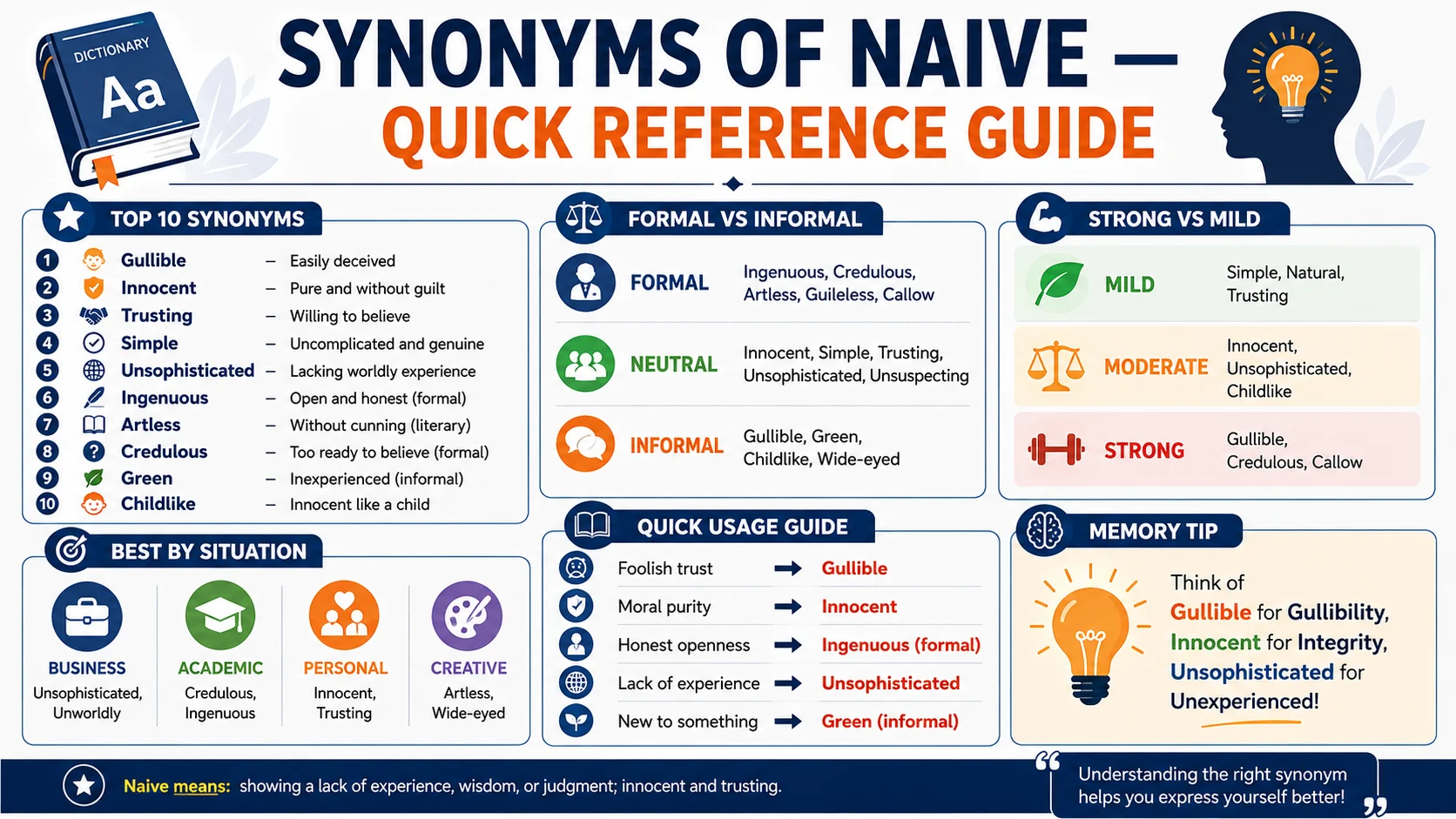
Naive means lacking experience, wisdom, or judgment often trusting too easily. The best synonyms include gullible, ingenuous, unsophisticated, innocent, trusting, credulous, artless, guileless, green, callow, childlike, simple, unworldly, unsuspecting, and natural. But each synonym has a slightly different meaning, tone, or context, so choosing the right one depends on your situation.
Have you ever called someone naive or been called naive yourself? It’s a word that can be gently descriptive or sharply critical, depending on how you use it. Maybe you’re writing an email, a school essay, or simply trying to express yourself more clearly in English. The word naive is useful, but using it too often can make your writing sound repetitive.
That’s where synonyms come in. Learning alternative words for naive will help you speak and write more naturally, just like a native speaker. In this guide, you’ll discover 20 powerful synonyms for naive, complete with meanings, examples, and practical usage tips. By the end, you’ll know exactly which word to use in any situation whether you’re writing a business report, having a casual conversation, or describing a character in a story.
What Does “Naive” Mean?
Definition
In simple terms, naive describes someone who lacks experience, worldly wisdom, or informed judgment. It can mean being too trusting believing things too easily because you don’t know any better. It can also mean being simple and natural, without any artificiality or pretense. For example, a child is naive because they haven’t learned that not everyone tells the truth. A naive belief is one that ignores how complicated the real world actually is.
Pronunciation
| Feature | Value |
|---|---|
| US IPA | /naɪˈiːv/ or /nɑˈiːv/ |
| UK IPA | /naɪˈiːv/ |
| Syllables | 2 |
| Tip | Stress the second syllable: ny-EEV |
The word comes from French, where it’s spelled naïve with two dots (a diaeresis) over the ‘i’. In English, both naive and naïve are correct, but naive is much more common.
Grammar
| Grammar Feature | Information |
|---|---|
| Part of Speech | Adjective |
| Common Position | Before a noun or after a linking verb |
| Typical Pattern | naive about something or naive to do something |
Example Sentences:
- She’s so naive she believes everything she reads online.
- It was naive to think we could finish the project in one day.
- He has a very naive attitude toward politics.
Grammar Note: Naive is often used with the preposition about (naive about the world) or with an infinitive (naive to believe). You can also use it with intensifiers like very, so, too, or incredibly.
Word Family
20 Synonyms of “Naive”
1. Gullible
Meaning: Too willing to believe everything you’re told; easily tricked.
Best Used For: Daily conversation, describing someone who falls for scams or lies.
Formality: Informal
Tone: Critical, slightly negative
Frequency: ⭐⭐⭐⭐⭐ Very Common
CEFR Level: B1
Example Sentence 1: I’m so gullible I believed him when he said he was a prince!
Example Sentence 2: Scammers target gullible people who don’t question what they’re told.
Usage Tip: Gullible is more negative than naive. It suggests foolishness and a weakness for being deceived. Use it when you want to criticize someone for being too trusting. Native speakers often use it in phrases like “You’re so gullible!” Don’t use it when you mean innocent in a positive way.
2. Ingenuous
Meaning: Childlike in being open, honest, and unable to hide feelings; natural and innocent.
Best Used For: Formal writing, literature, describing someone with pure intentions.
Formality: Formal
Tone: Positive, admiring
Frequency: ⭐⭐ Rare
CEFR Level: C1
Example Sentence 1: He seemed too ingenuous for a reporter he couldn’t hide his emotions.
Example Sentence 2: Her ingenuous admission of guilt surprised everyone in the room.
Usage Tip: Ingenuous is a sophisticated, positive word. It suggests honesty and openness without any cunning. It’s different from naive because it doesn’t necessarily mean foolish it means pure and genuine. Use it in academic or literary writing. Don’t confuse it with disingenuous, which means dishonest or insincere!
3. Unsophisticated
Meaning: Lacking experience of the world; not knowing how things work in society.
Best Used For: Describing someone who is inexperienced with city life, culture, or social norms.
Formality: Neutral to formal
Tone: Neutral, descriptive
Frequency: ⭐⭐⭐ Moderate
CEFR Level: B2
Example Sentence 1: He was quite unsophisticated in the ways of the world when he first moved to the city.
Example Sentence 2: The tourists looked unsophisticated as they tried to navigate the subway.
Usage Tip: Unsophisticated is a neutral word that simply means lacking experience or refinement. It’s not as harsh as gullible and not as positive as ingenuous. Use it when you want to describe someone who is inexperienced without being judgmental. It’s common in both formal and informal contexts.
4. Innocent
Meaning: Pure and without sin or harmful intentions; not knowing evil or danger.
Best Used For: Describing children, victims, or people who are morally pure.
Formality: Neutral
Tone: Positive, sympathetic
Frequency: ⭐⭐⭐⭐⭐ Very Common
CEFR Level: A2
Example Sentence 1: They seemed so young and innocent, like they had never experienced hardship.
Example Sentence 2: The innocent victim had no idea what was about to happen.
Usage Tip: Innocent is a very common, positive word. It suggests purity and lack of guilt or evil. It’s broader than naive you can be innocent of a crime (meaning not guilty) or innocent in spirit (meaning pure). Use it when you want to emphasize goodness rather than foolishness.
5. Trusting
Meaning: Willing to believe that others are honest and have good intentions.
Best Used For: Describing someone who gives people the benefit of the doubt.
Formality: Neutral
Tone: Neutral to positive
Frequency: ⭐⭐⭐⭐ Common
CEFR Level: B1
Example Sentence 1: She’s so trusting that she never locks her front door.
Example Sentence 2: A trusting child will follow a stranger if they seem friendly.
Usage Tip: Trusting is a neutral word. It can be a good quality (trusting friends) or a weakness (trusting strangers too easily). It’s less negative than gullible and less formal than credulous. Use it when you want to focus on the willingness to trust rather than the foolishness of doing so.
6. Credulous
Meaning: Too ready to believe things; easily convinced without good evidence.
Best Used For: Formal writing, psychology, describing people who believe superstitions or misinformation.
Formality: Formal
Tone: Critical, analytical
Frequency: ⭐⭐ Rare
CEFR Level: C1
Example Sentence 1: Children can be credulous and accept everything they’re told.
Example Sentence 2: The credulous audience believed every word of the fake news story.
Usage Tip: Credulous is a formal synonym for gullible. It’s often used in psychology, philosophy, and academic writing. It suggests a tendency to believe without sufficient evidence. Use it when you want a sophisticated word for being too trusting. Avoid it in casual conversation it sounds too academic.
7. Artless
Meaning: Without trickery or cunning; natural and simple.
Best Used For: Literary writing, positive descriptions of genuine people.
Formality: Formal to literary
Tone: Positive, admiring
Frequency: ⭐⭐ Rare
CEFR Level: C1
Example Sentence 1: He had an artless air and a charming smile that won everyone over.
Example Sentence 2: Her artless grace and simple goodness made her beloved by all.
Usage Tip: Artless is a beautiful, literary word. It means without artifice (trickery or pretension). It’s almost always positive it describes someone who is genuine and natural. Use it in creative writing and formal descriptions. Don’t confuse it with artful, which means clever or cunning the opposite!
8. Guileless
Meaning: Without any cunning or deceit; completely honest and open.
Best Used For: Describing someone who is incapable of lying or being dishonest.
Formality: Formal
Tone: Positive, admiring
Frequency: ⭐⭐ Rare
CEFR Level: C1
Example Sentence 1: She was so guileless that he had no choice but to believe her.
Example Sentence 2: His guileless expression made it impossible to doubt his sincerity.
Usage Tip: Guileless is very similar to artless but focuses on the absence of deceit. It’s a positive word that suggests complete honesty and openness. Use it in formal or literary writing. It’s not common in everyday conversation but is powerful when used correctly.
9. Green
Meaning: Inexperienced or immature; new to something.
Best Used For: Describing young or inexperienced people, especially in work or sports.
Formality: Informal
Tone: Neutral, slightly informal
Frequency: ⭐⭐⭐ Moderate
CEFR Level: B2
Example Sentence 1: He was a young lad, very green and immature when he joined the army.
Example Sentence 2: The new interns are still green they’ll learn quickly.
Usage Tip: Green is an informal way to say inexperienced. It’s often used in work contexts (green employee) or sports (green rookie). It doesn’t mean foolish it just means new and learning. Use it in casual conversation and informal writing. Avoid it in formal contexts.
10. Callow
Meaning: Young and inexperienced; immature.
Best Used For: Describing young people who lack experience and maturity.
Formality: Formal to literary
Tone: Critical, slightly dismissive
Frequency: ⭐ Rare
CEFR Level: C1
Example Sentence 1: Although he’s 25, he still behaves like a callow youth in some ways.
Example Sentence 2: The callow recruit had no idea what he was getting into.
Usage Tip: Callow is a formal, somewhat critical word for someone who is young and inexperienced. It suggests immaturity and lack of wisdom. It’s often used in literature and formal writing. Use it when you want to emphasize youth and inexperience in a slightly negative way. Avoid it in everyday conversation.
11. Childlike
Meaning: Having the innocent, trusting qualities of a child.
Best Used For: Describing positive childlike qualities wonder, trust, joy.
Formality: Neutral
Tone: Positive, warm
Frequency: ⭐⭐⭐ Moderate
CEFR Level: B1
Example Sentence 1: She had never lost her childlike sense of wonder about the world.
Example Sentence 2: His childlike trust in people was both touching and worrying.
Usage Tip: Childlike is usually positive. It suggests the best qualities of childhood innocence, curiosity, and trust. Don’t confuse it with childish, which is negative and means immature or silly. Use childlike when you want to praise someone’s pure, innocent nature.
12. Simple
Meaning: Without complexity or cunning; natural and straightforward.
Best Used For: Describing someone who is honest, unpretentious, and easy to understand.
Formality: Neutral
Tone: Neutral to positive
Frequency: ⭐⭐⭐⭐⭐ Very Common
CEFR Level: A2
Example Sentence 1: He was as simple as a child no hidden motives, no tricks.
Example Sentence 2: She lived a simple life in the countryside, away from all the city drama.
Usage Tip: Simple can mean naive in the sense of being uncomplicated and without cunning. But it has many meanings. When used to describe a person, it can be neutral or positive (meaning honest and straightforward) or negative (meaning foolish). Context is everything. Use it carefully to avoid sounding insulting.
13. Unworldly
Meaning: Not interested in or experienced with the practical matters of the world.
Best Used For: Describing someone who is spiritual, idealistic, or disconnected from everyday concerns.
Formality: Formal
Tone: Neutral to positive
Frequency: ⭐⭐ Rare
CEFR Level: C1
Example Sentence 1: Stephen is a little unworldly about such practical matters as money and business.
Example Sentence 2: Her unworldly idealism made her a terrible businesswoman but a wonderful friend.
Usage Tip: Unworldly suggests a lack of interest in or understanding of practical, worldly concerns. It’s often used for people who are spiritual, artistic, or idealistic. It’s not as negative as naive it can even be admirable. Use it in formal writing when describing someone who is above petty concerns.
14. Unsuspecting
Meaning: Not expecting anything bad; not aware of danger or deception.
Best Used For: Describing victims, targets of scams, or people caught off guard.
Formality: Neutral
Tone: Neutral, sympathetic
Frequency: ⭐⭐⭐ Moderate
CEFR Level: B2
Example Sentence 1: The unsuspecting tourists had no idea they were being followed.
Example Sentence 2: Scammers often target unsuspecting elderly people.
Usage Tip: Unsuspecting focuses on not expecting trouble. It’s often used for victims it suggests that someone was caught off guard because they didn’t suspect anything. It’s less about general foolishness and more about being unaware in a specific situation. Use it when you want to describe someone who was taken by surprise.
15. Natural
Meaning: Without artificiality or pretension; spontaneous and genuine.
Best Used For: Describing someone who is authentic and unpretentious.
Formality: Neutral
Tone: Positive
Frequency: ⭐⭐⭐⭐⭐ Very Common
CEFR Level: A2
Example Sentence 1: Her natural manner made everyone feel comfortable around her.
Example Sentence 2: He had a natural charm that couldn’t be faked.
Usage Tip: Natural is one of the positive synonyms for naive. It suggests being genuine and unpretentious. It’s different from naive because it doesn’t imply foolishness just authenticity. Use it when you want to praise someone for being real and down-to-earth.
16. Unaffected
Meaning: Not changed or influenced by others; natural and genuine.
Best Used For: Describing someone who is authentic and not trying to impress others.
Formality: Formal
Tone: Positive
Frequency: ⭐⭐ Rare
CEFR Level: B2
Example Sentence 1: She remained unaffected and charming, even after becoming famous.
Example Sentence 2: His unaffected honesty was refreshing in a world full of pretenders.
Usage Tip: Unaffected means genuine and not influenced by social pressures. It’s a positive synonym for naive that suggests authenticity. Use it when you want to describe someone who stays true to themselves. It’s more formal than natural and works well in professional and literary writing.
17. Wide-eyed
Meaning: Showing childlike innocence and wonder; easily impressed or surprised.
Best Used For: Creative writing, describing someone who is amazed by new experiences.
Formality: Informal
Tone: Neutral, descriptive
Frequency: ⭐⭐ Rare
CEFR Level: B2
Example Sentence 1: The wide-eyed children stared at the magician in amazement.
Example Sentence 2: She arrived in the city wide-eyed, ready to believe anything.
Usage Tip: Wide-eyed is a vivid, metaphorical word. It suggests the look of someone who is innocent and easily amazed, like a child seeing something for the first time. Use it in creative writing and descriptive prose. It’s too informal for academic or business writing.
18. Dewy-eyed
Meaning: Innocent and trusting, often to the point of being unrealistic.
Best Used For: Describing someone with unrealistic, romantic ideals.
Formality: Informal
Tone: Slightly critical, descriptive
Frequency: ⭐ Rare
CEFR Level: C1
Example Sentence 1: Her dewy-eyed optimism about the future was touching but unrealistic.
Example Sentence 2: He still had dewy-eyed ideas about love and romance.
Usage Tip: Dewy-eyed suggests innocence that is almost too good to be true. It’s often used for people who have romantic or idealistic views that don’t match reality. It’s slightly negative but not as harsh as gullible. Use it in creative or descriptive writing.
19. Innocent (as a noun)
Meaning: A person who is naive or inexperienced.
Best Used For: Describing someone who is inexperienced and trusting as a type of person.
Formality: Neutral
Tone: Neutral to sympathetic
Frequency: ⭐⭐⭐ Moderate
CEFR Level: B1
Example Sentence 1: Only the naive believed her story.
Example Sentence 2: In a city like this, the naive don’t last long.
Usage Tip: When used as a noun (with the), naive refers to a group of people who are inexperienced and trusting. This is a formal usage. In everyday conversation, people usually say “naive people” instead.
20. Unjaded
Meaning: Not tired, bored, or cynical from too much experience; still fresh and trusting.
Best Used For: Describing someone who has maintained their innocence despite experience.
Formality: Informal
Tone: Positive
Frequency: ⭐ Rare
CEFR Level: C1
Example Sentence 1: After 30 years of teaching, she remained unjaded and still loved her job.
Example Sentence 2: His unjaded enthusiasm was contagious.
Usage Tip: Unjaded is the opposite of jaded (tired and cynical from too much experience). It suggests someone who has kept their enthusiasm and trust despite the challenges of life. It’s a positive word that’s used when you want to praise someone for not becoming cynical.
Synonyms Comparison Table
| Synonym | Best Context | Formality | Tone | Frequency |
|---|---|---|---|---|
| Gullible | Everyday, scams | Informal | Critical | ⭐⭐⭐⭐⭐ |
| Innocent | Morality, children | Neutral | Positive | ⭐⭐⭐⭐⭐ |
| Simple | Describing character | Neutral | Neutral | ⭐⭐⭐⭐⭐ |
| Natural | Authenticity | Neutral | Positive | ⭐⭐⭐⭐⭐ |
| Trusting | Relationships | Neutral | Neutral | ⭐⭐⭐⭐ |
| Unsophisticated | Inexperience | Neutral | Neutral | ⭐⭐⭐ |
| Green | Work, sports | Informal | Neutral | ⭐⭐⭐ |
| Childlike | Wonder, innocence | Neutral | Positive | ⭐⭐⭐ |
| Unsuspecting | Victims | Neutral | Sympathetic | ⭐⭐⭐ |
| Ingenuous | Formal writing | Formal | Positive | ⭐⭐ |
| Artless | Literature | Formal | Positive | ⭐⭐ |
| Guileless | Honesty | Formal | Positive | ⭐⭐ |
| Unworldly | Idealism | Formal | Neutral | ⭐⭐ |
| Credulous | Academic | Formal | Critical | ⭐⭐ |
| Callow | Youth | Formal | Critical | ⭐ |
| Wide-eyed | Creative writing | Informal | Descriptive | ⭐⭐ |
Best Synonyms by Situation
| Situation | Best Synonym | Why It Works |
|---|---|---|
| Daily Conversation | Gullible or Trusting | Natural, easy to understand |
| Business Email | Unsophisticated or Unworldly | Professional and clear |
| Academic Writing | Credulous or Ingenuous | Precise and formal |
| School Assignment | Innocent or Simple | Simple and appropriate |
| Professional Meeting | Unsophisticated | Professional and neutral |
| Creative Writing | Artless or Wide-eyed | Imagery-rich and descriptive |
| Social Media | Gullible or Green | Modern and relatable |
| Movie Review | Childlike or Innocent | Describes characters naturally |
| Book Review | Artless or Guileless | Literary and precise |
Formal vs Informal Synonyms
Formal Alternatives
| Synonym | Best Used For |
|---|---|
| Ingenuous | Literary, academic descriptions of pure honesty |
| Credulous | Psychology, philosophy, formal analysis |
| Artless | Literature, positive descriptions of genuineness |
| Guileless | Formal writing about honesty and sincerity |
| Callow | Describing immature youth in formal contexts |
| Unworldly | Describing idealism and lack of practical knowledge |
Neutral Alternatives
| Synonym | Best Used For |
|---|---|
| Innocent | Everyday descriptions of purity and lack of guilt |
| Simple | Describing uncomplicated, genuine people |
| Trusting | Describing willingness to believe others |
| Unsophisticated | Describing lack of worldly experience |
| Unsuspecting | Describing someone caught off guard |
Informal Alternatives
| Synonym | Best Used For |
|---|---|
| Gullible | Criticizing someone who believes anything |
| Green | Describing inexperience at work or in sports |
| Childlike | Describing positive innocence |
| Wide-eyed | Creative descriptions of innocent wonder |
When to Choose Each Level of Formality: Use formal synonyms in academic papers, business reports, and professional presentations. Use neutral synonyms in everyday writing, emails, and most conversations. Use informal synonyms with friends, in creative writing, and on social media. The key is matching your word to your audience and situation.
Strong vs Mild Synonyms
Mild
- Simple — A basic lack of complexity
- Natural — Genuine and unpretentious
- Unsuspecting — Not expecting trouble
- Trusting — Willing to believe others
These words are suitable for everyday situations. They don’t carry strong negative judgment.
Moderate
- Innocent — Pure and without guilt
- Unsophisticated — Lacking worldly experience
- Green — New and inexperienced
- Childlike — Having childlike qualities
These words are more expressive than mild synonyms. They suggest a connection that matters but isn’t overwhelming.
Strong
- Gullible — Foolishly easy to deceive
- Credulous — Too ready to believe without evidence
- Callow — Immature and inexperienced
- Naive itself — Lacking wisdom and judgment
Use these words carefully. They convey criticism or judgment and should be reserved for situations where someone truly lacks wisdom. Overusing them can make your writing sound harsh.
Real-Life Examples
In the Workplace:
- “He was politically naive when he started, but he learned quickly.”
- “The new intern is still green, but she’s eager to learn.”
In Academic Writing:
- “The study’s naive assumption about human behavior limited its findings.”
- “Children are credulous and will accept what they are told by authority figures.”
In Everyday Conversation:
- “I was young and naive at the time, and I didn’t think anything bad could happen.”
- “Don’t be so naive he’s just trying to sell you something!”
In Creative Writing:
- “Her artless grace and simple goodness made her beloved by all.”
- “The wide-eyed children stared at the magician in amazement.”
In Business Emails:
- “It would be naive to think we can complete this project without more resources.”
- “We need to be realistic, not unworldly, about our budget constraints.”
In Social Media:
- “I can’t believe how gullible I was I actually fell for that!”
- “Stay childlike, not childish keep your wonder but lose the naivety.”
Common Collocations
| Common Phrase | Better Alternative |
|---|---|
| Naive belief | Uninformed belief, innocent belief |
| Naive question | Simple question, basic question |
| Naive assumption | Unrealistic assumption, unfounded assumption |
| Naive optimism | Unrealistic optimism |
| Hopelessly naive | Dangerously naive, foolishly naive |
| Incredibly naive | Remarkably naive, astonishingly naive |
| Politically naive | Inexperienced politically, unwise politically |
| Naive approach | Simple approach, unsophisticated approach |
| Naive view | Simplistic view, uninformed view |
| Naive trust | Blind trust, unquestioning trust |
Common Phrases
| Phrase | Meaning | Stronger Alternative |
|---|---|---|
| Young and naive | Inexperienced due to youth | Young and inexperienced |
| Politically naive | Lacking political understanding | Politically inexperienced |
| Naive enough to believe | So trusting that you believe anything | Gullible enough to believe |
| Refreshingly naive | Innocent in a charming way | Refreshingly innocent |
| Naive about the world | Lacking worldly experience | Unworldly |
| It’s naive to think | It’s unrealistic to think | It’s unrealistic to think |
| Born yesterday | Very naive or gullible | Extremely gullible |
Context Guide
| Situation | Best Synonym | Reason |
|---|---|---|
| Essay | Ingenuous or Credulous | Academic and precise |
| Speech | Innocent or Simple | Clear and impactful |
| Business Email | Unsophisticated or Unworldly | Professional and clear |
| Novel | Artless or Wide-eyed | Imagery-rich and descriptive |
| Presentation | Naive or Unsophisticated | Audience-friendly |
| Conversation | Gullible or Trusting | Natural and easy |
| Academic Writing | Credulous or Ingenuous | Formal and precise |
| Marketing Copy | Innocent or Simple | Engaging and relatable |
Related Words
Near Synonyms
- Gullible — Easily deceived
- Ingenuous — Honest and open
- Unsophisticated — Lacking worldly experience
- Innocent — Pure and without guilt
- Trusting — Willing to believe others
- Credulous — Too ready to believe
- Artless — Without cunning
- Guileless — Completely honest
Antonyms
- Sophisticated — Experienced and worldly
- Worldly — Experienced in life
- Cynical — Distrustful of others’ motives
- Skeptical — Doubting and questioning
- Savvy — Practical and well-informed
- Experienced — Having knowledge from experience
- Wary — Cautious and suspicious
- Artful — Clever and cunning
Related Adjectives
- Inexperienced — Lacking experience
- Uninformed — Lacking knowledge
- Unsuspecting — Not expecting trouble
- Trusting — Willing to believe
Related Nouns
- Naivety — The quality of being naive
- Innocence — The state of being innocent
- Inexperience — Lack of experience
- Credulity — A tendency to believe too easily
- Gullibility — The quality of being easily deceived
Related Verbs
- Trust — To believe in someone’s honesty
- Believe — To accept as true
- Deceive — To trick or mislead
- Exploit — To take advantage of someone’s naivety
Frequently Asked Questions
What is another word for naive?
The most common synonyms are gullible, innocent, trusting, simple, and unsophisticated. The best choice depends on your context. For criticizing someone who believes anything, use gullible. For describing someone pure and good, use innocent. For inexperience, use unsophisticated.
Which synonym sounds the most professional?
Ingenuous, credulous, and unsophisticated sound the most professional. Ingenuous suggests honest openness, credulous suggests a tendency to believe too easily, and unsophisticated suggests a lack of worldly experience. These words work well in academic and business writing.
What is the strongest synonym for naive?
Gullible is the strongest negative synonym it means foolishly easy to deceive. Credulous is the strongest formal synonym it means too ready to believe without evidence. Choose based on whether you want informal criticism (gullible) or formal analysis (credulous).
Which synonym is best for essays?
Credulous, ingenuous, and unsophisticated work best in essays. Credulous is great for psychology or philosophy papers. Ingenuous works for literary analysis. Unsophisticated is useful for social commentary. They’re all formal enough for academic writing.
What’s the difference between naive and gullible?
Naive means lacking experience or judgment it can be neutral or even positive. Gullible means easily deceived it’s always negative. You can be naive because you’re young and innocent, but you’re gullible because you’re foolish enough to believe anything. Gullible is a stronger, more critical word.
Which synonym is most common in everyday English?
Innocent, simple, and gullible are the most common in everyday conversation. Native speakers use these words daily. Innocent is the most positive, gullible is the most critical, and simple is the most neutral. For everyday use, these three are your best bets.
What is the opposite of naive?
The main opposites are sophisticated, worldly, cynical, and skeptical. Sophisticated means experienced and refined. Worldly means experienced in life. Cynical means distrustful of others. Skeptical means questioning and doubtful. Choose based on whether you mean experienced, distrustful, or questioning.
Is naive a positive or negative word?
Naive can be both. It can be positive when it means innocent, natural, and unpretentious. It can be negative when it means foolish, gullible, and lacking judgment. The tone depends on context. “She has a naive charm” is positive. “He’s politically naive” is negative. Always consider your context.
Conclusion
Naive is a fascinating word with two sides. On one hand, it describes innocence, naturalness, and genuine simplicity qualities we often admire. On the other hand, it describes foolishness, gullibility, and a lack of judgment qualities we often criticize.
Now you have 20 powerful synonyms to choose from. Remember:
- Use gullible for foolish trust and easy deception
- Use innocent for purity and lack of guilt
- Use ingenuous for honest openness in formal writing
- Use unsophisticated for lack of worldly experience
- Use artless or guileless for genuine, honest people
- Use credulous for academic discussions of belief
- Use green or callow for inexperience in work or youth
The key to choosing the right synonym is understanding your context, tone, and audience. A word that works perfectly in a business email might sound odd in a creative story. Practice using these synonyms in your daily writing and speaking, and soon they’ll feel completely natural.
Start small try replacing naive with innocent or unsophisticated in your next conversation. Then experiment with more advanced words like ingenuous or guileless when the situation is right. Your vocabulary will grow, and your English will sound more fluent and natural.
