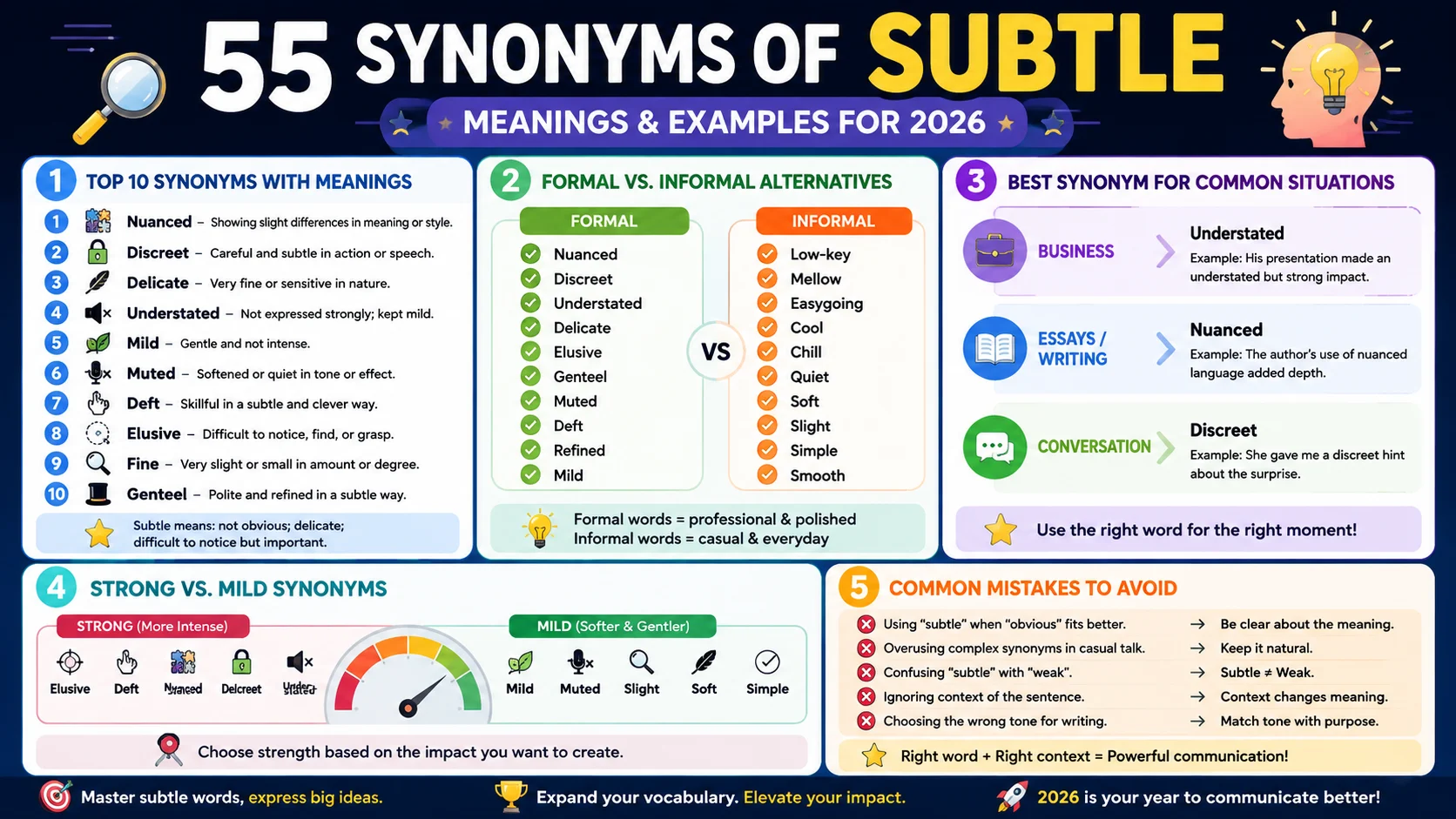
“Subtle” means not obvious, delicate, or difficult to notice. The best synonyms are slight, delicate, faint, understated, and nuanced. “Slight” is the most common alternative. Each synonym has a slightly different meaning and context where it fits best.
Top 10 Synonyms
- Slight
- Delicate
- Faint
- Understated
- Nuanced
- Refined
- Gentle
- Mild
- Soft
- Elegant
“Subtle” is a beautiful word that describes things that are delicate, clever, or not obvious. But using it too often can make your English feel repetitive and dull.
Think about it. You can have a subtle color, a subtle difference, a subtle hint, or a subtle joke. Each situation might need a different word that captures the exact shade of meaning.
In this guide, you’ll learn 35 powerful synonyms for “subtle.” You’ll discover exactly when to use each one, how formal they are, and what common mistakes to avoid. Let’s begin!
What Does “Subtle” Mean?
Definition
Subtle” means something that is not obvious, easy to notice, or direct. It can be delicate, faint, or clever. A subtle thing requires careful attention to perceive. It can describe differences, colors, flavors, comments, or even a person’s way of doing things.
Pronunciation
| Feature | Value |
|---|---|
| US IPA | /ˈsʌtəl/ |
| UK IPA | /ˈsʌtəl/ |
| Syllables | 2 (sub-tle) |
| Tip | The “b” is silent. Say “sut-tle” not “sub-tle.” |
Grammar
| Grammar Feature | Information |
|---|---|
| Part of Speech | Adjective |
| Common Position | Before a noun or after a linking verb |
| Typical Pattern | Subtle + noun / Subject + be + subtle |
Examples:
- “There is a subtle difference between the two colors.”
- “Her criticism was very subtle.”
- “He has a subtle sense of humor.”
Grammar Note: “Subtle” can describe both physical things (colors, flavors) and abstract things (differences, comments).
Word Family
| Word | Part of Speech | Meaning |
|---|---|---|
| Subtle | Adjective | Not obvious, delicate |
| Subtly | Adverb | In a subtle way |
| Subtlety | Noun | The quality of being subtle |
| Subtilty | Noun | Old spelling of subtlety |
15 Synonyms of “Subtle”
Slight
Meaning: Very small in degree, amount, or intensity.
Best Used For: Differences, changes, imperfections.
Formality: Neutral
Tone: Simple, Direct
Frequency: ⭐⭐⭐⭐⭐ (Very Common)
CEFR Level: A2
Example Sentence 1: “There was a slight difference in their opinions.”
Example Sentence 2: “She noticed a slight change in his behavior.”
Usage Tip: “Slight” is the most common and natural synonym. Use it for small differences or changes.
Common Confusion: Slight vs Subtle. “Slight” emphasizes smallness. “Subtle” emphasizes being hard to notice.
Delicate
Meaning: Very fine, fragile, or easily broken; requiring careful handling.
Best Used For: Objects, flavors, matters requiring tact.
Formality: Formal
Tone: Gentle, Refined
Frequency: ⭐⭐⭐⭐ (Common)
CEFR Level: B1
Example Sentence 1: “The delicate flavor of the sauce was perfect.
Example Sentence 2: “This is a delicate matter that needs careful handling.
Usage Tip: “Delicate” emphasizes fragility or fineness. Use it for physical objects or sensitive topics.
Faint
Meaning: Very weak, not strong, or barely perceptible.
Best Used For: Sounds, smells, colors, lights.
Formality: Neutral
Tone: Weak, Barely Noticeable
Frequency: ⭐⭐⭐⭐ (Common)
CEFR Level: B1
Example Sentence 1: “There was a faint smell of roses in the room.”
Example Sentence 2: “He heard a faint sound in the distance.”
Usage Tip: “Faint” is perfect for things that are barely perceptible—sounds, smells, or light.
Understated
Meaning: Presented in a simple, subtle way that is not showy.
Best Used For: Style, design, fashion, art.
Formality: Formal
Tone: Elegant, Refined
Frequency: ⭐⭐⭐ (Moderate)
CEFR Level: B2
Example Sentence 1: “Her understated elegance impressed everyone.
Example Sentence 2: “The design is understated but beautiful.”
Usage Tip: “Understated” is a positive word for something that is elegant and not flashy.
Nuanced
Meaning: Having very small differences or shades of meaning.
Best Used For: Arguments, performances, writing, opinions.
Formality: Formal
Tone: Intellectual, Detailed
Frequency: ⭐⭐⭐ (Moderate)
CEFR Level: C1
Example Sentence 1: “Her nuanced performance captured the character perfectly.”
Example Sentence 2: “The article offers a nuanced view of the situation.”
Usage Tip: “Nuanced” is a sophisticated word for complex, detailed understanding.
Refined
Meaning: Elegant and well-developed; improved by removing impurities.
Best Used For: Taste, manners, language, art.
Formality: Formal
Tone: Sophisticated, Elegant
Frequency: ⭐⭐⭐ (Moderate)
CEFR Level: B2
Example Sentence 1: “He has very refined taste in music.”
Example Sentence 2: “Her refined manners made her popular.”
Usage Tip: “Refined” suggests sophistication and good taste.
Gentle
Meaning: Mild, kind, or moderate; not harsh or severe.
Best Used For: Touch, manner, criticism, sound.
Formality: Neutral
Tone: Kind, Mild
Frequency: ⭐⭐⭐⭐⭐ (Very Common)
CEFR Level: A2
Example Sentence 1: “She gave him a gentle reminder.”
Example Sentence 2: “The gentle breeze cooled the afternoon.”
Usage Tip: “Gentle” emphasizes mildness and kindness. Use it for touches, reminders, or criticism.
Mild
Meaning: Not severe, harsh, or strong; moderate.
Best Used For: Weather, flavors, reactions, criticism.
Formality: Neutral
Tone: Moderate, Calm
Frequency: ⭐⭐⭐⭐⭐ (Very Common)
CEFR Level: A2
Example Sentence 1: “The curry had a mild flavor.”
Example Sentence 2: “He received mild criticism for his work.”
Usage Tip: “Mild” is great for describing things that are not strong or extreme.
Soft
Meaning: Not hard, loud, or harsh; smooth and gentle.
Best Used For: Colors, sounds, lighting, textures.
Formality: Neutral
Tone: Gentle, Pleasant
Frequency: ⭐⭐⭐⭐⭐ (Very Common)
CEFR Level: A2
Example Sentence 1: “The room was decorated in soft colors.”
Example Sentence 2: “There was a soft glow from the lamp.
Usage Tip: “Soft” describes gentle, pleasant things. Use it for colors, light, and textures.
Elegant
Meaning: Graceful and stylish in appearance or manner.
Best Used For: Design, style, solutions, writing.
Formality: Formal
Tone: Stylish, Graceful
Frequency: ⭐⭐⭐⭐ (Common)
CEFR Level: B2
Example Sentence 1: “She wore an elegant dress to the party.”
Example Sentence 2: “His solution was elegant and simple.”
Usage Tip: “Elegant” is a positive word for something beautiful and stylish.
Clever
Meaning: Intelligent, quick-thinking, or skillfully done.
Best Used For: Ideas, solutions, humor, remarks.
Formality: Neutral
Tone: Intelligent, Skillful
Frequency: ⭐⭐⭐⭐⭐ (Very Common)
CEFR Level: B1
Example Sentence 1: “She made a clever remark that made everyone laugh.”
Example Sentence 2: “That was a clever solution to the problem.”
Usage Tip: “Clever” is perfect for subtle humor or intelligent solutions.
Insidious
Meaning: Gradually causing harm in a subtle, unnoticed way.
Best Used For: Dangers, diseases, influences.
Formality: Formal
Tone: Negative, Dangerous
Frequency: ⭐⭐ (Rare)
CEFR Level: C1
Example Sentence 1: “The insidious disease spread without anyone noticing.”
Example Sentence 2: “The insidious influence of media on children is concerning.”
Usage Tip: “Insidious” has a negative meaning. Use it for things that cause harm gradually.
Elusive
Meaning: Difficult to find, catch, or understand.
Best Used For: Answers, memories, feelings, animals.
Formality: Formal
Tone: Mysterious, Hard to Catch
Frequency: ⭐⭐⭐ (Moderate)
CEFR Level: B2
Example Sentence 1: “The answer remained elusive despite hours of searching.”
Example Sentence 2: “She had an elusive memory of the event.”
Usage Tip: “Elusive” describes things that are hard to catch or understand.
Fine
Meaning: Very thin, delicate, or of high quality.
Best Used For: Details, distinctions, textures, taste.
Formality: Neutral
Tone: Detailed, Refined
Frequency: ⭐⭐⭐⭐⭐ (Very Common)
CEFR Level: A2
Example Sentence 1: “There’s a fine line between confidence and arrogance.”
Example Sentence 2: “She has a fine eye for detail.”
Usage Tip: “Fine” is a versatile word for small, delicate distinctions.
Indirect
Meaning: Not done in a direct or straightforward way.
Best Used For: Remarks, criticism, communication.
Formality: Neutral
Tone: Roundabout, Evasive
Frequency: ⭐⭐⭐⭐ (Common)
CEFR Level: B1
Example Sentence 1: “He made an indirect reference to the problem.”
Example Sentence 2: “Her indirect criticism was still hurtful.”
Usage Tip: “Indirect” describes communication that is not straightforward.
Synonyms Comparison Table
| Synonym | Best Context | Formality | Tone | Frequency |
|---|---|---|---|---|
| Slight | Small differences | Neutral | Simple | ⭐⭐⭐⭐⭐ |
| Gentle | Touch, reminders | Neutral | Kind | ⭐⭐⭐⭐⭐ |
| Mild | Weather, flavors | Neutral | Moderate | ⭐⭐⭐⭐⭐ |
| Soft | Colors, sounds | Neutral | Gentle | ⭐⭐⭐⭐⭐ |
| Fine | Details, distinctions | Neutral | Detailed | ⭐⭐⭐⭐⭐ |
| Clever | Humor, solutions | Neutral | Intelligent | ⭐⭐⭐⭐⭐ |
| Delicate | Objects, matters | Formal | Refined | ⭐⭐⭐⭐ |
| Understated | Style, design | Formal | Elegant | ⭐⭐⭐ |
| Nuanced | Arguments, views | Formal | Intellectual | ⭐⭐⭐ |
| Refined | Taste, manners | Formal | Sophisticated | ⭐⭐⭐ |
| Elusive | Answers, memories | Formal | Mysterious | ⭐⭐⭐ |
Best Synonyms by Situation
| Situation | Best Synonym | Why It Works |
|---|---|---|
| Daily Conversation | Slight / Gentle | Natural and common |
| Business Email | Nuanced / Refined | Professional and sophisticated |
| Academic Writing | Nuanced | Formal and precise |
| School Assignment | Slight / Gentle | Clear and appropriate |
| Professional Meeting | Understated | Professional and refined |
| Presentation | Elegant / Refined | Positive and impressive |
| Creative Writing | Elusive / Delicate | Adds literary depth |
| Social Media | Slight / Gentle | Casual and natural |
| Art Criticism | Understated / Nuanced | Sophisticated and precise |
Formal vs Informal Synonyms
Formal Alternatives
| Synonym | Best Used For |
|---|---|
| Nuanced | Academic writing, complex analysis |
| Understated | Design, elegance, style |
| Refined | Taste, manners, sophisticated contexts |
| Delicate | Sensitive matters, fine objects |
| Elusive | Mystery, hard-to-find things |
Neutral Alternatives
| Synonym | Best Used For |
|---|---|
| Slight | Small differences |
| Gentle | Kind, mild actions |
| Mild | Moderation |
| Soft | Gentle sensations |
| Fine | Small distinctions |
Informal Alternatives
| Synonym | Best Used For |
|---|---|
| Clever | Intelligent humor |
| Faint | Barely noticeable |
| Indirect | Roundabout communication |
Choosing the Right Level: Use “nuanced” and “refined” for professional and academic contexts. Use “slight” and “gentle” for everyday situations. Use “clever” with friends.
Strong vs Mild Synonyms
Mild
Suitable for everyday situations with less intensity.
- Slight
- Gentle
- Mild
- Soft
Moderate
More sophisticated or specific alternatives.
- Understated
- Delicate
- Refined
- Faint
Strong
High-intensity alternatives suggesting complexity or mystery.
- Nuanced (deep understanding)
- Elusive (hard to catch)
- Insidious (dangerously subtle)
- Intricate (complex and detailed)
How Intensity Changes Meaning: “A slight difference” is simple. “A nuanced difference” sounds much more sophisticated. Choose stronger words when you want to emphasize depth or complexity.
Real-Life Examples
School: “There was a slight difference between the two answers.”
Office: “Her understated leadership style is very effective.”
Business Email: “We need a nuanced approach to this problem.”
Meetings: “The subtle changes in the market went unnoticed.”
Presentations: “This is a delicate matter that requires care.”
Daily Conversations: “I noticed a faint smell of coffee in the kitchen.”
Social Media: “His clever comment made everyone laugh.”
Academic Writing: “A nuanced understanding of the issue is essential.”
Common Collocations
| Common Phrase | Better Alternative |
|---|---|
| Subtle difference | Slight difference |
| Subtle hint | Gentle hint |
| Subtle change | Nuanced change |
| Subtle flavor | Delicate flavor |
| Subtle criticism | Understated criticism |
| Subtle joke | Clever joke |
Common Phrases
A fine line: A subtle distinction. (e.g., “There’s a fine line between love and obsession.”)
In a nutshell: In a very brief way. (e.g., “To put it in a nutshell, it was a disaster.”)
Under the radar: Unnoticed. (e.g., “The change went under the radar.”)
A delicate balance: A situation requiring careful handling. (e.g., “The ecosystem has a delicate balance.”)
A mild manner: A gentle, calm way of behaving. (e.g., “He has a mild manner.”)
Context Guide
| Situation | Best Synonym | Reason |
|---|---|---|
| Essay | Nuanced | Academic and precise |
| Speech | Understated | Elegant and powerful |
| Business Email | Refined | Professional and polished |
| Novel | Elusive / Insidious | Adds literary depth |
| Presentation | Elegant / Nuanced | Sophisticated and impressive |
| Conversation | Slight / Gentle | Natural and relatable |
| Academic Writing | Nuanced | Precise and intellectual |
| Art Review | Understated / Nuanced | Sophisticated and precise |
Related Words
Near Synonyms
- Perceptive: Having or showing insight.
- Tactful: Showing sensitivity in dealing with others.
- Diplomatic: Skilled in dealing with people.
- Discreet: Careful and cautious in what you say.
- Subtle (itself): The quality we’re exploring.
Antonyms
- Obvious: Easy to see or understand.
- Blatant: Completely obvious and offensive.
- Glaring: Extremely obvious.
- Striking: Clearly noticeable.
- Gross: Obvious and unacceptable.
Related Adjectives
- Perceptive: Quick to notice things.
- Tactful: Showing sensitivity.
- Diplomatic: Skilled in dealing with others.
- Discreet: Careful and cautious.
- Insightful: Showing good understanding.
Related Nouns
- Subtlety: The quality of being subtle.
- Nuance: A small difference or shade of meaning.
- Refinement: Elegance and sophistication.
- Elegance: Graceful and stylish quality.
- Delicacy: Fineness or fragility.
Related Verbs
- Hint: To suggest indirectly.
- Imply: To suggest without saying directly.
- Insinuate: To suggest indirectly (often negative).
- Allude: To refer to indirectly.
- Convey: To communicate indirectly.
Frequently Asked Questions
What is another word for subtle?
Common synonyms include slight, delicate, faint, understated, nuanced, and refined. “Slight” is the most common and direct alternative.
Which synonym sounds the most professional?
Nuanced and refined sound very professional. “Understated” is excellent for design and style contexts.
What is the strongest synonym for subtle?
Nuanced is one of the strongest, suggesting deep, complex understanding. “Elusive” is strong for hard-to-find things.
Which synonym is best for essays?
Nuanced is the best choice for academic essays. It suggests sophisticated, detailed understanding.
What’s the difference between subtle and slight?
“Slight” emphasizes smallness in degree. “Subtle” emphasizes being hard to notice. You can have a slight difference (small) or a subtle difference (hard to notice).
Which synonym is most common in everyday English?
“Slight,” “gentle,” and “mild” are the most common in everyday speech.
What is the opposite of subtle?
Common opposites are obvious, blatant, glaring, and striking. These words describe things that are easy to notice.
Conclusion
“Subtle” is a wonderful word, but now you have 35 fantastic alternatives. Each synonym adds a different shade of meaning to your language.
Remember, the key is understanding the context. Use “slight” for small differences. Use “delicate” for fragile or sensitive things. Use “nuanced” for complex understanding. Use “understated” for elegant style. Use “gentle” for kind, mild actions.
The best way to improve is practice. Try using one or two new synonyms each day. Listen for these words in conversations and books. Your vocabulary will become richer and more precise with time.
