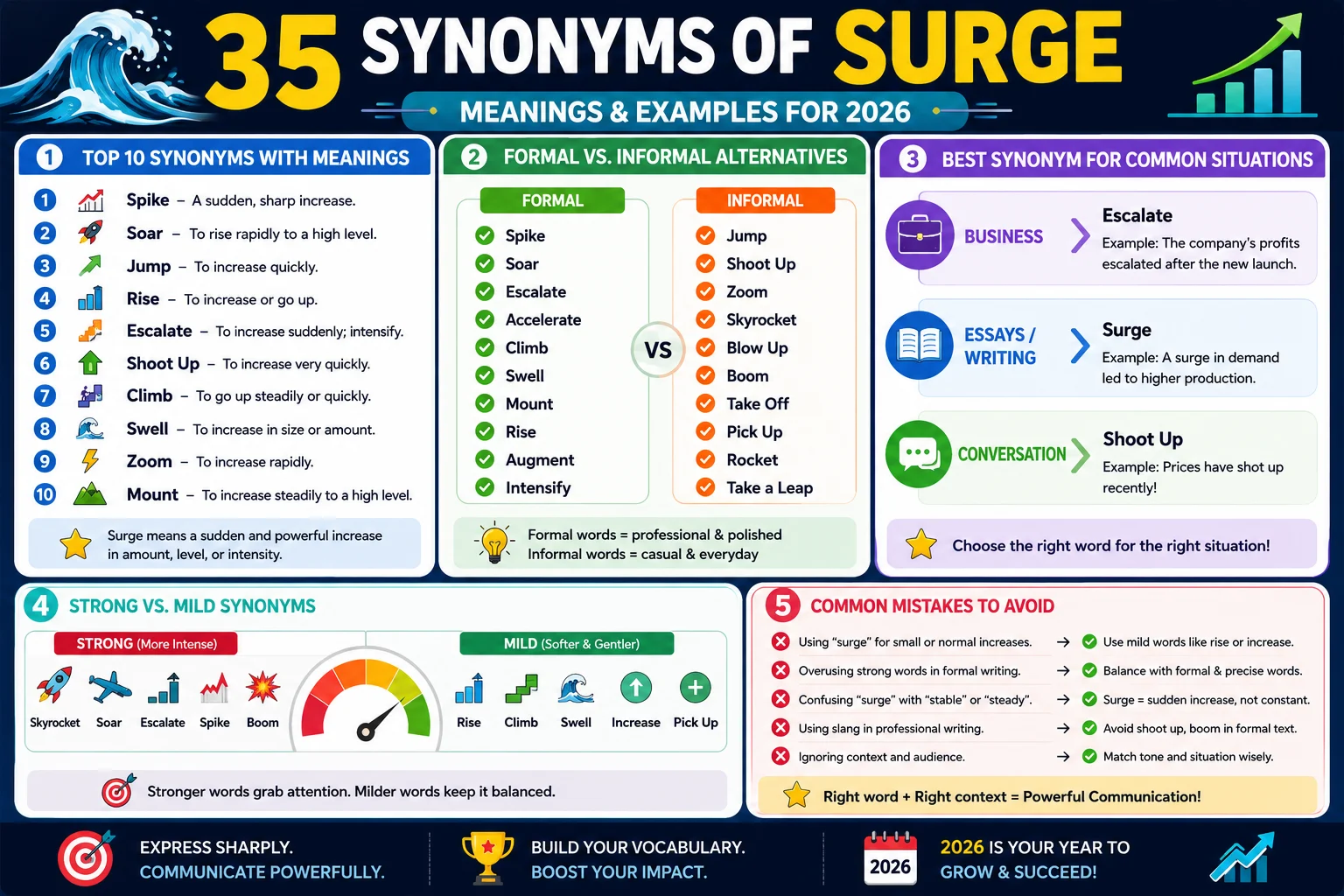
“Surge” means a sudden, powerful increase or movement forward. The best synonyms are rush, wave, flood, upsurge, and spike. “Rush” is the most common natural alternative. Each synonym has a slightly different meaning and context where it fits best.
Top 10 Synonyms
- Rush
- Wave
- Flood
- Upsurge
- Spike
- Increase
- Flow
- Stream
- Swell
- Onslaught
“Surge” is a powerful word. It describes something rising or moving forward quickly and with force. Whether it’s electricity, emotions, crowds, or prices, a surge is always sudden and strong. But using it too often can make your English feel repetitive.
Think about it. A surge of energy, a surge of water, a surge of people, or a surge of emotion. Each situation might need a different word that captures the exact type of movement or increase.
In this guide, you’ll learn 35 powerful synonyms for “surge.” You’ll discover exactly when to use each one, how formal they are, and what common mistakes to avoid. Let’s begin!
What Does “Surge” Mean?
Definition
Surge” means a sudden, powerful increase or forward movement. It can be physical, like a wave of water rushing forward. It can also be figurative, like a sudden increase in prices, emotions, or energy. When something surges, it rises quickly and with force.
Pronunciation
| Feature | Value |
|---|---|
| US IPA | /sɜrdʒ/ |
| UK IPA | /sɜːdʒ/ |
| Syllables | 1 |
| Tip | Rhymes with “urge” and “purge” |
Grammar
| Grammar Feature | Information |
|---|---|
| Part of Speech | Verb and Noun |
| Common Position | Subject (noun) or after subject (verb) |
| Typical Pattern | Surge + of + something / Surge + forward/up |
Examples:
- “A surge of emotion washed over her.” (noun)
- “The crowd surged forward.” (verb)
- “Prices surged dramatically.” (verb)
Grammar Note: “Surge” works as both a noun and a verb. As a noun, it often follows “a surge of.” As a verb, it describes the action of moving or increasing suddenly.
Word Family
| Word | Part of Speech | Meaning |
|---|---|---|
| Surge | Verb/Noun | To rise or move suddenly and powerfully |
| Surging | Gerund/Adjective | The act of surging |
| Surged | Verb (past) | Moved or rose suddenly |
15 Synonyms of “Surge”
Rush
Meaning: A sudden, quick movement or flow of people or things.
Best Used For: Crowds, emotions, physical movement.
Formality: Neutral
Tone: Quick, Energetic
Frequency: ⭐⭐⭐⭐⭐ (Very Common)
CEFR Level: A2
Example Sentence 1: “A rush of adrenaline helped him escape.”
Example Sentence 2: “There was a rush of people toward the exit.”
Usage Tip: “Rush” is the most common and direct synonym for a quick, powerful movement or flow.
Wave
Meaning: A sudden increase or movement of something, often occurring in a series.
Best Used For: Emotions, crime, protests, weather.
Formality: Neutral
Tone: Flowing, Powerful
Frequency: ⭐⭐⭐⭐⭐ (Very Common)
CEFR Level: A2
Example Sentence 1: “A wave of anger swept through the crowd.”
Example Sentence 2: “There’s been a wave of new cases recently.”
Usage Tip: “Wave” suggests something coming in a series or sweeping over an area. It’s very versatile.
Flood
Meaning: A large amount or sudden arrival of something.
Best Used For: Water, emotions, people, information.
Formality: Neutral
Tone: Overwhelming, Powerful
Frequency: ⭐⭐⭐⭐ (Common)
CEFR Level: B1
Example Sentence 1: “A flood of letters arrived at the office.”
Example Sentence 2: “She felt a flood of relief.”
Usage Tip: “Flood” suggests a large, overwhelming amount. It’s more intense than “surge.”
Upsurge
Meaning: A sudden, significant increase.
Best Used For: Data, statistics, trends, emotions.
Formality: Formal
Tone: Analytical, Professional
Frequency: ⭐⭐⭐ (Moderate)
CEFR Level: B2
Example Sentence 1: “There has been an upsurge in online sales.”
Example Sentence 2: “An upsurge of support followed his speech.”
Usage Tip: “Upsurge” is a formal word for a sudden increase. Use it in business or academic writing.
Spike
Meaning: A sudden, sharp increase, often followed by a decrease.
Best Used For: Charts, data, graphs, electricity.
Formality: Neutral
Tone: Technical, Sharp
Frequency: ⭐⭐⭐⭐ (Common)
CEFR Level: B2
Example Sentence 1: “The graph showed a spike in sales.”
Example Sentence 2: “Prices spiked last month.”
Usage Tip: “Spike” is great for data and charts. It suggests a sharp, noticeable increase.
Increase
Meaning: A rise in size, amount, or degree.
Best Used For: General growth, numbers, statistics.
Formality: Neutral
Tone: Neutral, Factual
Frequency: ⭐⭐⭐⭐⭐ (Very Common)
CEFR Level: A2
Example Sentence 1: “There was a sudden increase in attendance.”
Example Sentence 2: “We saw an increase in customers this month.
Usage Tip: “Increase” is the most neutral alternative. Use it when you need a general word for something getting bigger.
Flow
Meaning: A steady, continuous movement of something.
Best Used For: Water, traffic, ideas, time.
Formality: Neutral
Tone: Smooth, Steady
Frequency: ⭐⭐⭐⭐ (Common)
CEFR Level: B1
Example Sentence 1: “A steady flow of visitors arrived all day.”
Example Sentence 2: “The flow of information was constant.”
Usage Tip: “Flow” suggests a continuous, often smooth movement. It’s less sudden than “surge.”
Stream
Meaning: A continuous flow of people or things.
Best Used For: People, traffic, data.
Formality: Neutral
Tone: Continuous, Flowing
Frequency: ⭐⭐⭐⭐ (Common)
CEFR Level: B1
Example Sentence 1: “A stream of people entered the building.”
Example Sentence 2: “She watched the stream of cars on the highway.”
Usage Tip: “Stream” is like “flow” but often used for people, vehicles, or data.
Swell
Meaning: A gradual or sudden increase in size or force.
Best Used For: Water, emotions, crowds, pride.
Formality: Neutral
Tone: Building, Powerful
Frequency: ⭐⭐⭐ (Moderate)
CEFR Level: B2
Example Sentence 1: “A swell of pride filled his heart.”
Example Sentence 2: “The crowd began to swell.”
Usage Tip: “Swell” suggests something growing in size or force, often with a feeling of power.
Onslaught
Meaning: A powerful, overwhelming attack or arrival of something.
Best Used For: Negative events, criticism, attacks.
Formality: Formal
Tone: Negative, Overwhelming
Frequency: ⭐⭐ (Rare)
CEFR Level: C1
Example Sentence 1: “The company faced an onslaught of criticism.”
Example Sentence 2: “The city was unprepared for the onslaught of tourists.”
Usage Tip: “Onslaught” has a negative tone. Use it for overwhelming, often unwanted, events.
Cascade
Meaning: A large amount of something that falls or flows, often in stages.
Best Used For: Water, events, information.
Formality: Formal
Tone: Flowing, Stepped
Frequency: ⭐⭐ (Rare)
CEFR Level: C1
Example Sentence 1: “A cascade of water fell from the cliff.”
Example Sentence 2: “An unexpected cascade of events followed.
Usage Tip: “Cascade” suggests a layered, flowing movement. It’s a beautiful, descriptive word.
Influx
Meaning: A large flow of people or things into a place.
Best Used For: People, goods, money.
Formality: Formal
Tone: Incoming, Flowing
Frequency: ⭐⭐⭐ (Moderate)
CEFR Level: B2
Example Sentence 1: “The city experienced an influx of tourists.”
Example Sentence 2: “There was an influx of new ideas.”
Usage Tip: “Influx” emphasizes arrival. Use it when something is flowing into a place or system.
Surfeit
Meaning: An excessive amount of something.
Best Used For: Negative contexts, excess.
Formality: Formal
Tone: Negative, Excess
Frequency: ⭐ (Very Rare)
CEFR Level: C1
Example Sentence 1: “A surfeit of information overwhelmed her.”
Example Sentence 2: “There was a surfeit of complaints.”
Usage Tip: “Surfeit” means too much of something. It has a negative tone and is very formal.
Deluge
Meaning: A sudden, huge flow of something.
Best Used For: Water, challenges, obligations.
Formality: Formal
Tone: Overwhelming
Frequency: ⭐⭐ (Rare)
CEFR Level: C1
Example Sentence 1: “A deluge of rain flooded the streets.”
Example Sentence 2: “She faced a deluge of emails after the announcement.”
Usage Tip: “Deluge” suggests an overwhelming amount, often of water or work.
Charge
Meaning: A forward movement with power and speed.
Best Used For: Military, crowds, electricity.
Formality: Neutral
Tone: Powerful, Forward
Frequency: ⭐⭐⭐ (Moderate)
CEFR Level: B2
Example Sentence 1: “The soldiers made a sudden charge forward.”
Example Sentence 2: “A charge of excitement ran through the crowd.”
Usage Tip: “Charge” suggests a forceful, fast forward movement, often in military or athletic contexts.
Synonyms Comparison Table
| Synonym | Best Context | Formality | Tone | Frequency |
|---|---|---|---|---|
| Rush | Quick movement | Neutral | Energetic | ⭐⭐⭐⭐⭐ |
| Wave | Emotions, events | Neutral | Flowing | ⭐⭐⭐⭐⭐ |
| Increase | General growth | Neutral | Factual | ⭐⭐⭐⭐⭐ |
| Flood | Overwhelming amount | Neutral | Intense | ⭐⭐⭐⭐ |
| Spike | Data, charts | Neutral | Sharp | ⭐⭐⭐⭐ |
| Flow | Steady movement | Neutral | Smooth | ⭐⭐⭐⭐ |
| Stream | People, data | Neutral | Continuous | ⭐⭐⭐⭐ |
| Upsurge | Sudden increase | Formal | Professional | ⭐⭐⭐ |
| Swell | Growing force | Neutral | Building | ⭐⭐⭐ |
| Influx | Incoming flow | Formal | Arrival | ⭐⭐⭐ |
Best Synonyms by Situation
| Situation | Best Synonym | Why It Works |
|---|---|---|
| Daily Conversation | Rush | Natural and common |
| Business Email | Upsurge | Professional and precise |
| Academic Writing | Upsurge | Formal and analytical |
| School Assignment | Increase | Clear and factual |
| Professional Meeting | Spike | Technical and sharp |
| Presentation | Wave | Visual and clear |
| Creative Writing | Swell | Adds depth and feeling |
| Social Media | Rush | Casual and energetic |
| Data Analysis | Spike | Precise and technical |
Formal vs Informal Synonyms
Formal Alternatives
| Synonym | Best Used For |
|---|---|
| Upsurge | Statistical increases |
| Influx | Incoming flows of people or goods |
| Surfeit | Excessive amounts |
| Deluge | Overwhelming flow |
| Onslaught | Negative attacks or criticism |
Neutral Alternatives
| Synonym | Best Used For |
|---|---|
| Rush | Quick movement |
| Wave | Flowing events |
| Increase | General growth |
| Flow | Steady movement |
| Stream | Continuous flow |
Informal Alternatives
| Synonym | Best Used For |
|---|---|
| Spike | Sharp increases |
| Flood | Overwhelming amounts |
| Charge | Forceful movement |
Choosing the Right Level: Use “upsurge” and “influx” for professional contexts. Use “rush” and “wave” for everyday situations. Use “deluge” and “onslaught” for dramatic, formal writing.
Strong vs Mild Synonyms
Mild
Suitable for everyday situations with less intensity.
- Increase
- Flow
- Stream
Moderate
More forceful or noticeable alternatives.
- Rush
- Wave
- Upsurge
- Spike
Strong
High-intensity alternatives suggesting overwhelming force.
- Flood (overwhelming)
- Onslaught (powerful attack)
- Deluge (huge flow)
- Surfeit (excessive amount)
How Intensity Changes Meaning: “There was an increase” is mild. “There was a flood” is overwhelming. Choose stronger words when you want to emphasize intensity or excess.
Real-Life Examples
School: “There was a surge of interest in the science fair.”
Office: “We saw an upsurge in online sales this quarter.”
Business Email: “There has been a spike in customer complaints.”
Meetings: “A flood of new ideas came from the brainstorming session.”
Presentations: “The graph shows a wave of growth over the last year.”
Daily Conversations: “I felt a rush of energy after drinking coffee.”
Social Media: “There’s been a surge of support for the campaign.”
Academic Writing: “The data shows an upsurge in population growth.”
Common Collocations
| Common Phrase | Better Alternative |
|---|---|
| Surge of emotion | Wave of emotion |
| Surge in prices | Spike in prices |
| Surge of energy | Rush of energy |
| Surge of water | Flood of water |
| Surge of support | Wave of support |
Common Phrases
Rush of blood: A sudden strong emotion. (e.g., “He got a rush of blood and did something uninformed.”)
Wave of the future: A powerful new trend. (e.g., “This technology is the wave of the future.”)
Flood of tears: A lot of crying. (e.g., “She broke into a flood of tears.”)
In the flow: In a state of complete focus. (e.g., “I was in the flow and got a lot done.”)
Ride the wave: To go along with a trend. (e.g., “You need to ride the wave of change.”)
Context Guide
| Situation | Best Synonym | Reason |
|---|---|---|
| Essay | Upsurge | Academic and formal |
| Speech | Wave | Inspiring and visual |
| Business Email | Spike | Professional and precise |
| Novel | Swell | Adds literary depth |
| Presentation | Upsurge | Formal and clear |
| Conversation | Rush | Natural and relatable |
| Academic Writing | Upsurge | Precise and formal |
| Marketing Copy | Wave | Engaging and visual |
Related Words
Near Synonyms
- Tide: A powerful, rising force. (e.g., “The tide of public opinion shifted.”)
- Torrent: A strong, rushing flow. (e.g., “A torrent of rain fell.”)
- Outpouring: A large, sudden expression. (e.g., “An outpouring of grief followed.”)
- Boom: A sudden period of growth. (e.g., “The economy experienced a boom.”)
Antonyms
- Decline: A decrease.
- Trickle: A small, slow flow.
- Drip: A slow, small drop.
- Ebb: To decrease or recede.
- Dwindle: To become smaller.
Related Adjectives
- Swift: Quick and fast.
- Powerful: Having great force.
- Sudden: Happening unexpectedly.
- Sharp: Having a sudden increase (for data).
- Abrupt: Sudden and unexpected.
Related Nouns
- Increase: A rise in something.
- Flow: A steady movement.
- Movement: A change of position.
- Swell: A growth in size.
- Wave: A moving force.
Related Verbs
- Rush: To move quickly.
- Flow: To move steadily.
- Swell: To grow in size.
- Spike: To increase sharply.
- Rise: To go upward.
Frequently Asked Questions
What is another word for surge?
Common synonyms include rush, wave, flood, upsurge, spike, increase, and flow. “Rush” is the most common and direct alternative.
Which synonym sounds the most professional?
Upsurge and spike sound professional. “Upsurge” is excellent for business and academic contexts. “Spike” is great for data analysis.
What is the strongest synonym for surge?
Flood and deluge are among the strongest synonyms. They suggest overwhelming amounts. “Onslaught” is also strong but has negative connotations.
Which synonym is best for essays?
Upsurge is the best choice for academic essays. It’s formal and precise.
What’s the difference between surge and spike?
“Surge” is broader and suggests a general, powerful increase. “Spike” is more specific to data and charts, suggesting a sharp, pointed increase.
Which synonym is most common in everyday English?
“Rush” and “wave” are very common in everyday speech. “Increase” is also frequently used.
What is the opposite of surge?
Common opposites are decline, decrease, and trickle. These words describe a reduction or small flow.
Conclusion
“Surge” is a powerful and useful word, but now you have 35 fantastic alternatives. Each synonym adds a different shade of meaning to your language.
Remember, the key is understanding the context. Use “rush” for quick movement. Use “wave” for emotions and events. Use “spike” for data and charts. Use “upsurge” for professional contexts. Use “flood” for overwhelming amounts.
The best way to improve is practice. Try using one or two new synonyms each day. Listen for these words in conversations and books. Your vocabulary will become richer and more expressive with time.
