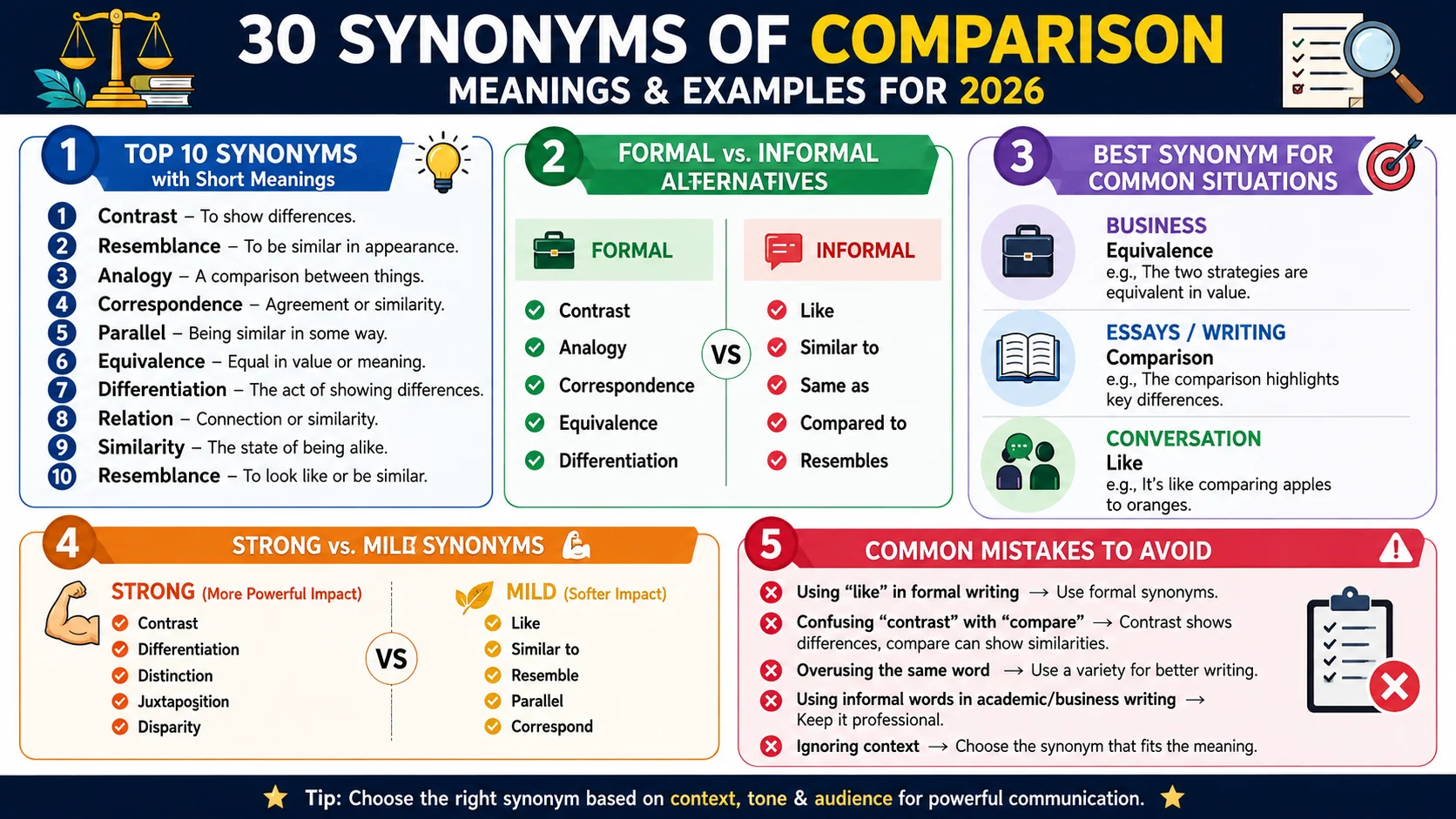
“Comparison” means examining how things are similar or different. The best synonyms are contrast, likeness, parallel, resemblance, and analogy. “Contrast” is the most common alternative. Each synonym has a slightly different meaning and context.
Top 10 Synonyms
- Contrast
- Likeness
- Parallel
- Resemblance
- Analogy
- Similarity
- Comparison
- Correlation
- Distinction
- Equality
“Comparison” is a word we use constantly. We compare prices, compare ideas, compare people, and compare products. It’s incredibly useful, but using it too often can make your English feel repetitive.
Think about it. You compare two options before buying. You compare your work to others. You compare your progress to your goals. Each situation might need a different word that captures the specific type of comparison.
In this guide, you’ll learn 35 powerful synonyms for “comparison.” You’ll discover exactly when to use each one, how formal they are, and what common mistakes to avoid. Let’s begin!
What Does “Comparison” Mean?
Definition
Comparison” means examining two or more things to see how they are similar or different. It’s about looking at things side by side. When you compare, you notice what’s the same and what’s different. It helps you make decisions, understand things better, and evaluate quality.
Pronunciation
| Feature | Value |
|---|---|
| US IPA | /kəmˈpærəsən/ |
| UK IPA | /kəmˈpærɪsən/ |
| Syllables | 4 (com-par-i-son) |
| Tip | Stress the second syllable: “kum-PAIR-ih-sun” |
Grammar
| Grammar Feature | Information |
|---|---|
| Part of Speech | Noun |
| Common Position | Subject or object |
| Typical Pattern | Comparison + between/of + things |
Examples:
- “The comparison between the two products was interesting.” (between)
- “She made a comparison of the two methods.” (of)
- “There’s no comparison between them.” (no comparison)
Grammar Note: “Comparison” is usually used with “between” when comparing two things directly, or “of” when describing the act.
Word Family
| Word | Part of Speech | Meaning |
|---|---|---|
| Compare | Verb | To examine similarities and differences |
| Comparison | Noun | The act of comparing |
| Comparable | Adjective | Similar enough to be compared |
| Comparative | Adjective | Based on comparison |
| Comparatively | Adverb | In a comparative way |
15 Synonyms of “Comparison”
Contrast
Meaning: The act of comparing to show differences.
Best Used For: Showing differences, opposites, clear distinctions.
Formality: Neutral
Tone: Analytical, Distinctive
Frequency: ⭐⭐⭐⭐⭐ (Very Common)
CEFR Level: B1
Example Sentence 1: “The contrast between the two paintings was striking.”
Example Sentence 2: “Her speech was a stark contrast to his.”
Usage Tip: “Contrast” focuses on differences. Use it when you want to highlight how things are not alike.
Common Confusion: Comparison vs Contrast. “Comparison” can include both similarities and differences. “Contrast” specifically focuses on differences.
Likeness
Meaning: The quality of being similar to something else.
Best Used For: Appearance, character, family resemblance.
Formality: Neutral
Tone: Similar, Resembling
Frequency: ⭐⭐⭐ (Moderate)
CEFR Level: B2
Example Sentence 1: “There’s a strong likeness between the two sisters.”
Example Sentence 2: “The statue bears a striking likeness to the famous actor.”
Usage Tip: “Likeness” emphasizes similarity in appearance or character. It’s often used for people or art.
Parallel
Meaning: A similarity or relationship between two things.
Best Used For: Stories, events, arguments, historical patterns.
Formality: Formal
Tone: Analytical, Connected
Frequency: ⭐⭐⭐ (Moderate)
CEFR Level: B2
Example Sentence 1: “There are interesting parallels between the two novels.
Example Sentence 2: “Historians see parallels between the two periods.”
Usage Tip: “Parallel” suggests a strong similarity that runs alongside each other. Use it for analytical comparisons.
Resemblance
Meaning: The state of being similar to someone or something.
Best Used For: Physical appearance, family traits, close similarities.
Formality: Neutral
Tone: Similar, Close
Frequency: ⭐⭐⭐ (Moderate)
CEFR Level: B2
Example Sentence 1: “She bears a striking resemblance to her mother.”
Example Sentence 2: “The resemblance between the two cars is uncanny.”
Usage Tip: “Resemblance” is often used for physical similarity. “Striking resemblance” is a common phrase.
Analogy
Meaning: A comparison that explains something by showing how it’s similar to something else.
Best Used For: Explaining complex ideas, teaching, arguments.
Formality: Formal
Tone: Explanatory, Logical
Frequency: ⭐⭐⭐ (Moderate)
CEFR Level: C1
Example Sentence 1: “The teacher used an analogy to explain the concept.”
Example Sentence 2: “The analogy between a computer and the human brain is helpful.”
Usage Tip: “Analogy” is used to explain or persuade. You’re not just comparing—you’re using the comparison to teach something.
Similarity
Meaning: The state of being similar or having features in common.
Best Used For: General similarities, shared features.
Formality: Neutral
Tone: Factual, Clear
Frequency: ⭐⭐⭐⭐⭐ (Very Common)
CEFR Level: B1
Example Sentence 1: “There are many similarities between the two cultures.”
Example Sentence 2: “The similarity of their opinions surprised me.
Usage Tip: “Similarity” is the direct opposite of “difference.” It’s very common and straightforward.
Correlation
Meaning: A connection or relationship between two or more things.
Best Used For: Statistics, research, data analysis.
Formality: Formal
Tone: Scientific, Analytical
Frequency: ⭐⭐⭐ (Moderate)
CEFR Level: C1
Example Sentence 1: “There is a strong correlation between exercise and health.”
Example Sentence 2: “The study found a correlation between income and education.”
Usage Tip: “Correlation” is a formal, scientific word. Use it for data and research contexts.
Distinction
Meaning: A difference or contrast between similar things.
Best Used For: Quality, excellence, clear differences.
Formality: Formal
Tone: Clear, Defining
Frequency: ⭐⭐⭐⭐ (Common)
CEFR Level: B2
Example Sentence 1: “There is a clear distinction between the two products.”
Example Sentence 2: “She made a distinction between fact and opinion.”
Usage Tip: “Distinction” can mean a clear difference or a mark of excellence. Use it for highlighting important differences.
Equality
Meaning: The state of being equal in value, status, or amount.
Best Used For: Rights, opportunities, fairness.
Formality: Formal
Tone: Fair, Balanced
Frequency: ⭐⭐⭐⭐ (Common)
CEFR Level: B1
Example Sentence 1: “They fought for equality between men and women.”
Example Sentence 2: “The goal is equality of opportunity for all.
Usage Tip: “Equality” emphasizes sameness in value, status, or rights. It’s often used in social and political contexts.
Balance
Meaning: A situation where things are equal or in the right proportion.
Best Used For: Life, work, relationships, harmony.
Formality: Neutral
Tone: Harmonious, Fair
Frequency: ⭐⭐⭐⭐⭐ (Very Common)
CEFR Level: B1
Example Sentence 1: “She tries to maintain a balance between work and family.”
Example Sentence 2: “The balance of power has shifted.
Usage Tip: “Balance” suggests a fair or harmonious comparison where things are equally weighted.
Affinity
Meaning: A natural liking or similarity between people or things.
Best Used For: Personal connections, tastes, shared interests.
Formality: Formal
Tone: Connected, Natural
Frequency: ⭐⭐⭐ (Moderate)
CEFR Level: C1
Example Sentence 1: “He has a natural affinity for music.”
Example Sentence 2: “There is an affinity between the two artists.”
Usage Tip: “Affinity” suggests a natural connection or similarity that feels effortless.
Metaphor
Meaning: A figure of speech that compares something to something else.
Best Used For: Literature, poetry, creative writing.
Formality: Formal
Tone: Literary, Creative
Frequency: ⭐⭐⭐ (Moderate)
CEFR Level: B2
Example Sentence 1: “The poem is filled with powerful metaphors.”
Example Sentence 2: “She used a metaphor to describe her feelings.”
Usage Tip: “Metaphor” is a literary term. Use it when comparing through imaginative language.
Relative
meaning: Something whose meaning depends on comparison with something else.
Best Used For: Measurements, evaluations, context.
Formality: Neutral
Tone: Contextual, Comparative
Frequency: ⭐⭐⭐ (Moderate)
CEFR Level: B2
Example Sentence 1: “Success is relative to your goals.”
Example Sentence 2: “The price is reasonable relative to the quality.”
Usage Tip: “Relative” emphasizes that something only has meaning when compared to something else.
Juxtaposition
Meaning: The act of placing things side by side for comparison.
Best Used For: Art, design, literature.
Formality: Formal
Tone: Artistic, Analytical
Frequency: ⭐ (Very Rare)
CEFR Level: C1
Example Sentence 1: “The painting shows the juxtaposition of light and darkness.”
Example Sentence 2: “The juxtaposition of the two characters is striking.”
Usage Tip: “Juxtaposition” is a sophisticated word for placing things together to highlight differences or similarities.
Homology
Meaning: Similarity due to shared origin.
Best Used For: Biology, evolution, scientific contexts.
Formality: Very Formal
Tone: Scientific, Technical
Frequency: ⭐ (Very Rare)
CEFR Level: C1
Example Sentence 1: “There is homology between the bones of different animals.”
Example Sentence 2: “The homology of the two species is evident.”
Usage Tip: “Homology” is a technical scientific term. Use it only in biology or evolution contexts.
Synonyms Comparison Table
| Synonym | Best Context | Formality | Tone | Frequency |
|---|---|---|---|---|
| Similarity | General similarities | Neutral | Factual | ⭐⭐⭐⭐⭐ |
| Balance | Harmony, fairness | Neutral | Harmonious | ⭐⭐⭐⭐⭐ |
| Contrast | Showing differences | Neutral | Analytical | ⭐⭐⭐⭐⭐ |
| Distinction | Clear differences | Formal | Clear | ⭐⭐⭐⭐ |
| Likeness | Physical similarity | Neutral | Similar | ⭐⭐⭐ |
| Parallel | Analytical comparisons | Formal | Connected | ⭐⭐⭐ |
| Analogy | Explaining concepts | Formal | Logical | ⭐⭐⭐ |
| Correlation | Data, research | Formal | Scientific | ⭐⭐⭐ |
| Affinity | Natural connections | Formal | Connected | ⭐⭐⭐ |
| Juxtaposition | Art, literature | Formal | Artistic | ⭐ |
Best Synonyms by Situation
| Situation | Best Synonym | Why It Works |
|---|---|---|
| Daily Conversation | Similarity | Natural and common |
| Business Email | Comparison | Professional and clear |
| Academic Writing | Correlation | Formal and precise |
| School Assignment | Contrast | Shows analytical thinking |
| Professional Meeting | Parallel | Sophisticated and thoughtful |
| Presentation | Analogy | Helps explain complex ideas |
| Creative Writing | Juxtaposition | Adds literary depth |
| Social Media | Likeness | Casual and relatable |
| Science Writing | Correlation | Technical and accurate |
Formal vs Informal Synonyms
Formal Alternatives
| Synonym | Best Used For |
|---|---|
| Correlation | Research, data, scientific writing |
| Analogy | Explanations, teaching |
| Juxtaposition | Art, literature, criticism |
| Affinity | Connections, relationships |
| Homology | Biology, evolution |
Neutral Alternatives
| Synonym | Best Used For |
|---|---|
| Similarity | Most general situations |
| Contrast | Showing differences |
| Distinction | Clear differences |
| Likeness | Physical similarity |
Informal Alternatives
| Synonym | Best Used For |
|---|---|
| Comparison | General use |
| Balance | Everyday life |
| Parallel | Casual comparison |
Choosing the Right Level: Use “correlation” and “analogy” for formal writing. Use “similarity” and “contrast” for most situations. Use “likeness” and “balance” for everyday contexts.
Strong vs Mild Synonyms
Mild
Suitable for everyday situations with less intensity.
- Likeness
- Similarity
- Comparison
Moderate
More analytical or specific alternatives.
- Contrast
- Parallel
- Distinction
- Balance
Strong
High-intensity alternatives suggesting deep analysis.
- Correlation (statistical connection)
- Juxtaposition (artistic comparison)
- Analogy (explanatory comparison)
- Homology (scientific similarity)
How Intensity Changes Meaning: “There is a likeness” is mild. “There is a striking juxtaposition” is strong. Choose stronger words when you want to emphasize the depth or importance of the comparison.
Real-Life Examples
School: “The teacher asked us to write a comparison of the two poems.”
Office: “The report shows a strong correlation between sales and advertising.”
Business Email: “We need to make a contrast between the two approaches.”
Meetings: “There’s an interesting parallel between our two companies.”
Presentations: “I’ll use an analogy to help explain this complex idea.”
Daily Conversations: “There’s a striking likeness between you and your sister.”
Social Media: “The balance between work and life is so important.”
Academic Writing: “The juxtaposition of these two theories reveals their differences.”
Common Collocations
| Common Phrase | Better Alternative |
|---|---|
| Comparison between | Contrast between |
| Make a comparison | Draw a comparison |
| In comparison to | In contrast to |
| Comparison chart | Comparison table |
| Comparison shopping | Price comparison |
Common Phrases
In comparison: When considered against something. (e.g., “In comparison, the second option is better.”)
Beyond compare: So good nothing can compare. (e.g., “Her beauty is beyond compare.”)
Draw a parallel: To note similarities. (e.g., “I draw a parallel between the two situations.”)
As compared to: When making a comparison. (e.g., “Sales increased as compared to last year.”)
There’s no comparison: One is much better. (e.g., “There’s no comparison between the two cars.”)
Pale in comparison: To seem less important. (e.g., “My achievements pale in comparison to hers.”)
Context Guide
| Situation | Best Synonym | Reason |
|---|---|---|
| Essay | Analogy | Academic and explanatory |
| Speech | Parallel | Thoughtful and inspiring |
| Business Email | Comparison | Professional and clear |
| Novel | Juxtaposition | Adds literary depth |
| Presentation | Analogy | Helps explain complex ideas |
| Conversation | Similarity | Natural and relatable |
| Academic Writing | Correlation | Precise and analytical |
| Marketing Copy | Distinction | Highlights uniqueness |
Related Words
Near Synonyms
- Relation: A connection between things.
- Interrelation: A mutual connection.
- Proportion: A comparative relation.
- Ratio: A numerical comparison.
- Correspondence: A similarity or connection.
Antonyms
- Difference: The state of being different.
- Disparity: A great difference.
- Contrast: Difference (when used as a noun).
- Divergence: Moving apart.
- Dissonance: Lack of harmony.
Related Adjectives
- Comparable: Similar enough to compare.
- Contrasting: Showing differences.
- Analogous: Similar in a way that can be compared.
- Distinct: Clearly different.
- Parallel: Similar and running alongside.
Related Nouns
- Similarity: The quality of being similar.
- Analogy: A comparison for explanation.
- Parity: Equality or similarity.
- Correlation: A mutual relationship.
- Proportion: A comparative ratio.
Related Verbs
- Compare: To examine similarities and differences.
- Contrast: To show differences.
- Correlate: To have a mutual relationship.
- Resemble: To be similar to.
- Parallel: To be similar to.
Frequently Asked Questions
What is another word for comparison?
Common synonyms include contrast, likeness, parallel, resemblance, and analogy. “Contrast” is the most common alternative when focusing on differences.
Which synonym sounds the most professional?
Correlation and analogy sound the most professional. “Correlation” is excellent for research contexts. “Analogy” is great for explanations.
What is the strongest synonym for comparison?
Analogy is one of the strongest synonyms. It suggests a comparison that teaches or explains something. “Juxtaposition” is also strong in artistic contexts.
Which synonym is best for essays?
Analogy and correlation are excellent for academic essays. “Parallel” is also a good choice for analytical writing.
What’s the difference between comparison and contrast?
“Comparison” can include both similarities and differences. “Contrast” specifically focuses on differences. You compare for both, but you contrast for differences only.
Which synonym is most common in everyday English?
“Similarity” is very common in everyday speech. “Comparison” itself is also widely used. “Balance” and “likeness” are also frequently heard.
What is the opposite of comparison?
Common opposites are difference, disparity, and divergence. These words describe things that are not similar.
Conclusion
“Comparison” is a powerful and useful word, but now you have 35 fantastic alternatives. Each synonym adds a different shade of meaning to your language.
Remember, the key is understanding the context. Use “similarity” for general likeness. Use “contrast” for differences. Use “analogy” for explaining ideas. Use “correlation” for data. Use “parallel” for analytical comparisons.
The best way to improve is practice. Try using one or two new synonyms each day. Listen for these words in conversations and books. Your vocabulary will become richer and more expressive with time.
