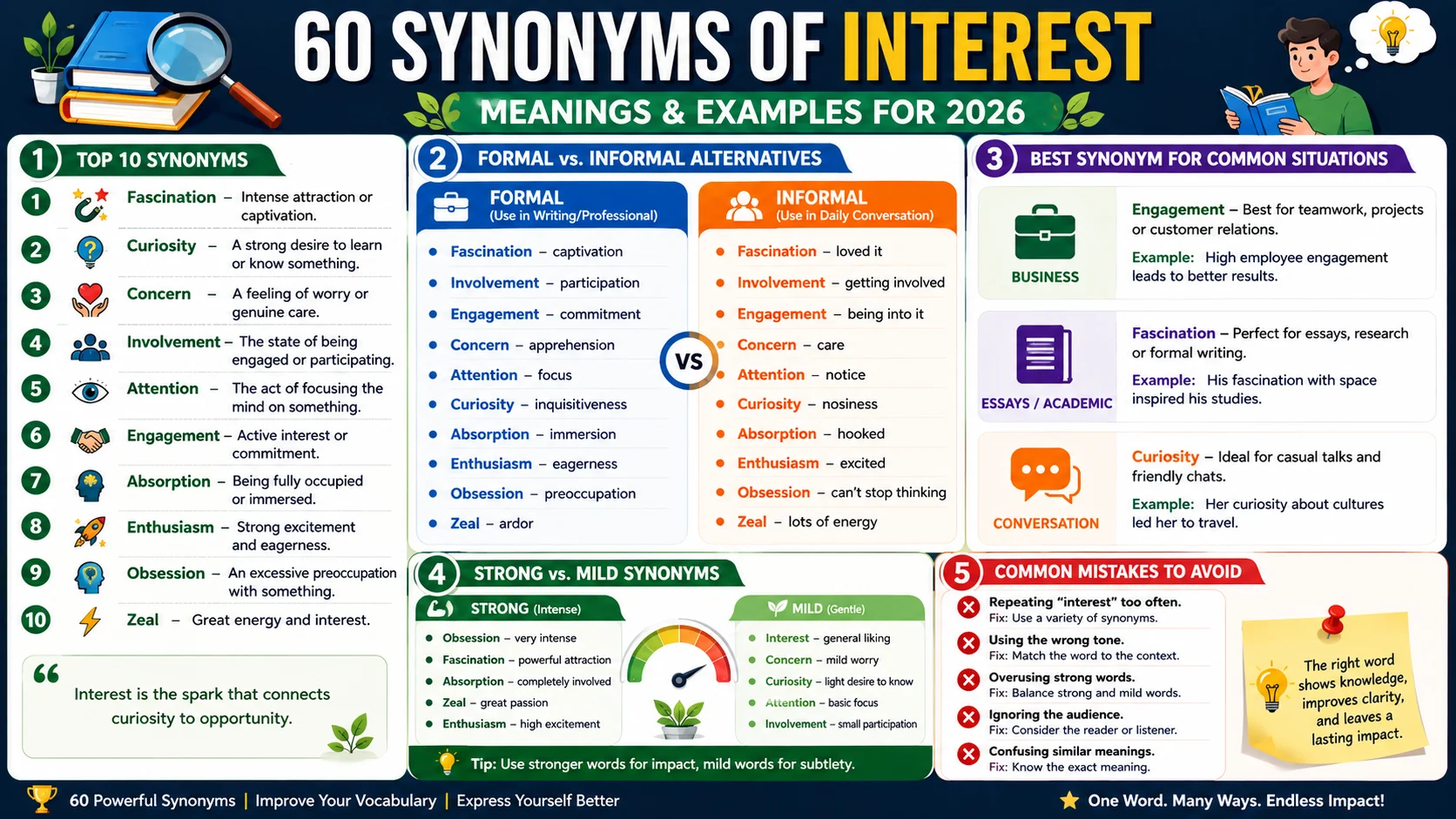
“Interest” means a feeling of wanting to know or learn about something, or something that holds your attention. The best synonyms are curiosity, fascination, attention, concern, and preoccupation. “Curiosity” is the most common natural alternative. Each synonym has a slightly different meaning and context.
Top 10 Synonyms
- Curiosity
- Fascination
- Attention
- Concern
- Preoccupation
- Enthusiasm
- Passion
- Engagement
- Involvement
- Appeal
What is another word for interest when you want your English to sound more precise? The answer depends on the context. Interest is a common word, but repeating it can make your writing feel basic or predictable.
Whether you need an interest synonym for an essay, conversation, email, or professional writing, choosing the right alternative matters. For example, curiosity suggests a desire to know more, while enthusiasm shows excitement or strong eagerness.
In this guide, we’ve carefully selected 35 interest synonyms with clear meanings, examples, tone, and usage notes. You’ll also learn when each synonym for interest works best and which alternatives may sound unnatural in certain contexts. If you’re exploring synonyms of interest, an interest thesaurus, or simply searching for another word for interest, this practical guide will help you choose confidently.
Let’s explore the most useful synonyms for interest and improve your vocabulary for 2026.
What Does “Interest” Mean?
Definition
Interest” has two main meanings. First, it means a feeling of wanting to know or learn about something. Second, it means something that holds your attention or gives you pleasure. When you have an interest in something, you care about it and want to know more about it.
Pronunciation
| Feature | Value |
|---|---|
| US IPA | /ˈɪntrəst/ |
| UK IPA | /ˈɪntrɪst/ |
| Syllables | 2 (in-ter-est) |
| Tip | Stress the first syllable: “IN-truhst” |
Grammar
| Grammar Feature | Information |
|---|---|
| Part of Speech | Noun |
| Common Position | Subject or object |
| Typical Pattern | Interest + in + something |
Examples:
- “She has a strong interest in art.” (feeling)
- “His main interest is photography.” (hobby)
- “The topic holds great interest for me.” (attention)
Grammar Note: “Interest” can be countable (a hobby) or uncountable (the feeling). You can have “an interest” or just “interest.”
Word Family
| Word | Part of Speech | Meaning |
|---|---|---|
| Interest | Noun/Verb | A feeling of wanting to know; to attract attention |
| Interested | Adjective | Having or showing interest |
| Interesting | Adjective | Arousing curiosity or attention |
| Interestedly | Adverb | In an interested manner |
15 Synonyms of “Interest”
Curiosity
Meaning: A strong desire to know or learn something.
Best Used For: Learning, exploration, discovery.
Formality: Neutral
Tone: Inquisitive, Adventurous
Frequency: ⭐⭐⭐⭐⭐ (Very Common)
CEFR Level: B1
Example Sentence 1: “Her curiosity about science led her to become a researcher.”
Example Sentence 2: “The child’s curiosity made him ask endless questions.”
Usage Tip: “Curiosity” is the best synonym when the interest is about learning and discovery. It’s a very common and natural word.
Common Confusion: Curiosity vs Interest. “Curiosity” is the desire to know. “Interest” can be broader, including enjoyment or concern.
Fascination
Meaning: A powerful attraction or strong interest in something.
Best Used For: Strong emotions, things that captivate you.
Formality: Formal
Tone: Captivating, Intense
Frequency: ⭐⭐⭐ (Moderate)
CEFR Level: B2
Example Sentence 1: “He has a lifelong fascination with space exploration.”
Example Sentence 2: “Her fascination with history began in childhood.”
Usage Tip: “Fascination” suggests a very strong, almost magical interest. Use it for things that truly captivate you.
Attention
Meaning: The act of focusing your mind on something.
Best Used For: Focusing, listening, observing.
Formality: Neutral
Tone: Focused, Observant
Frequency: ⭐⭐⭐⭐⭐ (Very Common)
CEFR Level: A2
Example Sentence 1: “The teacher needs to hold the students’ attention.
Example Sentence 2: “The book captured my attention from the first page.”
Usage Tip: “Attention” focuses on the act of paying attention, not just wanting to know. It’s a great alternative in many contexts.
Concern
Meaning: A feeling of worry or interest about something.
Best Used For: Worry, care, involvement.
Formality: Formal
Tone: Caring, Serious
Frequency: ⭐⭐⭐⭐ (Common)
CEFR Level: B1
Example Sentence 1: “She showed great concern for the environment.”
Example Sentence 2: “The pollution issue is a concern for everyone.”
Usage Tip: “Concern” often implies caring about something that matters. It’s a formal word that suggests responsibility.
Preoccupation
Meaning: Something that takes up all your attention and thoughts.
Best Used For: Obsessions, major focuses, deep interests.
Formality: Formal
Tone: Absorbed, Consuming
Frequency: ⭐⭐⭐ (Moderate)
CEFR Level: C1
Example Sentence 1: “His main preoccupation is his family’s well-being.”
Example Sentence 2: “Work has become her preoccupation.”
Usage Tip: “Preoccupation” suggests an interest that dominates your thoughts. It’s a formal, slightly strong word.
Enthusiasm
Meaning: Great eagerness and excitement about something.
Best Used For: Energy, passion, active interests.
Formality: Neutral
Tone: Excited, Energetic
Frequency: ⭐⭐⭐⭐ (Common)
CEFR Level: B2
Example Sentence 1: “Her enthusiasm for dance is contagious.”
Example Sentence 2: “He greeted the idea with great enthusiasm.”
Usage Tip: “Enthusiasm” is about energy and excitement. It’s a positive, active form of interest.
Passion
Meaning: A very strong and powerful interest or love for something.
Best Used For: Deep commitment, strong emotions, lifelong interests.
Formality: Neutral
Tone: Intense, Emotional
Frequency: ⭐⭐⭐⭐ (Common)
CEFR Level: B2
Example Sentence 1: “She has a passion for helping others.”
Example Sentence 2: “His passion for music is evident in his performances.”
Usage Tip: “Passion” is the strongest word for interest. Use it only for things you deeply love and commit to.
Engagement
Meaning: The state of being involved and interested in something.
Best Used For: Work, education, active participation.
Formality: Formal
Tone: Active, Involved
Frequency: ⭐⭐⭐ (Moderate)
CEFR Level: B2
Example Sentence 1: “Student engagement is key to learning.”
Example Sentence 2: “Her engagement with the project was impressive.”
Usage Tip: “Engagement” suggests active participation, not just passive interest. It’s excellent for professional and educational contexts.
Involvement
Meaning: The state of being connected or taking part in something.
Best Used For: Participation, relationships, projects.
Formality: Neutral
Tone: Connected, Participatory
Frequency: ⭐⭐⭐⭐ (Common)
CEFR Level: B1
Example Sentence 1: “Her involvement in the community is well-known.”
Example Sentence 2: “Active involvement in class helps students learn.”
Usage Tip: “Involvement” emphasizes taking part, not just having interest. Use it for participation and connection.
Appeal
Meaning: The quality of being attractive or interesting.
Best Used For: Things, products, people, ideas.
Formality: Neutral
Tone: Attractive, Engaging
Frequency: ⭐⭐⭐⭐ (Common)
CEFR Level: B2
Example Sentence 1: “The appeal of the job was the flexible hours.”
Example Sentence 2: “This book has great appeal to young readers.”
Usage Tip: “Appeal” is about what makes something interesting. It’s the attractiveness of the thing itself, not your feeling.
Absorption
Meaning: Complete involvement in something, losing awareness of everything else.
Best Used For: Deep concentration, being completely fascinated.
Formality: Formal
Tone: Deeply absorbed, Focused
Frequency: ⭐⭐ (Rare)
CEFR Level: C1
Example Sentence 1: “His absorption in the book was complete.”
Example Sentence 2: “Her absorption in her work made her lose track of time.”
Usage Tip: “Absorption” suggests being completely absorbed and losing yourself in an interest. It’s a formal, literary word.
Inquisitiveness
Meaning: A strong desire to know things.
Best Used For: Learners, investigators, curious people.
Formality: Formal
Tone: Inquisitive, Questioning
Frequency: ⭐⭐ (Rare)
CEFR Level: C1
Example Sentence 1: “His inquisitiveness made him an excellent scientist.
Example Sentence 2: “Her inquisitiveness led her to ask many questions.”
Usage Tip: “Inquisitiveness” is a more formal version of “curiosity.” Use it for serious academic contexts.
Attraction
Meaning: The quality that makes something appealing.
Best Used For: People, places, activities.
Formality: Neutral
Tone: Appealing, Magnetic
Frequency: ⭐⭐⭐ (Moderate)
CEFR Level: B2
Example Sentence 1: “The city’s main attraction is its beautiful architecture.
Example Sentence 2: “She felt a strong attraction to the arts.”
Usage Tip: “Attraction” suggests being drawn to something. It works for both people and activities.
Avocation
Meaning: A hobby or minor interest that you do for pleasure.
Best Used For: Hobbies, leisure activities.
Formality: Formal
Tone: Leisurely, Enjoyable
Frequency: ⭐ (Very Rare)
CEFR Level: C1
Example Sentence 1: “Her avocation is painting landscapes.”
Example Sentence 2: “He pursued his avocation of gardening with great joy.
Usage Tip: “Avocation” is a very formal word for a hobby. It’s rare in everyday speech but useful in writing.
Diversion
Meaning: Something that takes your attention away.
Best Used For: Entertainment, relaxation, distractions.
Formality: Formal
Tone: Light, Distracting
Frequency: ⭐⭐ (Rare)
CEFR Level: C1
Example Sentence 1: “Reading is a pleasant diversion from work.”
Example Sentence 2: “Her painting was a diversion from her stressful job.”
Usage Tip: “Diversion” suggests an interest that provides escape or entertainment. It’s often about relaxation.
Synonyms Comparison Table
| Synonym | Best Context | Formality | Tone | Frequency |
|---|---|---|---|---|
| Curiosity | Learning, discovery | Neutral | Inquisitive | ⭐⭐⭐⭐⭐ |
| Attention | Focusing | Neutral | Focused | ⭐⭐⭐⭐⭐ |
| Enthusiasm | Excitement, energy | Neutral | Energetic | ⭐⭐⭐⭐ |
| Passion | Deep love, commitment | Neutral | Intense | ⭐⭐⭐⭐ |
| Appeal | Attractiveness | Neutral | Engaging | ⭐⭐⭐⭐ |
| Involvement | Participation | Neutral | Connected | ⭐⭐⭐⭐ |
| Fascination | Strong attraction | Formal | Captivating | ⭐⭐⭐ |
| Concern | Worry, care | Formal | Serious | ⭐⭐⭐⭐ |
| Engagement | Active participation | Formal | Active | ⭐⭐⭐ |
| Preoccupation | Dominant focus | Formal | Consuming | ⭐⭐⭐ |
Best Synonyms by Situation
| Situation | Best Synonym | Why It Works |
|---|---|---|
| Daily Conversation | Curiosity | Natural and common |
| Business Email | Engagement | Professional and clear |
| Academic Writing | Fascination | Formal and precise |
| School Assignment | Enthusiasm | Shows excitement |
| Professional Meeting | Involvement | Sounds committed |
| Presentation | Passion | Inspiring and strong |
| Creative Writing | Preoccupation | Adds literary depth |
| Social Media | Interest | Simple and relatable |
| Job Interview | Passion | Shows commitment |
Formal vs Informal Synonyms
Formal Alternatives
| Synonym | Best Used For |
|---|---|
| Fascination | Strong intellectual interest |
| Engagement | Professional commitment |
| Preoccupation | Dominant focus of attention |
| Avocation | Formal term for hobby |
| Diversion | Entertainment or relaxation |
Neutral Alternatives
| Synonym | Best Used For |
|---|---|
| Curiosity | Learning and discovery |
| Attention | General focus |
| Enthusiasm | Excitement and energy |
| Appeal | Attractiveness |
Informal Alternatives
| Synonym | Best Used For |
|---|---|
| Interest | General use |
| Hobby | Leisure activities |
| Thing | Casual interest |
Choosing the Right Level: Use “engagement” and “involvement” in professional contexts. Use “curiosity” and “enthusiasm” in everyday conversation. Use “avocation” only in formal writing.
Strong vs Mild Synonyms
Mild
Suitable for everyday situations with less intensity.
- Interest
- Curiosity
- Attention
Moderate
More active or involved alternatives.
- Enthusiasm
- Involvement
- Concern
- Appeal
Strong
High-intensity alternatives suggesting deep interest.
- Passion (deep love)
- Fascination (captivating)
- Preoccupation (dominating)
- Absorption (complete immersion)
How Intensity Changes Meaning: “I have an interest in art” is mild. “I have a passion for art” is much stronger. “I am absorbed in art” suggests complete immersion. Choose the intensity that matches your feeling.
Real-Life Examples
School: “Her curiosity about science led her to major in biology.”
Office: “Employee engagement has increased this quarter.”
Business Email: “I have a strong interest in your proposal.”
Meetings: “Her enthusiasm for the project is contagious.”
Presentations: “The appeal of our product is its simplicity.”
Daily Conversations: “I have a new interest learning Spanish!”
Social Media: “She has a passion for photography.”
Academic Writing: “This study examines the fascination with social media.”
Common Collocations
| Common Phrase | Better Alternative |
|---|---|
| Have an interest | Have a curiosity (for learning) |
| Show interest | Show enthusiasm |
| Lose interest | Become disengaged |
| Take an interest | Become involved |
| Common interest | Shared passion |
| Special interest | Personal passion |
Common Phrases
In the interest of: For the benefit of. (e.g., “In the interest of fairness, we will wait.”)
Take an interest: To start being interested. (e.g., “She took an interest in photography.”)
Hold someone’s interest: To keep someone interested. (e.g., “The topic held my interest.”)
Interest rate: The percentage charged for borrowing money.
A point of interest: Something that is interesting. (e.g., “The museum has many points of interest.”)
Context Guide
| Situation | Best Synonym | Reason |
|---|---|---|
| Essay | Fascination | Academic and formal |
| Speech | Passion | Inspiring and strong |
| Business Email | Engagement | Professional and clear |
| Novel | Preoccupation | Adds literary depth |
| Presentation | Enthusiasm | Energetic and engaging |
| Conversation | Curiosity | Natural and relatable |
| Academic Writing | Inquisitiveness | Precise and scholarly |
| Marketing Copy | Appeal | Engaging and persuasive |
Related Words
Near Synonyms
- Hobby: An activity done for pleasure. (e.g., “Gardening is his hobby.”)
- Pursuit: An activity you engage in. (e.g., “The pursuit of knowledge.”)
- Pastime: A pleasant way of spending time. (e.g., “Reading is my favorite pastime.”)
- Obsession: An extreme interest. (e.g., “His obsession with detail.”)
Antonyms
- Boredom: Lack of interest.
- Indifference: Lack of concern.
- Disinterest: Lack of interest.
- Apathy: Lack of emotion or interest.
Related Adjectives
- Interesting: Arousing curiosity.
- Fascinating: Extremely interesting.
- Engaging: Holding attention.
- Captivating: Attracting attention.
- Intriguing: Curious and interesting.
Related Nouns
- Attraction: The quality of being interesting.
- Engagement: Active participation.
- Involvement: Taking part.
- Commitment: Dedication.
Related Verbs
- Interest: To attract attention.
- Fascinate: To attract strongly.
- Intrigue: To arouse curiosity.
- Engage: To attract and hold attention.
Frequently Asked Questions
What is another word for interest?
Common synonyms include curiosity, fascination, attention, concern, and enthusiasm. “Curiosity” is the most common and direct alternative.
Which synonym sounds the most professional?
Engagement and involvement sound very professional. “Fascination” is excellent for academic contexts.
What is the strongest synonym for interest?
Passion is one of the strongest synonyms. It suggests deep love and commitment. “Fascination” is also very strong, suggesting being captivated.
Which synonym is best for essays?
Fascination is excellent for essays. “Inquisitiveness” is also very formal and precise.
What’s the difference between interest and curiosity?
“Interest” is broader and includes enjoyment and concern. “Curiosity” specifically means the desire to know and learn.
Which synonym is most common in everyday English?
“Curiosity” and “enthusiasm” are very common in everyday speech. “Interest” itself is also still widely used.
What is the opposite of interest?
Common opposites are boredom, indifference, and apathy. These words describe a lack of interest or caring.
Conclusion
“Interest” is a wonderful word, but now you have 35 fantastic alternatives. Each synonym adds a different shade of meaning to your language.
Remember, the key is understanding the context. Use “curiosity” for learning and discovery. Use “passion” for deep commitment. Use “engagement” for active participation. Use “fascination” for strong attraction. Use “enthusiasm” for energy and excitement.
The best way to improve is practice. Try using one or two new synonyms each day. Listen for these words in conversations, books, and movies. Your vocabulary will become richer and more impressive with time.
