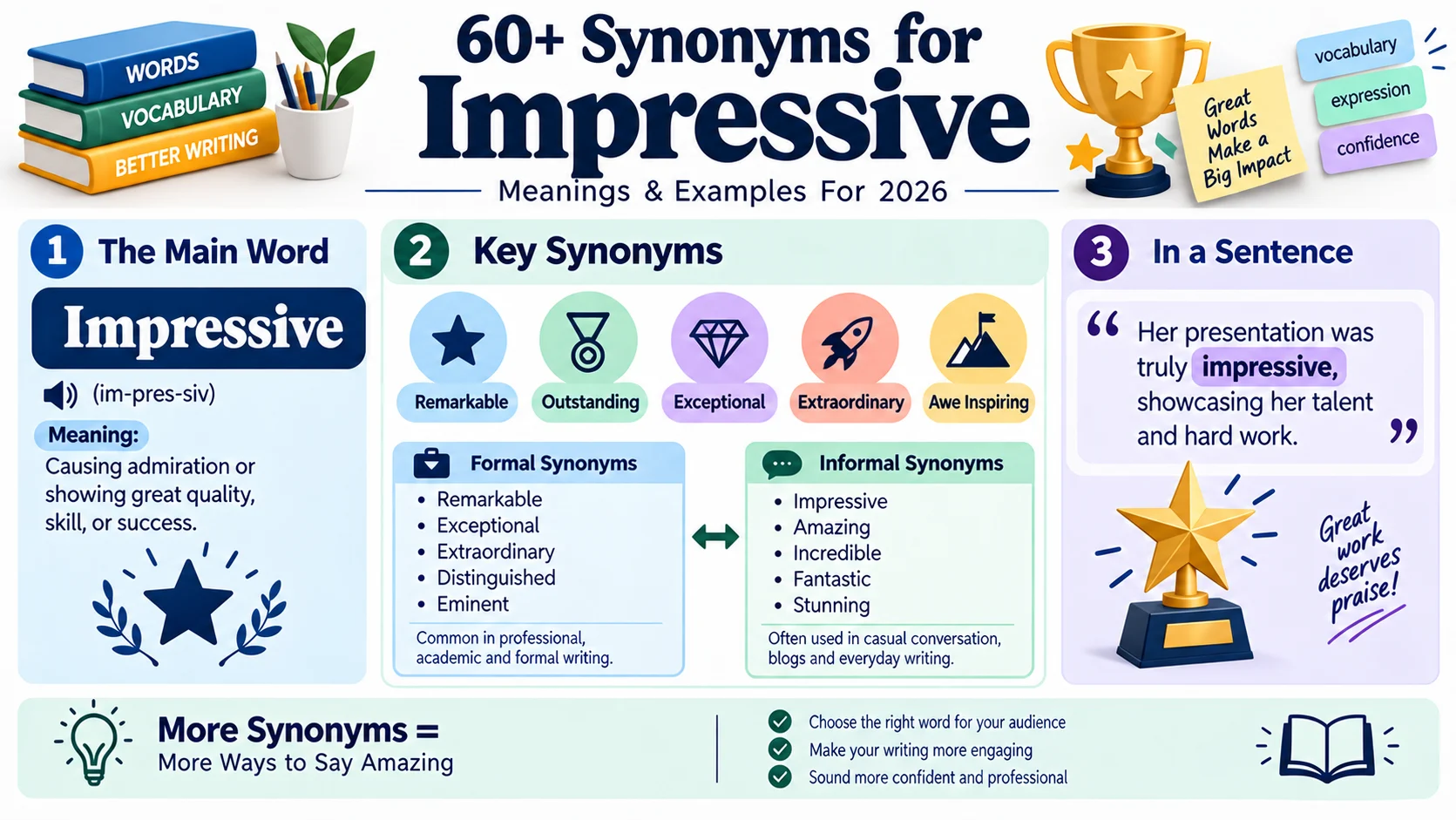
Impressive describes something that causes admiration, respect, or awe because of its excellence, size, or skill. The best synonyms depend on your context. For formal writing, use remarkable or notable. For casual conversation, use awesome or amazing. For a strong emotional tone, try astonishing or awe inspiring.
Meaning, Tone and Context
The word “impressive” is an adjective that describes something that stands out and commands attention. Its core function is to express that something is worthy of admiration or respect. The tone is generally positive and can range from mild appreciation to strong awe.
1. Simple Definition: Impressive means causing someone to feel admiration or respect because of a special quality, skill, or achievement.
2. Part of Speech: Impressive is an adjective.
- Adjective: “Her presentation was very impressive.”
- Adverb: “He performed impressively well under pressure.”
- Verb: to impress. “She impressed the interview panel with her confidence.”
- Noun: impression. “He made a strong impression on his new boss.”
3. Tone: The tone is generally positive. It can be neutral and factual when describing a notable achievement, or highly emotional when describing something that causes awe.
4. Formality: “Impressive” is a neutral word. It is appropriate for both business reports and casual conversation. For very formal contexts, you might use “remarkable” or “formidable.”
5. Common Use Cases: You will encounter “impressive” in many situations.
- Professional Context: “The team delivered an impressive increase in quarterly sales.”
- Resume: “Managed an impressive portfolio of high value clients.”
- Casual Conversation: “That was an impressive goal he scored.”
6. Important Word Forms:
- Verb: to impress. “He tried to impress his date with a fancy dinner.”
- Noun: impression. “The new employee made a good impression.”
- Adjective: impressionable. “Teenagers are often impressionable.”
When and How to Use “Impressive”
Knowing when to use “impressive” is about understanding its broad, positive meaning. It is a safe choice when you want to express admiration without being overly specific. Here are several scenarios where it is the perfect choice.
- Professional Context: To praise a colleague’s work or a team’s achievement.
Example: “Your attention to detail on this project was truly impressive.” - Academic Context: To describe a strong argument or a well researched paper.
Example: “The student’s thesis was an impressive piece of original research.” - Resume and Cover Letter: To highlight a significant accomplishment.
Example: “Achieved an impressive 25 percent reduction in operational costs.” - Casual Conversation: To react to a piece of news or a personal achievement.
Example: “Wow, running a marathon is impressive.” - Creative Writing: To describe a powerful scene, character, or performance.
Example: “The castle was an impressive sight, towering over the village.” - Social Media Captions: To compliment a friend’s photo or achievement.
Example: “This transformation is so impressive.” - Email Context: To acknowledge a job well done.
Example: “The client was impressed with the quality of your work.” - Job Interview: To describe a past achievement.
Example: “I led an impressive turnaround of the underperforming department.”
Another Word for “Impressive”
Choosing the best replacement for “impressive” depends on your specific context and the level of admiration you want to express. Here are the most effective alternatives categorized by use.
- Professional Writing: “Remarkable” or “Notable.” “The team made a remarkable recovery after the setback.”
- Academic Writing: “Significant” or “Substantial.” “The study revealed a significant improvement in test scores.”
- Casual Conversation: “Awesome” or “Amazing.” “That concert was amazing.”
- Emotional Writing: “Awe inspiring” or “Astonishing.” “The view from the mountain was awe inspiring.”
- Creative Writing: “Formidable” or “Majestic.” “The fortress was a formidable structure.”
- Resume or Workplace: “Outstanding” or “Exceptional.” “Received an award for outstanding performance.”
- Social Media Captions: “Impressive” or “Incredible.” “This sunset is incredible.”
- Stronger Meaning: “Extraordinary.” This word suggests something is beyond the ordinary and truly special. “Her talent is extraordinary.”
- Softer Meaning: “Commendable.” This word suggests something is worthy of praise but is not necessarily awe inspiring. “His effort was commendable.”
When Not to Use “Impressive”
While “impressive” is a useful word, it can be too vague or weak in certain situations. Using a more precise synonym can improve clarity and impact.
- When You Need Specificity: If you want to praise a specific skill, use a more precise word. “The presentation was impressive” is vague. “The presentation was insightful and well structured” is much clearer.
- When Describing a Major Achievement: “Impressive” can sound too mild for something truly extraordinary. “Winning the Nobel Prize is impressive” is an understatement. “Winning the Nobel Prize is extraordinary” is more appropriate.
- When Being Critical: “Impressive” is a positive word. If you want to be critical, use a negative synonym like “unimpressive” or “mediocre.
Example of Precision: Compare these two sentences.
- Vague: “Her sales numbers were impressive.”
- Precise: “Her sales numbers were exceptional, exceeding the target by 40 percent.”
The second sentence is more specific and provides a clearer picture of her achievement.
Words Commonly Confused With “Impressive”
Understanding the differences between these related words will significantly refine your English.
- Impressive vs. Impressed: “Impressive” describes the thing that causes admiration. “Impressed” describes the person who feels admiration. “The speech was impressive” vs. “I was impressed by the speech.”
- Impressive vs. Impressionable: “Impressive” means causing admiration. “Impressionable” means easily influenced. “The movie was impressive” vs. “The child is impressionable.”
- Impressive vs. Impromptu: “Impressive” means causing admiration. “Impromptu” means done without preparation. “She gave an impressive speech” vs. “She gave an impromptu speech.”
- Impressive vs. Impervious: “Impressive” means causing admiration. “Impervious” means not allowing something to pass through or not affected by something. “The fortress was impressive” vs. “The fortress was impervious to attack.”
- Impressive vs. Impractical: “Impressive” means causing admiration. “Impractical” means not sensible or realistic. “The design was impressive” vs. “The design was impractical.”
- Impressive vs. Imposing: “Impressive” is a general word for admiration. “Imposing” often refers to size or appearance that is impressive in a grand or intimidating way. “The building was imposing.”
Best Synonym by Context for “Impressive”
| Context | Best Synonym | Why It Works | Example |
|---|---|---|---|
| Formal Writing | Remarkable | It is a strong, formal word for something noteworthy. | “The report showed remarkable growth in the third quarter.” |
| Academic Writing | Significant | It suggests importance and statistical relevance. | “The study found a significant correlation between the variables.” |
| Professional/Business | Outstanding | It suggests excellence that stands above the rest. | “Her performance this year has been outstanding.” |
| Resume | Exceptional | It highlights rare and superior quality. | “An exceptional leader with a track record of success.” |
| Casual Conversation | Awesome | It is simple, positive, and widely used. | “That was an awesome movie.” |
| Creative Writing | Formidable | It adds a sense of power and strength. | “The army was a formidable force.” |
| Emotional Tone | Awe Inspiring | It conveys a deep sense of wonder and respect. | “The cathedral was an awe inspiring sight.” |
| Strong Intensity | Extraordinary | It suggests something is beyond the ordinary. | “Her talent for music is extraordinary.” |
| Soft/Moderate Tone | Commendable | It is a gentle, respectful word for praise. | “His efforts to help the community are commendable.” |
| Social Media Captions | Incredible | It is a modern, engaging word for online content. | “This view is incredible.” |
| US/UK Usage | Impressive | Both dialects use “impressive” widely. | US: “That is an impressive resume.” UK: “That is an impressive CV.” |
Which Synonym Should You Choose?
Choosing the right word can seem difficult, but this simple guide will help you decide. It is all about matching the word to your goal, audience, and the message you want to send.
- Is your goal to praise someone in a professional setting? Use “outstanding,” “exceptional,” or “remarkable.” These words are formal and respectful.
- Is your goal to express strong admiration or awe? Use “astonishing,” “extraordinary,” or “awe inspiring.” These words convey deep emotion.
- Is your goal to be more specific about what makes something impressive? Instead of “impressive,” use words like “insightful,” “innovative,” or “efficient.” This makes your praise more meaningful.
- Are you writing for a casual audience? Use “awesome,” “amazing,” or “incredible.” These words are friendly and engaging.
- Are you writing a resume or cover letter? Use “exceptional,” “outstanding,” or “proven.” These words highlight your achievements and value.
- Do you want to be subtle and understated? Use “notable,” “commendable,” or “admirable.” These words express respect without exaggeration.
Real Life Examples of “Impressive” in Sentences
Here are examples of how “impressive” and its stronger synonyms can be used in different real world scenarios.
- School: “She received an impressive score on her final exam.” Stronger: “She received an outstanding score on her final exam.”
- Workplace: “The team’s response to the crisis was impressive.” Stronger: “The team’s response to the crisis was remarkable.”
- Writing: “The author’s command of language is impressive.” Stronger: “The author’s command of language is extraordinary.”
- Conversation: “That was an impressive dinner you cooked.” Stronger: “That was an amazing dinner you cooked.”
- Social Media: “Check out this impressive before and after photo.” Stronger: “Check out this incredible before and after photo.”
- Resume: “I have an impressive track record in sales.” Stronger: “I have an exceptional track record in sales.”
- Email: “Your prompt response was impressive.” Stronger: “Your prompt response was greatly appreciated.”
- Storytelling: “The hero’s strength was impressive.” Stronger: “The hero’s strength was formidable.”
25 Synonyms for “Impressive”
The following table lists 25 accurate and practical synonyms for “impressive.
| Synonym | Simple Meaning | Best Used For | Example Sentence |
|---|---|---|---|
| Remarkable | Worthy of attention or notice. | Formal, professional. | “The team made a remarkable recovery.” |
| Outstanding | Exceptionally good. | Professional, resumes. | “Her performance was outstanding.” |
| Exceptional | Unusually excellent. | Professional, resumes. | “He has an exceptional talent for design.” |
| Extraordinary | Beyond what is usual or ordinary. | Strong praise, formal. | “The view from the top was extraordinary.” |
| Significant | Important and notable. | Academic, formal. | “There was a significant increase in profits.” |
| Notable | Worthy of attention. | Formal, neutral. | “The event was a notable success.” |
| Striking | Very noticeable and attractive. | Creative, visual. | “She wore a striking red dress.” |
| Imposing | Grand and impressive in size. | Describing buildings, people. | “The castle was an imposing structure.” |
| Formidable | Inspiring respect or fear. | Creative, strong praise. | “The opponent was a formidable competitor.” |
| Awe Inspiring | Filling someone with wonder. | Emotional, creative. | “The Grand Canyon is awe inspiring.” |
| Astonishing | Extremely surprising. | Strong emotional praise. | “The magician’s trick was astonishing.” |
| Amazing | Causing great surprise or wonder. | Casual, general. | “You did an amazing job.” |
| Awesome | Extremely good. | Casual, social media. | “That was an awesome concert.” |
| Incredible | Impossible to believe. | Casual, social media. | “Her progress has been incredible.” |
| Marvelous | Causing great wonder. | Positive, slightly formal. | “We had a marvelous time on vacation.” |
| Splendid | Magnificent and very good. | Positive, slightly formal. | “That is a splendid idea.” |
| Magnificent | Impressively beautiful. | Creative, formal. | “The palace was magnificent.” |
| Majestic | Having grandeur. | Creative, descriptive. | “The mountains were majestic.” |
| Commendable | Deserving praise. | Soft praise, formal. | “Her dedication is commendable.” |
| Admirable | Deserving respect. | Formal, neutral. | “His honesty was admirable.” |
| Phenomenal | Remarkable and extraordinary. | Strong praise, modern. | “The response to the campaign was phenomenal.” |
| Stellar | Outstanding and excellent. | Professional, modern. | “She gave a stellar performance.” |
| Top notch | Of the highest quality. | Casual, professional. | “The service at the hotel was top notch.” |
| First rate | Of the best quality. | Professional, formal. | “The research was first rate.” |
| Mind blowing | Overwhelmingly impressive. | Casual, social media. | “The special effects were mind blowing.” |
Synonym Groups and Usage Differences
Professional vs. Personal Synonyms
In a professional setting, like a business report or a resume, choose “outstanding,” “exceptional,” or “remarkable.” These words sound polished and credible. In a personal setting, “awesome,” “amazing,” or “incredible” are more natural and friendly. For example, you would tell a colleague “Your work has been outstanding,” but a friend “Your new apartment is amazing.”
Formal vs. Conversational Synonyms
Formal Synonyms: “Remarkable,” “notable,” and “formidable” are perfect for academic papers, legal documents, or formal speeches.
Conversational Synonyms: “Awesome,” “amazing,” and “cool” are the best choices for everyday conversations and emails to friends.
Academic Synonyms
In essays and research papers, “significant” is a powerful and precise word. It allows you to discuss findings that are important and meaningful. “Substantial” is also useful for describing large amounts or important changes.
Professional and Business Synonyms
“Outstanding” is a safe and professional choice for almost any workplace communication. “Exceptional” is effective when discussing rare talent or achievement. “Stellar” is a modern word that works well in reviews and presentations.
Creative or Literary Synonyms
These words add a layer of artistry to your descriptions.
- Majestic: Suggests grandeur and beauty.
- Awe inspiring: Conveys a deep sense of wonder.
- Striking: Perfect for describing something visually noticeable.
Slang or Modern Synonyms
Mind blowing,” “epic,” and “sick” are modern and casual synonyms. They are acceptable in social media captions and very informal conversations. They should be avoided in academic or professional writing.
Strongest vs. Weaker Synonyms
Here is an intensity scale from mild to strongest:
- Notable, Commendable: Mild, focused on respect and praise.
- Impressive, Remarkable: Moderate, the standard words.
- Outstanding, Exceptional: Strong, suggests superior quality.
- Extraordinary, Astonishing: Very strong, suggests something beyond the ordinary.
- Awe Inspiring, Mind Blowing: Strongest, suggests overwhelming wonder.
Emotional vs. Neutral Synonyms
Emotional Synonyms: “Awe inspiring,” “astonishing,” and “mind blowing” all carry strong emotional weight. They create a sense of wonder and surprise.
Neutral Synonyms: “Notable,” “significant,” and “commendable” are factual and free of strong emotional charge.
Antonyms of “Impressive”
Here are 15 clear antonyms for “impressive,” which are words that mean the opposite: ordinary, unremarkable, or weak.
| Antonym | Meaning | Example Sentence |
|---|---|---|
| Unimpressive | Not causing admiration. | “The performance was unimpressive.” |
| Ordinary | Normal and not special. | “It was just an ordinary day.” |
| Mediocre | Of only average quality. | “The food was mediocre at best.” |
| Unremarkable | Not worthy of attention. | “The view was unremarkable.” |
| Insignificant | Too small to be important. | “The change was insignificant.” |
| Common | Happening often and not special. | “It is a common mistake.” |
| Average | Typical and not exceptional. | “His grades were average.” |
| Underwhelming | Not as good as expected. | “The ending of the movie was underwhelming.” |
| Disappointing | Failing to meet expectations. | “The results were disappointing.” |
| Weak | Not strong or effective. | “The argument was weak.” |
| Poor | Of low quality. | “The service was poor.” |
| Inferior | Lower in quality. | “The product was inferior to the competitor’s.” |
| Trivial | Of little value or importance. | “It was a trivial matter.” |
| Mundane | Dull and ordinary. | “His daily routine was mundane.” |
| Forgettable | Not memorable. | “The performance was forgettable.” |
Comparison: “Impressive” vs. Similar Words
Impressive vs. Impressed
Main Difference: “Impressive” describes the thing that causes admiration. “Impressed” describes the person who feels admiration.
Which One Is Stronger: They are different. “Impressive” is a quality. “Impressed” is a feeling.
Which One Is More Formal: Both are neutral.
Example Sentence with Impressive: “The building was very impressive.”
Example Sentence with Impressed: “I was very impressed by the building.”
Impressive vs. Imposing
Main Difference: “Impressive” is a general word for admiration. “Imposing” specifically refers to size, appearance, or manner that is grand and often intimidating.
Which One Is Stronger: “Imposing” is stronger and more specific.
Which One Is More Formal: “Imposing” is slightly more formal.
Example Sentence with Impressive: “She has an impressive resume.”
Example Sentence with Imposing: “The judge had an imposing presence in the courtroom.”
Impressive vs. Remarkable
Main Difference: “Impressive” is a general word. “Remarkable” means something is worthy of attention or notice, often because it is unusual.
Which One Is Stronger: “Remarkable” is often stronger because it implies something stands out from the norm.
Which One Is More Formal: “Remarkable” is more formal.
Example Sentence with Impressive: “That was an impressive goal.”
Example Sentence with Remarkable: “Her recovery was truly remarkable.”
Impressive vs. Outstanding
Main Difference: “Impressive” means causing admiration. “Outstanding” means exceptionally good, standing above others.
Which One Is Stronger: “Outstanding” is stronger. It implies excellence, not just admiration.
Which One Is More Formal: “Outstanding” is more formal and common in professional evaluations.
Example Sentence with Impressive: “The team did an impressive job.”
Example Sentence with Outstanding: “The team did an outstanding job, exceeding all expectations.”
Impressive vs. Extraordinary
Main Difference: “Impressive” is a general word. “Extraordinary” means something is beyond what is usual or ordinary.
Which One Is Stronger: “Extraordinary” is stronger. It suggests something is truly special.
Which One Is More Formal: “Extraordinary” is more formal.
Example Sentence with Impressive: “He has an impressive collection of stamps.”
Example Sentence with Extraordinary: “She has an extraordinary talent for singing.”
Impressive vs. Awesome
Main Difference: “Impressive” is a neutral word. “Awesome” is a casual, informal word that means extremely good.
Which One Is Stronger: “Awesome” is stronger in casual contexts but less formal.
Which One Is More Formal: “Impressive” is more formal. “Awesome” is very casual.
Example Sentence with Impressive: “The architecture was impressive.”
Example Sentence with Awesome: “The concert was awesome.”
Common Phrases and Expressions with “Impressive”
1. Leave a Good Impression
Meaning: To make someone have a positive opinion of you.
Example Sentence: “He left a good impression on the interview panel.”
2. Make an Impression
Meaning: To have a strong effect on someone.
Example Sentence: “She made a strong impression with her confident speech.”
3. Under the Impression
Meaning: Believing something to be true.
Example Sentence: “I was under the impression that the meeting was cancelled.”
4. Impressive Feat
Meaning: A remarkable achievement.
Example Sentence: “Climbing the mountain was an impressive feat.”
5. Impressive Track Record
Meaning: A history of success.
Example Sentence: “The candidate has an impressive track record in sales.”
6. Dressed to Impress
Meaning: Wearing clothes to make people admire you.
Example Sentence: “She was dressed to impress at the gala.”
7. First Impressions Count
Meaning: The first opinion people form is important.
Example Sentence: “Remember, first impressions count, so be on time.”
8. Impressive Display
Meaning: A spectacular show or demonstration.
Example Sentence: “The fireworks were an impressive display.”
Common Mistakes to Avoid
1. Using “Impressive” When a More Precise Synonym Is Better
Mistake: “The report was impressive.”
Better: “The report was thorough and insightful.” This is more specific and meaningful.
2. Confusing “Impressive” with “Impressed”
Mistake: “I was impressive by the performance.”
Better: “I was impressed by the performance.” The person feels impressed. The performance is impressive.
3. Using a Casual Synonym in Formal Writing
Mistake: “The results were awesome.”
Better: “The results were exceptional.” “Awesome” is too casual for a formal report.
4. Using an Overly Dramatic Synonym for a Simple Situation
Mistake: “He made a mind blowing cup of coffee.”
Better: “He made a great cup of coffee.” “Mind blowing” is too strong for a simple cup of coffee.
5. Repeating the Same Word Too Often
Mistake: “The speech was impressive. The venue was impressive. The food was impressive.”
Better: “The speech was impressive. The venue was elegant. The food was delicious.” This variation makes the writing more engaging.
6. Choosing a Synonym with the Wrong Emotional Tone
Mistake: “The company’s profits were awe inspiring.”
Better: “The company’s profits were remarkable.” “Awe inspiring” is too emotional for a financial report.
7. Using Slang in Academic or Professional Writing
Mistake: “The research was epic.”
Better: “The research was significant.” “Epic” is too casual for academic writing.
FAQs
1. What is the best synonym for impressive?
The best synonym depends on your context. For professional use, “outstanding” is a safe choice. For casual conversation, “awesome” works well. For strong praise, use “extraordinary.”
2. What is a formal synonym for impressive?
A formal synonym for impressive is “remarkable” or “notable.” Both are appropriate for formal writing and professional communication.
3. What is an informal synonym for impressive?
An informal synonym for impressive is “awesome” or “amazing.” These words are perfect for everyday conversation and friendly emails.
4. What is another word for impressive in professional writing?
In professional writing, “outstanding” is an excellent choice. “Exceptional” is also effective when discussing rare talent. “Stellar” is useful for reviews and presentations.
5. What is the difference between impressive and impressed?
“Impressive” describes the thing that causes admiration. “Impressed” describes the person who feels admiration. You feel impressed by something impressive.
6. What is the opposite of impressive?
The opposite of impressive is “unimpressive,” “ordinary,” or “mediocre.” These words describe something that does not cause admiration.
Conclusion
The word “impressive” is a useful and positive term. It expresses admiration for someone or something that stands out. However, choosing the right synonym depends entirely on your context, audience, and the tone you wish to convey.
For a professional setting, “outstanding” or “exceptional” work well. For a formal context, “remarkable” or “notable” are excellent choices. In casual conversation, “awesome” or “amazing” are natural and friendly. For strong emotional praise, “extraordinary” or “awe inspiring” convey the right feeling.
The best advice is to think about your purpose and your audience before you choose a word. Do you want to be respectful, excited, understated, or specific? Matching your word to your intention will make your communication more effective and your English more precise.
A practical vocabulary tip: Try replacing “impressive” with a more specific synonym in your writing this week. If you are praising a colleague, use “outstanding.” If you are describing a beautiful view, use “awe inspiring.” This small change will significantly improve the clarity and sophistication of your English.
