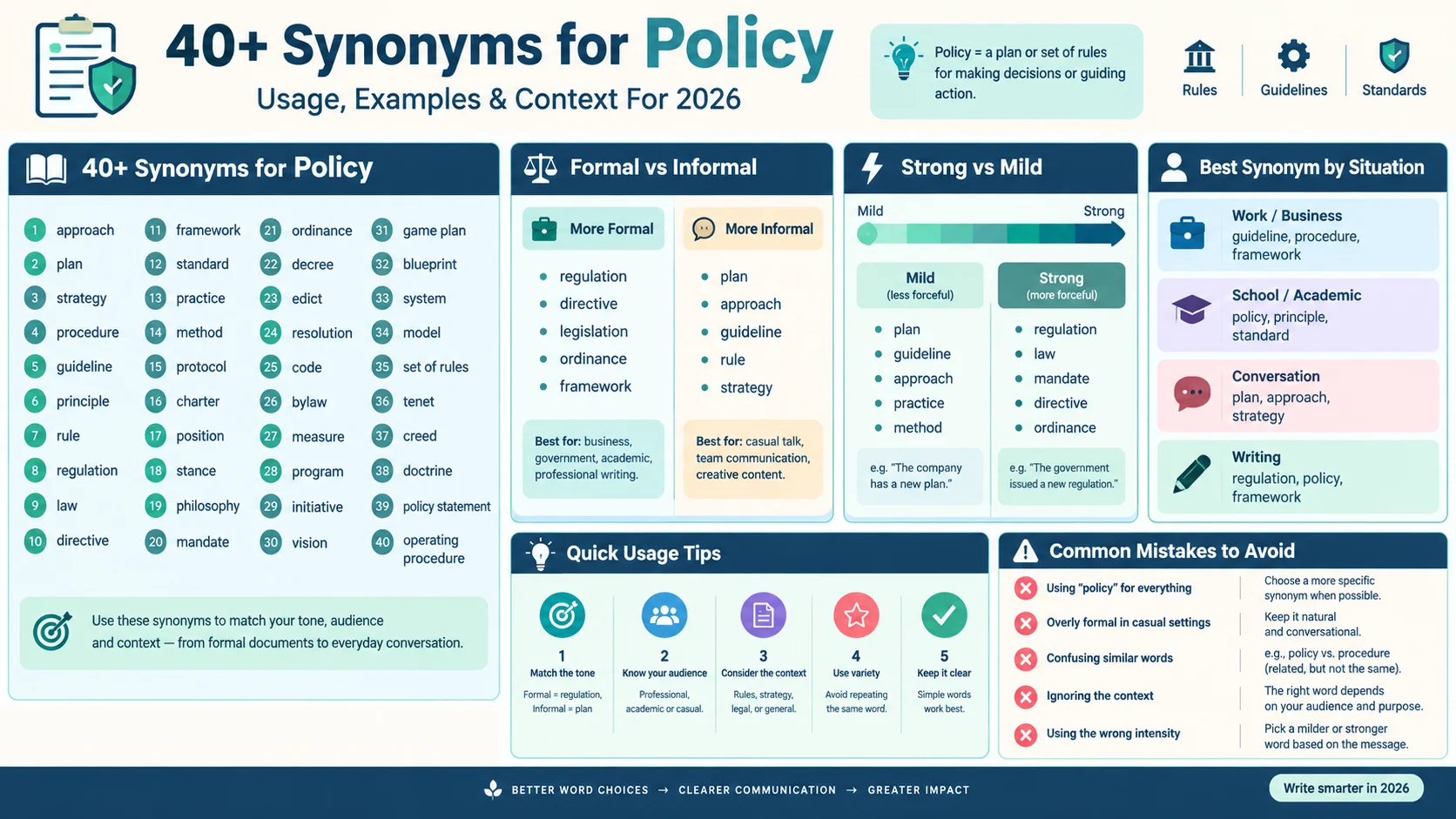
A policy is a formal set of rules, principles, or guidelines that guides decisions and actions within an organization or government. The best synonym depends on context: use procedure for step-by-step processes, guideline for flexible advice, and protocol for official rules.
Top 10 Synonyms:
- Procedure
- Guideline
- Protocol
- Regulation
- Rule
- Principle
- Directive
- Standard
- Framework
- Strategy
Every synonym has a slightly different meaning, tone, or context. Choosing the right one makes your writing clearer and more professional.
Have you ever been writing a business email, a school essay, or a workplace document and found yourself stuck on the word “policy”?
You know what you want to say. You need to describe a set of rules or guidelines. But using “policy” repeatedly makes your writing sound repetitive and dull.
Imagine you are drafting an employee handbook. You need to explain rules about vacation time, social media use, and workplace conduct. Each of these might require a different word to sound natural and precise.
This guide will teach you exactly which synonym to use in every situation. You will learn the subtle differences between procedure, guideline, protocol, regulation, and many other useful alternatives. By the end, you will have a powerful vocabulary for discussing rules, principles, and official guidelines.
What Does “Policy” Mean?
Definition
A policy is a deliberate system of principles that guides decisions and actions. It is a plan or course of action adopted by a government, business, or individual .
In everyday language, a policy is simply a rule or set of rules that tells people what they should or should not do. Companies have policies about dress codes and time off. Governments have policies about taxes and healthcare. Schools have policies about attendance and behavior.
The key idea is that a policy provides direction. It helps people make consistent decisions without having to figure out every situation from scratch.
Pronunciation
US IPA: /ˈpɑː.lə.si/
UK IPA: /ˈpɒl.ə.si/
Syllables: 3 (pol-i-cy)
Tip: Stress the first syllable “POL.” The second syllable sounds like “uh,” not “ee.” The final syllable sounds like “see.”
Grammar
| Grammar Feature | Information |
|---|---|
| Part of Speech | Noun (countable and uncountable) |
| Common Position | Subject, object, or object of a preposition |
| Typical Pattern | Policy on + topic OR adjective + policy |
Example sentences:
- “The company’s policy on remote work has changed recently.”
- “The government introduced a new policy to reduce pollution.”
- “Our refund policy is clearly stated on the receipt.”
Grammar note: Policy is often followed by “on” when describing a specific topic. It can be modified by adjectives like “new,” “current,” “official,” “strict,” or “flexible.”
Word Family
| Word | Part of Speech | Meaning |
|---|---|---|
| Policy | Noun | A set of rules or principles that guide decisions |
| Policies | Noun (plural) | Multiple sets of rules or guidelines |
| Policymaker | Noun | A person who creates policies |
| Policymaking | Noun | The process of creating policies |
| Policed | Verb | Enforced or monitored according to rules |
12 Synonyms of “Policy”
Procedure
Meaning: A specific way of doing something, usually a series of steps followed in order .
Best Used For: Business, healthcare, education, and technical writing.
Formality: Neutral to Formal
Tone: Professional, Neutral
Frequency: ⭐⭐⭐⭐⭐ Very Common
CEFR Level: B1
Example Sentence 1: “The hospital follows a strict procedure for disinfecting equipment.”
Example Sentence 2: “Please review the refund procedure before contacting customer service.”
Usage Tip: Procedure focuses on how something is done, not what the rule is. Use it when you want to describe steps or a process. A policy is the rule itself, while a procedure explains how to follow that rule.
Guideline
Meaning: A piece of advice or recommendation that is not strictly enforced .
Best Used For: Professional writing, healthcare, education, and advisory contexts.
Formality: Neutral
Tone: Helpful, Flexible
Frequency: ⭐⭐⭐⭐⭐ Very Common
CEFR Level: B1
Example Sentence 1: “The new guidelines for healthy eating emphasize fresh vegetables and whole grains.”
Example Sentence 2: “These guidelines are not mandatory, but they will help you succeed.”
Usage Tip: Guidelines are softer than policies. They offer direction without strict enforcement. Native speakers use “guideline” when they want to sound helpful rather than commanding.
Protocol
Meaning: A formal set of rules for official situations or ceremonies .
Best Used For: Diplomacy, healthcare, government, and formal events.
Formality: Formal
Tone: Official, Serious
Frequency: ⭐⭐⭐⭐ Common
CEFR Level: B2
Example Sentence 1: “Diplomats must follow strict protocol during state dinners.”
Example Sentence 2: “The hospital has a protocol for handling infectious diseases.”
Usage Tip: Protocol is more formal than policy. It suggests strict rules that must be followed exactly. Use it for official situations, ceremonies, or medical procedures.
Regulation
Meaning: An official rule made by a government or authority .
Best Used For: Government, law, business compliance, and safety contexts.
Formality: Formal
Tone: Official, Legal
Frequency: ⭐⭐⭐⭐ Common
CEFR Level: B2
Example Sentence 1: “New environmental regulations will limit carbon emissions.”
Example Sentence 2: “The bank must comply with federal regulations.”
Usage Tip: Regulation is stronger than policy. It carries legal weight and often involves penalties for violation. Use it when discussing laws and government rules.
Rule
Meaning: A statement that tells people what they must or must not do .
Best Used For: Daily conversation, education, sports, and general writing.
Formality: Neutral to Informal
Tone: Direct, Clear
Frequency: ⭐⭐⭐⭐⭐ Very Common
CEFR Level: A2
Example Sentence 1: “The first rule of the game is to have fun.”
Example Sentence 2: “School rules prohibit phones during class.”
Usage Tip: Rule is the simplest and most general synonym. It works in almost any context. Use it when you want to be clear and direct without sounding too formal.
Principle
Meaning: A basic belief or value that guides behavior .
Best Used For: Philosophy, ethics, leadership, and academic writing.
Formality: Formal
Tone: Serious, Ethical
Frequency: ⭐⭐⭐⭐ Common
CEFR Level: B2
Example Sentence 1: “Honesty is a core principle of our organization.”
Example Sentence 2: “She refused to compromise her principles for money.”
Usage Tip: Principle refers to a fundamental belief, not a specific rule. Use it when discussing values and ethics. A policy is practical, while a principle is philosophical.
Directive
Meaning: An official instruction or order .
Best Used For: Business, government, military, and management contexts.
Formality: Formal
Tone: Authoritative, Official
Frequency: ⭐⭐⭐ Moderate
CEFR Level: B2
Example Sentence 1: “The manager issued a directive to reduce costs by ten percent.”
Example Sentence 2: “The EU directive on data protection affects all member states.”
Usage Tip: Directive is more commanding than policy. It implies someone in authority has given an order. Use it when you want to emphasize compliance and authority.
Standard
Meaning: An accepted level of quality or behavior .
Best Used For: Business, manufacturing, education, and quality control.
Formality: Neutral to Formal
Tone: Professional, Objective
Frequency: ⭐⭐⭐⭐ Common
CEFR Level: B1
Example Sentence 1: “The company maintains high standards for customer service.”
Example Sentence 2: “Safety standards must be met before the building opens.”
Usage Tip: Standard refers to a level of quality or achievement. It is often used in plural form. Use it when discussing expectations and benchmarks rather than rules.
Framework
Meaning: A basic structure of ideas or rules that supports something .
Best Used For: Business, academic writing, government, and strategy.
Formality: Formal
Tone: Professional, Structured
Frequency: ⭐⭐⭐⭐ Common
CEFR Level: B2
Example Sentence 1: “The new legal framework protects consumer rights.”
Example Sentence 2: “We need a clear framework for making decisions.”
Usage Tip: Framework is broader than policy. It provides the structure within which policies are created. Use it when discussing systems and overarching structures.
Strategy
Meaning: A plan of action designed to achieve a goal .
Best Used For: Business, marketing, military, and planning contexts.
Formality: Neutral to Formal
Tone: Strategic, Forward-looking
Frequency: ⭐⭐⭐⭐⭐ Very Common
CEFR Level: B1
Example Sentence 1: “The company’s marketing strategy focuses on social media.”
Example Sentence 2: “We need a new strategy to address declining sales.”
Usage Tip: Strategy focuses on achieving goals, while policy focuses on rules. A strategy is about what you want to achieve and how. A policy is about what is allowed or required.
Doctrine
Meaning: A set of beliefs or principles taught by a group .
Best Used For: Religion, law, politics, and formal academic writing.
Formality: Formal
Tone: Authoritative, Serious
Frequency: ⭐⭐ Rare
CEFR Level: C1
Example Sentence 1: “The Monroe Doctrine shaped American foreign policy for decades.”
Example Sentence 2: “The church’s doctrine has remained unchanged for centuries.”
Usage Tip: Doctrine is a formal and often religious or legal term. It refers to a body of teachings or beliefs. Use it sparingly and only in appropriate contexts.
Mandate
Meaning: An official order or authorization to do something .
Best Used For: Government, business, and formal directives.
Formality: Formal
Tone: Authoritative, Official
Frequency: ⭐⭐⭐ Moderate
CEFR Level: B2
Example Sentence 1: “The new mandate requires all employees to receive training.”
Example Sentence 2: “The election gave the president a clear mandate for reform.”
Usage Tip: Mandate is strong and official. It suggests authority and obligation. Use it when discussing requirements that must be followed.
Synonyms Comparison Table
| Synonym | Best Context | Formality | Tone | Frequency |
|---|---|---|---|---|
| Procedure | Step-by-step processes | Neutral/Formal | Professional | ⭐⭐⭐⭐⭐ |
| Guideline | Advice, recommendations | Neutral | Helpful | ⭐⭐⭐⭐⭐ |
| Protocol | Official, ceremonial rules | Formal | Serious | ⭐⭐⭐⭐ |
| Regulation | Government rules | Formal | Legal | ⭐⭐⭐⭐ |
| Rule | General use | Neutral | Direct | ⭐⭐⭐⭐⭐ |
| Principle | Ethics, values | Formal | Ethical | ⭐⭐⭐⭐ |
| Directive | Official orders | Formal | Authoritative | ⭐⭐⭐ |
| Standard | Quality expectations | Neutral/Formal | Professional | ⭐⭐⭐⭐ |
| Framework | Systems, structures | Formal | Structured | ⭐⭐⭐⭐ |
| Strategy | Planning, goals | Neutral/Formal | Strategic | ⭐⭐⭐⭐⭐ |
| Doctrine | Beliefs, teachings | Formal | Authoritative | ⭐⭐ |
| Mandate | Official requirements | Formal | Authoritative | ⭐⭐⭐ |
Best Synonyms by Situation
| Situation | Best Synonym | Why It Works |
|---|---|---|
| Daily Conversation | Rule | Simple, clear, and widely understood. |
| Business Email | Guideline or Procedure | Sounds professional without being too rigid. |
| Academic Writing | Framework or Principle | Shows analytical depth and precision. |
| School Assignment | Rule or Guideline | Clear and easy for teachers to understand. |
| Professional Meeting | Protocol or Standard | Communicates authority and professionalism. |
| Presentation | Strategy or Framework | Engaging and forward-looking. |
| Creative Writing | Principle or Doctrine | Adds depth and philosophical weight. |
| Social Media | Rule | Casual and direct. |
| Legal Document | Regulation or Mandate | Precise and legally appropriate. |
| Healthcare Setting | Protocol or Procedure | Standard terminology in medical contexts. |
Formal vs Informal Synonyms
Formal Alternatives
| Synonym | Best Used For |
|---|---|
| Regulation | Legal and government documents |
| Protocol | Official ceremonies and medical contexts |
| Directive | Management and government orders |
| Doctrine | Religious and legal teachings |
| Mandate | Official requirements and authorizations |
Neutral Alternatives
| Synonym | Best Used For |
|---|---|
| Procedure | Business and technical writing |
| Guideline | Advisory and educational contexts |
| Standard | Quality control and expectations |
| Framework | Strategic and academic writing |
| Strategy | Business and marketing planning |
Informal Alternatives
| Synonym | Best Used For |
|---|---|
| Rule | Everyday conversation and general writing |
Choosing the right level of formality: Match your word choice to your audience and purpose. Formal alternatives like regulation and directive work best in legal, governmental, and official business contexts. Neutral options like guideline and procedure fit most professional situations. For casual conversations, rule is always safe and natural.
Strong vs Mild Synonyms
Mild
These alternatives are gentle and advisory.
- Guideline
- Principle
Moderate
These are balanced and suitable for most contexts.
- Procedure
- Rule
- Standard
- Framework
Strong
These are authoritative and carry significant weight.
- Regulation
- Directive
- Mandate
- Protocol
How intensity changes meaning: Mild synonyms like guideline suggest flexibility and choice. Moderate synonyms like procedure and standard communicate expectations without harshness. Strong synonyms like mandate and regulation imply obligation and consequences. Choose your intensity based on how much authority you want to convey.
Real-Life Examples
School Context:
“The school’s attendance policy requires students to arrive before the first bell. Teachers follow a clear procedure for recording tardiness.”
Office Context:
“HR updated the remote work guidelines last month. The new protocol requires employees to log their hours daily.”
Business Email:
“Please review our refund policy before responding to the customer. The procedure for processing returns is attached.”
Professional Meeting:
“We need to establish a clear framework for decision-making. Our current strategy lacks consistency.”
Presentation:
“The new government regulations will affect how we operate. We must adapt our compliance protocol immediately.”
Legal Document:
“The mandate requires all contractors to meet safety standards. Failure to comply may result in penalties.”
Daily Conversation:
“The rule at our house is simple: no phones at dinner. My parents are strict about that policy.”
Academic Writing:
“The theoretical framework draws on principles of social justice. This doctrine has influenced policy debates for decades.”
Common Collocations
| Common Phrase | Better Alternative |
|---|---|
| Company policy | Company guideline, Corporate protocol |
| Government policy | Government regulation, Federal mandate |
| Strict policy | Firm guideline, Rigid protocol |
| New policy | Updated procedure, Fresh directive |
| Policy change | Policy shift, Procedural update |
| Privacy policy | Privacy guideline, Data protection protocol |
| Return policy | Refund procedure, Exchange guideline |
| Foreign policy | Diplomatic strategy, International framework |
Common Phrases
Honesty is the best policy
Meaning: Telling the truth is always the best approach.
Better alternative: “Integrity pays off” or “Truthfulness wins.”
Example: “I always tell my kids that honesty is the best policy.”
Policy decision
Meaning: A decision made at a high level about rules or direction.
Better alternative: “Strategic choice” or “Executive decision.”
Example: “Whether to expand overseas is a policy decision for the board.”
Policy holder
Meaning: A person who owns an insurance policy.
Better alternative: “Insured person” or “Covered individual.”
Example: “The policy holder must file the claim within thirty days.”
Policy maker
Meaning: A person who creates rules and guidelines.
Better alternative: “Decision maker” or “Legislator.”
Example: “Policy makers are debating new environmental regulations.”
Context Guide
| Situation | Best Synonym | Reason |
|---|---|---|
| Essay | Framework or Principle | Academic and analytical |
| Speech | Strategy or Standard | Engaging and clear |
| Business Email | Guideline or Procedure | Professional and direct |
| Novel | Principle or Doctrine | Literary and philosophical |
| Presentation | Strategy or Framework | Audience-friendly and strategic |
| Conversation | Rule | Natural and simple |
| Academic Writing | Framework or Doctrine | Demonstrates precision |
| Marketing Copy | Guideline or Standard | Relatable and modern |
Related Words
Near Synonyms
Rule, regulation, guideline, procedure, protocol, standard, principle, directive
These words all relate to guiding behavior or decisions.
Antonyms
- Anarchy
- Chaos
- Lawlessness
- Disorder
Related Adjectives
- Policy-driven
- Regulatory
- Procedural
- Strategic
- Official
Related Nouns
- Policymaker
- Compliance
- Governance
- Enforcement
- Legislation
Related Verbs
- Enforce
- Implement
- Comply
- Regulate
- Mandate
Frequently Asked Questions
What is another word for policy?
The best synonym depends on context. Use procedure for step-by-step processes, guideline for flexible advice, regulation for government rules, and protocol for official situations. Rule works well in everyday conversation.
Which synonym sounds most professional?
Protocol and framework sound most professional in business settings. Regulation and mandate work best in legal and government contexts. These words convey authority and precision.
What is a formal synonym for policy?
Regulation, directive, and doctrine are formal alternatives. Regulation refers to government rules. Directive means an official order. Doctrine describes a set of beliefs or teachings.
What is the difference between policy and procedure?
A policy is a rule or principle that guides decisions. A procedure is a specific way of doing something, usually a series of steps. Policies tell you what to do; procedures tell you how to do it.
What is the opposite of policy?
The opposites of policy include anarchy, chaos, and lawlessness. While policy means order and rules, these words describe the absence of structure or control.
Which synonym is best for essays?
Framework and principle work best in academic essays. They sound analytical and precise. Guideline also works well when discussing recommendations rather than strict rules.
Conclusion
Policy is a powerful word that describes rules, principles, and guidelines shaping decisions. Mastering its synonyms gives you the ability to communicate with precision in any context.
The best synonym depends on your situation. Use procedure for step-by-step processes. Choose guideline for flexible advice. Select regulation for government rules. Pick protocol for official situations. Use rule for everyday conversation.
Paying attention to formality and tone matters just as much. Formal writing benefits from regulation and directive. Neutral contexts welcome guideline and framework. Casual conversations work best with simple words like rule.
The next time you write “policy,” pause and consider which synonym will communicate your meaning most effectively. Your writing will become clearer, more professional, and more engaging.
