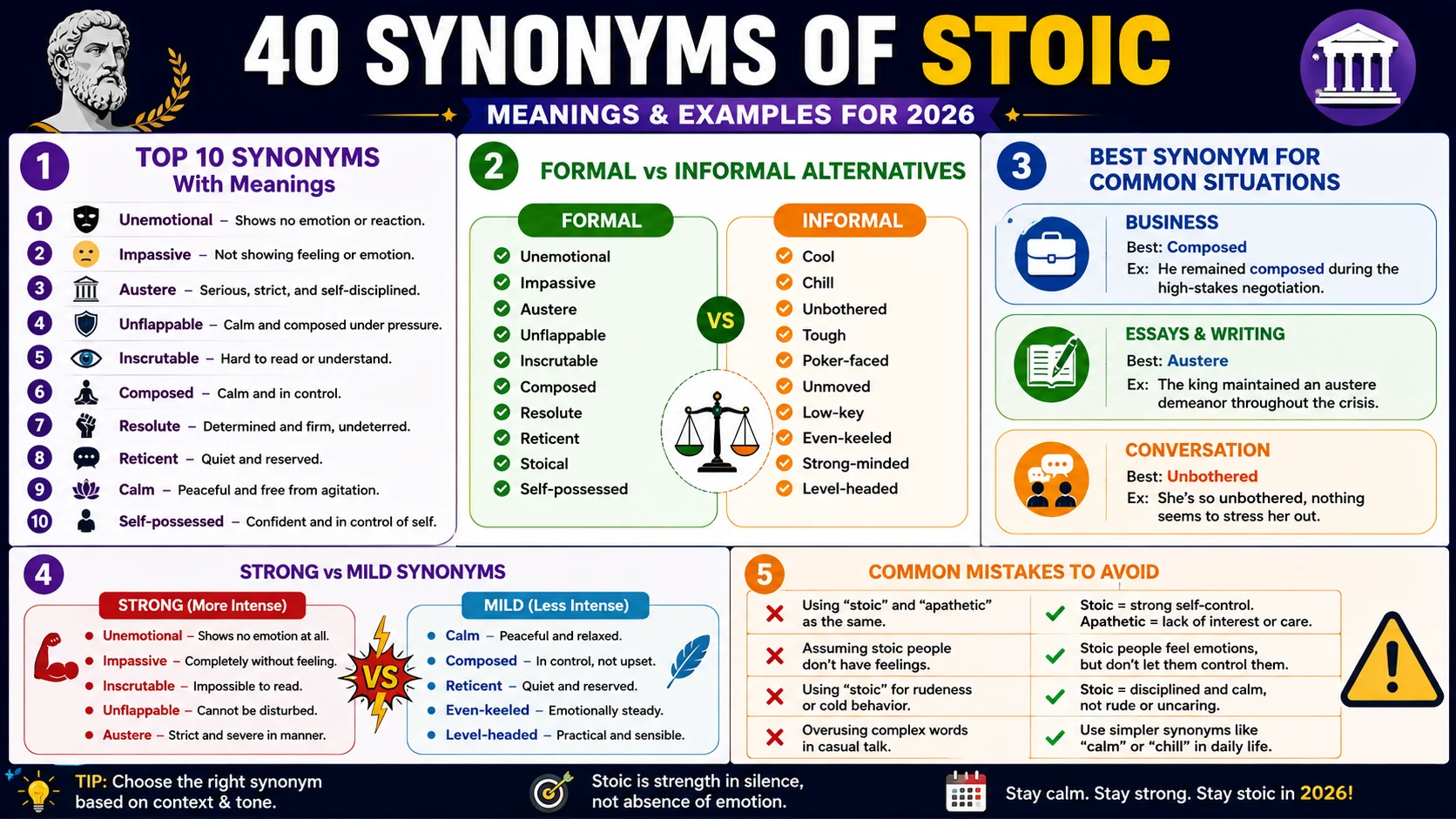
“Stoic” describes someone who endures pain or hardship without showing emotion or complaining. The best synonyms are unemotional, unflinching, resolute, impassive, and phlegmatic. “Unemotional” is the most common alternative. Each synonym has a slightly different shade of meaning.
Top 10 Synonyms
- Unemotional
- Unflinching
- Resolute
- Impassive
- Phlegmatic
- Stoical
- Undemonstrative
- Stolid
- Unmoved
- Apathetic
“Stoic” is a fascinating word. It comes from an ancient Greek philosophy that taught people to endure hardship without complaining. Today, we use it to describe someone who stays calm and unemotional in tough situations.
But using “stoic” too often can make your writing feel repetitive. There are many wonderful alternatives that capture different shades of emotional control and resilience.
In this guide, you’ll learn 35 powerful synonyms for “stoic.” You’ll discover exactly when to use each one, how formal they are, and what common mistakes to avoid. Let’s begin!
What Does “Stoic” Mean?
Definition
Stoic” means showing no emotion or complaint when something difficult or painful happens. A stoic person stays calm, strong, and unemotional in the face of hardship. They don’t show their feelings, even when things are hard. The word comes from Stoicism, an ancient Greek philosophy that valued emotional control.
Pronunciation
| Feature | Value |
|---|---|
| US IPA | /ˈstoʊɪk/ |
| UK IPA | /ˈstəʊɪk/ |
| Syllables | 2 (sto-ic) |
| Tip | Stress the first syllable: “STOW-ik” |
Grammar
| Grammar Feature | Information |
|---|---|
| Part of Speech | Adjective (and noun) |
| Common Position | Before a noun or after a linking verb |
| Typical Pattern | Be + stoic / Stoic + noun |
Examples:
- “He remained stoic during the crisis.” (adjective)
- “The stoic soldier showed no fear.” (adjective)
- “She is a stoic in difficult times.” (noun)
Grammar Note: “Stoic” can be used as both an adjective (describing a person) and a noun (a person who is stoic). The noun is less common.
Word Family
| Word | Part of Speech | Meaning |
|---|---|---|
| Stoic | Adjective/Noun | Showing no emotion in hardship |
| Stoical | Adjective | Another form of stoic |
| Stoicism | Noun | The philosophy or practice of being stoic |
| Stoically | Adverb | In a stoic manner |
15 Synonyms of “Stoic”
Unemotional
Meaning: Not showing or feeling strong emotions.
Best Used For: General situations where someone is calm and controlled.
Formality: Neutral
Tone: Neutral, Clinical
Frequency: ⭐⭐⭐⭐⭐ (Very Common)
CEFR Level: B2
Example Sentence 1: “He remained unemotional during the argument.”
Example Sentence 2: “The doctor stayed unemotional while delivering the news.”
Usage Tip: “Unemotional” is the most direct and common alternative. It’s a simple, clear word that works in almost any context.
Unflinching
Meaning: Not showing fear or hesitation in the face of danger or difficulty.
Best Used For: Brave or courageous contexts, facing challenges.
Formality: Formal
Tone: Brave, Steadfast
Frequency: ⭐⭐⭐ (Moderate)
CEFR Level: B2
Example Sentence 1: “She gave an unflinching account of the accident.”
Example Sentence 2: “The soldier was unflinching in battle.”
Usage Tip: “Unflinching” emphasizes courage and not backing down. It’s more about bravery than just emotional control.
Resolute
Meaning: Determined and firm, not changing your mind or being persuaded.
Best Used For: Decisions, goals, standing firm.
Formality: Formal
Tone: Determined, Strong
Frequency: ⭐⭐⭐⭐ (Common)
CEFR Level: B2
Example Sentence 1: “He remained resolute in his decision.”
Example Sentence 2: “She was resolute despite the difficulties.”
Usage Tip: “Resolute” emphasizes firmness of purpose. It’s about being determined, not just unemotional.
Common Confusion: Resolute vs Stoic. “Resolute” is about determination. “Stoic” is about not showing emotion.
Impassive
Meaning: Not showing any emotion or reaction.
Best Used For: Facial expressions, reactions, formal contexts.
Formality: Formal
Tone: Controlled, Unreadable
Frequency: ⭐⭐⭐ (Moderate)
CEFR Level: B2
Example Sentence 1: “Her face remained impassive during the interview.”
Example Sentence 2: “The judge was impassive throughout the trial.”
Usage Tip: “Impassive” is a formal word that specifically describes someone who shows no emotion on their face. Perfect for courtroom or formal settings.
Phlegmatic
Meaning: Calm and unemotional, not easily excited or upset.
Best Used For: Describing personality types, formal contexts.
Formality: Formal
Tone: Calm, Temperate
Frequency: ⭐⭐ (Rare)
CEFR Level: C1
Example Sentence 1: “He has a phlegmatic personality and rarely gets upset.”
Example Sentence 2: “She faced the crisis with phlegmatic calm.”
Usage Tip: “Phlegmatic” is quite rare and formal. It describes someone who is naturally calm and unemotional. It comes from ancient medicine.
Stoical
Meaning: Another form of “stoic.” Showing patience and endurance without complaining.
Best Used For: Formal writing, endurance contexts.
Formality: Formal
Tone: Patient, Enduring
Frequency: ⭐⭐⭐ (Moderate)
CEFR Level: B2
Example Sentence 1: “She faced her illness with stoical acceptance.”
Example Sentence 2: “He endured the pain with stoical patience.”
Usage Tip: “Stoical” is just a slightly more formal version of “stoic.” They mean the same thing and can be used interchangeably.
Undemonstrative
Meaning: Not showing emotions or feelings openly.
Best Used For: Personality descriptions, people who are reserved.
Formality: Formal
Tone: Reserved, Private
Frequency: ⭐⭐ (Rare)
CEFR Level: C1
Example Sentence 1: “He is an undemonstrative man who never shows affection openly.”
Example Sentence 2: “Her undemonstrative nature made her hard to read.
Usage Tip: “Undemonstrative” describes someone who doesn’t show emotions, especially affection or excitement. It’s about emotional expression, not just reaction.
Stolid
Meaning: Calm and not easily excited, sometimes seeming slow or dull.
Best Used For: Describing someone who is calm but not emotional.
Formality: Formal
Tone: Calm, Phlegmatic
Frequency: ⭐⭐⭐ (Moderate)
CEFR Level: C1
Example Sentence 1: “His stolid face showed no reaction to the news.”
Example Sentence 2: “The stolid soldier waited patiently.”
Usage Tip: “Stolid” suggests a heavy, slow calmness. It can sometimes imply the person is dull or unresponsive.
Unmoved
Meaning: Not affected by emotion or persuasion.
Best Used For: Emotional appeals, persuasion, not reacting emotionally.
Formality: Neutral
Tone: Steady, Unaffected
Frequency: ⭐⭐⭐⭐ (Common)
CEFR Level: B2
Example Sentence 1: “She was unmoved by the sad story.”
Example Sentence 2: “He remained unmoved by their arguments.”
Usage Tip: “Unmoved” focuses on not being affected emotionally. It’s a common and natural alternative to “stoic.”
Apathetic
Meaning: Not interested, concerned, or emotional.
Best Used For: Negative contexts, lack of interest.
Formality: Neutral
Tone: Negative, Uninterested
Frequency: ⭐⭐⭐⭐ (Common)
CEFR Level: B2
Example Sentence 1: “The students were apathetic about the election.”
Example Sentence 2: “He was apathetic and showed no emotion.”
Usage Tip: “Apathetic” has a negative tone. It suggests a lack of interest, not just emotional control. Use it carefully.
Common Confusion: Apathetic vs Stoic. “Apathetic” is negative and suggests not caring. “Stoic” is more neutral or positive, suggesting strength through hardship.
Dispassionate
Meaning: Not influenced by personal feelings or emotions.
Best Used For: Judgments, decisions, formal analysis.
Formality: Formal
Tone: Objective, Reasoned
Frequency: ⭐⭐⭐ (Moderate)
CEFR Level: B2
Example Sentence 1: “The judge gave a dispassionate ruling.”
Example Sentence 2: “We need a dispassionate analysis of the situation.”
Usage Tip: “Dispassionate” is about being objective and reasonable, without emotion clouding judgment. It’s great for professional contexts.
Composed
Meaning: Calm and in control of your feelings.
Best Used For: Crisis situations, staying calm.
Formality: Neutral
Tone: Calm, Controlled
Frequency: ⭐⭐⭐⭐ (Common)
CEFR Level: B2
Example Sentence 1: “She remained composed throughout the emergency.”
Example Sentence 2: “He was composed and ready to answer questions.”
Usage Tip: “Composed” is about staying calm and in control. It’s a positive word that works well in professional and personal contexts.
Unruffled
Meaning: Calm and not agitated, even in difficult situations.
Best Used For: Crisis situations, staying calm under pressure.
Formality: Neutral
Tone: Calm, Collected
Frequency: ⭐⭐⭐ (Moderate)
CEFR Level: B2
Example Sentence 1: “She was unruffled by the angry complaints.”
Example Sentence 2: “The pilot remained unruffled during the turbulence.”
Usage Tip: “Unruffled” means calm despite difficulties. It suggests you don’t get easily disturbed.
Indifferent
Meaning: Not caring or interested.
Best Used For: Situations where someone doesn’t care.
Formality: Neutral
Tone: Negative, Unconcerned
Frequency: ⭐⭐⭐⭐ (Common)
CEFR Level: B2
Example Sentence 1: “He was indifferent to the criticism.”
Example Sentence 2: “She felt indifferent about the outcome.”
Usage Tip: “Indifferent” suggests not caring. It’s similar to “apathetic” but focuses on lack of interest or concern.
Long-suffering
Meaning: Patiently enduring trouble or suffering for a long time.
Best Used For: Endurance, patience through hardship.
Formality: Neutral
Tone: Patient, Enduring
Frequency: ⭐⭐⭐ (Moderate)
CEFR Level: B2
Example Sentence 1: “She was a long-suffering wife who endured years of hardship.”
Example Sentence 2: “His long-suffering patience was finally rewarded.”
Usage Tip: “Long-suffering” emphasizes patience and endurance over time. It’s not just about not showing emotion, but about enduring suffering for a long time.
Synonyms Comparison Table
| Synonym | Best Context | Formality | Tone | Frequency |
|---|---|---|---|---|
| Unemotional | General use | Neutral | Neutral | ⭐⭐⭐⭐⭐ |
| Composed | Calm in crises | Neutral | Positive | ⭐⭐⭐⭐ |
| Unmoved | Emotional situations | Neutral | Steady | ⭐⭐⭐⭐ |
| Dispassionate | Judgments, analysis | Formal | Objective | ⭐⭐⭐ |
| Impassive | Facial expressions | Formal | Controlled | ⭐⭐⭐ |
| Resolute | Decisions, goals | Formal | Determined | ⭐⭐⭐⭐ |
| Unflinching | Courage, challenges | Formal | Brave | ⭐⭐⭐ |
| Indifferent | Lack of caring | Neutral | Negative | ⭐⭐⭐⭐ |
| Apathetic | Lack of interest | Neutral | Negative | ⭐⭐⭐⭐ |
| Stolid | Heavy calmness | Formal | Phlegmatic | ⭐⭐⭐ |
Best Synonyms by Situation
| Situation | Best Synonym | Why It Works |
|---|---|---|
| Daily Conversation | Unemotional | Natural and simple |
| Business Email | Composed | Professional and positive |
| Academic Writing | Dispassionate | Formal and objective |
| School Assignment | Resolute | Shows strength of character |
| Professional Meeting | Composed | Sounds professional |
| Presentation | Unruffled | Calm and capable |
| Creative Writing | Impassive | Adds literary quality |
| Social Media | Unmoved | Relatable and direct |
| Legal Context | Impassive | Professional and controlled |
Formal vs Informal Synonyms
Formal Alternatives
| Synonym | Best Used For |
|---|---|
| Impassive | Courtrooms, formal settings |
| Dispassionate | Judgments, analysis |
| Phlegmatic | Personality descriptions |
| Stolid | Formal descriptions of calmness |
| Undemonstrative | Reserved personalities |
Neutral Alternatives
| Synonym | Best Used For |
|---|---|
| Unemotional | Most general situations |
| Composed | Staying calm |
| Unmoved | Not reacting emotionally |
| Unruffled | Staying calm under pressure |
Informal Alternatives
| Synonym | Best Used For |
|---|---|
| Unemotional | Everyday speech |
| Calm | Most situations |
| Cool | Casual conversations |
Choosing the Right Level: In academic writing, use “dispassionate” or “impassive.” In professional contexts, use “composed” or “unruffled.” In casual conversation, “unemotional” or “calm” sound natural.
Strong vs Mild Synonyms
Mild
Suitable for everyday situations with less intensity.
- Unemotional
- Calm
- Composed
Moderate
More effortful or specific alternatives.
- Unmoved
- Unruffled
- Resolute
- Dispassionate
Strong
High-intensity alternatives suggesting deep emotional control.
- Impassive (complete emotional control)
- Stolid (heavy, unmoving calm)
- Phlegmatic (natural unemotional temperament)
- Unflinching (facing difficulty without fear)
How Intensity Changes Meaning: “He was calm” is simple. “He was impassive” suggests complete emotional control. Choose stronger words when you want to emphasize extreme emotional control or resilience.
Real-Life Examples
School: “The teacher remained unemotional when delivering the bad news.”
Office: “She was composed during the difficult meeting.”
Business Email: “We need a dispassionate analysis of the situation.”
Meetings: “He stayed unruffled despite the tough questions.”
Presentations: “The speaker was composed and confident.”
Daily Conversations: “My grandfather is very stoic about his health problems.”
Social Media: “She stayed unmoved by the negative comments.”
Academic Writing: “The researcher provided a dispassionate evaluation.”
Common Collocations
| Common Phrase | Better Alternative |
|---|---|
| Stoic face | Impassive face |
| Stoic silence | Unemotional silence |
| Stoic endurance | Patient endurance |
| Stoic acceptance | Calm acceptance |
| Stoic response | Unruffled response |
Common Phrases
Stiff upper lip: A British phrase meaning to remain stoic. (e.g., “He kept a stiff upper lip throughout the ordeal.”)
Keep your cool: To stay calm. (e.g., “She kept her cool during the argument.”)
Bite the bullet: To endure something painful without complaint. (e.g., “He had to bite the bullet and face the consequences.”)
Take it on the chin: To accept something bad without complaining. (e.g., “She took the criticism on the chin.”)
Keep a poker face: To not show emotion. (e.g., “He kept a poker face during the meeting.”)
Context Guide
| Situation | Best Synonym | Reason |
|---|---|---|
| Essay | Dispassionate | Academic and objective |
| Speech | Resolute | Inspiring and firm |
| Business Email | Composed | Professional and controlled |
| Novel | Impassive | Adds literary depth |
| Presentation | Unruffled | Calm and capable |
| Conversation | Unemotional | Natural and clear |
| Academic Writing | Impassive | Formal and precise |
| Marketing Copy | Composed | Professional and trustworthy |
Related Words
Near Synonyms
- Temperate: Calm and restrained. (e.g., “He has a temperate response to criticism.”)
- Imperturbable: Calm and not easily disturbed. (e.g., “She is imperturbable in emergencies.”)
- Unflappable: Calm under pressure. (e.g., “He is unflappable in a crisis.”)
- Placid: Calm and peaceful. (e.g., “She has a placid demeanor.”)
Antonyms
- Emotional: Showing strong feelings.
- Volatile: Easily upset or explosive.
- vehement: Overly emotional.
- Dramatic: Reacting emotionally.
- Excitable: Easily excited.
Related Adjectives
- Emotionless: Showing no emotion.
- Calm: Peaceful and controlled.
- Serene: Completely calm.
- Tranquil: Quiet and peaceful.
- Controlled: In control of emotions.
Related Nouns
- Stoicism: The philosophy of being stoic.
- Resilience: The ability to recover from hardship.
- Fortitude: Courage and strength in pain.
- Endurance: The ability to last through hardship.
Related Verbs
- Endure: To suffer through something.
- Tolerate: To accept something unpleasant.
- Persevere: To continue despite difficulty.
- Bear: To withstand something.
Frequently Asked Questions
What is another word for stoic?
Common synonyms are unemotional, unflinching, resolute, impassive, and phlegmatic. The best choice depends on the context and what aspect of emotional control you want to emphasize.
Which synonym sounds the most professional?
Dispassionate and impassive sound very professional. They are often used in legal, academic, and business contexts.
What is the strongest synonym for stoic?
Impassive is one of the strongest synonyms. It describes someone who shows absolutely no emotion. “Stolid” is also strong, suggesting heavy, unmoving calm.
Which synonym is best for essays?
Dispassionate is excellent for academic essays. “Impassive” and “phlegmatic” are also good for formal writing.
What’s the difference between stoic and unemotional?
“Stoic” often implies enduring hardship without complaint. “Unemotional” is a broader word that simply means not showing emotion, without the endurance aspect.
Which synonym is most common in everyday English?
“Unemotional” is the most common alternative. “Composed” and “unmoved” are also frequently used.
What is the opposite of stoic?
Common opposites are emotional, intense, vehement, piercing, chaotic. These describe people who show strong emotions.
Conclusion
Stoic” is a powerful word with rich meaning, but now you have 35 fantastic alternatives to choose from. Each synonym adds a different shade of meaning to your language.
Remember, the key is understanding the context and choosing the right word. Use “unemotional” for general situations. Use “resolute” for determination. Use “impassive” for complete emotional control. Use “composed” for staying calm in crises. Use “dispassionate” for objective analysis.
The best way to improve is practice. Try using one or two new synonyms each day. Listen for these words in conversations, books, and movies. Your vocabulary will become richer and more impressive with time.
