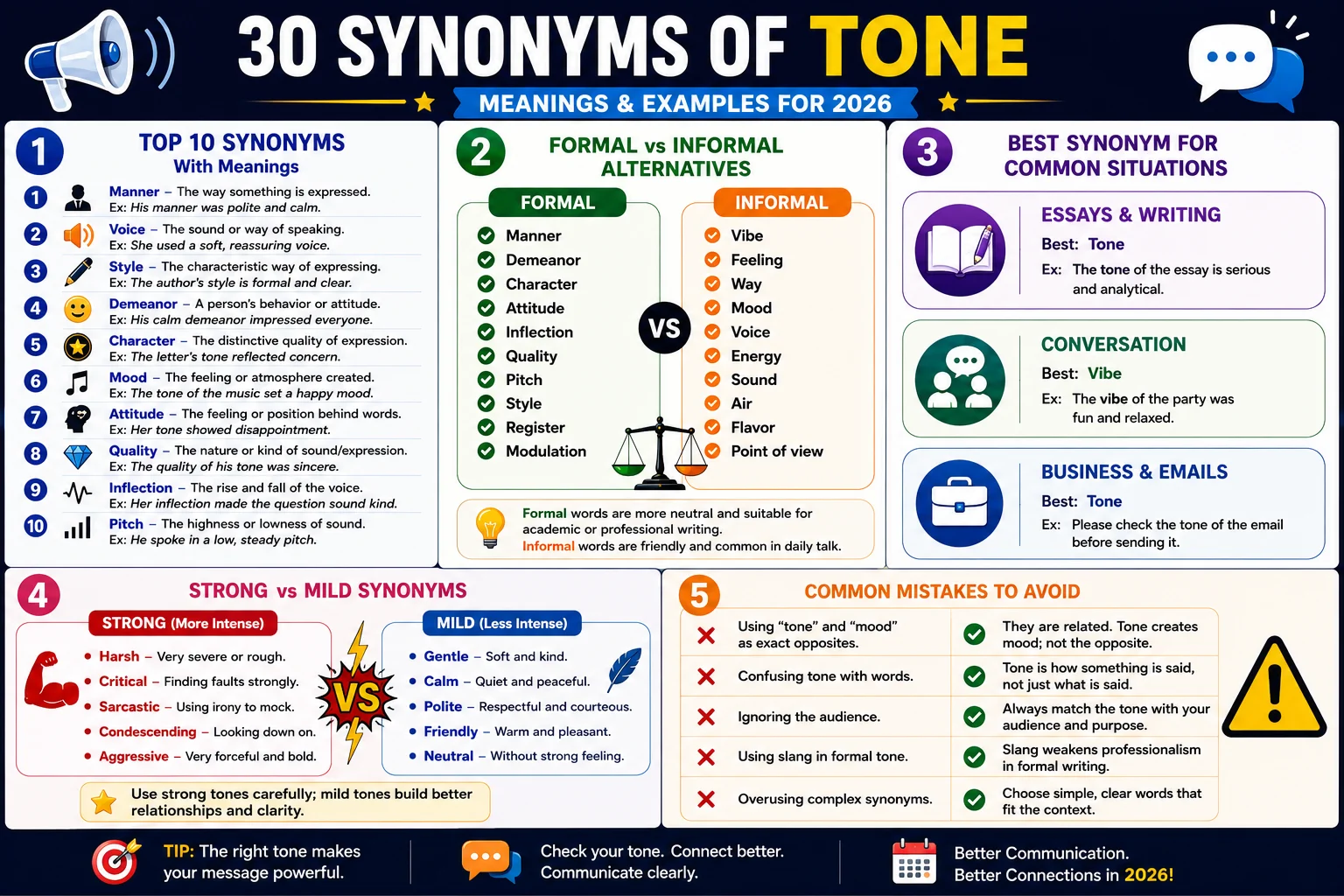
“Tone” means the general character, mood, or attitude of something. It can also mean the quality of sound. The best synonyms are mood, attitude, character, style, and atmosphere. “Mood” is the most common alternative. Each synonym has a slightly different meaning and context.
Top 10 Synonyms
- Mood
- Attitude
- Character
- Style
- Atmosphere
- Quality
- Accent
- Pitch
- Tempo
- Inflection
“Tone” is a word we use in many different ways. It can describe the sound of a voice, the mood of a piece of writing, or the general feeling of a place. It’s useful, but using it too often can make your language feel repetitive.
Think about it. You might talk about the tone of a voice, the tone of an email, or the tone of a room’s decor. Each situation might need a different word that captures the exact meaning more precisely.
In this guide, you’ll learn 35 powerful synonyms for “tone.” You’ll discover exactly when to use each one, how formal they are, and what common mistakes to avoid. Let’s begin!
What Does “Tone” Mean?
Definition
Tone” has two main meanings. First, it means the quality or character of sound, especially in a voice or musical note. Second, it means the general mood, attitude, or character of something like a piece of writing, a conversation, or a place. It’s about the feeling, quality, or style of something.
Pronunciation
| Feature | Value |
|---|---|
| US IPA | /toʊn/ |
| UK IPA | /təʊn/ |
| Syllables | 1 |
| Tip | Rhymes with “phone” and “bone” |
Grammar
| Grammar Feature | Information |
|---|---|
| Part of Speech | Noun |
| Common Position | Subject or object |
| Typical Pattern | Tone + of + something |
Examples:
- “The tone of her voice was angry.” (sound quality)
- “The tone of the email was friendly.” (attitude)
- “The painting has a warm tone.” (color quality)
Grammar Note: “Tone” can be countable or uncountable. You can have “a tone” (specific quality) or “tone” (general concept).
Word Family
| Word | Part of Speech | Meaning |
|---|---|---|
| Tone | Noun | Quality of sound or general character |
| Toneless | Adjective | Without tone |
| Tonal | Adjective | Relating to tone |
| Tone-deaf | Adjective | Unable to distinguish musical pitches |
15 Synonyms of “Tone”
Mood
Meaning: The general feeling or atmosphere that someone or something creates.
Best Used For: Describing feelings in places, writing, music, and people.
Formality: Neutral
Tone: Emotional, Descriptive
Frequency: ⭐⭐⭐⭐⭐ (Very Common)
CEFR Level: A2
Example Sentence 1: “The mood in the room was tense and uncomfortable.”
Example Sentence 2: “The movie has a dark and mysterious mood.”
Usage Tip: “Mood” is the most natural alternative for describing the feeling of a place, event, or piece of art.
Common Confusion: Mood vs Tone. “Mood” is what the audience feels. “Tone” is the creator’s attitude. They’re closely related but slightly different.
Attitude
Meaning: A person’s way of thinking or feeling about something.
Best Used For: Describing someone’s tone in speech or writing.
Formality: Neutral
Tone: Personal, Judgmental
Frequency: ⭐⭐⭐⭐⭐ (Very Common)
CEFR Level: A2
Example Sentence 1: “His attitude toward the project was very positive.”
Example Sentence 2: “She has a professional attitude at work.”
Usage Tip: “Attitude” is great for describing the tone behind someone’s words or actions.
Character
Meaning: The particular combination of qualities in someone or something.
Best Used For: Describing the distinctive quality of a place, person, or thing.
Formality: Formal
Tone: Descriptive, Intellectual
Frequency: ⭐⭐⭐⭐ (Common)
CEFR Level: B1
Example Sentence 1: “The old building has a lot of character.
Example Sentence 2: “Her character comes through in her writing.”
Usage Tip: “Character” suggests a distinctive, unique quality. Use it when you want to highlight what makes something special.
Style
Meaning: A particular way of doing something or expressing something.
Best Used For: Writing, art, design, and personal expression.
Formality: Neutral
Tone: Creative, Artistic
Frequency: ⭐⭐⭐⭐⭐ (Very Common)
CEFR Level: A2
Example Sentence 1: “Her writing style is very clear and direct.”
Example Sentence 2: “The restaurant has a modern style.”
Usage Tip: “Style” focuses on the way something is done. Use it for artistic and expressive contexts.
Atmosphere
Meaning: The feeling or mood that surrounds a place or situation.
Best Used For: Places, events, and written descriptions.
Formality: Formal
Tone: Descriptive, Imaginative
Frequency: ⭐⭐⭐⭐ (Common)
CEFR Level: B1
Example Sentence 1: “The atmosphere in the café was cozy and welcoming.”
Example Sentence 2: “The atmosphere at the concert was electric.”
Usage Tip: “Atmosphere” is about the feeling of a place or event. It’s more external than “mood.”
Quality
Meaning: A distinctive feature or characteristic of something.
Best Used For: Sound, character, general description.
Formality: Neutral
Tone: Analytical, Descriptive
Frequency: ⭐⭐⭐⭐⭐ (Very Common)
CEFR Level: A2
Example Sentence 1: “The quality of her voice is very distinctive.”
Example Sentence 2: “The sound quality was excellent.”
Usage Tip: “Quality” is a general word for describing characteristics. Use it for sound, voice, and general features.
Accent
Meaning: A particular way of pronouncing words, or emphasis on something.
Best Used For: Speech, pronunciation, emphasis.
Formality: Neutral
Tone: Observational, Linguistic
Frequency: ⭐⭐⭐⭐ (Common)
CEFR Level: B1
Example Sentence 1: “She speaks with a British accent.”
Example Sentence 2: “The accent should be on the first syllable.”
Usage Tip: “Accent” is specifically about pronunciation or emphasis, not general mood.
Pitch
Meaning: The highness or lowness of a sound.
Best Used For: Sound, voice, music.
Formality: Neutral
Tone: Technical, Observational
Frequency: ⭐⭐⭐ (Moderate)
CEFR Level: B1
Example Sentence 1: “His voice was high in pitch.”
Example Sentence 2: “The pitch of the instrument was perfect.”
Usage Tip: “Pitch” is a technical term for the highness or lowness of sound. Use it for musical and voice contexts.
Tempo
Meaning: The speed or pace of something, especially music or speech.
Best Used For: Music, speech, activity.
Formality: Neutral
Tone: Rhythmic, Measured
Frequency: ⭐⭐⭐ (Moderate)
CEFR Level: B2
Example Sentence 1: “The tempo of the music was slow.”
Example Sentence 2: “She spoke at a fast tempo.”
Usage Tip: “Tempo” is about speed or pace. Use it for music, speech, and any rhythmic activity.
Inflection
Meaning: A change in the pitch or tone of the voice.
Best Used For: Speech, voice, meaning.
Formality: Formal
Tone: Technical, Linguistic
Frequency: ⭐⭐ (Rare)
CEFR Level: C1
Example Sentence 1: “She used a questioning inflection at the end of the sentence.”
Example Sentence 2: “His voice had a soft inflection.”
Usage Tip: “Inflection” is a technical linguistic term. Use it when describing voice changes that affect meaning.
Cadence
Meaning: The rhythm or flow of sound in speech or music.
Best Used For: Speech, music, poetry.
Formality: Formal
Tone: Rhythmic, Literary
Frequency: ⭐⭐ (Rare)
CEFR Level: C1
Example Sentence 1: “The cadence of her speech was soothing.”
Example Sentence 2: “The poem has a beautiful cadence.
Usage Tip: “Cadence” is a literary word for rhythm. Use it in poetic or descriptive contexts.
Aura
Meaning: The distinctive atmosphere or quality surrounding someone or something.
Best Used For: People, places, spiritual contexts.
Formality: Formal
Tone: Mystical, Descriptive
Frequency: ⭐⭐⭐ (Moderate)
CEFR Level: B2
Example Sentence 1: “She has an aura of confidence.”
Example Sentence 2: “The old library had an aura of peace.”
Usage Tip: “Aura” suggests a mysterious or special quality. Use it for describing people or places with a unique feeling.
Color
Meaning: A distinctive quality or character.
Best Used For: Writing, personality, description.
Formality: Neutral
Tone: Creative, Descriptive
Frequency: ⭐⭐⭐⭐ (Common)
CEFR Level: B1
Example Sentence 1: “His writing has a lot of color and emotion.”
Example Sentence 2: “The story was full of local color.”
Usage Tip: “Color” as a synonym for tone adds vividness. Use it in creative and descriptive contexts.
Flavor
Meaning: A distinctive quality or character.
Best Used For: Writing, experiences, places.
Formality: Informal
Tone: Creative, Imaginative
Frequency: ⭐⭐⭐ (Moderate)
CEFR Level: B1
Example Sentence 1: “The book has a distinctly British flavor.”
Example Sentence 2: “The neighborhood has a vibrant flavor.”
Usage Tip: “Flavor” is an informal, creative synonym for distinctive quality. It’s great for descriptive writing.
Spirit
Meaning: The prevailing or typical quality, mood, or attitude.
Best Used For: Communities, organizations, groups.
Formality: Neutral
Tone: Positive, Inspirational
Frequency: ⭐⭐⭐⭐ (Common)
CEFR Level: B1
Example Sentence 1: “The team has a great spirit of cooperation.”
Example Sentence 2: “The spirit of the festival was lively.”
Usage Tip: “Spirit” emphasizes the positive, energetic quality of a group or situation.
Synonyms Comparison Table
| Synonym | Best Context | Formality | Tone | Frequency |
|---|---|---|---|---|
| Mood | General feeling | Neutral | Emotional | ⭐⭐⭐⭐⭐ |
| Attitude | Personal tone | Neutral | Personal | ⭐⭐⭐⭐⭐ |
| Style | Expression | Neutral | Creative | ⭐⭐⭐⭐⭐ |
| Atmosphere | Place/event | Formal | Descriptive | ⭐⭐⭐⭐ |
| Quality | Sound/character | Neutral | Analytical | ⭐⭐⭐⭐⭐ |
| Character | Distinctive quality | Formal | Intellectual | ⭐⭐⭐⭐ |
| Pitch | Sound height | Neutral | Technical | ⭐⭐⭐ |
| Tempo | Speed/pace | Neutral | Rhythmic | ⭐⭐⭐ |
| Inflection | Voice change | Formal | Linguistic | ⭐⭐ |
| Cadence | Rhythm | Formal | Literary | ⭐⭐ |
Best Synonyms by Situation
| Situation | Best Synonym | Why It Works |
|---|---|---|
| Daily Conversation | Mood / Attitude | Natural and clear |
| Business Email | Style / Tone | Professional |
| Academic Writing | Character | Formal and precise |
| School Assignment | Mood / Atmosphere | Descriptive |
| Professional Meeting | Attitude | Direct and clear |
| Presentation | Style / Quality | Professional |
| Creative Writing | Flavor / Aura | Literary and vivid |
| Social Media | Vibe (slang) | Casual and modern |
| Music Review | Tempo / Pitch | Technical and accurate |
Formal vs Informal Synonyms
Formal Alternatives
| Synonym | Best Used For |
|---|---|
| Atmosphere | Describing places and events |
| Character | Distinctive qualities |
| Inflection | Voice changes, linguistic contexts |
| Cadence | Speech and music rhythm |
| Aura | Mysterious or special quality |
Neutral Alternatives
| Synonym | Best Used For |
|---|---|
| Mood | General feelings |
| Attitude | Personal feelings |
| Style | Creative expression |
| Quality | Sound and general features |
Informal Alternatives
| Synonym | Best Used For |
|---|---|
| Vibe | Casual conversation |
| Flavor | Distinctive quality |
| Spirit | Positive group energy |
Choosing the Right Level: Use “atmosphere” and “character” in formal contexts. Use “mood” and “attitude” in everyday conversation. Use “vibe” only with friends.
Strong vs Mild Synonyms
Mild
Suitable for everyday descriptions.
- Mood
- Style
- Feel
Moderate
More descriptive or specific alternatives.
- Attitude
- Atmosphere
- Quality
- Character
Strong
High-intensity or technical alternatives.
- Inflection (technical voice change)
- Cadence (literary rhythm)
- Aura (mystical quality)
- Tempo (exact speed)
How Intensity Changes Meaning: “The mood was sad” is simple. “The atmosphere was melancholic” sounds more sophisticated. “His cadence was measured” is very precise. Choose based on how technical or descriptive you want to be.
Real-Life Examples
School: “The tone of the teacher’s voice was encouraging.”
Office: “The attitude of the team was very positive.”
Business Email: “Please consider the tone of your message.”
Meetings: “The atmosphere in the room was professional.”
Presentations: “The style of the presentation was very engaging.”
Daily Conversations: “I don’t like the mood she’s in today.”
Social Media: “I love the vibe of this place!”
Creative Writing: “The author’s writing has a unique flavor.”
Common Collocations
| Common Phrase | Better Alternative |
|---|---|
| Tone of voice | Quality of voice |
| Tone of the email | Attitude of the email |
| Tone of the room | Atmosphere of the room |
| Musical tone | Musical quality |
| Tone of the conversation | Mood of the conversation |
Common Phrases
Set the tone: To establish a mood or atmosphere. (e.g., “The music set the tone for the evening.”)
Tone down: To make less intense. (e.g., “You should tone down your criticism.”)
Give tone to: To add character or quality. (e.g., “The furniture gives the room a warm tone.”)
Tone deaf: Unable to distinguish pitch or insensitive. (e.g., “His comments were tone-deaf.”)
In good taste: Appropriate and refined. (e.g., “Her style was in good taste.”)
Context Guide
| Situation | Best Synonym | Reason |
|---|---|---|
| Essay | Character / Atmosphere | Academic and descriptive |
| Speech | Mood / Spirit | Engaging and inspiring |
| Business Email | Style / Attitude | Professional and clear |
| Novel | Cadence / Flavor | Literary and vivid |
| Presentation | Style / Quality | Professional and clear |
| Conversation | Mood / Attitude | Natural and direct |
| Academic Writing | Character / Quality | Precise and formal |
| Marketing Copy | Vibe / Spirit | Engaging and modern |
Related Words
Near Synonyms
- Vibe: A casual word for atmosphere or feeling. (e.g., “I love the vibe of this place.”)
- Feel: The general impression or atmosphere. (e.g., “The restaurant has a cozy feel.”)
- Temper: The quality of being angry or irritable. (e.g., “She has a bad temper.”)
- Temperament: A person’s natural mood. (e.g., “He has a calm temperament.”)
Antonyms
- Monotone: Without variation in pitch.
- Flatness: Lack of expression.
- Dullness: Lacking interest or excitement.
- Uniformity: Lack of variation.
Related Adjectives
- Tonal: Relating to tone.
- Monotonous: Lacking variation.
- Melodic: Pleasant sounding.
- Harmonious: Having a pleasant tone.
- Resonant: Deep and rich in tone.
Related Nouns
- Resonance: The quality of sound.
- Timbre: The quality of a musical sound.
- Harmony: A pleasing combination of sounds.
- Melody: A sequence of notes.
Related Verbs
- Intone: To speak in a particular tone.
- Inflect: To change the pitch of the voice.
- Modulate: To adjust or change the tone.
- Resonate: To produce a deep or rich sound.
Frequently Asked Questions
What is another word for tone?
Common synonyms include mood, attitude, character, style, and atmosphere. The best choice depends on whether you’re describing sound, writing, or general feeling.
Which synonym sounds the most professional?
Character and atmosphere sound very professional. “Quality” is also excellent for sound descriptions.
What is the strongest synonym for tone?
Cadence and inflection are the strongest technical synonyms. They are precise linguistic terms for voice quality and rhythm.
Which synonym is best for essays?
Character and atmosphere are excellent for essays. “Quality” is also good for analytical writing.
What’s the difference between tone and mood?
Tone is the creator’s or speaker’s attitude. Mood is how the audience or reader feels. The tone of a story might be humorous, but the mood might still be sad.
Which synonym is most common in everyday English?
“Mood” and “attitude” are very common in everyday speech. “Style” is also frequently used.
What is the opposite of tone?
Common opposites include monotone, flatness, and dullness. These words mean lacking variation or expression.
Conclusion
“Tone” is a versatile word, but now you have 35 fantastic alternatives. Each synonym adds a different shade of meaning to your language.
Remember, the key is understanding the context. Use “mood” for general feelings. Use “attitude” for personal feelings. Use “atmosphere” for places. Use “style” for creative expression. Use “cadence” and “inflection” for precise voice descriptions.
The best way to improve is practice. Try using one or two new synonyms each day. Listen for these words in conversations, books, and movies. Your vocabulary will become richer and more expressive with time.
