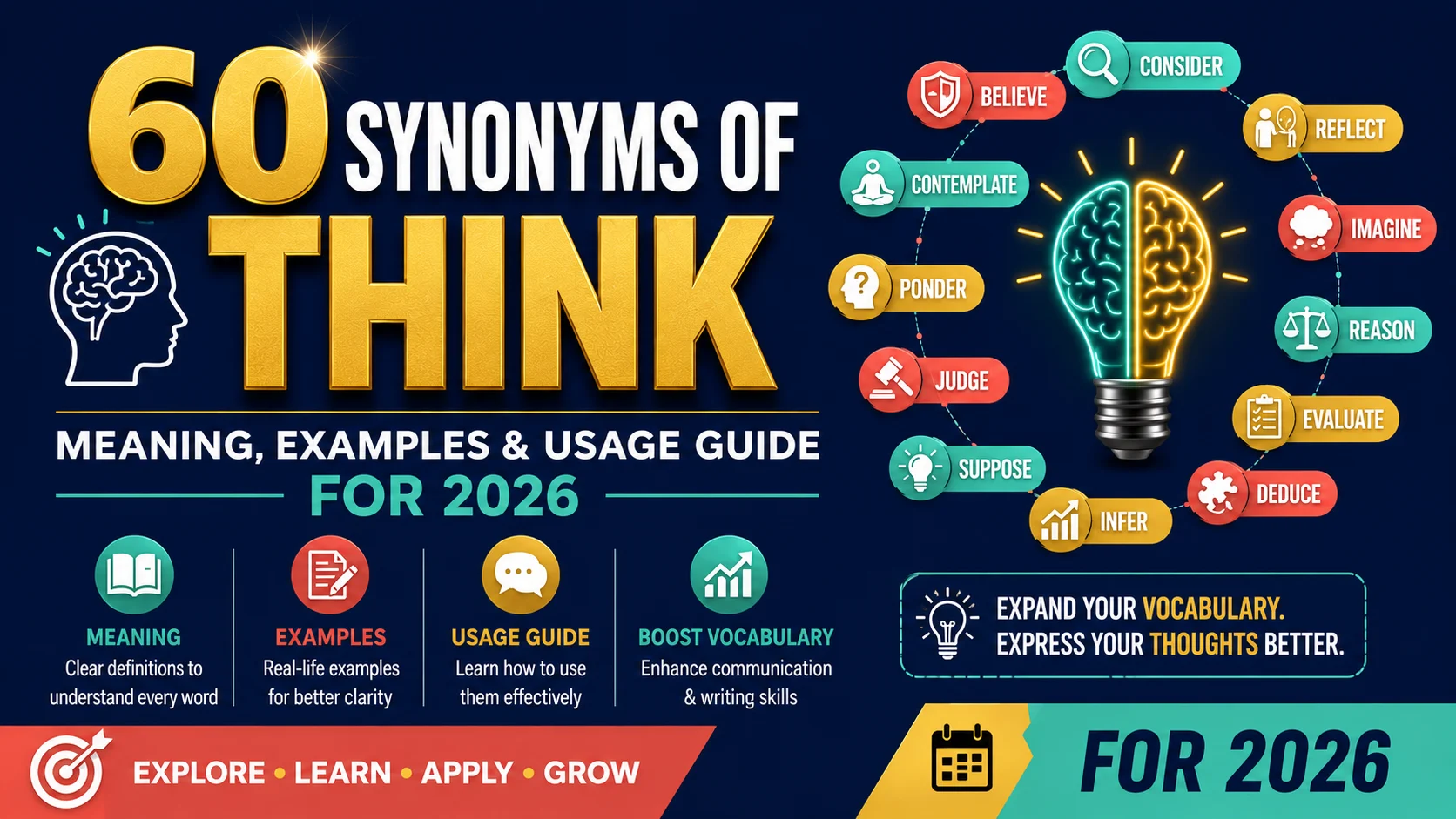
Think means to use your mind to consider ideas or form opinions. The best synonyms include believe, consider, reflect, ponder, contemplate, meditate, reason, and imagine. The most common everyday synonym is believe, while consider works best for careful thought. Each synonym has a slightly different meaning, tone, or context, so choose carefully based on your situation.
Top 10 Synonyms
- Believe
- Consider
- Reflect
- Ponder
- Contemplate
- Meditate
- Reason
- Imagine
- Suppose
- Reckon
Every synonym has a slightly different meaning, tone, or context, so choose carefully based on your situation.
Do you realize how often you use the word “think”? It’s one of the most common verbs in English, but overusing it can make your writing sound repetitive and dull.
Learning synonyms for “think” helps you express yourself more precisely. Whether you’re sharing an opinion, considering a decision, or just daydreaming, having the right word makes your English sound more natural and sophisticated.
In this guide, you’ll discover 35 powerful alternatives to “think.” You’ll learn their meanings, when to use them, and which ones native speakers prefer in different situations. Let’s begin!
What Does “Think” Mean?
Definition
Think means to use your brain to form ideas, opinions, or memories. It’s the process of considering something in your mind.
In everyday terms, when you think, you’re actively using your mind. You might be solving a problem, remembering something, imagining the future, or forming an opinion.
Think can describe:
- Forming opinions (“I think this is a good idea”)
- Considering options (“Think carefully before you decide”)
- Remembering (“I can’t think of his name”)
- Imagining (“Think of a world without war”)
Pronunciation
| Feature | Value |
|---|---|
| US IPA | /θɪŋk/ |
| UK IPA | /θɪŋk/ |
| Syllables | 1 |
| Tip | Put your tongue between your teeth for the ‘th’ sound |
Grammar
| Grammar Feature | Information |
|---|---|
| Part of Speech | Verb (irregular) |
| Common Position | After the subject, before the object |
| Typical Pattern | think + about/of + noun |
Example Sentences:
- “I think we should leave now.”
- “She thinks about the future often.”
- “He thought carefully before answering.”
Grammar Notes: “Think” is an irregular verb. Its forms are: think (base), thinks (third person), thought (past), thought (past participle), thinking (present participle). It’s often followed by “about” or “of.”
Word Family
| Word | Part of Speech | Meaning |
|---|---|---|
| Think | Verb | To use your mind to consider |
| Thought | Noun | An idea or opinion |
| Thinking | Noun/Adjective | The process of using your mind |
| Thoughtful | Adjective | Showing careful consideration |
| Thoughtless | Adjective | Not considering others |
| Thinker | Noun | A person who thinks deeply |
| Rethink | Verb | To think again |
60 Synonyms of “Think”
1. Believe
Meaning: To accept that something is true or real.
Best Used For: Opinions, faith, accepting ideas as true.
Formality: Neutral
Tone: Personal, Convicted
Frequency: ⭐⭐⭐⭐⭐ Very Common
CEFR Level: A2
Example Sentence 1: “I believe we made the right decision.”
Example Sentence 2: “She believes in helping others.”
Usage Tip: “Believe” is stronger than “think.” Use it when you have conviction. It’s perfect for opinions and faith.
Common Confusion: “Think” vs “Believe” – “Think” is more tentative. “Believe” suggests stronger conviction. “I think it might rain” vs “I believe it will rain.”
2. Consider
Meaning: To think about something carefully before making a decision.
Best Used For: Decisions, options, careful thought.
Formality: Neutral to Formal
Tone: Careful, Deliberate
Frequency: ⭐⭐⭐⭐⭐ Very Common
CEFR Level: B1
Example Sentence 1: “Please consider all your options before choosing.”
Example Sentence 2: “We are considering a change in strategy.”
Usage Tip: “Consider” suggests careful, thoughtful attention. Use it for important decisions and serious thinking.
3. Reflect
Meaning: To think deeply and carefully about something.
Best Used For: Personal growth, learning, serious thought.
Formality: Formal
Tone: Deep, Serious
Frequency: ⭐⭐⭐⭐ Common
CEFR Level: B2
Example Sentence 1: “She reflected on her childhood memories.”
Example Sentence 2: “Reflect on what you learned today.”
Usage Tip: “Reflect” suggests thinking with intention and depth. Use it for meaningful, serious thinking.
4. Ponder
Meaning: To think about something slowly and carefully.
Best Used For: Deep questions, serious decisions, contemplation.
Formality: Formal
Tone: Deep, Contemplative
Frequency: ⭐⭐⭐ Moderate
CEFR Level: B2
Example Sentence 1: “He pondered the meaning of life.
Example Sentence 2: “She pondered her next move carefully.”
Usage Tip: “Ponder” suggests slow, thoughtful consideration. Use it for big questions and important decisions.
5. Contemplate
Meaning: To think about something for a long time.
Best Used For: Big decisions, spiritual thoughts, serious reflection.
Formality: Formal
Tone: Deep, Serious
Frequency: ⭐⭐⭐ Moderate
CEFR Level: B2
Example Sentence 1: “She contemplated changing careers.”
Example Sentence 2: “He contemplated the stars and wondered about the universe.”
Usage Tip: “Contemplate” suggests long, deep thinking. Use it for life-changing decisions and philosophical questions.
6. Meditate
Meaning: To think deeply and calmly, often for relaxation or spiritual reasons.
Best Used For: Relaxation, mindfulness, spiritual practice.
Formality: Neutral
Tone: Calm, Peaceful
Frequency: ⭐⭐⭐⭐ Common
CEFR Level: B2
Example Sentence 1: “She meditates every morning to start her day calmly.”
Example Sentence 2: “He meditated on the problem and found a solution.”
Usage Tip: “Meditate” suggests peaceful, focused thinking. Use it for mindfulness and calm reflection.
7. Reason
Meaning: To think in a logical way; to use facts to reach a conclusion.
Best Used For: Problem-solving, arguments, logic.
Formality: Formal
Tone: Logical, Analytical
Frequency: ⭐⭐⭐⭐ Common
CEFR Level: B2
Example Sentence 1: “She reasoned that it was better to wait.”
Example Sentence 2: “He reasoned with himself before making the choice.”
Usage Tip: “Reason” suggests using logic and facts. Use it when thinking is based on evidence.
8. Imagine
Meaning: To form a picture or idea in your mind.
Best Used For: Creativity, planning, daydreaming.
Formality: Neutral
Tone: Creative, Positive
Frequency: ⭐⭐⭐⭐⭐ Very Common
CEFR Level: A2
Example Sentence 1: “Imagine a world without pollution.”
Example Sentence 2: “She imagined herself on a tropical beach.”
Usage Tip: “Imagine” is about creative thinking and mental images. Use it for creativity and planning.
9. Suppose
Meaning: To guess that something is true; to think without certainty.
Best Used For: Guessing, assumptions, hypotheticals.
Formality: Neutral
Tone: Tentative, Uncertain
Frequency: ⭐⭐⭐⭐ Common
CEFR Level: B1
Example Sentence 1: “I suppose you’re right about that.”
Example Sentence 2: “Suppose we arrive late—what then?”
Usage Tip: “Suppose” suggests uncertainty. Use it for guesses and assumptions.
10. Reckon
Meaning: To think or believe something, often used informally.
Best Used For: Informal conversation, opinions, guesses.
Formality: Informal
Tone: Casual, Friendly
Frequency: ⭐⭐⭐⭐ Common
CEFR Level: B1
Example Sentence 1: “I reckon it’s going to rain tomorrow.”
Example Sentence 2: “She reckons she can finish the project by Friday.”
Usage Tip: “Reckon” is informal and common in British English. Use it with friends and in casual contexts.
11. Assume
Meaning: To think something is true without proof.
Best Used For: Guesses, predictions, logical conclusions.
Formality: Neutral to Formal
Tone: Logical, Tentative
Frequency: ⭐⭐⭐⭐⭐ Very Common
CEFR Level: B1
Example Sentence 1: “I assume you’ve already eaten lunch.”
Example Sentence 2: “She assumed the package would arrive today.”
Usage Tip: “Assume” suggests thinking without certainty. Use it when you’re making a logical guess.
12. Presume
Meaning: To think something is true based on likely evidence.
Best Used For: Logical conclusions, formal guesses.
Formality: Formal
Tone: Logical, Confident
Frequency: ⭐⭐⭐⭐ Common
CEFR Level: B2
Example Sentence 1: “I presume you have completed the assignment.
Example Sentence 2: “He presumed the meeting was canceled.”
Usage Tip: “Presume” is similar to “assume” but suggests more confidence. Use it in formal contexts.
13. Conclude
Meaning: To decide or think something after considering the facts.
Best Used For: Decisions, research, conclusions.
Formality: Formal
Tone: Decisive, Logical
Frequency: ⭐⭐⭐⭐ Common
CEFR Level: B2
Example Sentence 1: “She concluded that the plan wouldn’t work.”
Example Sentence 2: “The jury concluded the defendant was innocent.”
Usage Tip: “Conclude” suggests reaching a final opinion. Use it when you’ve finished thinking and made a decision.
14. Determine
Meaning: To think and decide after careful consideration.
Best Used For: Decisions, solving problems, official outcomes.
Formality: Formal
Tone: Decisive, Official
Frequency: ⭐⭐⭐⭐ Common
CEFR Level: B2
Example Sentence 1: “She determined that the best option was to wait.”
Example Sentence 2: “The committee determined the winner.”
Usage Tip: “Determine” suggests reaching a firm conclusion. Use it for important decisions and official outcomes.
15. Deduce
Meaning: To think and figure out something using logic.
Best Used For: Detectives, problems, logic.
Formality: Formal
Tone: Logical, Analytical
Frequency: ⭐⭐⭐ Moderate
CEFR Level: B2
Example Sentence 1: “He deduced the answer from the clues.”
Example Sentence 2: “She deduced that he was lying.”
Usage Tip: “Deduce” is about using logic to figure things out. Use it for problem-solving and detective work.
16. Conceive
Meaning: To form an idea or plan in your mind.
Best Used For: Creativity, ideas, planning.
Formality: Formal
Tone: Creative, Ambitious
Frequency: ⭐⭐⭐ Moderate
CEFR Level: B2
Example Sentence 1: “She conceived a brilliant idea for a new business.”
Example Sentence 2: “He conceived the project years ago.”
Usage Tip: “Conceive” suggests creating ideas. Use it for creativity and new concepts.
17. Daydream
Meaning: To think about pleasant things instead of what you should do.
Best Used For: Imagination, distraction, creativity.
Formality: Informal
Tone: Pleasant, Dreamy
Frequency: ⭐⭐⭐ Moderate
CEFR Level: B2
Example Sentence 1: “She daydreamed about her vacation all day.”
Example Sentence 2: “He was daydreaming instead of working.”
Usage Tip: “Daydream” is when you think about pleasant things. Use it for idle, pleasant thoughts.
18. Dream
Meaning: To think about future hopes or goals.
Best Used For: Goals, ambitions, hopes.
Formality: Neutral
Tone: Hopeful, Ambitious
Frequency: ⭐⭐⭐⭐⭐ Very Common
CEFR Level: A2
Example Sentence 1: “She dreams of becoming a doctor.”
Example Sentence 2: “He dreamed about traveling the world.”
Usage Tip: “Dream” suggests hopes and ambitions. Use it for future goals.
19. Envision
Meaning: To imagine something in the future.
Best Used For: Future planning, goals, creativity.
Formality: Formal
Tone: Hopeful, Ambitious
Frequency: ⭐⭐⭐ Moderate
CEFR Level: B2
Example Sentence 1: “She envisioned a successful career.”
Example Sentence 2: “He envisioned a world without poverty.”
Usage Tip: “Envision” is about seeing something in the future. Use it for goals and dreams.
20. Visualize
Meaning: To form a picture of something in your mind.
Best Used For: Goals, planning, mental practice.
Formality: Neutral
Tone: Creative, Practical
Frequency: ⭐⭐⭐⭐ Common
CEFR Level: B2
Example Sentence 1: “She visualized her success before the competition.”
Example Sentence 2: “Try to visualize the final product.”
Usage Tip: “Visualize” suggests creating mental images. Use it for planning and goal-setting.
21. Muse
Meaning: To think about something in a quiet, serious way.
Best Used For: Poetry, deep thought, reflection.
Formality: Formal to Literary
Tone: Quiet, Deep
Frequency: ⭐⭐ Rare
CEFR Level: C1
Example Sentence 1: “She mused about the meaning of the poem.
Example Sentence 2: “He mused on life’s mysteries.”
Usage Tip: “Muse” is literary and elegant. Use it for serious reflection.
22. Cogitate
Meaning: To think deeply and carefully.
Best Used For: Very formal contexts, deep thinking.
Formality: Very Formal
Tone: Intellectual, Serious
Frequency: ⭐ Rare
CEFR Level: C1
Example Sentence 1: “She cogitated on the problem for hours.”
Example Sentence 2: “He cogitated before making his decision.”
Usage Tip: “Cogitate” is extremely formal. Use it only in very serious or academic contexts.
23. Speculate
Meaning: To think or guess about something without knowing the facts.
Best Used For: Guessing, predictions, theories.
Formality: Formal
Tone: Tentative, Curious
Frequency: ⭐⭐⭐⭐ Common
CEFR Level: B2
Example Sentence 1: “Journalists speculated about the election results.”
Example Sentence 2: “She speculated on the reasons for the change.”
Usage Tip: “Speculate” suggests guessing without complete knowledge. Use it for predictions and theories.
24. Ruminate
Meaning: To think deeply and repeatedly about something.
Best Used For: Overthinking, deep contemplation.
Formality: Formal
Tone: Deep, Sometimes Negative
Frequency: ⭐⭐⭐ Moderate
CEFR Level: C1
Example Sentence 1: “She ruminated on her mistakes for days.”
Example Sentence 2: “He ruminated about his future.”
Usage Tip: “Ruminate” suggests thinking about something over and over. Use it for deep, repeated thoughts.
25. Deliberate
Meaning: To think about something very carefully.
Best Used For: Decisions, serious choices.
Formality: Formal
Tone: Careful, Serious
Frequency: ⭐⭐⭐ Moderate
CEFR Level: B2
Example Sentence 1: “The jury deliberated for three days.”
Example Sentence 2: “She deliberated before accepting the job.”
Usage Tip: “Deliberate” is for careful, formal thinking. Use it for important decisions.
26. Brood
Meaning: To think about something unhappy or worrying.
Best Used For: Negative thoughts, worry.
Formality: Neutral
Tone: Negative, Worried
Frequency: ⭐⭐⭐ Moderate
CEFR Level: B2
Example Sentence 1: “She brooded about the argument all night.”
Example Sentence 2: “He brooded over his failure.”
Usage Tip: “Brood” suggests negative, worrying thoughts. Use it carefully for unhappy thinking.
27. Fret
Meaning: To worry or think anxiously.
Best Used For: Anxiety, worry, concern.
Formality: Neutral
Tone: Anxious, Negative
Frequency: ⭐⭐⭐ Moderate
CEFR Level: B2
Example Sentence 1: “She fretted about her exam results.”
Example Sentence 2: “Don’t fret—everything will be fine.”
Usage Tip: “Fret” suggests anxious thinking. Use it for worry and concern.
28. Ponder over
Meaning: To think about something seriously.
Best Used For: Deep thoughts, decisions.
Formality: Formal
Tone: Deep, Serious
Frequency: ⭐⭐⭐ Moderate
CEFR Level: B2
Example Sentence 1: “She pondered over the difficult question.”
Example Sentence 2: “He pondered over his next career move.”
Usage Tip: Similar to “ponder” but with extra emphasis. Use for deep thinking.
29. Mull over
Meaning: To think about something carefully.
Best Used For: Decisions, options.
Formality: Neutral
Tone: Careful, Considerate
Frequency: ⭐⭐⭐ Moderate
CEFR Level: B2
Example Sentence 1: “Mull over the offer before you decide.”
Example Sentence 2: “She mulled over her options for days.”
Usage Tip: “Mull over” is natural and common. Use it for careful consideration.
30. Wrestle with
Meaning: To struggle mentally with a problem.
Best Used For: Difficult problems, decisions.
Formality: Neutral
Tone: Struggling, Challenging
Frequency: ⭐⭐⭐ Moderate
CEFR Level: B2
Example Sentence 1: “He wrestled with the difficult decision.”
Example Sentence 2: “She wrestled with the problem all weekend.”
Usage Tip: Use this when thinking is difficult or challenging.
31. Figure
Meaning: To think or suppose (informal).
Best Used For: Casual conversation.
Formality: Informal
Tone: Casual, Friendly
Frequency: ⭐⭐⭐⭐ Common
CEFR Level: B1
Example Sentence 1: “I figure we should leave at 9 AM.”
Example Sentence 2: “She figured out the answer quickly.”
Usage Tip: “Figure” is casual. Use it in everyday conversation.
32. Guess
Meaning: To think something without enough information.
Best Used For: Guesses, opinions.
Formality: Informal
Tone: Tentative, Casual
Frequency: ⭐⭐⭐⭐⭐ Very Common
CEFR Level: A2
Example Sentence 1: “I guess you’re right about that.”
Example Sentence 2: “She guessed the answer correctly.”
Usage Tip: “Guess” suggests uncertainty. Use it for casual opinions and predictions.
33. Suspect
Meaning: To think something is probably true.
Best Used For: Suspicion, intuition.
Formality: Neutral
Tone: Suspicious, Intuitive
Frequency: ⭐⭐⭐⭐ Common
CEFR Level: B1
Example Sentence 1: “I suspect he’s lying to us.”
Example Sentence 2: “She suspected something was wrong.”
Usage Tip: “Suspect” suggests intuition or suspicion. Use it when you have a feeling about something.
34. Conjecture
Meaning: To think or guess without proof.
Best Used For: Academic writing, speculation.
Formality: Very Formal
Tone: Academic, Tentative
Frequency: ⭐⭐ Rare
CEFR Level: C1
Example Sentence 1: “The researchers conjectured about the results.”
Example Sentence 2: “He conjectured that the evidence was hidden.”
Usage Tip: “Conjecture” is academic and formal. Use it in scholarly writing.
35. Philosophize
Meaning: To think deeply about important questions.
Best Used For: Deep thoughts, philosophy.
Formality: Formal to Literary
Tone: Deep, Intellectual
Frequency: ⭐⭐ Rare
CEFR Level: C1
Example Sentence 1: “She philosophized about the meaning of life.
Example Sentence 2: “He philosophized on human nature.”
Usage Tip: Use this for deep, philosophical thinking. It suggests exploring big ideas.
Synonyms Comparison Table
| Synonym | Best Context | Formality | Tone | Frequency |
|---|---|---|---|---|
| Believe | Opinions | Neutral | Convicted | ⭐⭐⭐⭐⭐ |
| Consider | Decisions | Neutral | Careful | ⭐⭐⭐⭐⭐ |
| Reflect | Deep thought | Formal | Serious | ⭐⭐⭐⭐ |
| Ponder | Deep questions | Formal | Contemplative | ⭐⭐⭐ |
| Contemplate | Life decisions | Formal | Deep | ⭐⭐⭐ |
| Meditate | Mindfulness | Neutral | Calm | ⭐⭐⭐⭐ |
| Reason | Logic | Formal | Analytical | ⭐⭐⭐⭐ |
| Imagine | Creativity | Neutral | Creative | ⭐⭐⭐⭐⭐ |
| Suppose | Guessing | Neutral | Tentative | ⭐⭐⭐⭐ |
| Reckon | Informal | Informal | Casual | ⭐⭐⭐⭐ |
Best Synonyms by Situation
| Situation | Best Synonym | Why It Works |
|---|---|---|
| Decision-Making | Consider, Deliberate | Shows careful thought |
| Opinion | Believe, Think | Natural and clear |
| Deep Thought | Reflect, Contemplate | Shows serious thinking |
| Problem-Solving | Reason, Deduce | Shows logic |
| Creativity | Imagine, Envision | Shows creativity |
| Casual Conversation | Reckon, Figure | Natural and friendly |
| Academic Writing | Conclude, Determine | Precise and scholarly |
| Mindfulness | Meditate, Reflect | Calm and focused |
| Worry | Brood, Fret | Shows anxious thought |
Formal vs Informal Synonyms
Formal Alternatives
| Synonym | Best Used For |
|---|---|
| Contemplate | Big decisions |
| Deliberate | Careful decisions |
| Ruminate | Deep, repeated thinking |
| Conclude | Final opinions |
| Determine | Official conclusions |
| Conjecture | Academic speculation |
Neutral Alternatives
| Synonym | Best Used For |
|---|---|
| Consider | Decisions |
| Reflect | Deep thought |
| Imagine | Creativity |
| Suppose | Guessing |
| Believe | Opinions |
Informal Alternatives
| Synonym | Best Used For |
|---|---|
| Reckon | Casual opinions |
| Figure | Casual opinions |
| Guess | Guessing |
| Daydream | Idle thinking |
Strong vs Mild Synonyms
Mild (Everyday Situations)
- Think
- Believe
- Suppose
- Guess
- Imagine
Moderate (More Expressive)
- Consider
- Reflect
- Ponder
- Reason
- Conclude
Strong (High-Intensity)
- Contemplate
- Deliberate
- Philosophize
- Ruminate
- Deduce
Remember: Stronger doesn’t always mean better. “Contemplate” sounds deep but might be too formal for casual conversation.
Real-Life Examples
In the Office
“Before making a decision, I considered all the available options.”
In a Business Meeting
“We need to determine the best course of action moving forward.”
In Daily Conversation
“I reckon it’ll rain later. What do you think?”
In Academic Writing
“The researchers concluded that the results were significant.”
In Personal Reflection
“She reflected on her career choices and felt satisfied.”
In Problem-Solving
“He reasoned that the problem was caused by a software bug.”
In Creative Work
“The artist envisioned a beautiful future for the project.”
Common Collocations
| Common Phrase | Better Alternative |
|---|---|
| Think about | Consider, Reflect on |
| Think of | Imagine, Conceive |
| Think hard | Ponder, Deliberate |
| Think twice | Reflect, Consider carefully |
| Think logically | Reason, Deduce |
| Think positively | Envision, Imagine |
Common Phrases
- “Think about it” – Meaning: Consider it. Use “consider” for more formal.
- “Think outside the box” – Meaning: Think creatively. Use “imagine” or “innovate.”
- “Think on your feet” – Meaning: Think quickly. Use “reason quickly.”
- “Think twice” – Meaning: Be careful. Use “deliberate” or “reflect.”
Context Guide
| Situation | Best Synonym | Reason |
|---|---|---|
| Essay | Conclude, Determine | Formal and precise |
| Speech | Believe, Imagine | Engaging and inspiring |
| Business Email | Consider, Reflect | Professional and careful |
| Novel | Muse, Ponder | Literary and descriptive |
| Presentation | Reason, Conclude | Logical and confident |
| Conversation | Think, Reckon | Natural and easy |
| Academic Writing | Deduce, Conjecture | Scholarly and precise |
Related Words
Near Synonyms
- Believe: Accept as true
- Consider: Think carefully
- Reflect: Think deeply
- Imagine: Form mental images
Antonyms
- Ignore: Not think about
- Forget: Fail to remember
- Dismiss: Reject without thinking
- Neglect: Fail to consider
Related Adjectives
- Thoughtful: Showing deep thinking
- Considerate: Thinking of others
- Reflective: Showing deep thought
- Logical: Using good reasoning
Related Nouns
- Thought: An idea or opinion
- Reasoning: Logical thinking
- Consideration: Careful thinking
- Reflection: Deep thought
Related Verbs
- Remember: Bring to mind
- Imagine: Create in mind
- Understand: Know the meaning
- Believe: Accept as true
Frequently Asked Questions
What is another word for think?
The best alternatives are believe, consider, reflect, ponder, contemplate, meditate, reason, and imagine. The most common everyday synonym is believe, while consider works best for careful thought. Your choice depends on the context.
Which synonym sounds the most professional?
Consider, determine, conclude, and reflect sound the most professional. These words appear in business reports and official communications. Deliberate is also professional but more formal.
What is the strongest synonym for think?
Contemplate, deliberate, philosophize, and ruminate are among the strongest alternatives. They suggest deep, serious thought. Use them carefully as they can sound dramatic.
Which synonym is best for essays?
Conclude, determine, reflect, and consider work best in academic essays. They’re formal enough for academic writing while remaining clear and accessible. Avoid informal alternatives like reckon in essays.
What’s the difference between think and believe?
Think is more tentative and general. Believe suggests stronger conviction. You can say “I think it might rain” (uncertain) but “I believe in justice” (strong conviction).
Which synonym is most common in everyday English?
Think itself is the most common. The most common alternatives are believe and consider. Native speakers use these frequently in conversation.
What is the opposite of think?
The most common opposites are ignore, forget, dismiss, and neglect. These words describe not thinking about something.
Is “reckon” a real word?
Yes, “reckon” is a real word meaning to think or believe. It’s very common in British English and informal American English. However, avoid it in formal writing.
Conclusion
Learning alternatives to “think” makes your English more precise and natural. The right word depends on your context, audience, and what you want to express.
For everyday situations, think itself is fine. But when you want to be more specific, choose carefully:
- For opinions: use believe or reckon
- For careful thought: use consider or reflect
- For deep thought: use ponder or contemplate
- For logic: use reason or deduce
- For creativity: use imagine or envision
Remember these key principles:
- Formal situations need formal words like contemplate, determine, or conclude
- Neutral situations work well with consider, reflect, or believe
- Informal situations let you use reckon, figure, or guess
The more you practice using these alternatives, the more natural they’ll become. Start by replacing one or two uses of “think” in your next conversation or email. You’ll sound more impressive in no time!
