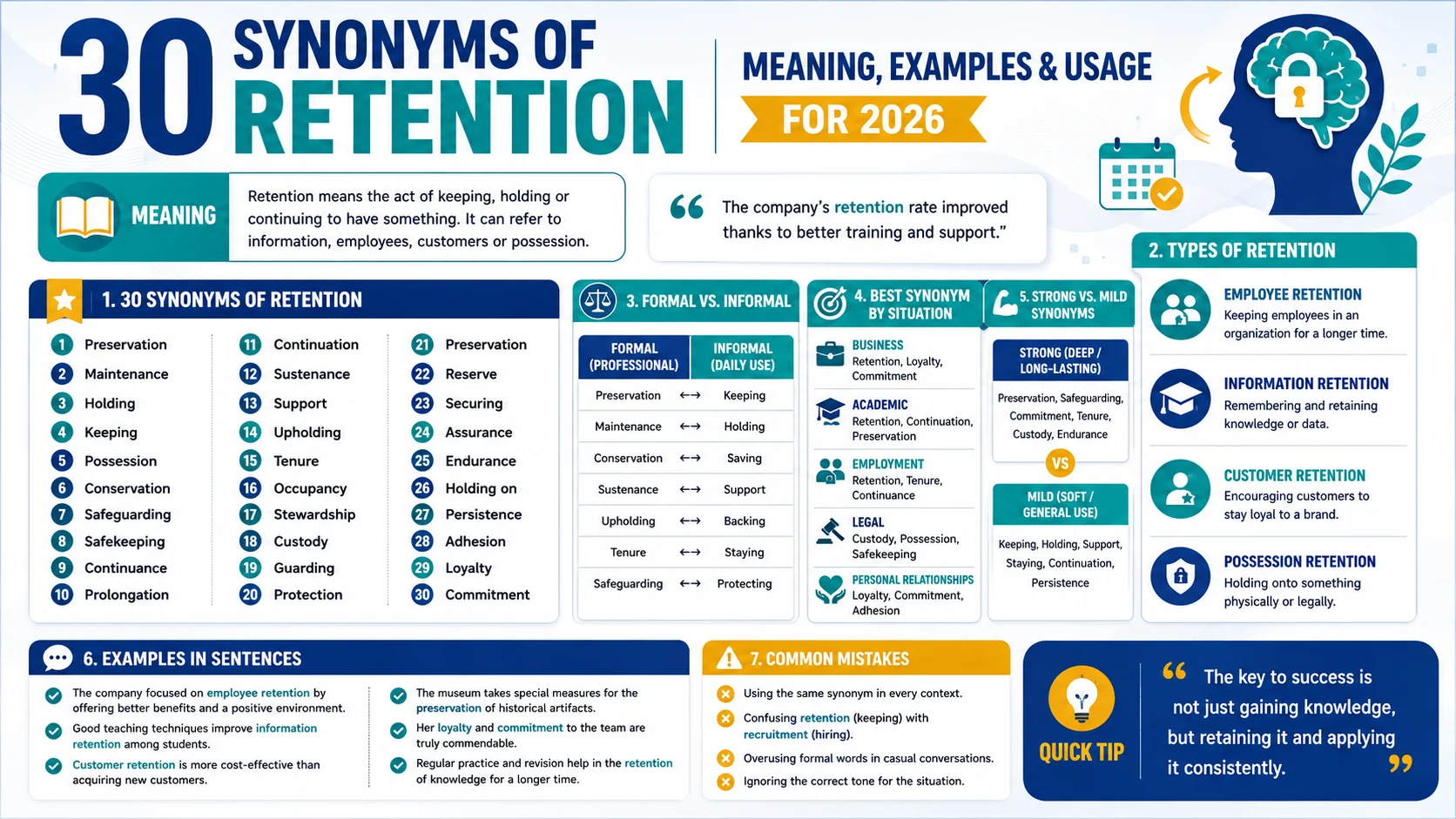
Retention means the ability to keep, hold, or remember something. The best synonyms include memory, recall, preservation, keeping, maintenance, storage, and recollection. The most common everyday synonym is memory when discussing learning, and keeping when talking about possession. Each synonym has a slightly different meaning, tone, and context.
Have you ever wondered why some things stick in your mind while others disappear instantly? That’s retention in action. It’s the power to hold onto information, objects, or even customers.
But here’s the thing: “retention” isn’t the only word you can use. Whether you’re discussing memory, business, or just trying to remember where you left your keys, there’s a perfect synonym waiting for you. In this guide, we’ll explore 30 alternatives to “retention” with clear explanations, real examples, and practical tips. By the end, you’ll choose the right word for any situation with confidence.
What Does “Retention” Mean?
Definition
Retention has three main meanings. First, it means the ability to remember or recall information—like memory retention in studying. Second, it means the act of keeping or holding something—like water retention or customer retention. Third, it means the ability to continue holding or maintaining something over time. Think of it as the power to keep what matters.
Pronunciation
| Feature | Information |
|---|---|
| US IPA | /rɪˈten.ʃən/ |
| UK IPA | /rɪˈten.ʃən/ |
| Syllables | 3 (re-ten-tion) |
| Tip | Stress the second syllable: re-TEN-tion |
Grammar
| Feature | Information |
|---|---|
| Part of Speech | Noun |
| Common Position | Subject or object of a sentence |
| Typical Pattern | “retention of [something]” |
Example Sentences:
- Good sleep improves memory retention.
- Water retention can cause swelling in the legs.
- The company focuses on customer retention strategies.
Grammar Note: “Retention” is usually uncountable. You can say “retention of information,” but not “retentions” unless you’re referring to multiple specific instances.
Word Family
| Word | Part of Speech | Meaning |
|---|---|---|
| Retain | Verb | To keep or hold onto something |
| Retention | Noun | The act of keeping or holding |
| Retentive | Adjective | Having the ability to remember or hold |
| Retentiveness | Noun | The quality of being retentive |
| Retained | Adjective | Kept or held onto |
30 Synonyms of Retention
1. Memory
Meaning: The ability to remember information or experiences.
Best Used For: Daily conversation, education, psychology.
Formality: Neutral
Tone: Neutral
Frequency: ⭐⭐⭐⭐⭐ Very Common
CEFR Level: A2
Example Sentence 1: A good memory helps with language learning.
Example Sentence 2: His memory of childhood events is surprisingly clear.
Usage Tip: “Memory” is the most natural choice in everyday conversation about remembering things. It’s simple and widely understood.
Common Confusion: Memory vs Retention. “Memory” is the ability to remember, while “retention” often refers to keeping things over time.
2. Recall
Meaning: The ability to remember something from the past.
Best Used For: Education, psychology, professional contexts.
Formality: Neutral
Tone: Neutral
Frequency: ⭐⭐⭐⭐⭐ Very Common
CEFR Level: B1
Example Sentence 1: Her recall of historical dates is impressive.
Example Sentence 2: The witness’s recall of the event was detailed.
Usage Tip: “Recall” emphasizes bringing information back to mind. It’s slightly more formal than “memory.”
3. Preservation
Meaning: The act of keeping something in its original state.
Best Used For: Environmental conservation, history, archiving.
Formality: Formal
Tone: Professional
Frequency: ⭐⭐⭐⭐ Common
CEFR Level: B2
Example Sentence 1: The preservation of historical documents is vital.
Example Sentence 2: Food preservation methods have improved significantly.
Usage Tip: “Preservation” suggests keeping something safe and unchanged. It’s often used for physical objects and the environment.
4. Keeping
Meaning: The act of having or holding something.
Best Used For: Daily conversation, informal contexts.
Formality: Informal
Tone: Casual
Frequency: ⭐⭐⭐⭐⭐ Very Common
CEFR Level: A2
Example Sentence 1: The keeping of records is important for the business.
Example Sentence 2: Safe keeping of valuables is essential.
Usage Tip: “Keeping” is a simple, everyday word for retention. It’s perfect for casual conversations.
5. Maintenance
Meaning: The act of keeping something in good condition.
Best Used For: Business, engineering, property management.
Formality: Formal
Tone: Professional
Frequency: ⭐⭐⭐⭐ Common
CEFR Level: B2
Example Sentence 1: Regular maintenance prevents equipment failure.
Example Sentence 2: Property maintenance costs are rising.
Usage Tip: “Maintenance” focuses on keeping things working or in good condition. It’s very common in business and technical contexts.
6. Storage
Meaning: The act of keeping things for future use.
Best Used For: Technology, business, logistics.
Formality: Neutral
Tone: Professional
Frequency: ⭐⭐⭐⭐⭐ Very Common
CEFR Level: B1
Example Sentence 1: Cloud storage allows data retention without physical space.
Example Sentence 2: The warehouse provides storage for seasonal items.
Usage Tip: “Storage” emphasizes keeping things in a specific place for later use. It’s very common in technology.
7. Recollection
Meaning: The act of remembering something.
Best Used For: Formal contexts, literature, psychology.
Formality: Formal
Tone: Neutral
Frequency: ⭐⭐⭐ Moderate
CEFR Level: B2
Example Sentence 1: Her recollection of the conversation was different from his.
Example Sentence 2: The book is based on the author’s childhood recollections.
Usage Tip: “Recollection” sounds more formal than “memory.” It suggests a conscious effort to remember.
8. Remembrance
Meaning: The act of remembering someone or something.
Best Used For: Ceremonies, memorials, formal writing.
Formality: Formal
Tone: Emotional, Reflective
Frequency: ⭐⭐⭐ Moderate
CEFR Level: B2
Example Sentence 1: A statue was built in remembrance of the soldiers.
Example Sentence 2: The holiday is observed in remembrance of historical events.
Usage Tip: “Remembrance” has emotional weight. It’s often used for honoring the past or remembering loved ones.
9. Custody
Meaning: The legal right to keep and care for something or someone.
Best Used For: Legal contexts, child custody, property.
Formality: Formal
Tone: Serious, Legal
Frequency: ⭐⭐⭐⭐ Common
CEFR Level: B2
Example Sentence 1: The court granted custody of the children to the mother.
Example Sentence 2: The museum has custody of ancient artifacts.
Usage Tip: “Custody” is specifically about legal or official responsibility for keeping something safe.
10. Guardianship
Meaning: The legal responsibility for protecting someone or something.
Best Used For: Legal contexts, child welfare, elder care.
Formality: Formal
Tone: Serious, Legal
Frequency: ⭐⭐⭐ Moderate
CEFR Level: B2
Example Sentence 1: She was granted guardianship of her younger siblings.
Example Sentence 2: The organization assumed guardianship of endangered species.
Usage Tip: “Guardianship” emphasizes protection and responsibility, not just keeping.
11. Possession
Meaning: The state of having or owning something.
Best Used For: Law, everyday conversation, property.
Formality: Neutral
Tone: Neutral
Frequency: ⭐⭐⭐⭐⭐ Very Common
CEFR Level: B1
Example Sentence 1: She regained possession of her belongings.
Example Sentence 2: The possession of illegal substances is prohibited.
Usage Tip: “Possession” focuses on ownership or having something physically.
12. Ownership
Meaning: The legal right to possess something.
Best Used For: Business, law, property.
Formality: Formal
Tone: Professional
Frequency: ⭐⭐⭐⭐⭐ Very Common
CEFR Level: B2
Example Sentence 1: The company retained ownership of the patents.
Example Sentence 2: Home ownership increased during that period.
Usage Tip: “Ownership” is more formal than “possession” and emphasizes legal rights.
13. Preservation
Meaning: Already covered above.
14. Conservation
Meaning: The act of protecting and preserving something.
Best Used For: Environment, history, energy.
Formality: Formal
Tone: Professional
Frequency: ⭐⭐⭐⭐ Common
CEFR Level: B2
Example Sentence 1: Water conservation is essential in dry regions.
Example Sentence 2: Wildlife conservation efforts have increased.
Usage Tip: “Conservation” is specifically about protecting resources or the environment from harm.
15. Sustenance
Meaning: The process of maintaining or supporting something.
Best Used For: Formal contexts, food, support.
Formality: Formal
Tone: Neutral
Frequency: ⭐⭐ Rare
CEFR Level: C1
Example Sentence 1: The land provides sustenance for the community.
Example Sentence 2: Cultural sustenance depends on continued support.
Usage Tip: “Sustenance” is a formal word that emphasizes support and maintenance, especially for life.
16. Durability
Meaning: The ability to last or withstand wear.
Best Used For: Products, materials, construction.
Formality: Neutral
Tone: Professional
Frequency: ⭐⭐⭐ Moderate
CEFR Level: B2
Example Sentence 1: The durability of the building materials is excellent.
Example Sentence 2: Customer retention improves product durability perception.
Usage Tip: “Durability” is about physical or metaphorical lasting power.
17. Endurance
Meaning: The ability to continue or last over time.
Best Used For: Sports, health, difficult situations.
Formality: Neutral
Tone: Positive
Frequency: ⭐⭐⭐⭐ Common
CEFR Level: B2
Example Sentence 1: Marathon runners need great endurance.
Example Sentence 2: Her endurance through the tough times was admirable.
Usage Tip: “Endurance” often involves difficulty or challenge. It suggests strength in continuing.
18. Loyalty
Meaning: The quality of staying committed or faithful.
Best Used For: Business, personal relationships.
Formality: Neutral
Tone: Positive
Frequency: ⭐⭐⭐⭐⭐ Very Common
CEFR Level: B1
Example Sentence 1: Customer loyalty is vital for business growth.
Example Sentence 2: His loyalty to the company was unwavering.
Usage Tip: “Loyalty” focuses on emotional commitment, especially in business contexts like “customer retention.”
19. Constancy
Meaning: The quality of staying the same or consistent.
Best Used For: Formal writing, philosophy, personal qualities.
Formality: Formal
Tone: Neutral
Frequency: ⭐⭐ Rare
CEFR Level: C1
Example Sentence 1: Her constancy in friendship was appreciated by all.
Example Sentence 2: The constancy of his support helped them succeed.
Usage Tip: “Constancy” is formal and emphasizes steadiness and reliability.
20. Tenacity
Meaning: The quality of holding onto something firmly.
Best Used For: Professional contexts, sports, personal traits.
Formality: Neutral
Tone: Positive
Frequency: ⭐⭐⭐ Moderate
CEFR Level: B2
Example Sentence 1: Her tenacity in negotiations secured the deal.
Example Sentence 2: The team’s tenacity led to victory.
Usage Tip: “Tenacity” suggests stubborn determination and holding firm.
21. Persistence
Meaning: The act of continuing firmly despite difficulty.
Best Used For: Professional contexts, education, personal development.
Formality: Neutral
Tone: Positive
Frequency: ⭐⭐⭐⭐ Common
CEFR Level: B2
Example Sentence 1: His persistence in learning paid off.
Example Sentence 2: Customer persistence can lead to better retention.
Usage Tip: “Persistence” emphasizes continuous effort despite obstacles.
22. Holding
Meaning: The act of keeping or having something.
Best Used For: Daily conversation, informal contexts.
Formality: Informal
Tone: Casual
Frequency: ⭐⭐⭐⭐ Common
CEFR Level: A2
Example Sentence 1: The holding of the records is essential for compliance.
Example Sentence 2: She took over the holding of all important documents.
Usage Tip: “Holding” is a simple, everyday word for keeping things.
23. Grasp
Meaning: Understanding or control of something.
Best Used For: Learning, understanding situations.
Formality: Neutral
Tone: Neutral
Frequency: ⭐⭐⭐⭐ Common
CEFR Level: B1
Example Sentence 1: He has a good grasp of the subject.
Example Sentence 2: She lost her grasp of the basic concepts.
Usage Tip: “Grasp” can mean mental retention or understanding, not just physical.
24. Captivation
Meaning: The ability to hold attention or interest.
Best Used For: Entertainment, marketing, writing.
Formality: Neutral
Tone: Positive, Emotional
Frequency: ⭐⭐ Rare
CEFR Level: C1
Example Sentence 1: The story’s captivation of the readers was immediate.
Example Sentence 2: Her captivation of the audience was remarkable.
Usage Tip: “Captivation” focuses on holding attention, not physical objects.
25. Detention
Meaning: The act of keeping someone in custody.
Best Used For: Law, schools, security.
Formality: Formal
Tone: Serious
Frequency: ⭐⭐⭐⭐ Common
CEFR Level: B2
Example Sentence 1: The detention of the suspects lasted two weeks.
Example Sentence 2: Students who misbehave may face detention.
Usage Tip: “Detention” is about forcibly keeping someone, often as a form of punishment.
26. Incarceration
Meaning: The state of being imprisoned.
Best Used For: Legal, criminal justice, formal writing.
Formality: Formal
Tone: Serious, Negative
Frequency: ⭐⭐⭐ Moderate
CEFR Level: B2
Example Sentence 1: The incarceration rate has increased in recent years.
Example Sentence 2: His incarceration lasted for five years.
Usage Tip: “Incarceration” is a formal word for imprisonment. Use it only in serious legal contexts.
27. Securement
Meaning: The act of making something safe or fixed.
Best Used For: Professional contexts, safety, business.
Formality: Formal
Tone: Professional
Frequency: ⭐⭐ Rare
CEFR Level: C1
Example Sentence 1: The securement of the data is a top priority.
Example Sentence 2: Proper securement of equipment prevents accidents.
Usage Tip: “Securement” is less common than “security.” It emphasizes the act of making things safe.
28. Retainment
Meaning: The act of retaining or keeping something.
Best Used For: Business, formal writing.
Formality: Formal
Tone: Professional
Frequency: ⭐⭐⭐ Moderate
CEFR Level: C1
Example Sentence 1: The retainment of key employees is challenging.
Example Sentence 2: Retainment strategies have changed over time.
Usage Tip: “Retainment” is a synonym but less common than “retention.” Both are correct.
29. Reserve
Meaning: Something kept for later use.
Best Used For: Business, environment, everyday situations.
Formality: Neutral
Tone: Neutral
Frequency: ⭐⭐⭐⭐ Common
CEFR Level: B1
Example Sentence 1: We have a reserve of emergency supplies.
Example Sentence 2: The company maintains a reserve fund for unexpected costs.
Usage Tip: “Reserve” often suggests keeping something for a specific future purpose.
30. Hold
Meaning: The act of keeping something in one’s possession.
Best Used For: Daily conversation, informal contexts.
Formality: Informal
Tone: Casual
Frequency: ⭐⭐⭐⭐⭐ Very Common
CEFR Level: A2
Example Sentence 1: He has a strong hold on his emotions.
Example Sentence 2: The company has a hold on the market share.
Usage Tip: “Hold” is one of the simplest and most common words for keeping something. It’s very versatile.
Synonyms Comparison Table
| Synonym | Best Context | Formality | Tone | Frequency |
|---|---|---|---|---|
| Memory | Daily life | Neutral | Neutral | ⭐⭐⭐⭐⭐ |
| Recall | Education | Neutral | Neutral | ⭐⭐⭐⭐⭐ |
| Preservation | Conservation | Formal | Professional | ⭐⭐⭐⭐ |
| Keeping | Daily life | Informal | Casual | ⭐⭐⭐⭐⭐ |
| Maintenance | Business, engineering | Formal | Professional | ⭐⭐⭐⭐ |
| Storage | Technology, logistics | Neutral | Professional | ⭐⭐⭐⭐⭐ |
| Recollection | Formal contexts | Formal | Neutral | ⭐⭐⭐ |
| Remembrance | Memorials | Formal | Emotional | ⭐⭐⭐ |
| Custody | Legal | Formal | Serious | ⭐⭐⭐⭐ |
| Possession | Law, daily life | Neutral | Neutral | ⭐⭐⭐⭐⭐ |
| Conservation | Environment | Formal | Professional | ⭐⭐⭐⭐ |
| Loyalty | Business | Neutral | Positive | ⭐⭐⭐⭐⭐ |
| Tenacity | Professional | Neutral | Positive | ⭐⭐⭐ |
| Persistence | Professional | Neutral | Positive | ⭐⭐⭐⭐ |
| Hold | Daily life | Informal | Casual | ⭐⭐⭐⭐⭐ |
Best Synonyms by Situation
| Situation | Best Synonym | Why It Works |
|---|---|---|
| Daily Conversation | Memory | Natural and clear |
| Business Email | Retention | Professional and standard |
| Academic Writing | Recollection | Precise and formal |
| School Assignment | Memory | Simple and appropriate |
| Professional Meeting | Maintenance | Professional and clear |
| Environmental Context | Conservation | Industry-standard |
| Creative Writing | Remembrance | Evocative and emotional |
| Social Media | Keeping | Casual and easy |
| Legal Context | Custody | Accurate and formal |
| Business Marketing | Loyalty | Customer-focused |
Formal vs Informal Synonyms
Formal Alternatives
| Synonym | Best Used For |
|---|---|
| Preservation | Environmental, historical contexts |
| Conservation | Environmental protection |
| Custody | Legal contexts |
| Guardianship | Legal responsibility |
| Ownership | Property, legal rights |
| Constancy | Formal writing |
| Incarceration | Legal, criminal justice |
Neutral Alternatives
| Synonym | Best Used For |
|---|---|
| Memory | General use |
| Recall | Remembering information |
| Storage | Keeping things for later |
| Possession | Having something |
| Loyalty | Business and personal |
Informal Alternatives
| Synonym | Best Used For |
|---|---|
| Keeping | Casual conversations |
| Holding | Everyday contexts |
| Hold | Simple situations |
Strong vs Mild Synonyms
Mild
- Keeping – simple act of having
- Holding – basic keeping
- Memory – normal remembering
Moderate
- Preservation – keeping safe
- Maintenance – keeping in good condition
- Storage – keeping for later
- Loyalty – committed keeping
Strong
- Custody – legal responsibility
- Guardianship – protective responsibility
- Incarceration – forced imprisonment
- Tenacity – firm holding
Real-Life Examples
School:
“Regular review is key to memory retention. Students who test themselves retain more information than those who just read.”
Workplace:
“The company’s employee retention program includes flexible hours and professional development opportunities.”
Business Email:
“We need to improve our customer retention strategy. Loyalty programs have shown promising results.”
Everyday Conversation:
“I wish I had better memory retention. I keep forgetting where I left my phone!”
Academic Paper:
“The study investigated the retention of vocabulary in second language learners through spaced repetition.”
Common Collocations
| Common Phrase | Better Alternative |
|---|---|
| Customer retention | Customer loyalty |
| Memory retention | Memory recall |
| Water retention | Water hold |
| Information retention | Information recall |
| Employee retention | Employee loyalty |
| Data retention | Data storage |
| Learning retention | Learning recall |
Common Phrases
| Phrase | Meaning | Better Alternative |
|---|---|---|
| Retention rate | The percentage of customers or employees who stay | Loyalty rate, stay rate |
| Power of retention | Ability to remember | Memory power |
| Retention of information | Remembering information | Memory of information |
Context Guide
| Situation | Best Synonym | Reason |
|---|---|---|
| Essay | Recollection | Academic precision |
| Speech | Memory | Easy to understand |
| Business Email | Retention | Professional standard |
| Novel | Remembrance | Literary and emotional |
| Presentation | Retention | Professional and clear |
| Conversation | Memory | Natural and common |
| Academic Writing | Preservation | Formal analysis |
| Marketing Copy | Loyalty | Engaging and positive |
Related Words
Near Synonyms
- Retention is related to memory but retention focuses on keeping, while memory focuses on remembering. You have memory of something but retention of something.
Antonyms
- Loss – losing what you had
- Forgetting – failing to remember
- Abandonment – giving up
- Surrender – giving up control
Related Adjectives
- Retentive – having good memory
- Retained – kept or maintained
- Maintainable – able to be kept up
Related Nouns
- Memory – ability to remember
- Preservation – keeping safe
- Conservation – protecting
Related Verbs
- Retain – to keep
- Remember – to recall
- Maintain – to keep in good condition
- Preserve – to keep safe
Frequently Asked Questions
What is another word for retention?
The most common synonyms for retention are memory, recall, preservation, keeping, maintenance, and storage. Each one has a different context, so choose based on your situation.
Which synonym sounds the most professional?
Retention itself is the most professional term. Other strong professional choices include preservation, maintenance, and conservation depending on the context.
What’s the difference between retention and memory?
Retention is the ability to keep or hold onto something over time, while memory is the ability to remember information. Retention focuses on keeping, while memory focuses on remembering.
Which synonym is best for everyday conversation?
Memory and keeping are the most natural choices for everyday conversation. They’re simple, widely understood, and work in almost any situation.
What is the strongest synonym for retention?
Tenacity, persistence, and custody are among the strongest synonyms. They suggest firm holding or legal responsibility.
What’s the difference between retention and preservation?
Retention is the act of keeping something, while preservation specifically means keeping it safe and unchanged. Preservation suggests protection.
Which synonym is most common in everyday English?
Memory, keeping, hold, and recall are the most common synonyms in everyday English. You’ll hear them frequently in daily conversation.
What is the opposite of retention?
Loss, forgetting, abandonment, and surrender are the main opposites. They all describe losing, failing to keep, or giving up.
What’s the difference between custody and guardianship?
Custody is the legal right to keep and care for someone or something. Guardianship emphasizes the responsibility to protect someone, often a child. Both are legal terms.
Can I use “storage” instead of “retention”?
Yes, but storage specifically suggests keeping something in a physical or digital space for later use. It’s excellent in technology and logistics contexts.
Conclusion
We’ve explored 30 powerful synonyms for “retention,” and the range is impressive. From the simple and everyday “memory” to the more specialized “custody” and “guardianship,” you now have a rich vocabulary to choose from.
The key is matching the synonym to your situation. For daily conversations, “memory” and “keeping” are your go-to options. For professional contexts, “retention” itself works best. For legal matters, use “custody” or “guardianship.” For environmental topics, choose “preservation” or “conservation.”
Remember, the most important thing is clarity. Choose words that your audience will understand easily. With these 30 synonyms, you’ll never feel stuck looking for the right word again. So start practicing, experiment with different contexts, and watch your English vocabulary grow!
