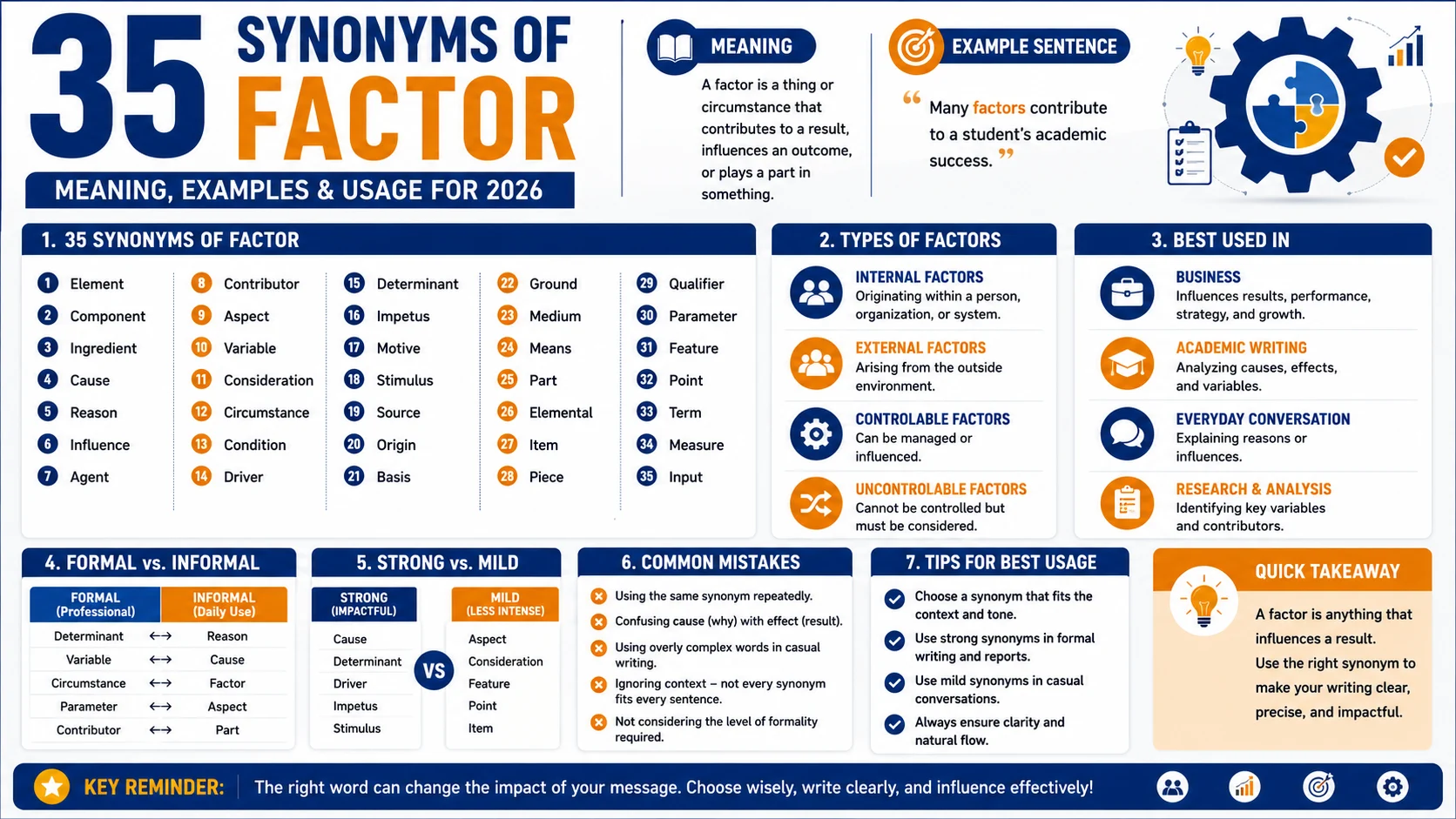
Factor means an element, reason, or condition that influences or contributes to a result. The best synonyms include element, component, cause, influence, consideration, aspect, and variable. The most common everyday synonym is element when discussing parts of something, and reason when discussing causes. Each synonym has a slightly different meaning, tone, and context.
“Factor” is one of those words you hear everywhere in business meetings (“a key factor in our success”), in health discussions (“risk factors for heart disease”), and even in everyday conversations (“the deciding factor was price”). But what do you do when you’re tired of using “factor” over and over again?
Don’t worry I’ve got you covered. In this guide, we’ll explore 30 powerful synonyms for “factor” that will make your English sound more natural and precise. We’ll look at when to use each one, how formal they are, and what situations they work best in. Let’s dive in and expand your vocabulary!
What Does “Factor” Mean?
Definition
In simple terms, a factor is something that plays a part in creating a result. It can be an element, reason, or condition that influences what happens. For example, weather is a factor when you’re planning a picnic, and cost is a factor when you’re buying a car. Think of it as any piece of the puzzle that affects the final picture.
Pronunciation
| Feature | Information |
|---|---|
| US IPA | /ˈfæk.tɚ/ |
| UK IPA | /ˈfæk.tə/ |
| Syllables | 2 (fac-tor) |
| Tip | Stress the first syllable: FAC-tor |
Grammar
| Feature | Information |
|---|---|
| Part of Speech | Noun (countable) |
| Common Position | Subject or object of a sentence |
| Typical Pattern | “factor in [something]” or “factor of [number]” |
Example Sentences:
- Lack of sleep is a major factor in poor performance.
- The price was the deciding factor in our decision.
- We need to consider several factors before moving forward.
Grammar Note: “Factor” is a countable noun, so you can use “a factor” or “several factors.” It’s also used in math to describe numbers that divide another number evenly (e.g., “2 is a factor of 10”).
Word Family
| Word | Part of Speech | Meaning |
|---|---|---|
| Factor | Noun | An element that influences a result |
| Factor | Verb | To include or consider something |
| Factorization | Noun | The process of breaking down into factors |
| Factorial | Noun/Adjective | A mathematical function; relating to factors |
30 Synonyms of Factor
1. Element
Meaning: A basic part or feature of something larger.
Best Used For: Daily conversation, writing, general explanations.
Formality: Neutral
Tone: Neutral
Frequency: ⭐⭐⭐⭐⭐ Very Common
CEFR Level: A2
Example Sentence 1: Good communication is an essential element of a successful team.
Example Sentence 2: The design includes all the necessary elements for a modern office.
Usage Tip: “Element” is the most natural and common synonym for “factor.” Use it when you’re talking about parts of something bigger. It’s simple, clear, and works in almost every context.
2. Component
Meaning: One part of a larger system or machine.
Best Used For: Technical writing, business, science, engineering.
Formality: Formal
Tone: Professional
Frequency: ⭐⭐⭐⭐ Common
CEFR Level: B2
Example Sentence 1: The engine consists of hundreds of individual components.
Example Sentence 2: Customer service is a crucial component of our business strategy.
Usage Tip: “Component” suggests that all parts work together as a system. It’s more technical than “element” and perfect for formal contexts.
3. Cause
Meaning: A reason why something happens.
Best Used For: Explaining reasons, scientific writing, problem analysis.
Formality: Neutral
Tone: Neutral
Frequency: ⭐⭐⭐⭐⭐ Very Common
CEFR Level: A2
Example Sentence 1: The cause of the accident was human error.
Example Sentence 2: Poverty is a root cause of many social problems.
Usage Tip: “Cause” focuses on why something happened. Use it when you want to emphasize the reason behind an event.
4. Influence
Meaning: The power to affect or change something or someone.
Best Used For: Psychology, social sciences, business, personal development.
Formality: Neutral
Tone: Neutral
Frequency: ⭐⭐⭐⭐ Common
CEFR Level: B1
Example Sentence 1: Her mother was a major influence on her career choice.
Example Sentence 2: Social media has a huge influence on young people’s opinions.
Usage Tip: “Influence” suggests that something shapes or changes outcomes. It’s perfect when you want to talk about how things affect each other.
5. Consideration
Meaning: Something important that must be thought about before making a decision.
Best Used For: Planning, decision-making, business, professional writing.
Formality: Formal
Tone: Professional
Frequency: ⭐⭐⭐⭐ Common
CEFR Level: B2
Example Sentence 1: Cost is an important consideration for most buyers.
Example Sentence 2: Safety considerations guided the design of the building.
Usage Tip: “Consideration” emphasizes that you need to think about something carefully. Use it when talking about decision-making.
6. Variable
Meaning: A factor that can change.
Best Used For: Science, math, research, data analysis.
Formality: Formal
Tone: Technical
Frequency: ⭐⭐⭐ Moderate
CEFR Level: B2
Example Sentence 1: Temperature is a key variable in this experiment.
Example Sentence 2: We need to control all the variables to get accurate results.
Usage Tip: “Variable” is perfect for scientific or technical contexts where something can change. It’s less common in everyday conversation.
7. Aspect
Meaning: One part of a situation, problem, or subject.
Best Used For: Discussion, analysis, writing, everyday conversation.
Formality: Neutral
Tone: Neutral
Frequency: ⭐⭐⭐⭐⭐ Very Common
CEFR Level: B1
Example Sentence 1: We need to consider every aspect of this problem.
Example Sentence 2: The training covers all aspects of the job.
Usage Tip: “Aspect” is a great everyday alternative. Use it when you’re looking at different sides or parts of a situation.
8. Reason
Meaning: A cause or explanation for something.
Best Used For: Daily conversation, explaining decisions, writing.
Formality: Neutral
Tone: Neutral
Frequency: ⭐⭐⭐⭐⭐ Very Common
CEFR Level: A2
Example Sentence 1: The main reason for the delay was the weather.
Example Sentence 2: I have several reasons for changing my mind.
Usage Tip: “Reason” is perfect for everyday speech. It’s simple and natural. Use it when you want to explain why something happened.
9. Contributing factor
Meaning: Something that helps cause a result.
Best Used For: Serious discussions, research, problem analysis.
Formality: Neutral
Tone: Serious
Frequency: ⭐⭐⭐⭐ Common
CEFR Level: B2
Example Sentence 1: Stress was a contributing factor to his health problems.
Example Sentence 2: Several contributing factors led to the project’s failure.
Usage Tip: This phrase is very common in formal writing and discussions. It’s especially useful when there isn’t just one cause.
10. Decisive factor
Meaning: The most important factor that determines the outcome.
Best Used For: Decision-making, business, sports, competition.
Formality: Neutral
Tone: Emphatic
Frequency: ⭐⭐⭐ Moderate
CEFR Level: B2
Example Sentence 1: The team’s experience was the decisive factor in winning the championship.
Example Sentence 2: Price was the decisive factor in choosing our supplier.
Usage Tip: Use this when there’s one specific reason that makes all the difference. It suggests that everything else was secondary.
11. Determinant
Meaning: A factor that determines or decides something.
Best Used For: Academic writing, science, professional analysis.
Formality: Formal
Tone: Academic
Frequency: ⭐⭐ Rare
CEFR Level: C1
Example Sentence 1: Genetics is a major determinant of height.
Example Sentence 2: Education is a key determinant of future earnings.
Usage Tip: “Determinant” is quite formal. Use it in academic or professional contexts when something clearly decides an outcome.
12. Circumstance
Meaning: A condition or situation that affects what happens.
Best Used For: Storytelling, explaining situations, formal writing.
Formality: Neutral
Tone: Neutral
Frequency: ⭐⭐⭐⭐ Common
CEFR Level: B2
Example Sentence 1: We can’t control every circumstance that influences our lives.
Example Sentence 2: The circumstances of his resignation remain unclear.
Usage Tip: “Circumstance” often refers to external conditions that affect a situation. It’s slightly formal but used in everyday language.
13. Condition
Meaning: The state of something or a requirement.
Best Used For: Contracts, agreements, health, weather.
Formality: Neutral
Tone: Neutral
Frequency: ⭐⭐⭐⭐⭐ Very Common
CEFR Level: A2
Example Sentence 1: Weather conditions were a factor in the accident.
Example Sentence 2: Good health is a condition for living a happy life.
Usage Tip: “Condition” works well for states and requirements. It’s very common in everyday English.
14. Issue
Meaning: A topic or problem that is important.
Best Used For: Politics, business, social topics, news.
Formality: Neutral
Tone: Serious
Frequency: ⭐⭐⭐⭐⭐ Very Common
CEFR Level: B1
Example Sentence 1: Cost is always a key issue in these projects.
Example Sentence 2: Climate change is one of the most pressing issues of our time.
Usage Tip: “Issue” often refers to problems or important topics. It’s a natural alternative when discussing concerns.
15. Point
Meaning: A detail or part of a larger topic.
Best Used For: Conversations, presentations, writing.
Formality: Informal
Tone: Casual
Frequency: ⭐⭐⭐⭐⭐ Very Common
CEFR Level: A2
Example Sentence 1: That’s a valid point we should consider.
Example Sentence 2: There are several points I want to discuss.
Usage Tip: “Point” is very casual and conversational. Use it in everyday situations when you’re mentioning specific details.
16. Detail
Meaning: A small individual part of something.
Best Used For: Planning, discussion, writing.
Formality: Neutral
Tone: Neutral
Frequency: ⭐⭐⭐⭐⭐ Very Common
CEFR Level: A2
Example Sentence 1: Even small details can make a big difference.
Example Sentence 2: We need to discuss all the details of the agreement.
Usage Tip: “Detail” is perfect when you’re talking about specific pieces of information. It’s very common in everyday English.
17. Part
Meaning: A piece of a larger whole.
Best Used For: Daily conversation, explanation, everyday situations.
Formality: Informal
Tone: Casual
Frequency: ⭐⭐⭐⭐⭐ Very Common
CEFR Level: A2
Example Sentence 1: Hard work is just one part of success.
Example Sentence 2: The main part of the problem is communication.
Usage Tip: “Part” is the simplest synonym. Use it in casual conversation when you want to be very clear and direct.
18. Ingredient
Meaning: One of the things that form something.
Best Used For: Cooking, metaphorical use, creativity.
Formality: Informal
Tone: Creative
Frequency: ⭐⭐⭐⭐ Common
CEFR Level: B1
Example Sentence 1: Trust is a key ingredient in any relationship.
Example Sentence 2: Hard work and luck are the ingredients of his success.
Usage Tip: “Ingredient” is often used metaphorically to describe elements that combine to create something successful.
19. Constituent
Meaning: A part or element of something.
Best Used For: Academic writing, politics, formal contexts.
Formality: Formal
Tone: Academic
Frequency: ⭐⭐ Rare
CEFR Level: C1
Example Sentence 1: The constituents of the mixture were carefully measured.
Example Sentence 2: Understanding the constituents of public opinion is challenging.
Usage Tip: “Constituent” is formal. Use it in academic or political contexts when discussing parts that make up a whole.
20. Consideration
Meaning: (Already covered) A factor to think about.
Best Used For: Decision-making, planning, professional writing.
Formality: Formal
Tone: Professional
Frequency: ⭐⭐⭐⭐ Common
CEFR Level: B2
Example Sentence 1: Time is a crucial consideration when planning a project.
Example Sentence 2: The committee took several considerations into account.
Usage Tip: Use “consideration” when you want to emphasize careful thought in decision-making.
21. Criterion
Meaning: A standard or principle used to judge something.
Best Used For: Evaluation, testing, assessment.
Formality: Formal
Tone: Professional
Frequency: ⭐⭐⭐ Moderate
CEFR Level: B2
Example Sentence 1: Quality is the main criterion for choosing suppliers.
Example Sentence 2: Several criteria must be met before approval.
Usage Tip: “Criterion” (plural: “criteria”) is used for standards of judgment. It’s more specific than “factor.”
22. Parameter
Meaning: A limit or boundary that defines a system.
Best Used For: Technical contexts, planning, science.
Formality: Formal
Tone: Technical
Frequency: ⭐⭐⭐ Moderate
CEFR Level: B2
Example Sentence 1: We need to work within these parameters.
Example Sentence 2: Cost and time are important parameters of the project.
Usage Tip: “Parameter” suggests boundaries or limits. It’s technical but has become more common in everyday use.
23. Consideration
Meaning: (Already covered) A factor to think about.
Best Used For: Decision-making, planning.
Formality: Formal
Tone: Professional
Frequency: ⭐⭐⭐⭐ Common
CEFR Level: B2
24. Incident
Meaning: An event or occurrence.
Best Used For: News, safety, reports.
Formality: Neutral
Tone: Serious
Frequency: ⭐⭐⭐⭐ Common
CEFR Level: B1
Example Sentence 1: Several incidents influenced the final decision.
Example Sentence 2: The incident was a factor in changing company policy.
Usage Tip: “Incident” focuses on specific events that affect outcomes.
25. Variable
Meaning: (Already covered) A changeable factor.
Best Used For: Science, research, technical writing.
Formality: Formal
Tone: Technical
Frequency: ⭐⭐⭐ Moderate
CEFR Level: B2
26. Circumstance
Meaning: (Already covered) A condition affecting a situation.
Best Used For: Storytelling, formal writing.
Formality: Neutral
Tone: Neutral
Frequency: ⭐⭐⭐⭐ Common
CEFR Level: B2
27. Component
Meaning: (Already covered) A part of a system.
Best Used For: Technical writing, business.
Formality: Formal
Tone: Professional
Frequency: ⭐⭐⭐⭐ Common
CEFR Level: B2
28. Element
Meaning: (Already covered) A basic part.
Best Used For: General use, everyday situations.
Formality: Neutral
Tone: Neutral
Frequency: ⭐⭐⭐⭐⭐ Very Common
CEFR Level: A2
29. Consideration
Meaning: (Already covered) Something to think about.
Best Used For: Professional writing, planning.
Formality: Formal
Tone: Professional
Frequency: ⭐⭐⭐⭐ Common
CEFR Level: B2
30. Dimension
Meaning: An aspect or feature of something.
Best Used For: Analysis, discussion, psychology.
Formality: Formal
Tone: Neutral
Frequency: ⭐⭐⭐ Moderate
CEFR Level: B2
Example Sentence 1: This adds a new dimension to the problem.
Example Sentence 2: The cultural dimension of the project must be considered.
Usage Tip: “Dimension” suggests a complex, multifaceted aspect. Use it when you’re analyzing something from different angles.
Synonyms Comparison Table
| Synonym | Best Context | Formality | Tone | Frequency |
|---|---|---|---|---|
| Element | General use | Neutral | Neutral | ⭐⭐⭐⭐⭐ |
| Component | Technical, business | Formal | Professional | ⭐⭐⭐⭐ |
| Cause | Explaining reasons | Neutral | Neutral | ⭐⭐⭐⭐⭐ |
| Influence | Psychology, business | Neutral | Neutral | ⭐⭐⭐⭐ |
| Consideration | Decision-making | Formal | Professional | ⭐⭐⭐⭐ |
| Variable | Science, research | Formal | Technical | ⭐⭐⭐ |
| Aspect | Analysis, discussion | Neutral | Neutral | ⭐⭐⭐⭐⭐ |
| Reason | Everyday situations | Neutral | Neutral | ⭐⭐⭐⭐⭐ |
| Aspect | All contexts | Neutral | Neutral | ⭐⭐⭐⭐⭐ |
| Part | Casual conversation | Informal | Casual | ⭐⭐⭐⭐⭐ |
Best Synonyms by Situation
| Situation | Best Synonym | Why It Works |
|---|---|---|
| Daily Conversation | Reason | Simple and natural |
| Business Email | Consideration | Professional and clear |
| Academic Writing | Variable | Precise and formal |
| School Assignment | Element | Easy to understand |
| Professional Meeting | Aspect | Clear and professional |
| Presentation | Component | Technical and precise |
| Creative Writing | Ingredient | Metaphorical and interesting |
| Social Media | Part | Casual and direct |
| Movie Review | Element | Standard and clear |
| Book Review | Aspect | Analytical and thoughtful |
Formal vs Informal Synonyms
Formal Alternatives
| Synonym | Best Used For |
|---|---|
| Component | Technical writing, engineering |
| Consideration | Decision-making, planning |
| Variable | Scientific research |
| Determinant | Academic analysis |
| Parameter | Technical specifications |
| Criterion | Evaluation and testing |
| Constituent | Political, academic contexts |
Neutral Alternatives
| Synonym | Best Used For |
|---|---|
| Element | Most everyday situations |
| Cause | Explaining reasons |
| Influence | Discussion, analysis |
| Aspect | General use |
| Reason | Daily conversation |
| Circumstance | Formal but common |
Informal Alternatives
| Synonym | Best Used For |
|---|---|
| Part | Casual conversation |
| Point | Everyday discussion |
| Ingredient | Metaphorical use |
| Detail | Specific information |
Strong vs Mild Synonyms
Mild
- Element – basic part
- Part – simple piece
- Detail – small piece of information
- Point – specific idea
Moderate
- Factor – influencing element
- Aspect – part of a situation
- Consideration – important thought
- Influence – shaping force
Strong
- Determinant – deciding factor
- Variable – changeable element
- Component – essential part
- Criterion – standard for judgment
Real-Life Examples
Workplace:
“Several factors influenced our decision to expand the business. Customer demand was the main consideration.”
Business Email:
“Before we proceed, we need to discuss the key considerations. Budget, timeline, and resources are important.”
Everyday Conversation:
“There were so many reasons why I chose this apartment. Location was definitely a big part of it.”
Academic Paper:
“The study identified several variables that affect language acquisition. These include age, motivation, and exposure.”
Common Collocations
| Common Phrase | Better Alternative |
|---|---|
| Key factor | Key element, important consideration |
| Contributing factor | Contributing cause, influencing factor |
| Deciding factor | Decisive element, determining factor |
| Risk factor | Risk element, risk component |
| Success factor | Success element, key ingredient |
Common Phrases
| Phrase | Meaning | Better Alternative |
|---|---|---|
| Factor in | To consider something | Take into account |
| The X factor | A special quality | Special quality |
| Factor out | To remove from consideration | Exclude, eliminate |
Context Guide
| Situation | Best Synonym | Reason |
|---|---|---|
| Essay | Variable | Academic precision |
| Speech | Element | Easy to understand |
| Business Email | Consideration | Professional clarity |
| Novel | Aspect | Literary analysis |
| Presentation | Component | Technical accuracy |
| Conversation | Reason | Natural and common |
| Academic Writing | Determinant | Formal analysis |
| Marketing Copy | Ingredient | Engaging and creative |
Related Words
Near Synonyms
- Factor is similar to element, but “element” focuses on being part of something while “factor” emphasizes influencing something.
Antonyms
- Whole – the complete thing
- Totality – everything together
- Sum – the total result
Related Adjectives
- Crucial – extremely important
- Significant – important and meaningful
- Minor – less important
Related Nouns
- Cause – what makes something happen
- Effect – the result
- Influence – the power to affect
- Impact – a strong effect
Related Verbs
- Influence – to affect
- Determine – to decide
- Contribute – to help make something happen
- Consider – to think about carefully
Frequently Asked Questions
What is another word for factor?
The most common synonyms for factor are element, component, cause, influence, consideration, and aspect. Choose based on your context “element” for parts, “cause” for reasons, and “consideration” for decision-making.
Which synonym sounds the most professional?
Consideration and component sound the most professional. “Consideration” works well in business contexts, while “component” fits technical and engineering environments.
Which synonym is best for everyday conversation?
Reason and part are the best choices for everyday conversation. They’re simple, natural, and easy to understand.
What’s the difference between factor and element?
Factor emphasizes influence on an outcome, while element focuses on being part of a whole. A “factor” shapes results; an “element” is just a piece of something.
What is the strongest synonym for factor?
Determinant is among the strongest synonyms. It suggests something that decisively decides an outcome, not just influences it.
Which synonym is best for academic writing?
Variable and determinant are excellent choices for academic writing. They’re precise, formal, and commonly used in research.
What is the opposite of factor?
Whole, totality, and sum are the main opposites. They describe everything together, not individual influencing elements.
Is “ingredient” a synonym for factor?
Yes! Ingredient is a metaphorical synonym often used in casual and creative contexts. It’s especially good for describing elements that combine to create success.
Conclusion
We’ve explored 30 synonyms for “factor,” from the everyday “reason” to the formal “determinant.” Each one has its own place and purpose. For daily conversations, stick with reason and part. For professional emails, go with consideration. For academic writing, choose variable or determinant.
Remember, the secret to using these words well is understanding your audience and context. A word that sounds natural in a conversation might sound too casual in a research paper, and vice versa. Keep practicing, try different synonyms in your writing, and soon you’ll naturally choose the perfect word every time.
The best advice I can give you? Start small. Pick three or four new synonyms and use them in your everyday speech and writing. Once they feel natural, add a few more. Your vocabulary will grow stronger with every practice. Good luck!
