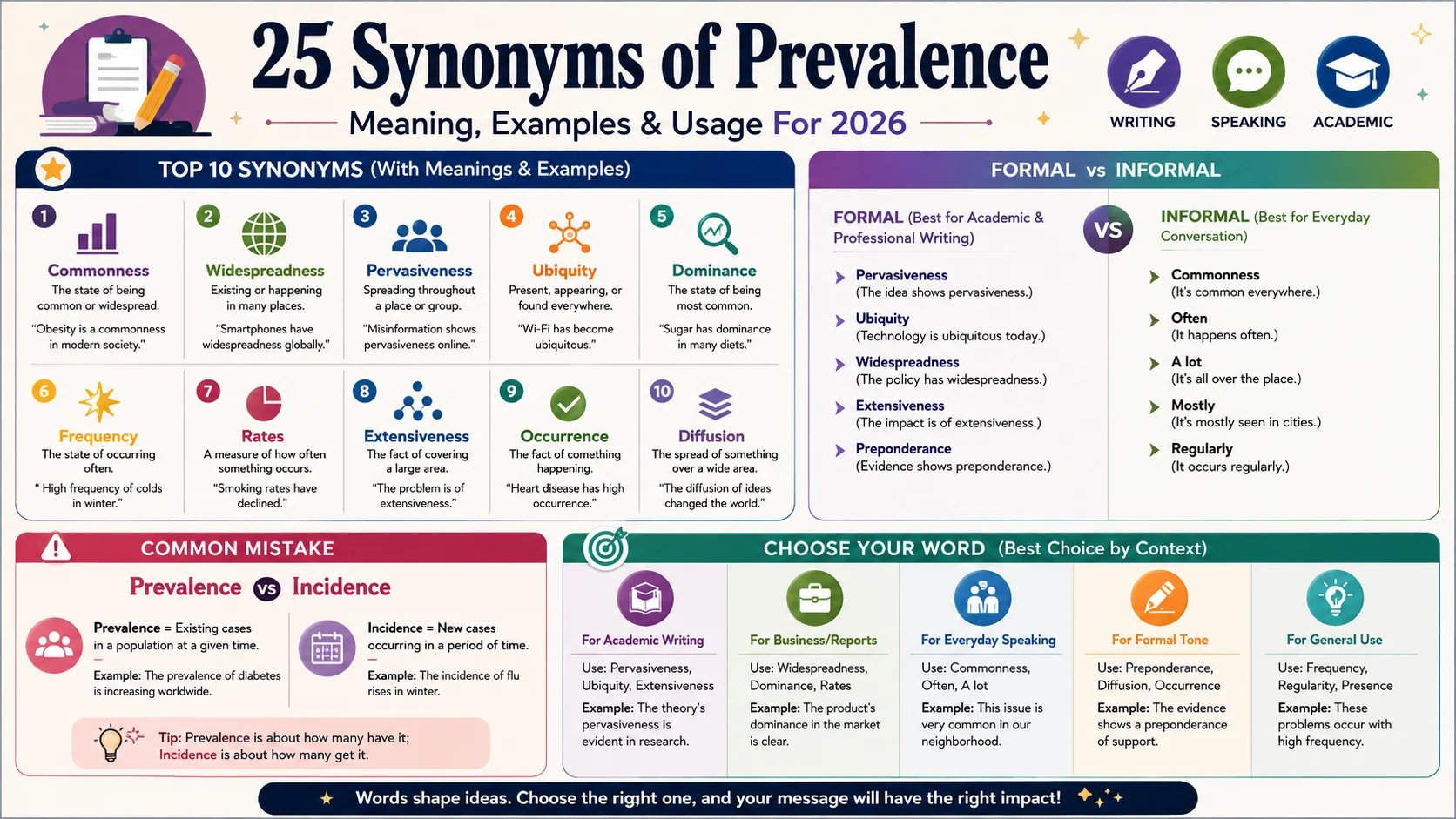
Prevalence means how common or widespread something is. If you need a synonym, common alternatives include commonness, frequency, pervasiveness, ubiquity, and dominance. The best choice depends on your context and what you’re describing .
Top 10 Synonyms
- Commonness
- Frequency
- Pervasiveness
- Ubiquity
- Dominance
- Rampancy
- Rifeness
- Universality
- Preponderance
- Currency
Have you ever wanted to say something is “common” but felt that word was too simple? Perhaps you are writing an essay and need a more formal term, or you are describing a trend and want to sound more professional.
The word prevalence is a powerful noun that describes the state of being widespread or common. Learning its synonyms not only improves your vocabulary but also helps you choose the exact word for your situation .
In this article, you will learn the meaning of prevalence, how to pronounce it, its grammar, and the best synonyms to use in different contexts like business, academic writing, and daily conversation.
What Does “Prevalence” Mean?
Definition
Prevalence is the noun that describes the quality of being widespread, common, or generally accepted .
In everyday language, it simply means how common something is. For example, the prevalence of smartphones means there are a lot of smartphones everywhere .
In more technical fields like medicine, it has a specific meaning: the number of people in a population who have a particular disease at a specific time . However, in general writing, it just refers to how usual or frequent something is.
Pronunciation
- US IPA: /ˈprev.ə.ləns/
- UK IPA: /ˈprev.əl.əns/
- Syllables: 3 (Prev – a – lence)
- Tip: Stress the first syllable. Say “PREV” like the start of “previous,” then “uh-lence.”
Grammar
- Part of Speech: Noun
- Common Position: Subject of a sentence or object of a preposition.
- Typical Pattern: The prevalence of [something] in [a place/time].
Examples:
- The prevalence of social media in our lives is undeniable.
- Researchers are studying the prevalence of the disease in rural areas.
- We were surprised by the prevalence of fake news online.
Word Family
| Word | Part of Speech | Meaning |
|---|---|---|
| Prevail | Verb | To prove more powerful than opposing forces; to be widespread. |
| Prevalence | Noun | The state of being widespread. |
| Prevalent | Adjective | Widespread in a particular area or at a particular time. |
| N/A | Adverb | There is no common adverb form. “Prevalently” is rarely used. |
| N/A | Related Form | N/A |
15 Synonyms of “Prevalence”
Commonness
Meaning: The state of happening often or being found in many places .
Best Used For: General, everyday conversation. It is the most direct and simple alternative to prevalence.
Formality: Neutral
Tone: Neutral
Frequency: ⭐⭐⭐⭐⭐ Very Common
CEFR Level: B1
Example Sentence 1: The commonness of fast food restaurants makes it hard to eat healthily.
Example Sentence 2: I was surprised by the commonness of this name in my country.
Usage Tip: Use this when you want to keep your language simple. It is less formal than “prevalence” but means almost the exact same thing.
Frequency
Meaning: The rate at which something happens; how often something occurs .
Best Used For: Statistics, science, or any situation where you are counting how often something happens.
Formality: Formal
Tone: Neutral/Professional
Frequency: ⭐⭐⭐⭐⭐ Very Common
CEFR Level: B2
Example Sentence 1: The frequency of extreme weather events has increased in recent years.
Example Sentence 2: We need to analyze the frequency of customer complaints.
Usage Tip: “Frequency” focuses on the rate of occurrence, while “prevalence” focuses on the extent of occurrence.
Pervasiveness
Meaning: The quality of spreading widely and being present in every part of something .
Best Used For: Describing ideas, influences, or problems that seem to be everywhere.
Formality: Formal/Academic
Tone: Professional
Frequency: ⭐⭐⭐⭐ Common
CEFR Level: B2/C1
Example Sentence 1: The pervasiveness of advertising on social media is overwhelming.
Example Sentence 2: We need to address the pervasiveness of this cultural attitude.
Usage Tip: This is a great word for academic writing. It suggests something is not just common, but unavoidable.
Ubiquity
Meaning: The state of being everywhere at the same time .
Best Used For: Emphasizing that something can be found absolutely everywhere.
Formality: Formal
Tone: Academic/Literary
Frequency: ⭐⭐⭐ Moderate
CEFR Level: C1
Example Sentence 1: The ubiquity of smartphones has changed how we interact with the world.
Example Sentence 2: Tourists are often amazed by the ubiquity of coffee shops in this city.
Usage Tip: “Ubiquity” is a very strong word. Use it only when you truly mean something is everywhere.
Dominance
Meaning: Being more powerful, important, or noticeable than other things .
Best Used For: Situations where one thing is the most important or powerful among others.
Formality: Neutral/Formal
Tone: Professional
Frequency: ⭐⭐⭐⭐⭐ Very Common
CEFR Level: B2
Example Sentence 1: The dominance of a few large tech companies is a major concern.
Example Sentence 2: Their dominance in the market is unchallenged.
Usage Tip: “Dominance” often implies superiority, not just commonness.
Rampancy
Meaning: Uncontrolled growth or spread; very common and often causing problems .
Best Used For: Negative situations that are spreading out of control.
Formality: Neutral
Tone: Negative/Slightly Alarming
Frequency: ⭐⭐ Rare
CEFR Level: C1
Example Sentence 1: The rampancy of corruption in the government is shocking.
Example Sentence 2: We must address the rampancy of misinformation online.
Usage Tip: This word has a negative connotation. Use it to describe things that are widespread and harmful.
Rifeness
Meaning: The state of being extremely common and widespread, often referring to bad things .
Best Used For: Similar to rampancy; describing widespread issues.
Formality: Neutral
Tone: Negative
Frequency: ⭐⭐ Rare
CEFR Level: C1
Example Sentence 1: The rifeness of poverty in the city is heartbreaking.
Example Sentence 2: Historians noted the rifeness of disease in the camps.
Usage Tip: “Rifeness” is less common than “prevalence.” It suggests that something is “rife,” or very abundant and usually unpleasant.
Universality
Meaning: The state of being true for everyone or in every case .
Best Used For: Concepts, principles, or rights that apply to all people.
Formality: Formal
Tone: Academic
Frequency: ⭐⭐⭐ Moderate
CEFR Level: B2/C1
Example Sentence 1: The universality of human rights is a key principle of international law.
Example Sentence 2: They discussed the universality of this mathematical theorem.
Usage Tip: “Universality” means something is not just common, but applies universally to everyone and everywhere.
Preponderance
Meaning: A superiority in numbers or amount; the largest part of something .
Best Used For: Focus on quantity. Use when discussing the majority of a group or items.
Formality: Formal
Tone: Neutral/Professional
Frequency: ⭐⭐⭐ Moderate
CEFR Level: C1
Example Sentence 1: The preponderance of evidence supports this conclusion.
Example Sentence 2: There is a preponderance of male students in the engineering department.
Usage Tip: “Preponderance” is about numbers. It’s a great word for legal or scientific writing when discussing evidence or demographics.
Currency
Meaning: The state of being generally accepted, used, or believed .
Best Used For: Ideas, beliefs, or words that are currently in use or accepted.
Formality: Neutral/Formal
Tone: Professional
Frequency: ⭐⭐⭐ Moderate
CEFR Level: B2/C1
Example Sentence 1: The new theory has gained currency among scientists.
Example Sentence 2: This phrase has a wide currency in American English.
Usage Tip: “Currency” does not mean money here. It refers to how commonly something is used or accepted.
Extensiveness
Meaning: The state of covering a large area or range .
Best Used For: Physical size or the broad scope of something.
Formality: Formal
Tone: Neutral
Frequency: ⭐⭐⭐ Moderate
CEFR Level: B2
Example Sentence 1: The extensiveness of the forest fire was alarming.
Example Sentence 2: The extensiveness of her knowledge is truly impressive.
Usage Tip: Use “extensiveness” for physical space or the breadth of a topic.
Popularity
Meaning: The state of being liked, admired, or supported by many people.
Best Used For: Describing how much people like something, not just how common it is.
Formality: Neutral
Tone: Positive
Frequency: ⭐⭐⭐⭐⭐ Very Common
CEFR Level: B1
Example Sentence 1: The popularity of online shopping has increased dramatically.
Example Sentence 2: He enjoys a wide popularity among young voters.
Usage Tip: “Prevalence” is neutral; “popularity” implies people like the thing.
Vogue
Meaning: The state of being currently popular or fashionable.
Best Used For: Describing trends, fashion, or styles.
Formality: Neutral
Tone: Positive/Neutral
Frequency: ⭐⭐ Rare
CEFR Level: B2
Example Sentence 1: This style has gone out of vogue.
Example Sentence 2: The vogue for minimalist design has changed the industry.
Usage Tip: “Vogue” often suggests something is popular now but will likely fade.
Generalness
Meaning: The state of being general or widespread.
Best Used For: Conversations where you need a simple word for “common.”
Formality: Neutral
Tone: Neutral
Frequency: ⭐⭐⭐ Moderate
CEFR Level: B1
Example Sentence 1: The generalness of this problem makes it difficult to address.
Usage Tip: This is a good alternative to “commonness” but is slightly less common.
Regularity
Meaning: The state of happening at regular intervals or frequently.
Best Used For: Habits, routines, or things that happen predictably.
Formality: Neutral
Tone: Neutral
Frequency: ⭐⭐⭐ Moderate
CEFR Level: B2
Example Sentence 1: The regularity of the trains is a pleasant surprise.
Example Sentence 2: She values the regularity of her exercise routine.
Usage Tip: Emphasizes the predictable pattern of something happening.
Synonyms Comparison Table
| Synonym | Best Context | Formality | Tone | Frequency |
|---|---|---|---|---|
| Commonness | Daily conversation | Neutral | Neutral | ⭐⭐⭐⭐⭐ |
| Frequency | Statistics, data | Formal | Neutral | ⭐⭐⭐⭐⭐ |
| Pervasiveness | Academic writing | Formal | Professional | ⭐⭐⭐⭐ |
| Ubiquity | Literary writing | Formal | Academic | ⭐⭐⭐ |
| Dominance | Business, politics | Formal | Professional | ⭐⭐⭐⭐⭐ |
| Rampancy | Negative events | Neutral | Negative | ⭐⭐ |
| Rifeness | Negative events | Neutral | Negative | ⭐⭐ |
| Universality | Law, morals | Formal | Academic | ⭐⭐⭐ |
| Preponderance | Law, evidence | Formal | Neutral | ⭐⭐⭐ |
| Currency | Ideas, phrases | Formal | Professional | ⭐⭐⭐ |
| Extensiveness | Scope, size | Formal | Neutral | ⭐⭐⭐ |
| Popularity | Social trends | Neutral | Positive | ⭐⭐⭐⭐⭐ |
Best Synonyms by Situation
| Situation | Best Synonym | Why It Works |
|---|---|---|
| Daily Conversation | Commonness | Simple and easy to understand. |
| Business Email | Pervasiveness | Sounds professional and serious. |
| Academic Writing | Ubiquity | Impressive vocabulary for essays. |
| School Assignment | Frequency | Great for science or social studies data. |
| Professional Meeting | Pervasiveness | Highlights the scope of a problem. |
| Presentation | Dominance | Emphasizes power and control. |
| Creative Writing | Ubiquity | Literary feel that adds depth. |
| Social Media | Prevalence or Popularity | “Prevalence” is common; “popularity” fits trends. |
| Movie Review | Pervasiveness | Describes an atmosphere or feeling. |
| Book Review | Ubiquity | Good for discussing themes. |
Formal vs Informal Synonyms
Formal Alternatives
These words are best for business, academic, and professional writing .
| Synonym | Best Used For |
|---|---|
| Pervasiveness | Academic papers and reports. |
| Ubiquity | Advanced vocabulary in formal essays. |
| Preponderance | Legal and scientific contexts. |
| Universality | Philosophical and political discussions. |
Neutral Alternatives
These are safe to use in most professional and personal contexts .
| Synonym | Best Used For |
|---|---|
| Commonness | General daily use. |
| Prevalence | General daily use. |
| Popularity | Discussing likes and trends. |
Informal Alternatives
These are more casual and often have a negative tone .
| Synonym | Best Used For |
|---|---|
| Rampancy | Complaining about problems. |
| Rifeness | Complaining about problems. |
Choosing the Right Tone
Choosing the right level of formality is key. If you are writing a school essay, use pervasiveness or ubiquity. If you are talking to a friend, use commonness. Using “ubiquity” in a casual conversation might sound strange.
Strong vs Mild Synonyms
Mild
Use these for everyday situations.
- Commonness: Simply states something is usual.
- Currency: States an idea is generally accepted.
Moderate
More expressive than the original word.
- Prevalence: The standard, neutral term.
- Frequency: Adds a sense of measurable rate.
Strong
High-intensity alternatives that should be used carefully.
- Ubiquity: Suggests near-total presence.
- Pervasiveness: Suggests something is spreading into all areas.
- Dominance: Suggests control and superiority.
How Intensity Changes Meaning
Using a strong synonym like “ubiquity” instead of “commonness” drastically changes the feeling of a sentence. It makes the statement sound more impressive and absolute.
Real-Life Examples
Here is how native speakers naturally use “prevalence” and its synonyms in context.
- Office: “The prevalence of Zoom calls means we need better headphones.”
- Business Email: “The pervasiveness of this software in our industry is undeniable.”
- Academic Writing: “This essay explores the ubiquity of social media in teenage culture.”
- Movie Review: “The film captures the rampancy of greed in modern society.”
- Daily Conversation: “I was shocked by the commonness of that last name.”
Common Collocations
| Common Phrase with “Prevalence” | Better Alternative (if needed) |
|---|---|
| High prevalence | High frequency, great pervasiveness |
| Prevalence of disease | Rampancy of disease, disease frequency |
| Prevalence of poverty | Rifeness of poverty |
| Prevalence of ideas | Currency of ideas |
| Prevalence of crime | Rampancy of crime |
Common Phrases
- “The high prevalence of” – This is the most common phrase used with the word. It simply means “a lot of.” Stronger Alternative: “The widespread pervasiveness of…
- “Gain currency” – To become widely used or accepted. Example: “These theories have gained currency in recent years.”
- “Prevalence of evidence” – A synonym for “preponderance of evidence,” meaning the majority of the proof.
Context Guide
| Situation | Best Synonym | Reason |
|---|---|---|
| Essay | Pervasiveness | Makes your argument sound sophisticated. |
| Speech | Prevalence | Safe, clear, and professional. |
| Business Email | Pervasiveness | Shows you understand the scale of an issue. |
| Novel | Ubiquity | Gives a literary and slightly old-fashioned feel. |
| Presentation | Dominance | Strong word for showing power. |
| Conversation | Commonness | Easy to understand; doesn’t sound pretentious. |
| Academic Writing | Ubiquity | Standard formal vocabulary. |
| Marketing Copy | Popularity | Positive connotation encourages sales. |
Related Words
Near Synonyms
- Incidence: Technically different from prevalence (new cases vs. total cases), but often used similarly in general language .
Antonyms
Related Adjectives
- Prevalent: Common or widespread.
- Rampant: Spreading unchecked.
- Pervasive: Spreading widely.
- Ubiquitous: Being everywhere.
Related Nouns
- Preponderance: A greater number or amount.
- Epidemic: A widespread occurrence of an infectious disease.
- Commonality: The state of sharing features or being common.
Related Verbs
- Prevail: To prove more powerful or to be widespread.
- Abound: To exist in large numbers.
Frequently Asked Questions
What is another word for prevalence?
The most common synonyms for prevalence are commonness and frequency. For a more advanced alternative, you can use pervasiveness or ubiquity .
Which synonym sounds the most professional?
Pervasiveness sounds very professional. It is often used in business and academic settings to describe how widespread a problem or trend is .
What is the strongest synonym for prevalence?
Ubiquity is the strongest synonym because it suggests that something is everywhere. Dominance is also strong because it implies superiority .
Which synonym is best for academic essays?
Ubiquity and pervasiveness are excellent for academic essays. Preponderance is best if you are discussing evidence or numbers .
What’s the difference between prevalence and incidence?
Prevalence is the total number of existing cases. Incidence is the number of new cases. For example, the prevalence of a disease is how many people have it now, while incidence is how many people got it last year .
What is the opposite of prevalence?
The opposite of prevalence is rarity, scarcity, or infrequency. These words describe something that does not happen often .
When should I avoid using “prevalence”?
Avoid using “prevalence” in casual conversation where commonness sounds more natural. Also, avoid it if you are not sure of the difference between “prevalence” and “incidence” in science .
Can I use “prevalence” to talk about popularity?
Not exactly. “Popularity” means people like something. “Prevalence” means it exists a lot. For example, a disease has a high prevalence but is not popular.
Conclusion
In summary, the word prevalence is a useful way to describe how common or widespread something is. While it is a great word, learning its synonyms like commonness, frequency, pervasiveness, and ubiquity allows you to express yourself with more precision .
Remember, context is everything. Choose a formal word like “pervasiveness” for an academic paper, but keep it simple with “commonness” in daily speech. Avoiding the use of the same word over and over is a sign of a strong vocabulary.
Now, try to use one of these new words in your next essay, email, or conversation.
