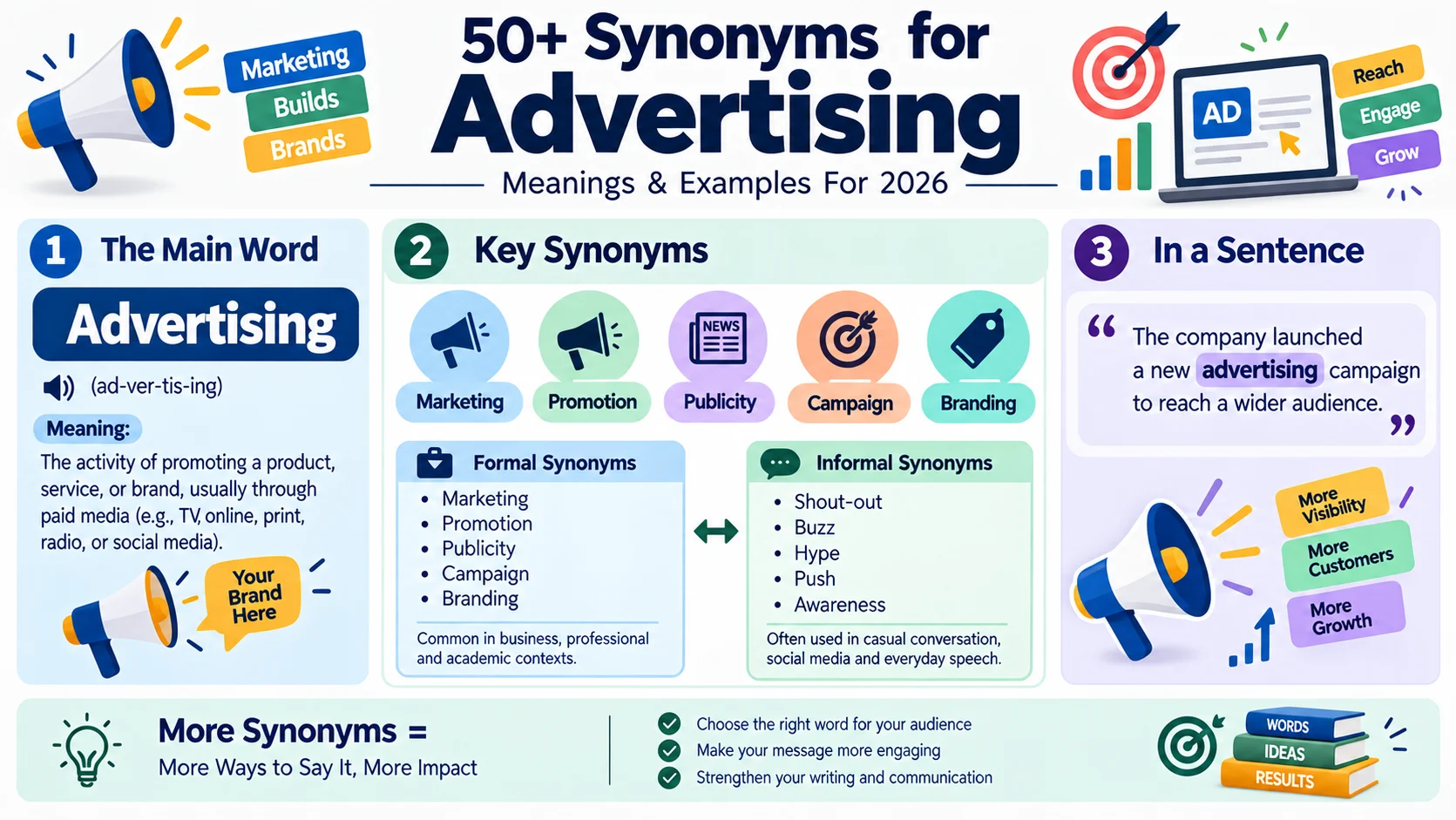
Advertising is the act of promoting products, services, or ideas to attract public attention and encourage sales. The best synonyms depend on your context. For business and formal use, try marketing or promotion. For a casual tone, use plug or hype. For digital contexts, consider campaign or branding.
Meaning, Tone and Context
The word “advertising” is a broad term that covers many activities related to promoting something. Its core function is to communicate a message to an audience with the goal of persuading them to take action. The tone is generally neutral and professional, but it can shift depending on the specific synonym you choose.
1. Simple Definition: Advertising is the activity of drawing public attention to a product, service, or event to encourage people to buy or support it.
2. Part of Speech: Advertising is primarily a noun. It is also the present participle of the verb “advertise.”
- Noun: “The advertising industry is worth billions of dollars.”
- Verb: “They are advertising their new product on social media.”
3. Tone: The tone is usually neutral and professional. It can be positive when describing creative campaigns, or negative when discussing misleading or aggressive advertising.
4. Formality: “Advertising” is a neutral word. It is appropriate for both business reports and casual conversation. For very formal contexts, you might use “promotion” or “marketing communications.”
5. Common Use Cases: You will encounter “advertising” in many situations.
- Business Reports: “Our advertising budget increased by 15 percent this quarter.”
- Resume: “Managed a team of five in the advertising department.”
- Casual Conversation: “I saw an advertisement for a new restaurant downtown.”
6. Important Word Forms:
- Verb: to advertise. “They advertise on television and radio.”
- Noun: advertisement or ad. “The advertisement was very creative.”
- Noun: advertiser. “The advertiser wanted a prime time slot.”
- Adjective: advertising. “She works for an advertising agency.”
When and How to Use “Advertising”
Knowing when to use “advertising” is about understanding its broad scope. It is the umbrella term for all promotional activities. Here are several scenarios where it is the perfect choice.
- Business Context: To discuss the overall industry or strategy of promoting products.
Example: “The company invested heavily in advertising to launch its new smartphone.” - Academic Context: To study the effects of media on consumer behavior.
Example: “Her thesis explored the impact of advertising on children.” - Resume and Professional Context: To describe your experience and skills.
Example: “Developed and executed advertising campaigns that increased brand awareness by 30 percent.” - Casual Conversation: To talk about a specific ad you saw or heard.
Example: “The advertising during the Super Bowl is always entertaining.” - Creative Writing: To describe the persuasive nature of media.
Example: “The city was a canvas of advertising, with billboards shouting for attention.” - Social Media Context: To discuss paid promotion on digital platforms.
Example: “We need to increase our advertising spend on Instagram and TikTok.” - Email Context: To inform a team about a new campaign.
Example: “Please review the attached advertising plan for the upcoming holiday season.” - Job Interview: To demonstrate your knowledge of the field.
Example: “I am passionate about digital advertising and its ability to reach specific audiences.”
Another Word for “Advertising”
Choosing the best replacement for “advertising” depends on your specific context and audience. Here are the most effective alternatives categorized by use.
- Professional Writing: “Marketing” or “Promotion.” “The marketing team developed a new strategy for the product launch.”
- Academic Writing: “Marketing communications” or “Persuasion.” “The study analyzed the role of marketing communications in shaping public opinion.”
- Casual Conversation: “Ads” or “Commercials.” “The ads during the game were funnier than the game itself.”
- Emotional Writing: “Hype” or “Buzz.” “There was a lot of hype around the new movie release.”
- Creative Writing: “Publicity” or “Campaign.” “The publicity stunt generated a lot of media attention.”
- Resume or Workplace: “Brand management” or “Campaign management.” “I have five years of experience in brand management.”
- Social Media Captions: “Promo” or “Sponsorship.” “Check out this sponsored post for a great cause.”
- Stronger Meaning: “Propaganda.” This word implies manipulative or biased advertising, often political. “The regime used propaganda to control the narrative.”
- Softer Meaning: “Awareness.” This focuses on informing the public rather than selling. “The goal of the campaign was to raise awareness about mental health.”
When Not to Use “Advertising”
While “advertising” is a versatile word, it can be too broad or generic in certain situations. Using a more precise synonym can improve clarity and impact.
- When You Need Specificity: If you are talking about a specific type of promotion, use a more precise word. “The company’s advertising was effective” is vague. “The company’s social media campaign was effective” is much clearer.
- When Discussing Digital Marketing: “Advertising” is often used broadly. “We need to improve our advertising” is less specific than “We need to improve our search engine marketing.”
- When Criticizing Directly: Using “advertising” can sound neutral when you want to be critical. Instead of “The advertising was misleading,” try “The advertising was deceptive.”
Example of Precision: Compare these two sentences.
- Vague: “She works in advertising.”
- Precise: “She works in brand strategy for a major agency.”
The second sentence is more specific and provides a clearer picture of her role.
Words Commonly Confused With “Advertising”
Understanding the differences between these related words will significantly refine your English.
- Advertising vs. Marketing: “Marketing” is a broader term. It includes advertising, but also covers market research, product development, pricing, and distribution. Advertising is just one part of the marketing mix.
- Advertising vs. Promotion: “Promotion” is also a broad term. It includes advertising, but also covers sales promotions, public relations, and personal selling. Advertising is a paid, non personal form of promotion.
- Advertising vs. Publicity: “Publicity” is free media coverage. Advertising is paid. You pay for an advertisement, but you earn publicity.
- Advertising vs. Branding: “Branding” is about creating a unique identity and image for a product or company. Advertising is one tool used to communicate that brand identity.
- Advertising vs. Propaganda: “Advertising” is generally used in a commercial context to sell products. “Propaganda” is used in a political or ideological context to influence beliefs. Propaganda often has a negative connotation.
- Advertising vs. PR (Public Relations): “Public Relations” is about managing the relationship between an organization and the public. It focuses on building trust and a positive reputation. Advertising is about delivering a specific message to sell something.
Best Synonym by Context for “Advertising”
| Context | Best Synonym | Why It Works | Example |
|---|---|---|---|
| Formal Writing | Promotion | It is a broad, professional term. | “The promotion of the new product was a huge success.” |
| Academic Writing | Marketing Communications | It is precise and covers all promotional messages. | “The study focused on marketing communications in the digital age.” |
| Professional/Business | Marketing | It covers the entire process of bringing a product to market. | “Our marketing strategy needs a complete overhaul.” |
| Resume | Campaign Management | It highlights your leadership and project skills. | “Expert in campaign management and brand development.” |
| Casual Conversation | Ads | It is simple and universally understood. | “Did you see the new ads for the iPhone?” |
| Creative Writing | Publicity | It adds a sense of drama and public attention. | “The film generated massive publicity before its release.” |
| Emotional Tone | Hype | It conveys excitement and intense buzz. | “The hype for the concert was unbelievable.” |
| Strong Intensity | Propaganda | It implies manipulative and biased persuasion. | “The posters were pure propaganda, full of lies.” |
| Soft/Moderate Tone | Awareness | It focuses on informing rather than selling. | “The campaign’s goal was to raise awareness for the charity.” |
| Social Media Captions | Promo | It is short, casual, and perfect for online use. | “Check out this special promo code for our followers.” |
| US/UK Usage | Advert (UK) / Ad (US) | Both are common, but “advert” is more British. | UK: “I saw an advert for a new car.” US: “I saw an ad for a new car.” |
Which Synonym Should You Choose?
Choosing the right word can seem difficult, but this simple guide will help you decide. It is all about matching the word to your goal, audience, and the message you want to send.
- Is your goal to sell a product or service? Use “advertising,” “promotion,” or “marketing.” These are the most direct and commercial terms.
- Is your goal to inform or educate the public? Use “awareness” or “public service announcement.” These focus on information rather than sales.
- Is your goal to build a positive reputation? Use “public relations” or “branding.” These focus on long term image and trust.
- Are you describing something creative and attention grabbing? Use “publicity” or “campaign.” These suggest a strategic and creative effort.
- Are you using a casual or social media tone? Use “ads,” “promo,” or “hype.” These are perfect for informal communication.
- Do you want to be critical or negative? Use “propaganda” or “spin.” Be careful with these, as they carry a strong negative tone.
Real Life Examples of “Advertising” in Sentences
Here are examples of how “advertising” and its stronger synonyms can be used in different real world scenarios.
- School: “For my media studies class, I have to analyze a print advertising campaign.”
- Workplace: “The marketing department is launching a new advertising campaign next month.” Stronger: “The marketing department is launching a new promotional campaign next month.”
- Writing: “The article discussed the history of advertising in the 20th century.” Stronger: “The article discussed the evolution of marketing communications in the 20th century.”
- Conversation: “I am so tired of all the advertising on YouTube.” Stronger: “I am so tired of all the ads on YouTube.”
- Social Media: “We need to boost our advertising on Instagram to reach more people.” Stronger: “We need to boost our sponsored posts on Instagram to reach more people.”
- Resume: “My background is in advertising and sales.” Stronger: “My background is in campaign management and brand strategy.”
- Email: “Please find the advertising budget for the next quarter.” Stronger: “Please find the marketing budget for the next quarter.”
- Storytelling: “The city was a blur of neon lights and aggressive advertising.” Stronger: “The city was a blur of neon lights and aggressive promotion.”
25 Synonyms for “Advertising”
The following table lists 25 accurate and practical synonyms for “advertising.
| Synonym | Simple Meaning | Best Used For | Example Sentence |
|---|---|---|---|
| Marketing | The process of promoting and selling products. | Business, professional. | “Our marketing team is developing a new strategy.” |
| Promotion | The act of raising awareness to sell something. | Business, general use. | “The promotion of the event was handled by a top agency.” |
| Publicity | Free media attention. | Creative, PR. | “The book received a lot of publicity after the author’s interview.” |
| Campaign | A planned series of activities to achieve a goal. | Business, political, social. | “The advertising campaign was launched across all platforms.” |
| Branding | Creating a unique identity for a product. | Business, creative. | “Good branding is essential for customer loyalty.” |
| PR (Public Relations) | Managing the public image of a company. | Professional, corporate. | “The PR team handled the crisis perfectly.” |
| Ad | A single advertisement. | Casual, general. | “I saw a funny ad for a new soft drink.” |
| Commercial | An advertisement on television or radio. | Casual, media. | “The commercial during the game was hilarious.” |
| Sponsorship | Providing money for an event in exchange for advertising. | Business, sports, events. | “The company secured a sponsorship for the marathon.” |
| Endorsement | A famous person publicly supporting a product. | Marketing, celebrity. | “The athlete signed a lucrative endorsement deal.” |
| Plug | A casual mention of a product. | Casual, social media. | “He gave a quick plug for his friend’s new book.” |
| Hype | Intense excitement and publicity. | Casual, entertainment. | “The hype for the new video game was unreal.” |
| Buzz | Excited talk and interest among people. | Marketing, social media. | “There is a lot of buzz around the new startup.” |
| Propaganda | Biased or misleading information used to promote a cause. | Political, critical. | “The government used propaganda to influence the election.” |
| Awareness | Informing the public about an issue. | Non profit, social. | “The campaign aimed to raise awareness about climate change.” |
| Marketing Communications | The messages used to communicate with a market. | Academic, formal. | “The course covers marketing communications and media.” |
| Sales Promotion | Short term incentives to boost sales. | Retail, business. | “The store used sales promotion tactics like buy one get one free.” |
| Direct Marketing | Contacting customers directly. | Business, email. | “Direct marketing through email can be very effective.” |
| Digital Marketing | Promoting products online. | Tech, modern business. | “Digital marketing includes SEO, social media, and email.” |
| Content Marketing | Creating valuable content to attract customers. | Modern marketing. | “Content marketing builds trust with the audience.” |
| Social Media Marketing | Promoting on social platforms. | Social media, modern. | “Social media marketing is key for reaching younger consumers.” |
| Influencer Marketing | Using influential people to promote products. | Social media, modern. | “Influencer marketing is a growing trend.” |
| Guerrilla Marketing | Unconventional, low cost marketing. | Creative, small business. | “The guerrilla marketing stunt got a lot of attention.” |
| Word of Mouth | Informal promotion by satisfied customers. | Casual, organic. | “The restaurant’s success was due to word of mouth.” |
| Blurb | A short description promoting a book or product. | Publishing, media. | “The blurb on the back cover made me want to read it.” |
Synonym Groups and Usage Differences
Professional vs. Personal Synonyms
In a professional setting, like a business report or a resume, choose “marketing,” “promotion,” or “campaign management.” These words sound polished and appropriate. In a personal setting, “ad,” “commercial,” or “plug” are more natural and friendly. For example, you would tell a colleague “We need a new marketing strategy,” but a friend “I saw a funny commercial.”
Formal vs. Conversational Synonyms
Formal Synonyms: “Marketing communications,” “promotion,” and “public relations” are perfect for academic papers, legal documents, or formal speeches.
Conversational Synonyms: “Ads,” “commercials,” and “hype” are the best choices for everyday conversations and emails to friends.
Academic Synonyms
In essays and research papers, “marketing communications” is a powerful and precise term. “Persuasion” is also useful for analyzing the techniques used to influence audiences. “Consumer culture” is another related academic term.
Professional and Business Synonyms
“Marketing” is a safe and professional choice for almost any workplace communication. “Promotion” is effective when discussing a specific campaign. “Branding” is great for discussing long term image and identity.
Creative or Literary Synonyms
These words add a layer of artistry to your descriptions.
- Publicity: Suggests a strategic effort to gain media attention.
- Hype: Conveys a sense of intense, almost chaotic excitement.
- Buzz: Perfect for describing the organic, word of mouth interest around something.
Slang or Modern Synonyms
Plug,” “hype,” and “shout out” are modern and casual synonyms. They are acceptable in social media captions, text messages, and very informal conversations. They should be avoided in academic or professional writing.
Strongest vs. Weaker Synonyms
Here is an intensity scale from mild to strongest:
- Awareness: Very mild, focused on informing.
- Promotion, Marketing: Mild to moderate, general business terms.
- Advertising: Moderate, the standard word.
- Hype, Buzz: Strong, suggests intense excitement.
- Propaganda: Strongest, suggests manipulation and bias.
Emotional vs. Neutral Synonyms
Emotional Synonyms: “Hype,” “buzz,” and “propaganda” all carry strong emotional weight. “Hype” is exciting, while “propaganda” is negative.
Neutral Synonyms: “Marketing,” “advertising,” and “promotion” are factual and free of emotional charge.
Antonyms of “Advertising”
Here are 15 clear antonyms for “advertising,” which are words that mean the opposite: hiding, concealing, or removing from public view.
| Antonym | Meaning | Example Sentence |
|---|---|---|
| Concealment | The act of hiding something. | “The concealment of the product’s flaws led to a lawsuit.” |
| Suppression | The act of preventing something from being known. | “The suppression of the report was criticized by the press.” |
| Secrecy | Keeping information hidden from others. | “The company operated in complete secrecy.” |
| Privacy | The state of being free from public attention. | “She valued her privacy and avoided the spotlight.” |
| Silence | The absence of communication. | “The company’s silence on the issue was suspicious.” |
| Censorship | The suppression of information. | “The regime used censorship to control the media.” |
| Withholding | Refusing to give information. | “The withholding of the evidence was a crime.” |
| Obscurity | The state of being unknown. | “The artist lived in obscurity for most of his life.” |
| Anonymity | The state of being anonymous. | “He wrote the article under the cover of anonymity.” |
| Hiding | The act of concealing oneself or something. | “The hiding of the documents was a deliberate act.” |
| Cover up | An attempt to prevent the public from discovering a mistake. | “The cover up of the scandal was worse than the crime.” |
| Discretion | The quality of behaving in a way that avoids attracting attention. | “He handled the matter with great discretion.” |
| Reserve | A lack of openness. | “She spoke with a certain reserve about her private life.” |
| Inhibition | A feeling that prevents you from doing something. | “His inhibition prevented him from promoting his own work.” |
| Modesty | The quality of not talking about your own abilities. | “Her modesty kept her from seeking publicity.” |
Comparison: “Advertising” vs. Similar Words
Advertising vs. Marketing
Main Difference: Marketing is the broad process of identifying and satisfying customer needs. Advertising is just one part of marketing, specifically the paid messages used to promote products.
Which One Is Stronger: “Marketing” is a stronger, more encompassing term.
Which One Is More Formal: Both are professional, but “marketing” is more strategic.
Example Sentence with Advertising: “The advertising budget was cut by 10 percent.”
Example Sentence with Marketing: “The marketing department is responsible for product development, pricing, and promotion.”
Advertising vs. Promotion
Main Difference: Promotion is a broader term that includes advertising, public relations, and sales promotions. Advertising is a specific, paid form of promotion.
Which One Is Stronger: “Promotion” is broader and can include many activities.
Which One Is More Formal: Both are formal, but “promotion” is more general.
Example Sentence with Advertising: “The advertising campaign was a success.”
Example Sentence with Promotion: “The promotion of the event included advertising, PR, and social media.”
Advertising vs. Publicity
Main Difference: Advertising is paid. Publicity is free, earned media attention. You pay for an ad, but you earn publicity.
Which One Is Stronger: “Publicity” can be more powerful because it comes from a third party source.
Which One Is More Formal: Both are neutral, but “publicity” is often used in the context of public relations.
Example Sentence with Advertising: “We spent a lot on advertising for the new product.”
Example Sentence with Publicity: “The celebrity scandal generated a lot of unwanted publicity.”
Advertising vs. Branding
Main Difference: Branding is about creating a unique identity and image. Advertising is a tool used to communicate that brand identity.
Which One Is Stronger: “Branding” is a deeper, more strategic concept.
Which One Is More Formal: Both are professional, but “branding” is more strategic.
Example Sentence with Advertising: “The advertising was designed to be visually striking.”
Example Sentence with Branding: “The company’s branding is all about innovation and trust.”
Advertising vs. Propaganda
Main Difference: Advertising is generally commercial and sells products. Propaganda is political or ideological and seeks to influence beliefs. Propaganda often has a negative connotation of manipulation.
Which One Is Stronger: “Propaganda” is much stronger and carries a negative tone.
Which One Is More Formal: “Propaganda” is often used in academic or political contexts.
Example Sentence with Advertising: “The advertising for the new car focused on safety.”
Example Sentence with Propaganda: “The posters were seen as political propaganda.”
Advertising vs. PR (Public Relations)
Main Difference: Public Relations is about managing the relationship between an organization and the public. It focuses on building trust and a positive reputation. Advertising is about delivering a specific message to sell something.
Which One Is Stronger: “Public Relations” is about long term reputation, while advertising is about short term messages.
Which One Is More Formal: Both are professional and often used in corporate settings.
Example Sentence with Advertising: “The advertising was a direct call to action.”
Example Sentence with PR: “The PR team worked to repair the company’s image after the crisis.”
Common Phrases and Expressions with “Advertising”
1. Word of Mouth Advertising
Meaning: Informal promotion by satisfied customers telling others.
Example Sentence: “The restaurant’s success was largely due to word of mouth advertising.”
2. Advertising Campaign
Meaning: A planned series of advertisements with a specific goal.
Example Sentence: “The new advertising campaign is set to launch next month.”
3. Advertising Agency
Meaning: A company that creates and manages advertisements for clients.
Example Sentence: “She works for a top advertising agency in New York.”
4. Advertising Budget
Meaning: The amount of money a company plans to spend on advertising.
Example Sentence: “We need to increase our advertising budget for the holiday season.”
5. False Advertising
Meaning: Making misleading or untrue claims in an advertisement.
Example Sentence: “The company was sued for false advertising.”
6. Free Publicity
Meaning: Media attention that is not paid for.
Example Sentence: “The viral video gave the small business a lot of free publicity.”
7. Media Buy
Meaning: The purchase of advertising space or time.
Example Sentence: “The media buy for the campaign was handled by a specialist.
8. Call to Action
Meaning: A prompt in an advertisement that encourages the viewer to do something.
Example Sentence: “The ad’s call to action was to visit the website.”
Common Mistakes to Avoid
1. Using “Advertising” When a More Precise Synonym Is Better
Mistake: “We need to improve our advertising.”
Better: “We need to improve our social media marketing.” This is more specific and actionable.
2. Confusing “Advertising” with “Marketing”
Mistake: “The marketing team is only responsible for making ads.”
Correction: Marketing is much broader. It includes advertising, but also research, product development, and pricing.
3. Using a Casual Synonym in Formal Writing
Mistake: “The report analyzed the hype around the new product.”
Better: “The report analyzed the promotion of the new product.” “Hype” is too casual for a formal report.
4. Using an Overly Dramatic Synonym for a Simple Situation
Mistake: “The company used propaganda to sell its soap.”
Better: “The company used advertising to sell its soap.” “Propaganda” is too strong and negative for selling soap.
5. Repeating the Same Word Too Often
Mistake: “The advertising was good. The advertising campaign was successful. The advertising budget was well spent.”
Better: “The advertising was good. The promotional campaign was successful. The marketing budget was well spent.” This variation makes the writing more engaging.
6. Choosing a Synonym with the Wrong Emotional Tone
Mistake: “I appreciated the propaganda for the charity event.”
Better: “I appreciated the promotion for the charity event.” “Propaganda” has a negative connotation, while “promotion” is positive and helpful.
7. Using Slang in Academic or Professional Writing
Mistake: “The article is a plug for the new study.”
Better: “The article is a promotion of the new study.” “Plug” is too casual for professional writing.
FAQs
1. What is the best synonym for advertising?
- The best synonym depends on your context. For general business use, “marketing” is a safe choice. For a specific campaign, use “promotion.” For a casual tone, use “ads.”
2. What is a formal synonym for advertising?
A formal synonym for advertising is “promotion” or “marketing communications.” Both are appropriate for formal writing and professional communication.
3. What is an informal synonym for advertising?
An informal synonym for advertising is “ads” or “plug.” “Hype” is also a good casual choice. These words are perfect for everyday conversation and friendly emails.
4. What is another word for advertising in professional writing?
In professional writing, “marketing” is an excellent choice. “Promotion” is also effective when discussing a specific campaign. “Branding” is useful for discussing long term strategy.
5. What is the difference between advertising and marketing?
Marketing is a broad process that includes advertising, product development, pricing, and distribution. Advertising is just one part of marketing, specifically the paid messages used to promote products.
6. What is the opposite of advertising?
The opposite of advertising is “concealment,” “secrecy,” or “suppression.” These words describe hiding information from the public rather than promoting it.
Conclusion
The word “advertising” is a broad and useful term. It covers all the activities we use to promote products, services, and ideas. However, choosing the right synonym depends entirely on your context, audience, and the tone you wish to convey.
For a professional setting, “marketing” or “promotion” work well. For a formal context, “marketing communications” is an excellent choice. In casual conversation, “ads” or “commercials” are natural and friendly. For a critical or negative tone, “propaganda” or “hype” convey the right feeling.
The best advice is to think about your purpose and your audience before you choose a word. Do you want to be strategic, informative, creative, or critical? Matching your word to your intention will make your communication more effective and your English more precise.
A practical vocabulary tip: Try replacing “advertising” with a more specific synonym in your writing this week. If you are discussing strategy, use “marketing.” If you are analyzing a specific campaign, use “promotion.” This small change will significantly improve the clarity and sophistication of your English.
