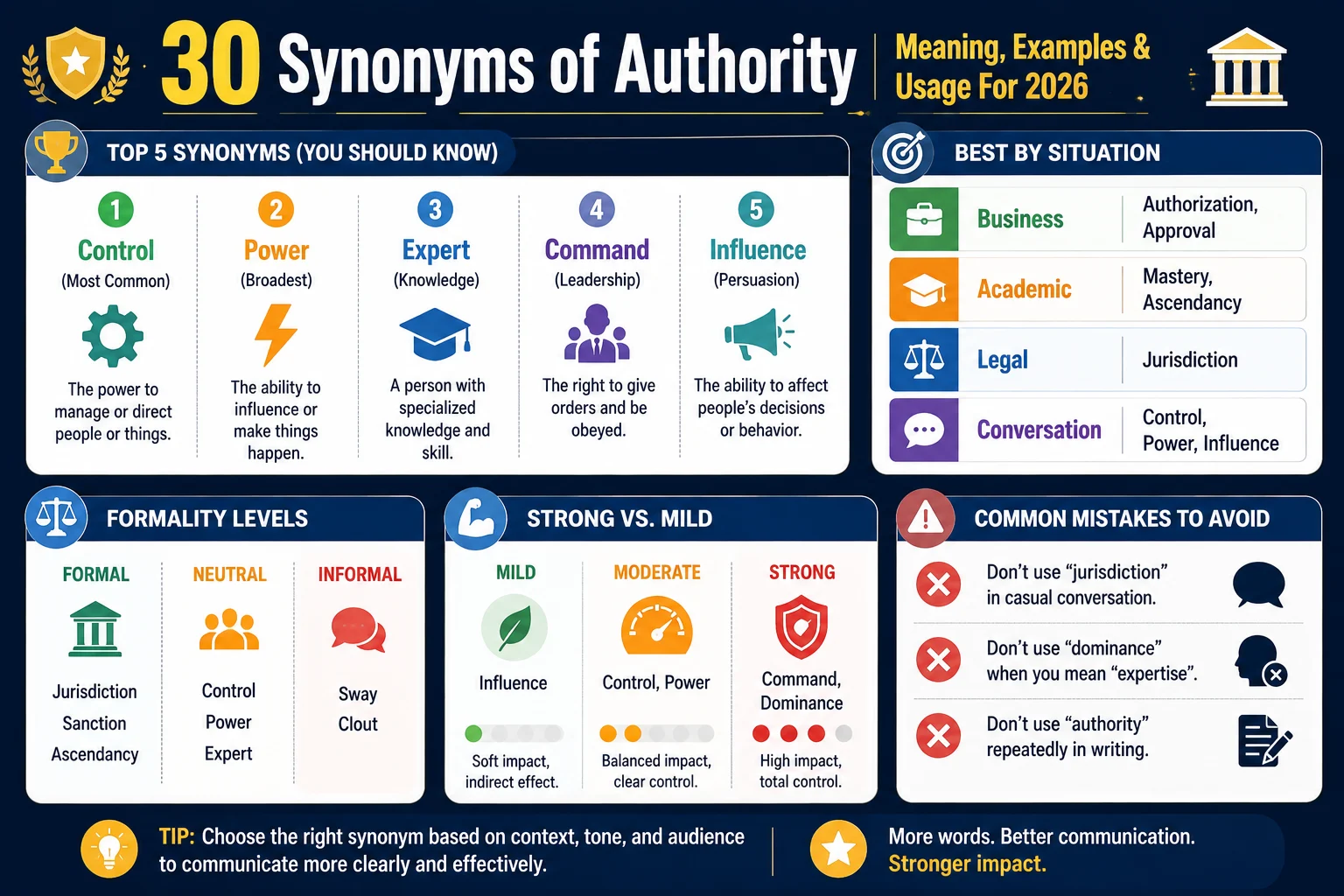
Authority means having power, control, or expert knowledge. The best synonyms depend on your context: control, power, influence, and expert are common choices. For official power, use jurisdiction; for personal confidence, try confidence; for an expert, use specialist. Each synonym carries a different tone and fits specific situations .
Top 10 Synonyms
- Control – power to direct or manage
- Power – ability to influence or control
- Influence – capacity to affect others indirectly
- Expert – person with deep knowledge
- Jurisdiction – official legal authority
- Command – authority to lead or direct
- Mastery – complete skill or control
- Sway – persuasive power or influence
- Specialist – expert in a particular field
- Dominance – superior power or control
Every synonym has a slightly different meaning, tone, or context. Let’s explore each one.
The word authority appears everywhere, from business meetings to classroom discussions. But using the same word repeatedly makes your writing dull and imprecise. Learning synonyms of authority helps you express exactly what you mean – whether you’re describing someone’s power, knowledge, or confidence.
In this guide, you’ll discover 30 powerful synonyms for authority, organized by meaning, formality, and usage. You’ll learn which words sound natural in conversation, which fit professional writing, and which should stay in academic papers. Each synonym includes clear examples and practical tips so you can start using them confidently today.
What Does “Authority” Mean?
Definition
Simply put, authority means having the power, right, or knowledge to do something or make decisions. It can refer to official power (like a judge’s authority to sentence someone), personal confidence (speaking with authority), or expert knowledge (being an authority on a subject). The word comes from the Latin auctoritas, meaning “invention, advice, or opinion.”
In everyday use, authority is the ability to influence others, make decisions, or command respect because of your position or expertise.
Pronunciation
| US IPA | /əˈθɔːrəti/ |
| UK IPA | /ɔːˈθɒrəti/ |
| Syllables | 4 (au-thor-i-ty) |
| Tip | Stress the second syllable: “uh-THOR-uh-tee” |
Grammar
| Grammar Feature | Information |
|---|---|
| Part of Speech | Noun (countable and uncountable) |
| Common Position | Subject, object, or after prepositions |
| Typical Pattern | “have authority,” “authority over,” “authority on” |
Examples:
- “She has authority over the entire department.” (uncountable, power)
- “He is an authority on ancient history.” (countable, expert)
- “The judge exercised her authority to dismiss the case.” (uncountable, power)
Note: When talking about a person who is an expert, “authority” is countable. When talking about power or control, it’s usually uncountable.
Word Family
| Word | Part of Speech | Meaning |
|---|---|---|
| Authority | Noun | Power, right, or expert knowledge |
| Authorize | Verb | To give official permission or power |
| Authorization | Noun | Official permission or approval |
| Authoritative | Adjective | Commanding and self-confident; reliable |
| Authoritatively | Adverb | In a confident and commanding way |
| Authoritarian | Adjective/Noun | Favoring strict obedience to authority |
15 Synonyms of “Authority”
1. Control
Meaning: The power to direct, manage, or influence people or situations.
Best Used For: Daily conversation, business writing, professional communication.
Formality: Neutral
Tone: Professional, Neutral
Frequency: ⭐⭐⭐⭐⭐ Very Common
CEFR Level: B1
Example Sentence 1: “The manager has full control over the project timeline.”
Example Sentence 2: “She lost control of the car on the icy road.”
Usage Tip: Use “control” when you want to emphasize the ability to direct or manage. It’s a safe, neutral choice in most situations. Unlike “authority,” “control” doesn’t imply official permission – it can be gained through force, skill, or position.
2. Power
Meaning: The ability to influence or control people, events, or things.
Best Used For: Conversation, writing, political discussion.
Formality: Neutral
Tone: Professional, Neutral
Frequency: ⭐⭐⭐⭐⭐ Very Common
CEFR Level: A2
Example Sentence 1: “The Prime Minister has the power to dismiss ministers” .
Example Sentence 2: “Knowledge is power in today’s competitive world.”
Usage Tip: “Power” is broader than “authority.” Authority is legitimate power given by a position or law. Power can be informal, illegal, or gained through influence. Native speakers often use “power” when talking about strength or ability, not just official control.
3. Influence
Meaning: The capacity to affect someone’s behavior, opinions, or decisions indirectly.
Best Used For: Daily conversation, professional writing, social situations.
Formality: Neutral
Tone: Neutral, Professional
Frequency: ⭐⭐⭐⭐⭐ Very Common
CEFR Level: B1
Example Sentence 1: “As we grew older, I had less influence and couldn’t control him” .
Example Sentence 2: “Social media has a huge influence on young people’s spending habits.”
Usage Tip: “Influence” is softer than “authority” or “control.” You don’t need a position of power to have influence – anyone can influence others through persuasion, charisma, or expertise. Use this when you want to describe indirect or gentle persuasion.
4. Expert
Meaning: A person with special knowledge or skill in a particular area.
Best Used For: Daily conversation, professional settings, academic writing.
Formality: Neutral
Tone: Professional, Positive
Frequency: ⭐⭐⭐⭐⭐ Very Common
CEFR Level: B1
Example Sentence 1: “Professor Ahmed is an expert on Russian affairs” .
Example Sentence 2: “She’s an expert in cybersecurity and frequently advises large companies.”
Usage Tip: Use “expert” when you want to emphasize someone’s knowledge, not their power. This is a common, natural alternative when “authority” means “expert.” Native speakers rarely say “an authority on” in casual conversation – they say “an expert in” or “a specialist in.
5. Jurisdiction
Meaning: The official power to make legal decisions or enforce laws in a specific area.
Best Used For: Legal writing, professional communication, formal documents.
Formality: Formal
Tone: Professional, Legal
Frequency: ⭐⭐⭐ Moderate
CEFR Level: C1
Example Sentence 1: “The British police have no jurisdiction over foreign bank accounts” .
Example Sentence 2: “This case falls outside the court’s jurisdiction.”
Usage Tip: Use “jurisdiction” specifically for legal or official authority. It always refers to a geographic area or defined scope of power. Avoid using this in everyday conversation – it sounds too formal and technical.
6. Command
Meaning: Authority to lead, direct, or control others, especially in a military or organizational context.
Best Used For: Professional communication, military contexts, leadership discussions.
Formality: Neutral to Formal
Tone: Professional, Authoritative
Frequency: ⭐⭐⭐⭐ Common
CEFR Level: B2
Example Sentence 1: “He has command of the entire naval fleet.”
Example Sentence 2: “The general took command of the operation.”
Usage Tip: “Command” suggests direct, clear leadership. It’s stronger than “authority” and often implies obedience from subordinates. Use it when talking about military, organizational, or leadership roles. Native speakers also use it figuratively, as in “she has command of the subject.”
7. Mastery
Meaning: Complete control or comprehensive knowledge of a subject or skill.
Best Used For: Academic writing, creative writing, professional settings.
Formality: Formal
Tone: Professional, Positive
Frequency: ⭐⭐⭐ Moderate
CEFR Level: B2
Example Sentence 1: “This is a region where humans have gained mastery over the major rivers” .
Example Sentence 2: “Her mastery of the piano amazed everyone at the concert.”
Usage Tip: “Mastery” combines control with skill and knowledge. It suggests depth and expertise. Use it when you want to emphasize that someone has achieved complete understanding or control, not just authority. It’s a strong, impressive word.
8. Sway
Meaning: Influence or persuasive power over people.
Best Used For: Creative writing, conversation (somewhat literary), political discussion.
Formality: Informal
Tone: Neutral, slightly literary
Frequency: ⭐⭐⭐ Moderate
CEFR Level: B2
Example Sentence 1: “How can mothers keep daughters under their sway?”
Example Sentence 2: “The charismatic leader held great sway over his followers.”
Usage Tip: “Sway” is a more literary or emotional word for influence. It’s often used in creative writing or speeches to describe persuasive power. In everyday conversation, “influence” is more common and natural.
9. Specialist
Meaning: A person who focuses on a particular area of study or work.
Best Used For: Daily conversation, professional communication, business writing.
Formality: Neutral
Tone: Professional, Positive
Frequency: ⭐⭐⭐⭐⭐ Very Common
CEFR Level: B1
Example Sentence 1: “She’s a specialist in diseases of the nervous system” .
Example Sentence 2: “We hired a specialist to fix the IT issue.”
Usage Tip: “Specialist” is often a more natural alternative to “authority” when describing someone with deep knowledge. It’s widely used and understood, particularly in business and medical contexts. Use “expert” and “specialist” interchangeably in most situations.
10. Dominance
Meaning: Superior power, control, or influence over others.
Best Used For: Academic writing, professional settings, discussions of competition.
Formality: Neutral to Formal
Tone: Professional, Neutral
Frequency: ⭐⭐⭐⭐ Common
CEFR Level: B2
Example Sentence 1: “They had five centuries of dominance by the Romans” .
Example Sentence 2: “The company’s market dominance is being challenged by new competitors.”
Usage Tip: “Dominance” implies a competitive situation – one group or person is clearly on top. It’s more forceful than “authority” and can have negative connotations of oppression. Use it carefully in professional writing to avoid sounding aggressive.
11. Prerogative
Meaning: A special right or privilege that belongs to a particular person or group.
Best Used For: Formal writing, legal contexts, academic work.
Formality: Formal
Tone: Professional, Neutral
Frequency: ⭐⭐ Rare
CEFR Level: C1
Example Sentence 1: “I thought it was a woman’s prerogative to change her mind” .
Example Sentence 2: “The board has the prerogative to approve or reject any proposal.”
Usage Tip: “Prerogative” is a formal word for an exclusive right. It’s often used in legal or political contexts and rarely appears in everyday conversation. Use only in formal writing where you need to emphasize a special entitlement.
12. Ascendancy
Meaning: A position of power, influence, or control over others.
Best Used For: Formal writing, historical texts, academic work.
Formality: Formal
Tone: Professional, Neutral
Frequency: ⭐⭐ Rare
CEFR Level: C1
Example Sentence 1: “The extremists are gaining ascendancy” .
Example Sentence 2: “During the 19th century, Britain’s naval ascendancy was unquestioned.”
Usage Tip: “Ascendancy” describes a rising or dominant position. It’s a sophisticated word best suited for formal or academic writing about politics, history, or social dynamics. Not appropriate for casual conversation.
13. Authorization
Meaning: Official permission or approval to do something.
Best Used For: Professional communication, business writing, formal documents.
Formality: Formal
Tone: Professional, Neutral
Frequency: ⭐⭐⭐⭐ Common
CEFR Level: B2
Example Sentence 1: “We need authorization from the manager before proceeding.”
Example Sentence 2: “The project requires formal authorization from the board.”
Usage Tip: Use “authorization” when you’re talking about official permission rather than personal power. It’s the noun form of “authorize” and fits business and legal contexts well. In everyday conversation, “permission” or “approval” sounds more natural.
14. Sanction
Meaning: Official permission or approval for an action.
Best Used For: Formal writing, legal contexts, government communication.
Formality: Formal
Tone: Professional, Neutral
Frequency: ⭐⭐⭐ Moderate
CEFR Level: C1
Example Sentence 1: “We need government sanction to proceed” .
Example Sentence 2: “The new policy received official sanction from the ministry.”
Usage Tip: “Sanction” has two meanings – approval and punishment. This makes it confusing in some contexts. When using it to mean authority or permission, the context must be clear. It’s primarily a formal word used in legal and government settings.
15. Assurance
Meaning: Confidence and certainty in one’s abilities; self-belief.
Best Used For: Professional writing, personal development, conversation.
Formality: Neutral
Tone: Positive, Professional
Frequency: ⭐⭐⭐⭐ Common
CEFR Level: B2
Example Sentence 1: “He spoke with great assurance during his presentation.”
Example Sentence 2: “Her natural assurance made her an effective leader.
Usage Tip: “Assurance” relates to self-confidence, not official power. When someone “speaks with authority,” they speak with confidence and certainty. “Assurance” captures that quality well. Use it when you want to emphasize how confidently someone expresses themselves.
Synonyms Comparison Table
| Synonym | Best Context | Formality | Tone | Frequency |
|---|---|---|---|---|
| Control | Directing or managing situations | Neutral | Professional, Neutral | ⭐⭐⭐⭐⭐ |
| Power | Broad influence or strength | Neutral | Neutral | ⭐⭐⭐⭐⭐ |
| Influence | Indirect persuasion | Neutral | Neutral | ⭐⭐⭐⭐⭐ |
| Expert | Someone with deep knowledge | Neutral | Professional, Positive | ⭐⭐⭐⭐⭐ |
| Specialist | Professional in a specific field | Neutral | Professional, Positive | ⭐⭐⭐⭐⭐ |
| Command | Military or organizational leadership | Neutral to Formal | Authoritative | ⭐⭐⭐⭐ |
| Jurisdiction | Legal authority in a specific area | Formal | Professional, Legal | ⭐⭐⭐ |
| Mastery | Complete skill or control | Formal | Professional, Positive | ⭐⭐⭐ |
| Sway | Persuasive power (literary) | Informal | Slightly Literary | ⭐⭐⭐ |
| Dominance | Superior competitive position | Neutral to Formal | Neutral | ⭐⭐⭐⭐ |
| Ascendancy | Rising political or social power | Formal | Neutral | ⭐⭐ |
| Prerogative | Exclusive right or privilege | Formal | Neutral | ⭐⭐ |
| Sanction | Official approval | Formal | Neutral | ⭐⭐⭐ |
| Authorization | Official permission | Formal | Professional, Neutral | ⭐⭐⭐⭐ |
| Assurance | Self-confidence | Neutral | Positive, Professional | ⭐⭐⭐⭐ |
Best Synonyms by Situation
| Situation | Best Synonym | Why It Works |
|---|---|---|
| Daily Conversation | Power, Control | Simple, widely understood, natural sounding |
| Business Email | Approval, Authorization | Clear, professional, action-oriented |
| Academic Writing | Mastery, Ascendancy | Sophisticated, precise, impressive |
| School Assignment | Expert, Influence | Appropriate level, easy to explain |
| Professional Meeting | Authority, Control | Direct, clear, commanding |
| Presentation | Confidence, Authority | Demonstrates credibility and knowledge |
| Creative Writing | Sway, Command | Expressive, vivid, engaging |
| Social Media | Influence, Power | Concise, modern, relevant |
| Movie Review | Authority, Expertise | Describes director or actor’s skill |
| Book Review | Mastery, Expertise | Shows depth of author’s knowledge |
Formal vs. Informal Synonyms
Formal Alternatives
| Synonym | Best Used For |
|---|---|
| Jurisdiction | Legal documents and court settings |
| Sanction | Government and policy contexts |
| Prerogative | Official rights and legal privileges |
| Ascendancy | Historical and political writing |
| Authorization | Business and legal permissions |
Neutral Alternatives
| Synonym | Best Used For |
|---|---|
| Control | Most everyday situations |
| Power | General discussions |
| Expert | Describing knowledgeable people |
| Influence | Social and professional settings |
| Authority | Standard professional use |
Informal Alternatives
| Synonym | Best Used For |
|---|---|
| Sway | Persuading or influencing friends |
| Say-so | Permission from someone in charge (very informal) |
| Weight | Describing someone’s influence or opinion impact |
When to choose each level: Use formal synonyms in academic papers, legal documents, and official communications. Use neutral synonyms in most professional and everyday situations. Use informal synonyms only with friends, family, or in very casual conversation.
Strong vs. Mild Synonyms
Mild
These synonyms are gentle and suitable for everyday situations where you don’t want to sound aggressive.
- Influence – soft, indirect power
- Weight – the strength of an opinion or argument
Moderate
These synonyms are more expressive than the original word and fit most professional situations.
- Control – direct but neutral management
- Power – a broad, flexible term
- Expert – emphasizes knowledge rather than control
Strong
These are high-intensity alternatives that should be used carefully because they can sound commanding or even aggressive.
- Command – implies unquestioned leadership
- Dominance – suggests being superior to others
- Mastery – complete, unquestionable control
Intensity matters: Choosing a stronger word changes how your message sounds. “She has influence” is gentle. “She has dominance” is powerful and competitive. Always match the intensity to your situation.
Real-Life Examples
In the Office
“Our team leader has the authority to approve all leave requests. If you need time off, make sure you submit your form to her.”
In a Business Email
“I’m writing to request authorization for the new marketing campaign. Please review the attached proposal and let me know if you can give your approval.”
In a Classroom
“My history professor is an expert on World War II. Her lectures are fascinating because she speaks with such authority on the subject.”
In a Presentation
“As the project manager, I have command of the entire implementation process. My team reports to me, and I’m responsible for final decisions.”
In Daily Conversation
“My grandmother has a lot of influence in our family. Everyone listens to her advice because she’s the wisest person we know.”
Common Collocations
| Common Phrase | Better Alternative |
|---|---|
| Have authority | Wield power, Exercise control |
| Authority figure | Leader, Boss, Supervisor |
| Speak with authority | Speak confidently, Speak with assurance |
| Authoritative source | Reliable source, Trusted expert |
| Abuse of authority | Misuse of power, Overstepping boundaries |
| In a position of authority | In a leadership role |
Common Phrases
“Under the authority of”
Means being controlled or governed by someone or something. Example: “The decision was made under the authority of the board.”
“In a position of authority”
Describes someone who has official power to make decisions. Example: “Teachers are in a position of authority over their students.”
“By the authority invested in me”
A formal expression used when someone performs an official act. Example: “By the authority invested in me, I now pronounce you married.”
“Without authority”
Means doing something without permission. Example: “She made the decision without authority.”
“An authority on”
Means someone who knows a lot about a subject. Example: “He’s an authority on ancient Greek philosophy.”
“Speak with authority”
Means to speak confidently and knowledgeably. Example: “She spoke with authority on the topic, which impressed everyone.”
Context Guide
| Situation | Best Synonym | Reason |
|---|---|---|
| Essay (Academic) | Mastery, Ascendancy | Formal and sophisticated language expected |
| Speech | Confidence, Command | Clear, commanding words engage listeners |
| Business Email | Authorization, Approval | Professional and action-oriented |
| Novel | Sway, Power | Vivid language engages readers |
| Presentation | Authority, Assurance | Projects confidence and credibility |
| Conversation | Control, Influence | Simple, natural, easy to understand |
| Academic Writing | Jurisdiction, Prerogative | Precise, formal terminology required |
| Marketing Copy | Influence, Authority | Persuasive words attract customers |
Related Words
Near Synonyms
Leadership – the action of leading a group or organization. Closely related to authority but focuses on the act of leading.
Preeminence – the fact of surpassing all others; superiority. A formal word describing being the best or most important.
Clout – influence or power (informal). Often used in politics and business: “He has a lot of political clout.”
Antonyms
| Opposite | Meaning |
|---|---|
| Subordination | Being lower in rank or position |
| Weakness | Lack of power or influence |
| Obedience | Following commands rather than giving them |
| Powerlessness | Having no control or influence |
Related Adjectives
- Authoritative – commanding and self-confident; reliable
- Powerful – having great power or influence
- Influential – having the power to affect others
- Dominant – most important or powerful
Related Nouns
- Leader – a person who leads or commands
- Manager – someone who controls or administers
- Supervisor – someone who oversees others
- Administration – those in power who manage an organization
Related Verbs
- Direct – to manage or guide
- Govern – to rule or exercise authority over
- Command – to give orders with authority
- Influence – to affect or persuade
Frequently Asked Questions
What is another word for authority?
The best alternatives depend on your context. For official power, use jurisdiction or command. For personal confidence, use assurance. For an expert, use expert or specialist. For general power, use control, power, or influence .
Which synonym for authority sounds the most professional?
Authority itself is perfectly professional. For alternatives, control, jurisdiction, and command sound professional in business settings. Authorization and approval work well in formal communications. Avoid informal words like say-so in professional writing.
What is the strongest synonym for authority?
Dominance is very strong and implies superior control over others. Command is also strong, suggesting unquestioned leadership. Mastery is the strongest when describing skill or knowledge. Use these carefully, as they can sound aggressive in some situations.
Which synonym is best for essays?
For academic essays, mastery, ascendancy, and expertise work well. If you’re writing a history paper, ascendancy is excellent for describing political control. For scientific writing, expert and specialist are clear and appropriate. Jurisdiction is perfect for legal topics.
What’s the difference between authority and power?
Authority is legitimate power given by a position, law, or official role. Power is broader – it can be gained through force, skill, money, or influence. A police officer has legal authority, but a criminal can have power through fear. All authority is power, but not all power is authority.
Which synonym for authority is most common in everyday English?
Power, control, and influence are the most common synonyms in everyday conversation. Expert and specialist are common when describing knowledgeable people. Native speakers usually say “expert” instead of “authority” when talking about someone with deep knowledge .
What is the opposite of authority?
The main opposites are subordination (being in a lower position), weakness (lack of power), and obedience (following rather than commanding). Powerlessness is another common opposite, meaning having no control or influence.
What’s the difference between authorization and authority?
Authority is the general power or right to do something. Authorization is the specific act of giving official permission. You have authority to make decisions, but you need authorization for a specific expense. Think of authority as the general ability and authorization as the specific permission .
Conclusion
Authority is a powerful word with many useful synonyms, each fitting different contexts. Remember that power and control work well for general situations, expert and specialist describe knowledgeable people, and jurisdiction and command suit formal or legal settings. The most important factor is always the context – choose your synonym based on formality, tone, and what you want to emphasize.
Start using these words naturally in your writing and speaking. Pay attention to how native speakers use them and experiment with different options. The more you practice, the more confident you’ll become in selecting the perfect word for every situation. Strong vocabulary isn’t about using big words – it’s about choosing the right word at the right time.
