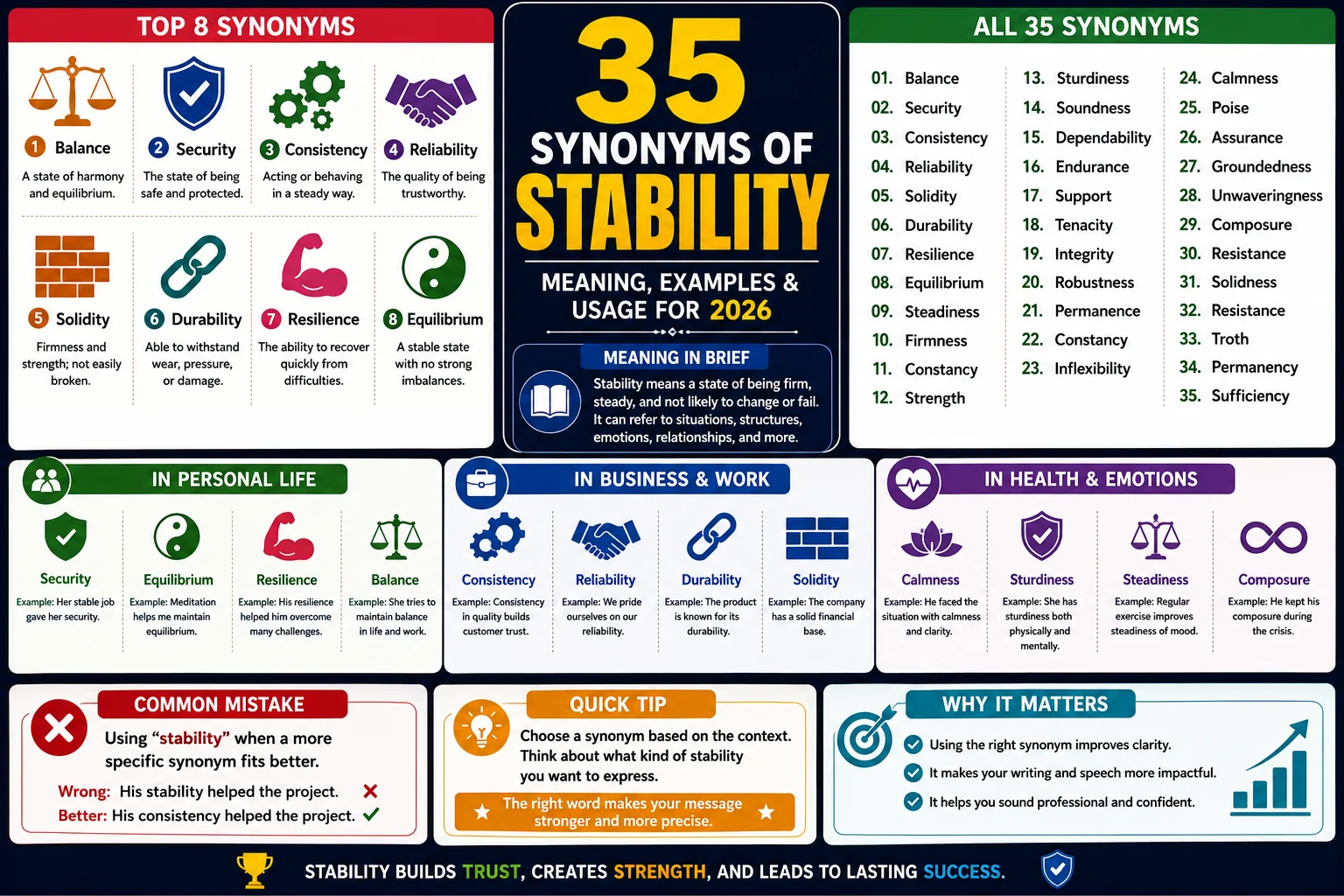
Stability means being steady, firm, and unlikely to change. The best synonyms include balance, steadiness, security, solidity, durability, reliability, and consistency. The most common everyday synonym is balance when discussing life or emotions, and security when discussing finances. Each synonym has a slightly different meaning, tone, and context.
Think about what keeps you feeling safe and grounded. That feeling of things being steady, reliable, and predictable that’s stability. We use this word everywhere, from talking about our emotions to describing the economy or even a table that doesn’t wobble.
But sometimes “stability” feels too formal or repetitive. Maybe you’re writing an essay, preparing a speech, or just trying to sound more natural in conversation. That’s where this guide comes in. I’ve put together 30 practical synonyms, complete with real examples and clear explanations. By the end, you’ll choose the perfect word for any situation without hesitation.
What Does “Stability” Mean?
Definition
In simple terms, stability is the quality of being steady, firm, and resistant to change. Think of it as the opposite of wobbling, falling, or breaking. It can describe physical objects, like a sturdy table, or more abstract things, like a calm mind, a secure job, or a consistent relationship. When something has stability, you can trust it not to suddenly fall apart or change unexpectedly.
Pronunciation
| Feature | Information |
|---|---|
| US IPA | /stəˈbɪl.ə.ti/ |
| UK IPA | /stəˈbɪl.ə.ti/ |
| Syllables | 4 (sta-bil-i-ty) |
| Tip | Stress the second syllable: sta-BIL-i-ty |
Grammar
| Feature | Information |
|---|---|
| Part of Speech | Noun |
| Common Position | Subject or object of a sentence |
| Typical Pattern | “stability of [something]” or “[something’s] stability” |
Example Sentences:
- The stability of the bridge was tested during the storm.
- She found emotional stability after years of counseling.
- Economic stability is essential for small businesses.
Grammar Note: “Stability” is almost always uncountable. We don’t say “stabilities” except in very rare technical contexts.
Word Family
| Word | Part of Speech | Meaning |
|---|---|---|
| Stabilize | Verb | To make something steady or firm |
| Stability | Noun | The state of being steady and unchanging |
| Stable | Adjective | Steady, firm, and unlikely to change |
| Unstable | Adjective | Not steady, likely to change or fall |
| Stabilization | Noun | The process of making something stable |
30 Synonyms of Stability
1. Balance
Meaning: A state where different parts are equal and working well together.
Best Used For: Daily conversation, mental health, lifestyle, design.
Formality: Neutral
Tone: Positive, Neutral
Frequency: ⭐⭐⭐⭐⭐ Very Common
CEFR Level: A2
Example Sentence 1: Finding a work-life balance has been a real challenge.
Example Sentence 2: Her emotional balance helped her stay calm during the crisis.
Usage Tip: “Balance” is one of the most versatile alternatives. Use it for emotional, physical, and lifestyle contexts. It’s very common in everyday speech.
2. Steadiness
Meaning: The quality of being regular, steady, and not easily upset.
Best Used For: Describing work performance, habits, or physical things.
Formality: Neutral
Tone: Positive, Reliable
Frequency: ⭐⭐⭐ Moderate
CEFR Level: B1
Example Sentence 1: His steadiness at work earned him a promotion.
Example Sentence 2: The steadiness of her hands made her an excellent surgeon.
Usage Tip: “Steadiness” emphasizes reliability and consistency. Use it when you want to highlight dependable behavior.
3. Security
Meaning: The feeling of being safe, protected, and free from worry.
Best Used For: Finances, emotions, national safety, technology.
Formality: Neutral
Tone: Positive, Reassuring
Frequency: ⭐⭐⭐⭐⭐ Very Common
CEFR Level: A2
Example Sentence 1: Financial security gave him the freedom to travel.
Example Sentence 2: The security of the building was their top priority.
Usage Tip: “Security” focuses on safety and protection. It’s a top choice for financial and emotional contexts.
4. Solidity
Meaning: The quality of being strong, firm, and well-built.
Best Used For: Describing materials, arguments, relationships.
Formality: Neutral
Tone: Positive, Strong
Frequency: ⭐⭐⭐ Moderate
CEFR Level: B2
Example Sentence 1: The solidity of their friendship lasted through difficult times.
Example Sentence 2: The argument lacked solidity and was easily challenged.
Usage Tip: “Solidity” often refers to physical strength but works well for abstract ideas like arguments or relationships.
5. Durability
Meaning: The ability to last a long time without breaking or wearing out.
Best Used For: Products, materials, buildings, relationships.
Formality: Neutral
Tone: Positive, Practical
Frequency: ⭐⭐⭐⭐ Common
CEFR Level: B2
Example Sentence 1: The durability of the phone case impressed everyone.
Example Sentence 2: The durability of their marriage came from mutual respect.
Usage Tip: “Durability” is perfect when discussing how long something can last. It’s common in product reviews and construction.
6. Reliability
Meaning: The quality of being trustworthy and always doing what you expect.
Best Used For: People, machines, services, information.
Formality: Neutral
Tone: Positive, Trustworthy
Frequency: ⭐⭐⭐⭐ Common
CEFR Level: B1
Example Sentence 1: His reliability made him the most trusted team member.
Example Sentence 2: The car’s reliability was its best selling point.
Usage Tip: “Reliability” emphasizes consistency and trustworthiness. It’s commonly used for both people and products.
7. Consistency
Meaning: Always behaving or performing in the same way.
Best Used For: Work performance, habits, sports, food quality.
Formality: Neutral
Tone: Positive
Frequency: ⭐⭐⭐⭐ Common
CEFR Level: B2
Example Sentence 1: Consistency in her daily routine helped her achieve her goals.
Example Sentence 2: The restaurant’s consistency keeps customers coming back.
Usage Tip: “Consistency” is about things being the same every time. Use it for habits, quality, and performance.
8. Firmness
Meaning: The quality of being solid, strict, or unchangeable.
Best Used For: Decisions, mattresses, parenting, materials.
Formality: Neutral
Tone: Neutral
Frequency: ⭐⭐⭐ Moderate
CEFR Level: B1
Example Sentence 1: His firmness on the issue surprised everyone.
Example Sentence 2: The mattress had the perfect balance of softness and firmness.
Usage Tip: “Firmness” can mean physical hardness or mental determination. It’s versatile but a bit formal.
9. Equilibrium
Meaning: A state of perfect balance, often in science or emotions.
Best Used For: Science, psychology, economics, philosophy.
Formality: Formal
Tone: Neutral, Scientific
Frequency: ⭐⭐ Rare
CEFR Level: C1
Example Sentence 1: The body must maintain its equilibrium to stay healthy.
Example Sentence 2: He struggled to find emotional equilibrium after the loss.
Usage Tip: “Equilibrium” is a formal, technical word. Use it in academic writing or when discussing scientific concepts.
10. Constancy
Meaning: The quality of being faithful, unchanging, and consistent.
Best Used For: Personal relationships, principles, loyalties.
Formality: Formal
Tone: Positive, Poetic
Frequency: ⭐⭐ Rare
CEFR Level: C1
Example Sentence 1: Her constancy through difficult times touched everyone.
Example Sentence 2: His constancy to his beliefs never wavered.
Usage Tip: “Constancy” has a slightly old-fashioned, literary feel. Use it in formal or creative writing.
11. Permanence
Meaning: The state of lasting forever or for a very long time.
Best Used For: Tattoos, marriage, structures, legacies.
Formality: Neutral
Tone: Positive, Serious
Frequency: ⭐⭐⭐ Moderate
CEFR Level: B2
Example Sentence 1: The permanence of his decision surprised his family.
Example Sentence 2: She longed for permanence in a world of constant change.
Usage Tip: “Permanence” emphasizes lasting forever. Use it when discussing things that aren’t easily changed.
12. Continuity
Meaning: The quality of continuing without interruption.
Best Used For: History, traditions, storytelling, processes.
Formality: Formal
Tone: Neutral
Frequency: ⭐⭐⭐ Moderate
CEFR Level: B2
Example Sentence 1: The continuity of the family business spanned five generations.
Example Sentence 2: The film’s continuity error ruined the illusion for viewers.
Usage Tip: “Continuity” focuses on things remaining unchanged over time. It’s common in historical and professional contexts.
13. Assurance
Meaning: A feeling of confidence and certainty.
Best Used For: Insurance, business, personal confidence.
Formality: Formal
Tone: Positive, Reassuring
Frequency: ⭐⭐⭐ Moderate
CEFR Level: B2
Example Sentence 1: The assurance of a steady income allowed him to relax.
Example Sentence 2: Her calm assurance inspired confidence in her team.
Usage Tip: “Assurance” is about inner confidence or outside guarantees. It’s formal but also personal.
14. Certainty
Meaning: The state of being completely sure or confident.
Best Used For: Decisions, beliefs, scientific facts.
Formality: Neutral
Tone: Positive, Confident
Frequency: ⭐⭐⭐⭐ Common
CEFR Level: B2
Example Sentence 1: He lacked certainty about his career path.
Example Sentence 2: The certainty of her answer convinced everyone.
Usage Tip: “Certainty” is about absolute confidence. Use it when there’s no doubt.
15. Soundness
Meaning: The quality of being safe, reliable, and in good condition.
Best Used For: Buildings, arguments, finances, health.
Formality: Formal
Tone: Positive, Trustworthy
Frequency: ⭐⭐ Rare
CEFR Level: C1
Example Sentence 1: The structural soundness of the bridge was confirmed.
Example Sentence 2: The soundness of her reasoning impressed the judges.
Usage Tip: “Soundness” is formal and often technical. Use it in professional or academic contexts.
16. Regularity
Meaning: The quality of happening at fixed times.
Best Used For: Routines, schedules, habits, patterns.
Formality: Neutral
Tone: Neutral
Frequency: ⭐⭐⭐ Moderate
CEFR Level: B2
Example Sentence 1: The regularity of his morning routine helped him focus.
Example Sentence 2: The regularity of the bus service impressed commuters.
Usage Tip: “Regularity” is about predictable timing. Use it for routines and schedules.
17. Rootedness
Meaning: A feeling of belonging and being connected to a place or community.
Best Used For: Migration, home, identity, culture.
Formality: Neutral
Tone: Positive, Warm
Frequency: ⭐⭐ Rare
CEFR Level: C1
Example Sentence 1: She found rootedness after moving back to her hometown.
Example Sentence 2: His rootedness in the community made him a trusted leader.
Usage Tip: “Rootedness” has a warm, personal feeling. Use it when discussing belonging and identity.
18. Order
Meaning: A state where everything is in its proper place.
Best Used For: Organization, society, systems.
Formality: Neutral
Tone: Positive, Calm
Frequency: ⭐⭐⭐⭐⭐ Very Common
CEFR Level: A2
Example Sentence 1: The new manager brought order to the chaotic office.
Example Sentence 2: She needed order in her life to feel at peace.
Usage Tip: “Order” is simple and versatile. Use it for physical and organizational stability.
19. Anchor
Meaning: A person or thing that provides stability and security.
Best Used For: Relationships, leadership, support systems.
Formality: Informal
Tone: Positive, Warm
Frequency: ⭐⭐⭐ Moderate
CEFR Level: B2
Example Sentence 1: Her grandmother was the anchor of the family.
Example Sentence 2: His principles served as an anchor through turbulent times.
Usage Tip: “Anchor” is a lovely metaphor. Use it for people or things that keep you grounded.
20. Bedrock
Meaning: A solid foundation that everything else is built on.
Best Used For: Principles, values, culture, systems.
Formality: Formal
Tone: Positive, Strong
Frequency: ⭐⭐⭐ Moderate
CEFR Level: C1
Example Sentence 1: Honesty is the bedrock of their relationship.
Example Sentence 2: Education is the bedrock of a functioning society.
Usage Tip: “Bedrock” is a strong, formal metaphor. Use it for foundational principles or values.
21. Foundation
Meaning: A strong base that supports everything else.
Best Used For: Buildings, relationships, ideas, education.
Formality: Neutral
Tone: Positive, Fundamental
Frequency: ⭐⭐⭐⭐ Common
CEFR Level: B1
Example Sentence 1: A good education provides the foundation for success.
Example Sentence 2: Trust is the foundation of any healthy relationship.
Usage Tip: “Foundation” is versatile and common. Use it for physical and abstract bases.
22. Predictability
Meaning: The quality of being known or expected in advance.
Best Used For: Behavior, weather, markets, results.
Formality: Neutral
Tone: Neutral
Frequency: ⭐⭐⭐ Moderate
CEFR Level: B2
Example Sentence 1: The predictability of the train schedule made commuting easier.
Example Sentence 2: The predictability of his reactions annoyed his colleagues.
Usage Tip: “Predictability” can be positive (reliability) or negative (boring). Choose carefully based on context.
23. Fixedness
Meaning: The state of being firmly established and unchanging.
Best Used For: Opinions, habits, physical objects.
Formality: Formal
Tone: Neutral
Frequency: ⭐ Rare
CEFR Level: C1
Example Sentence 1: The fixedness of his opinions made debate impossible.
Example Sentence 2: The fixedness of the tree’s roots prevented soil erosion.
Usage Tip: “Fixedness” is formal and often implies stubbornness. Use cautiously.
24. Sturdiness
Meaning: The quality of being strongly built, durable, and reliable.
Best Used For: Furniture, buildings, objects, people.
Formality: Neutral
Tone: Positive, Practical
Frequency: ⭐⭐⭐ Moderate
CEFR Level: B1
Example Sentence 1: The sturdiness of the old oak table impressed the buyer.
Example Sentence 2: Her sturdiness of character helped her overcome challenges.
Usage Tip: “Sturdiness” emphasizes physical strength but works for character too.
25. Endurance
Meaning: The ability to last a long time or withstand difficulties.
Best Used For: Sports, materials, relationships, patience.
Formality: Neutral
Tone: Positive, Strong
Frequency: ⭐⭐⭐⭐ Common
CEFR Level: B2
Example Sentence 1: The endurance of the marathon runners amazed the crowd.
Example Sentence 2: The friendship’s endurance through struggles proved its strength.
Usage Tip: “Endurance” focuses on lasting ability. Use it for physical and emotional strength.
26. Fortitude
Meaning: Mental and emotional strength when facing difficulty.
Best Used For: Personal struggles, courage, resilience.
Formality: Formal
Tone: Positive, Admirable
Frequency: ⭐⭐ Rare
CEFR Level: C1
Example Sentence 1: She faced the illness with remarkable fortitude.
Example Sentence 2: His fortitude during the crisis inspired his team.
Usage Tip: “Fortitude” is formal and describes inner strength. Use it for challenging situations.
27. Resilience
Meaning: The ability to recover quickly from difficulties.
Best Used For: Psychology, environment, business.
Formality: Neutral
Tone: Positive, Admirable
Frequency: ⭐⭐⭐⭐ Common
CEFR Level: B2
Example Sentence 1: Her resilience helped her rebuild her life after the loss.
Example Sentence 2: The community’s resilience was tested by the natural disaster.
Usage Tip: “Resilience” is very common and positive. Use it to describe bouncing back.
28. Steadfastness
Meaning: Loyalty, determination, and devotion that doesn’t change.
Best Used For: Relationships, principles, commitments.
Formality: Formal
Tone: Positive, Admirable
Frequency: ⭐⭐ Rare
CEFR Level: C1
Example Sentence 1: His steadfastness to his goals impressed everyone.
Example Sentence 2: Her steadfastness in the face of criticism was admirable.
Usage Tip: “Steadfastness” is formal and suggests unwavering loyalty.
29. Permanency
Meaning: The state of lasting forever, similar to permanence.
Best Used For: Legal documents, commitments, decisions.
Formality: Formal
Tone: Neutral
Frequency: ⭐⭐ Rare
CEFR Level: C1
Example Sentence 1: The court’s decision had a sense of permanency.
Example Sentence 2: He sought permanency in a constantly changing world.
Usage Tip: “Permanency” is a formal variant of “permanence.” Use it in professional contexts.
30. Unequivocalness
Meaning: The quality of being clear and without any doubt.
Best Used For: Official statements, decisions, instructions.
Formality: Very Formal
Tone: Serious, Clear
Frequency: ⭐ Very Rare
CEFR Level: C2
Example Sentence 1: The unequivocalness of her answer ended the debate.
Example Sentence 2: The policy’s unequivocalness made it easy to enforce.
Usage Tip: This word is very rare and formal. Only use it in highly professional contexts.
Synonyms Comparison Table
| Synonym | Best Context | Formality | Tone | Frequency |
|---|---|---|---|---|
| Balance | Daily life | Neutral | Positive | ⭐⭐⭐⭐⭐ |
| Security | Finance, safety | Neutral | Reassuring | ⭐⭐⭐⭐⭐ |
| Order | Organization | Neutral | Calm | ⭐⭐⭐⭐⭐ |
| Consistency | Habits, work | Neutral | Positive | ⭐⭐⭐⭐ |
| Reliability | People, products | Neutral | Trustworthy | ⭐⭐⭐⭐ |
| Durability | Products, materials | Neutral | Practical | ⭐⭐⭐⭐ |
| Endurance | Sports, difficulties | Neutral | Strong | ⭐⭐⭐⭐ |
| Resilience | Recovery, psychology | Neutral | Admirable | ⭐⭐⭐⭐ |
| Foundation | Ideas, education | Neutral | Fundamental | ⭐⭐⭐⭐ |
| Certainty | Decisions, beliefs | Neutral | Confident | ⭐⭐⭐⭐ |
| Steadiness | Work, physical | Neutral | Reliable | ⭐⭐⭐ |
| Solidity | Arguments, materials | Neutral | Strong | ⭐⭐⭐ |
| Permanence | Tattoos, marriage | Neutral | Serious | ⭐⭐⭐ |
| Equilibrium | Science, emotions | Formal | Scientific | ⭐⭐ |
| Constancy | Relationships | Formal | Poetic | ⭐⭐ |
| Fortitude | Personal struggles | Formal | Admirable | ⭐⭐ |
Best Synonyms by Situation
| Situation | Best Synonym | Why It Works |
|---|---|---|
| Daily Conversation | Balance | Natural and widely understood |
| Business Email | Consistency | Professional and clear |
| Academic Writing | Equilibrium | Precise and appropriate |
| School Assignment | Foundation | Easy to understand |
| Professional Meeting | Reliability | Professional and practical |
| Mental Health Discussion | Resilience | Common and empathetic |
| Creative Writing | Constancy | Poetic and flowing |
| Social Media | Stability | Short and well-known |
| Movie Review | Permanence | Thought-provoking |
| Book Review | Endurance | Literary and descriptive |
Formal vs Informal Synonyms
Formal Alternatives
| Synonym | Best Used For |
|---|---|
| Equilibrium | Scientific writing, economics |
| Constancy | Academic essays, philosophy |
| Fortitude | Professional speeches, formal writing |
| Soundness | Technical evaluations, finance |
| Unequivocalness | Legal documents, official statements |
Neutral Alternatives
| Synonym | Best Used For |
|---|---|
| Balance | Most everyday situations |
| Security | General use, personal life |
| Reliability | Professional and personal |
| Consistency | Habits, quality, performance |
| Foundation | Education, relationships |
Informal Alternatives
| Synonym | Best Used For |
|---|---|
| Anchor | Casual conversation, support |
| Bedrock | Friendly discussions, metaphors |
Choosing the Right Level: Use formal synonyms for research papers, legal documents, and professional speeches. Neutral synonyms work for most situations, including work emails and daily conversations. Save informal alternatives for chatting with friends.
Strong vs Mild Synonyms
Mild
- Balance – simple and everyday
- Regularity – basic consistency
- Order – calm and organized
Moderate
- Consistency – reliable performance
- Reliability – trust and dependability
- Durability – lasting strength
Strong
- Fortitude – deep inner strength
- Resilience – bouncing back powerfully
- Equilibrium – scientific precision
Intensity Matters: Choosing a strong synonym changes your message dramatically. “He has stability” is neutral, while “He has fortitude” implies heroic inner strength. Always match intensity to the situation.
Real-Life Examples
Workplace:
“The consistency of the team’s performance made them the top choice for the project.”
Business Email:
“We value your reliability and look forward to continuing our partnership.”
Everyday Conversation:
“I need to find better balance between my job and my family life.”
Therapy Context:
“She’s been working on building emotional resilience after the traumatic experience.”
Academic Writing:
“The study examined the economic equilibrium under various market conditions.”
Common Collocations
| Common Phrase | Better Alternative |
|---|---|
| Emotional stability | Emotional balance, resilience |
| Financial stability | Financial security, soundness |
| Political stability | Political order, continuity |
| Structural stability | Structural soundness, durability |
| Mental stability | Mental balance, equilibrium |
Common Phrases
| Phrase | Meaning | Better Alternative |
|---|---|---|
| Rock of stability | A person who provides security | Anchor of support |
| Pillar of stability | A reliable support | Foundation of strength |
| Harbor of stability | A safe, unchanging place | Secure refuge |
Context Guide
| Situation | Best Synonym | Reason |
|---|---|---|
| Essay | Equilibrium | Academic and precise |
| Speech | Resilience | Engaging and emotional |
| Business Email | Reliability | Professional and practical |
| Novel | Constancy | Literary and poetic |
| Presentation | Consistency | Clear and professional |
| Conversation | Balance | Natural and common |
| Academic Writing | Soundness | Formal and accurate |
| Marketing Copy | Security | Reassuring and attractive |
Related Words
Near Synonyms
- Balance emphasizes equality, while stability emphasizes firmness.
- Consistency focuses on sameness, while stability focuses on steadiness.
Antonyms
- Instability – the state of being unstable
- Chaos – complete disorder
- Volatility – quick and unpredictable change
Related Adjectives
- Stable – steady and unchanging
- Unstable – not steady, likely to change
- Reliable – consistently good and trustworthy
Related Nouns
- Balance – a state of equilibrium
- Security – freedom from danger
- Foundation – a base that supports everything
Related Verbs
- Stabilize – to make stable
- Secure – to make safe and stable
- Establish – to set up firmly
Frequently Asked Questions
What is another word for stability?
The most common synonyms for stability are balance, security, consistency, reliability, and solidity. The best choice depends on your context, but “balance” is the most versatile and widely used alternative.
Which synonym sounds the most professional?
Reliability, consistency, and soundness sound the most professional. These words are commonly used in business writing and professional communication. Equilibrium is also professional but more academic.
Which synonym is best for everyday conversation?
Balance is the best choice for everyday conversation. It’s natural, widely understood, and fits most casual contexts. Security is also common when discussing personal comfort and finances.
What is the strongest synonym for stability?
Fortitude, resilience, and equilibrium are among the strongest synonyms. They emphasize deep inner strength, scientific precision, or powerful recovery abilities.
What’s the difference between stability and consistency?
Stability is about being steady and unlikely to change, while consistency is about always acting or performing the same way. A stable table doesn’t wobble; a consistent worker always produces quality work.
Which synonym is most common in everyday English?
Balance, security, and order are the most commonly used synonyms for stability in everyday English. You’ll hear “work-life balance,” “financial security,” and “sense of order” frequently.
What is the opposite of stability?
Instability, chaos, and volatility are the main opposites of stability. Instability is the direct opposite, while chaos suggests complete disorder and volatility suggests rapid, unpredictable change.
Is “stability” a positive word?
Stability is generally positive, though its tone depends on context. It’s positive in most situations, but can sometimes imply a lack of excitement or growth. Always consider the situation.
Conclusion
We’ve explored 30 powerful synonyms for stability, and you now have a rich vocabulary to choose from. Remember, stability is about being steady, firm, and reliable. The best synonym depends on your situation use balance for everyday conversations, reliability for professional settings, equilibrium for academic writing, and resilience when discussing personal strength.
Context, formality, and tone matter a great deal. A word that sounds perfect in a casual conversation might feel out of place in a business email. Practice using these alternatives, experiment with different contexts, and your English will become more natural and confident. Keep learning, and you’ll always find the right word for the right moment.
