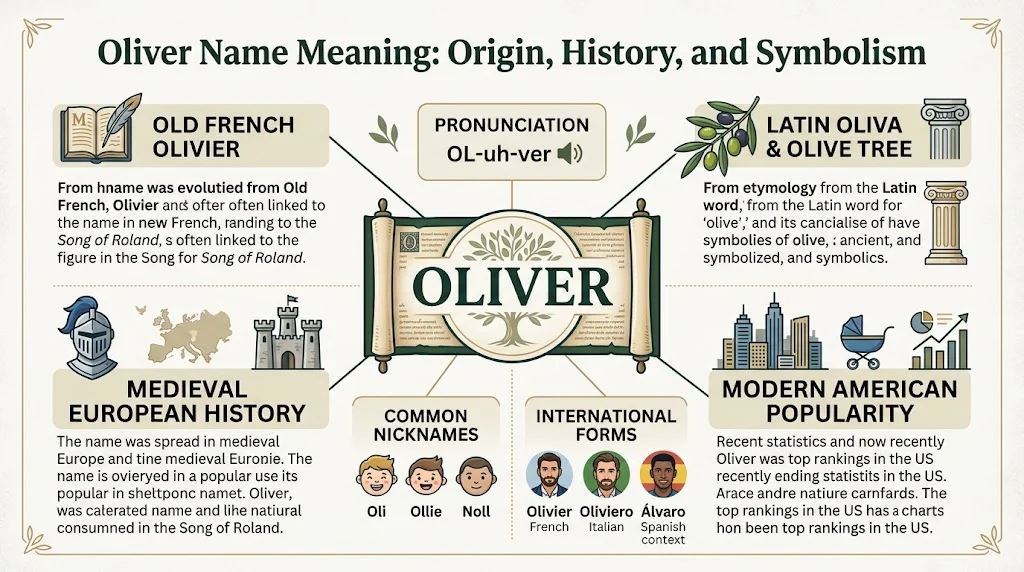
The olive name’s meaning is commonly connected with the “olive tree,” through Old French Olivier and Latin oliva. The name also has debated Germanic connections. It became prominent in medieval Europe and remains widely used in English speaking countries today.
The olive name’s meaning is most often explained as “olive tree,” linking the name with an ancient symbol of peace, endurance, fruitfulness, and renewal. The name has a long European history. Its story also includes French literature, medieval legend, English culture, and modern naming trends.
The name comes into English through Old French Olivier. That form was possibly influenced by the Latin word oliva, meaning “olive tree.” However, the etymology is not completely certain. Some historical sources have proposed connections with older Germanic or Norse names. Therefore, “olive tree” is the safest widely cited interpretation, rather than an absolute statement about a single original root.
Today, Oliver feels both traditional and contemporary. It works naturally in the United States, the United Kingdom, Australia, and several European naming traditions. In the United States, it has become especially prominent in recent decades. The U.S. The Social Security Administration ranked Oliver third among boys’ names for babies born in 2025.
This guide explains the history, pronunciation, symbolism, variants, nicknames, cultural associations, and modern usage of the name. It also separates established etymology from popular interpretations.
Quick Answer Box
| Meaning | Context | Primary Platforms | Example | Tone |
| Olive tree | Traditional name interpretation | Baby names, family records, social profiles | “Oliver James” | Classic |
| Peace and fruitfulness | Symbolic association with the olive | Names, literature, personal branding | “Oliver” as a first name | Warm |
| Olivier | Historical French form | European naming traditions | “Olivier” | Formal |
| Oli, Ollie, Olly | Common short forms | Texting, social media, everyday speech | “Ollie, are you coming?” | Friendly |
| Oliver | Modern English form | U.S. and international usage | “Oliver is my son’s name.” | Familiar |
What Does Oliver’s Name Mean?
The most common interpretation connects Oliver with the olive tree. This connection comes through the Old French form Olivier and the Latin word oliva. The olive tree has been important across Mediterranean cultures for thousands of years. As a result, the name carries several symbolic associations beyond its literal botanical reference.
The first association is peace. The olive branch has long served as a symbol of peace and reconciliation in Western traditions. Consequently, people sometimes interpret Oliver symbolically as a peaceful or peace associated name.
The second association is fruitfulness. Olive trees produce valuable fruit and oil. They can also survive for long periods under difficult conditions. Therefore, modern name descriptions sometimes connect Oliver with endurance, prosperity, stability, and growth.
However, these symbolic meanings should be separated from the strict linguistic meaning. “Peaceful” is not a literal translation of Oliver. Instead, it is a cultural association derived from the symbolism of the olive tree.
The Old French Connection
The English form Oliver developed from Old French Olivier. Medieval French played an important role in the development of English vocabulary and personal names.
Olivier also appears in the medieval Carolingian literary tradition. In La Chanson de Roland, Olivier is presented as a companion and adviser to Roland. This literary presence helped make the name familiar across medieval Western Europe.
Therefore, the history of the name is not simply botanical. It combines language, literature, mythology, and medieval naming culture.
The Latin Root
The Latin word oliva means “olive” or “olive tree.” The connection between Oliver and this Latin word is widely cited, but the complete historical pathway remains debated.
Names often change as they move between languages. Spelling, pronunciation, folk association, and local naming traditions can all reshape an older name.
Consequently, a modern name can have more than one proposed ancestor. Oliver is a good example of this linguistic complexity.
Possible Germanic and Norse Connections
Some historical name researchers have suggested that Olivier may have been influenced by a Germanic or Norse name. Proposed connections include Old Norse Áleifr, associated with the name Olaf, and other older Germanic forms.
These theories mean that the name should not be presented as having one completely undisputed etymology.
For everyday naming purposes, however, the olive tree interpretation remains the most recognizable explanation.
Contextual Dynamics and Nuances of the Name
Names develop meanings through both language and culture. Oliver demonstrates this clearly.
A dictionary style explanation may say “olive tree.” A family may associate the name with peace. Another person may connect it with literature, history, or a fictional character.
None of these interpretations necessarily replaces the others.
Literal Meaning Versus Symbolic Meaning
The literal interpretation concerns linguistic origin. The symbolic interpretation concerns cultural associations.
| Type | Interpretation |
| Literal | Olive tree |
| Linguistic | Connected with Old French Olivier |
| Latin association | Oliva, meaning olive |
| Symbolic | Peace, endurance, fruitfulness |
| Literary | Medieval European tradition |
| Modern | Classic, familiar, internationally recognizable |
This distinction matters when researching baby names. Online naming pages sometimes present symbolic qualities as though they were direct translations.
A more accurate approach is to say that Oliver is associated with the olive tree and that the olive tree carries symbolic meanings such as peace and longevity.
Why Olive Trees Matter to the Name
Olive trees have deep cultural importance around the Mediterranean. Their fruit provides food. Their oil has historically been used for cooking, lighting, medicine, and ritual purposes.
The tree itself can live for many years. Therefore, it naturally became associated with continuity and resilience.
As a result, parents who choose Oliver may appreciate the broader imagery even when they are not focused on historical linguistics.
Is Oliver a Biblical Name?
Oliver is not a traditional Hebrew biblical name. It is also not a direct biblical personal name in the way names such as David, Daniel, or Samuel are.
However, the olive tree and olive branch have strong biblical and Christian symbolism. That connection can make Oliver feel spiritually familiar to some families.
This distinction is important. The name’s linguistic origin and its later religious associations are separate questions.
Is Oliver an Irish Name?
Oliver is used in Ireland, but it is not originally an Irish Gaelic name.
It entered wider European naming culture through forms such as Olivier and later Oliver. Some Irish families may use it because of family history, cultural familiarity, or modern naming preferences.
Therefore, calling Oliver exclusively an Irish name would be inaccurate.
Real Life Conversation Examples Using oliver name meaning
People usually encounter the topic in baby naming discussions, family conversations, genealogy research, and social media questions.
The following examples show how the subject can appear naturally.
Example 1: Choosing a Baby Name
Maya: We are thinking about naming our son Oliver.
James: Do you know what it means?
Maya: I read that it is connected with the olive tree.
James: That is a nice meaning. The olive tree also has peaceful symbolism.
Maya: Exactly. We liked the history behind it.
Example 2: Asking About the Name
Alex: Why did you choose Oliver?
Jordan: We wanted something classic but not overly formal.
Alex: Does the meaning matter to you?
Jordan: Yes. I liked the connection with the olive tree and its symbolism.
Example 3: A Genealogy Discussion
Sarah: I found an Oliver in our family records from several generations ago.
Daniel: Really? That makes the name even more interesting.
Sarah: I was researching the oliver name’s meaning and discovered its medieval European history.
Daniel: So it has been around much longer than I thought.
Example 4: Comparing Names
Emma: I am deciding between Oliver and Theodore.
Liam: What matters most to you?
Emma: I want something traditional with a positive meaning.
Liam: Then you might want to compare the historical origins rather than just modern popularity.
Example 5: Casual Texting
Noah: What does Oliver mean?
Ethan: Usually “olive tree.”
Noah: Is that the whole story?
Ethan: Not exactly. The name has Old French roots and some debated older connections.
Noah: Interesting. I thought it was just an English name.
Platform Specific Breakdown
Oliver is a personal name, not internet slang. Therefore, its use across Snapchat, TikTok, Instagram, and texting usually reflects ordinary naming and identity practices rather than a special coded meaning.
Still, digital platforms influence how names are presented, shortened, searched, and interpreted.
How It Is Used on Snapchat
On Snapchat, Oliver may appear as a person’s display name, username, nickname, or contact name.
Common informal forms include Oli, Ollie, and Olly. The exact choice depends on personal preference and regional usage.
For example:
“Oliver”
“Ollie”
“Oli”
“Olly”
These forms can make the name feel more casual. However, they do not change the underlying meaning or etymology.
Snapchat users may also combine the name with numbers, initials, interests, or personal phrases when creating usernames.
The Role of oliver name meaning on TikTok
TikTok can amplify interest in baby names, name meanings, pronunciation, and cultural history. Users may search for names because of celebrities, fictional characters, family trends, or naming videos.
However, a TikTok interpretation is not automatically an authoritative etymology.
For example, a creator might describe Oliver as meaning “peaceful.” That statement is better understood as a symbolic interpretation. The more precise linguistic explanation connects the name with Old French Olivier and the Latin olive association.
Therefore, social media explanations should be compared with established name references.
Instagram and Texting Dynamics
Instagram profiles often display first names prominently. Someone named Oliver might use a formal version on a professional profile and a nickname such as Ollie in personal conversations.
Texting tends to favor shorter forms. Consequently, Oli, Ollie, and Olly can feel more conversational than Oliver.
The choice depends on the individual. There is no universal rule that determines which nickname an Oliver should use.
Alternative Meanings
Search engines and AI systems may encounter many variations of the same naming question.
Common searches include:
- What does Oliver mean?
- What is the meaning of Oliver?
- Oliver name origin
- Oliver baby name meaning
- Oliver meaning in English
- Oliver biblical meaning
- Oliver boy name meaning
- Oliver name history
- Meaning and origin of Oliver
- What does the name Oliver stand for?
These phrases have similar search intent, but they are not linguistically identical.
Semantic Variations
The primary concept can also be expressed through terms such as:
| Search Variation | Main Intent |
| Oliver origin | Etymology |
| Oliver definition | Meaning |
| Oliver history | Historical development |
| Oliver symbolism | Cultural interpretation |
| Oliver pronunciation | Spoken form |
| Oliver nickname | Short forms |
| Oliver popularity | Naming statistics |
| Oliver variants | International forms |
| Oliver baby name | Naming decision |
| Oliver meaning for a boy | Gender and naming context |
This semantic network helps readers find the specific information they need without repeating one exact phrase throughout every paragraph.
Pronunciation
In American English, Oliver is commonly pronounced approximately AH luh ver, with the stress on the first syllable.
Pronunciation varies by language and region. For example, British English has a somewhat different vowel quality.
The French form Olivier also has a distinct pronunciation and should not be treated as simply the same spoken form.
International Forms
Oliver has many related forms across languages and cultures.
| Language or Tradition | Form |
| English | Oliver |
| French | Olivier |
| Dutch | Olivier |
| Italian | Oliviero |
| Spanish | Oliverio |
| Hungarian | Olivér |
| Icelandic | Óliver |
| Polish | Oliwer or Oliwier |
| Swedish | Oliver or Olle |
| Finnish | Oliver or Olli |
| Serbian | Oliver |
| Croatian | Oliver |
| Macedonian | Oliver |
These forms demonstrate how the name has traveled across European languages.
Misinterpretations:
A useful naming guide should also explain what the name does not mean.
Oliver Does Not Literally Mean “Peace”
The olive branch is associated with peace. However, “peace” is a symbolic association, not the direct lexical translation of Oliver.
Oliver Is Not Exclusively English
English is one important usage tradition. Yet the name appears in many European languages.
Calling it exclusively English overlooks its wider history.
Oliver Is Not Proven to Have Only One Root
The Old French and Latin explanation is widely cited. Yet alternative Germanic and Norse theories exist.
Therefore, absolute claims about one uncontested origin should be avoided.
Oliver Is Not Internet Slang
The name does not have a universal hidden slang definition on Snapchat, TikTok, Instagram, or texting.
If a particular online community uses “Oliver” as an inside joke, that meaning would depend on that community. It would not redefine the historical name.
Popularity Does Not Define Meaning
A name can become popular without acquiring a new etymological meaning.
Popularity reflects naming behavior. Meaning reflects linguistic history and cultural interpretation.
These are separate dimensions.
How to Respond in Chat Comfortably
If someone asks about the name in a conversation, the best response depends on the level of detail they want.
A short answer could be:
“Oliver is traditionally connected with the olive tree, through the Old French Olivier and Latin oliva.”
A slightly longer answer could be:
“Oliver is generally linked to the olive tree. Its history comes through Old French Olivier, with a possible Latin connection to oliva. Some older Germanic theories also exist.”
For a baby naming conversation, you could say:
“Oliver has a classic European history and is commonly associated with the olive tree, which gives it peaceful and enduring symbolism.”
For genealogy research, a more precise response is better:
“The name appears in medieval European sources as Olivier. Its exact etymology is debated, although the connection with Latin oliva is widely cited.”
This distinction keeps the answer accurate without making the conversation unnecessarily academic.
FAQs
The most commonly cited meaning is “olive tree.” The name comes through Old French Olivier and is possibly connected with the Latin word oliva.
Is Oliver a biblical name?
Oliver is not a traditional biblical personal name. However, the olive tree has significant biblical and Christian symbolism, especially around peace and reconciliation.
Is Oliver an English name?
Oliver is widely used in English, but its history is broader than England. The English form developed through European naming traditions, particularly Old French Olivier.
What does the olive tree symbolize?
The olive tree can symbolize peace, endurance, fruitfulness, prosperity, and longevity. These are cultural associations rather than literal translations of the name.
Is Oliver a popular name in the United States?
Yes. The U.S. The Social Security Administration ranked Oliver third among boys’ names for babies born in 2025. It also ranked third for the broader 2020 through 2025 period in its decade data.
What are common nicknames for Oliver?
Common English short forms include Oli, Ollie, and Olly. Different families may prefer different spellings or pronunciations.
Is Olivier the same name as Oliver?
Olivier is a French and Dutch form related to Oliver. The two forms share the same broader naming history, but their pronunciations differ.
Does Oliver mean peaceful?
Not literally. The direct meaning is commonly associated with the olive tree. Peacefulness comes from the cultural symbolism of the olive branch and olive tree.
Is Oliver an old name?
Yes. The name has medieval European history. It became known through the medieval Chanson de Roland, where Olivier appears as a companion and adviser to Roland.
Why has Oliver remained popular?
Its continued use reflects several factors. It has historical depth, simple pronunciation, recognizable spelling, international variants, and established cultural familiarity. In the United States, its recent popularity is documented by Social Security Administration naming data.
Conclusion:
The Oliver name’s meaning is best understood through a combination of language, history, and cultural symbolism. Its most widely cited interpretation connects it with the olive tree. That connection comes through Old French Olivier and is associated with the Latin oliva.
The history becomes more interesting when viewed across medieval Europe. Olivier appeared in the Chanson de Roland, helping establish the name within an important medieval literary tradition. Later, Oliver became established in English naming culture.
The name also demonstrates why name meanings should be researched carefully. The olive tree explanation is widely accepted as the principal interpretation, but alternative historical theories exist. Symbolic descriptions such as “peaceful,” meanwhile, should be treated as cultural associations rather than literal translations.
In modern America, Oliver is not merely an old European name. It is also a highly popular contemporary choice. The Social Security Administration placed Oliver at number three among U.S. boys’ names for births in 2025.
Its appeal therefore combines several layers. Oliver has medieval roots, international forms, familiar pronunciation, friendly nicknames, and strong symbolic associations with the olive tree.
Most importantly, Oliver is a personal name rather than a universal piece of internet slang. Social platforms can change how people display or shorten the name, but they do not change its established etymological history.
For anyone researching the oliver name’s meaning, the clearest summary is simple: Oliver is a historic European name commonly associated with the olive tree, with additional cultural associations of peace, endurance, fruitfulness, and continuity.
