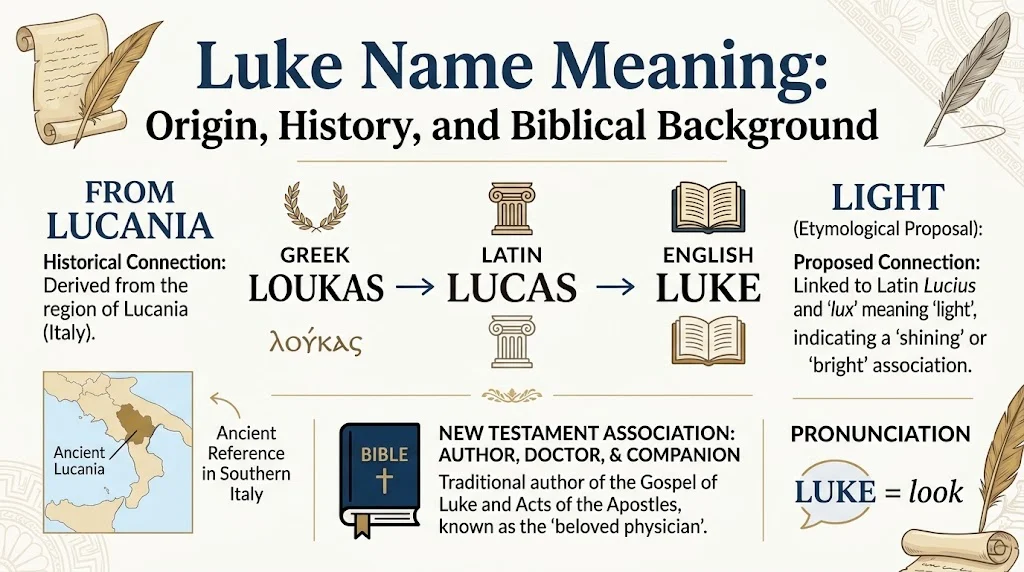
The luke name meaning is traditionally connected with the Greek Loukas and Latin Lucas. It is commonly explained as “from Lucania,” a region of southern Italy. Some sources also connect Luke with Lucius and the idea of light.
luke name meaning has a fascinating history that connects Greek, Latin, biblical, and English naming traditions.
The name is the English form of Latin Lucas. Latin Lucas comes from the Greek Λουκᾶς, written as Loukas in English transliteration. The deeper origin, however, is not completely certain. A common explanation connects Loukas with Loukanos, meaning “from Lucania.” Lucania was an ancient region in southern Italy. Another theory connects the name with the Roman name Lucius.
That uncertainty matters when explaining the name accurately. Many baby name websites simply define Luke as “light.” That popular explanation is understandable because Lucius is associated with the Latin word lux, meaning “light.” However, the etymology of Luke itself is more complicated.
The name also has strong biblical importance. Luke is traditionally identified with the physician and companion of Paul mentioned in the New Testament. Christian tradition associates him with the Gospel of Luke and the Acts of the Apostles.
Today, Luke feels short, familiar, and international. It works naturally in English while remaining closely connected to forms such as Lucas, Luca, Luka, Lukas, and Loukas.
This guide explains the history, linguistic background, biblical connection, pronunciation, variations, cultural context, and everyday use of the name.
QUICK ANSWER BOX
| Meaning | Context | Primary Platforms | Example | Tone |
| Traditionally linked with “from Lucania” | Greek and Latin naming history | Baby name sites, social profiles, naming discussions | “We chose Luke because of its biblical history.” | Classic and familiar |
| Sometimes associated with “light” through Lucius | Popular name interpretation | Baby naming content and family discussions | “Luke has a bright, positive association.” | Warm and positive |
| English form of Lucas | English and biblical usage | Personal names, books, media, social platforms | “Luke is his first name.” | Simple and modern |
What Does Luke’s name mean?
The most careful answer is that Luke is generally traced through Latin Lucas to Greek Loukas. The exact deeper etymology remains debated. One established explanation connects Loukas with Loukanos, referring to someone from Lucania in southern Italy.
The “from Lucania” explanation
Lucania was an ancient region in southern Italy. Under this explanation, Loukas functioned as a geographic name.
In simple terms, it could identify someone associated with Lucania. This pattern appears in many ancient names. A person’s name could reflect ancestry, birthplace, geography, occupation, or another identifying feature.
Behind the Name describes Luke as the English form of Latin Lucas and traces it to Greek Loukas. It presents the Lucania explanation as probable rather than absolutely proven.
That wording is important.
A responsible name guide should not present a disputed etymology as unquestionable fact. Instead, “probably from Lucania” is more precise.
The connection with Lucius
Another proposed explanation links Luke with the Latin name Lucius.
Lucius is connected with Latin lux, meaning “light.” Therefore, some modern explanations give Luke the associated meaning “light,” “bright,” or “bringer of light.” However, that interpretation should be presented as an alternative rather than the only historical explanation.
The distinction is especially useful for parents researching names. A simplified baby name definition may be attractive, but historical linguistics can be more complicated.
Oxford’s Greek Names in English project lists Luke as Λουκᾶς and marks its etymology with a question mark. That supports the idea that the deeper origin should be treated cautiously.
Why “light” is so often associated with Luke
The association exists partly because Luke belongs to the wider Lucas and Lucius naming family.
Lucius is associated with Latin lux. Because Lucas and Luke resemble names from this family, modern naming references often connect them with brightness or light.
Still, “light” is better described as a popular associated meaning than an undisputed literal translation of Luke.
This distinction makes the explanation more accurate.
Luke as a biblical name
Luke has a major place in Christian naming tradition.
The New Testament mentions Luke in several passages. Colossians 4:14 refers to Luke as “the beloved physician,” while other passages connect him with Paul. Christian tradition identifies this Luke with the author associated with the Gospel of Luke and Acts.
Because of this connection, Luke became established as a Christian given name.
The name therefore carries two different layers of meaning. First, it has a linguistic history rooted in Greek and Latin. Second, it has centuries of religious and cultural significance through the New Testament.
Contextual Dynamics and Nuances of the Term
A name does not operate like an ordinary dictionary word.
When someone asks about Luke, they usually want more than a translation. They may also want its cultural background, religious associations, pronunciation, popularity, personality associations, or suitable sibling names.
Linguistic context
Luke is the English form of Lucas.
The Greek form is Loukas, written Λουκᾶς. Latin uses Lucas. Other languages developed related forms. These include Luca, Luka, Lukas, Lukáš, Lúcás, Łukasz, and others.
This makes Luke part of a broad international naming family.
Cultural context
In the United States, Luke is immediately recognizable as a personal name.
It can sound biblical without being exclusively religious. That distinction is useful.
A family may choose Luke because of Saint Luke. Another family may simply like its short sound. Someone else may prefer it because it works easily with a longer surname.
Therefore, the name’s cultural meaning depends partly on the person using it.
Religious context
Luke has a particularly strong Christian association.
The name is connected with Luke the Evangelist in Christian tradition. Saint Luke is traditionally regarded as the author of the third Gospel and Acts. He is also associated with medicine because of the reference to him as a physician.
Consequently, some families associate the name with faith, service, learning, medicine, or biblical history.
Those associations are cultural interpretations. They are not literal dictionary meanings.
Modern naming context
Modern parents often prefer names that are easy to pronounce and spell.
Luke fits that pattern.
- It has one common spelling in English. It is short. It is also recognizable across many English speaking settings.
Furthermore, the name has international relatives. A child named Luke can easily be connected linguistically with Lucas, Luca, Luka, or Lukas.
Real Life Conversation Examples Using luke name meaning
The following conversations show how people might naturally discuss the name. They are examples of naming conversations, not examples of slang usage.
Example 1: Choosing a baby name
Parent 1: We keep coming back to Luke.
Parent 2: I like it. Do you know the meaning of the luke name?
Parent 1: Yes. It comes through Greek Loukas and Latin Lucas. One explanation connects it with Lucania.
Parent 2: I also saw that some sources connect it with light.
Parent 1: Right. That comes through the proposed connection with Lucius.
Example 2: Asking about biblical history
Friend: Is Luke a biblical name?
Parent: Yes. Luke appears in the New Testament.
Friend: Is he the person associated with the Gospel of Luke?
Parent: Christian tradition identifies him with the Gospel and Acts.
Friend: That gives the name a lot of history.
Parent: Exactly. That was one reason we liked it.
Example 3: Discussing pronunciation
Friend: How do you pronounce Luke?
Parent: Just “look.”
Friend: That’s easy.
Parent: Yes. The English pronunciation is very straightforward.
Example 4: Comparing Luke and Lucas
Friend: Why did you choose Luke instead of Lucas?
Parent: We wanted something shorter.
Friend: Do they have the same background?
Parent: They are closely related. Luke is the English form of Latin Lucas.
Friend: That makes sense.
Example 5: Explaining the meaning online
Follower: What does Luke mean?
Name Account: The name is generally traced through Greek Loukas and Latin Lucas. It is often explained as “from Lucania,” although another theory connects it with Lucius and “light.”
Follower: So “light” isn’t the only explanation?
Name Account: Correct. The deeper etymology is debated.
Platform Specific Breakdown
The name Luke is not internet slang. Therefore, its appearance on digital platforms usually reflects personal identity, baby naming, genealogy, biblical discussion, or entertainment.
How It Is Used on Snapchat
Snapchat does not give the name a special linguistic meaning.
If someone named Luke appears on Snapchat, Luke is normally simply that person’s given name. The platform may show it in a username, display name, profile, caption, or conversation.
For example:
“Luke sent me the photo.”
Here, Luke functions as a proper noun.
It does not indicate a hidden slang meaning.
That distinction prevents a common SEO problem. Search phrases about names can sometimes look like slang queries because people search them alongside social platforms. However, platform appearance does not automatically create a new definition.
The Role of luke name meaning on TikTok
TikTok can influence how people discover baby names.
Creators may publish videos about biblical names, baby name lists, pronunciation, historical meanings, or naming trends. Consequently, users may encounter Luke alongside terms such as “classic boy names,” “biblical boy names,” “short baby names,” or “names meaning light.”
However, TikTok does not establish the historical meaning of a name.
A creator can popularize an interpretation, but historical etymology should come from reliable linguistic or historical sources.
This matters because social content often compresses complicated origins into one attractive phrase.
For example, “Luke means light” is easy to remember. The fuller explanation is that the name’s etymology is debated, with a major theory connecting it to Lucania and another proposed connection involving Lucius.
Instagram and Texting Dynamics
Instagram works similarly.
Someone might write:
“Baby Luke is here!”
In this sentence, Luke is simply the child’s name.
A naming account might instead post:
“Classic biblical names: Luke, Mark, John, and Matthew.”
In that context, Luke has cultural and religious relevance.
Texting also does not change the name’s meaning. A message such as “Luke is coming at eight” uses Luke as a person’s name.
Therefore, users should not interpret the name as slang merely because it appears in casual digital communication.
Alternative Meanings
Search engines may return several interpretations when people search for the same naming topic.
Common semantic variations
Useful variations include:
- Luke name origin
- Luke meaning
- meaning of Luke
- Luke biblical meaning
- Luke baby name meaning
- Luke name origin and meaning
- what does Luke mean
- Luke Greek origin
- Luke Latin origin
- Luke biblical name
These phrases share the same search intent, but they do not all imply exactly the same question.
- For example, “Luke pronunciation” asks about speech. “Luke origin” asks about etymology. “Luke biblical meaning” asks about religious context.
Luke versus Lucas
Luke and Lucas are closely related.
Luke is the English form of Latin Lucas. Lucas itself is the Latin form of Greek Loukas.
Therefore, a person comparing Luke and Lucas is usually comparing related forms rather than completely different names.
Luke is shorter and more compact in English.
Lucas has a two syllable structure and is widely used in multiple languages.
Luke versus Luca
Luca is an Italian and Romanian form of Lucas. It is also used in several other languages and modern English naming contexts.
The relationship is therefore historical and linguistic rather than semantic.
The forms belong to the same broader family.
Luke versus Luka
Luka is used in several Slavic and related language traditions. Behind the Name lists Luka as a form of Lucas in Croatian, Serbian, Slovene, Macedonian, Russian, and Georgian usage.
Pronunciation can differ depending on the language.
Luke versus Lukas
Lukas is another international form.
It is used in German, Scandinavian, Dutch, and several other European naming traditions.
Consequently, families choosing between Luke and Lukas may be considering cultural style rather than a different underlying name.
Misinterpretations:
There are several situations where people can accidentally oversimplify the name.
Do not claim that “light” is the only meaning
This is the most important distinction.
It is common to see Luke described simply as “light.” However, historical sources do not establish that as the only certain etymology.
The Oxford Greek Names in English project lists the Greek Luke as Λουκᾶς and marks the etymology as uncertain.
Therefore, a more accurate explanation acknowledges both the Lucania theory and the proposed Lucius connection.
Do not treat Luke as internet slang
Luke is primarily a personal name.
Its appearance on Snapchat, TikTok, Instagram, or text messages does not automatically create slang terminology.
Context still matters.
Do not confuse biblical association with literal meaning
Luke’s biblical importance is significant.
However, “biblical name” and “literal dictionary meaning” are different concepts.
The name can be biblical while its exact linguistic origin remains debated.
Do not assume every Luke has religious parents
A person named Luke may have a Christian family background.
However, the name is also used by people who choose it for sound, tradition, family connections, cultural familiarity, or personal preference.
A name alone does not establish someone’s beliefs.
How to Respond in Chat Comfortably
When someone asks about Luke, a concise response usually works best.
For example:
“Luke is an English form of Lucas, from Greek Loukas. It is often linked with Lucania in southern Italy, although some sources connect it with Lucius and the idea of light.”
That response provides context without overstating certainty.
If someone asks about the biblical connection, you can say:
“Luke is a biblical name associated with the Gospel of Luke and Acts. Christian tradition identifies Luke as a physician and companion of Paul.”
If someone asks whether Luke means light, a careful answer is:
“‘Light’ is a common associated meaning, but the exact etymology is debated. A major explanation connects the name with Lucania.”
A short response for casual chat
“Luke is a classic biblical name. It comes through Greek Loukas and Latin Lucas, with an uncertain deeper origin.”
A response for parents
“Luke is short, familiar, and biblical. Its historical origin is usually traced through Greek Loukas and Latin Lucas. One major theory connects it with Lucania, while another links it with Lucius and ‘light.’”
A response for a naming discussion
“Luke and Lucas are closely related. Luke is the English form of Latin Lucas, while Luca and Luka are related forms used in other languages.”
These responses are clearer than simply saying that Luke means “light.”
FAQs
1. What is the luke name meaning?
The name is generally traced through Greek Loukas and Latin Lucas. One major explanation connects Loukas with Loukanos, meaning “from Lucania.” Another proposed connection involves Lucius and the concept of light.
2. Is Luke a biblical name?
Yes. Luke is a biblical name associated with the New Testament. Christian tradition identifies Luke with the physician and companion of Paul and with the author of the Gospel of Luke and Acts.
3. Does Luke mean light?
“Light” is a common modern interpretation, but it is not the only proposed etymology. The connection comes from the possible relationship with Lucius, which is associated with Latin lux, meaning “light.” The Lucania explanation is another major theory.
4. Is Luke short for Lucas?
Luke is the English form of Latin Lucas. The two names are therefore closely related, although Luke is normally treated as a distinct English given name today.
5. What language does the name come from?
The English name comes through Latin Lucas from Greek Loukas. The deeper origin is uncertain. A common theory connects it with the name Loukanos and the region of Lucania.
6. Is Luke a boy’s name?
Luke has traditionally been used as a masculine given name. Some naming references classify its English and biblical usage as masculine.
7. What are the international versions of Luke?
Related forms include Lucas, Luca, Luka, Lukas, Loukas, Lukáš, Lúcás, and Łukasz. The exact form depends on the language and naming tradition.
8. How is Luke pronounced?
In standard English, Luke is pronounced like “look.” It has one syllable.
9. Is Luke an old name?
Yes. The name has deep historical roots through Greek and Latin and has been used in Christian naming traditions for centuries. Its connection with Luke in the New Testament helped spread the name across Christian cultures.
10. What names pair well with Luke?
Luke works naturally with many traditional, modern, and biblical names. Examples include James, Daniel, Samuel, Matthew, Noah, Henry, Thomas, and Benjamin.
The best pairing depends on surname length, family tradition, and the desired style.
Conclusion:
like name meaning is best understood as a question about personal naming history rather than internet slang.
The name has a layered linguistic background. English Luke comes through Latin Lucas from Greek Loukas. One major explanation connects Loukas with Loukanos and the ancient region of Lucania in southern Italy. Another proposed theory connects the name with Lucius and the Latin concept of light.
The distinction between these theories is important. A simple definition can make the name easier to understand, but it can also hide historical uncertainty.
Luke also has a powerful biblical identity. Christian tradition connects the name with Luke the Evangelist, the physician mentioned in the New Testament and the traditional author associated with the Gospel of Luke and Acts.
Its international history adds another layer. Lucas, Luca, Luka, Lukas, Loukas, Lukáš, and Lúcás demonstrate how related forms developed across different languages and cultures.
In modern English, Luke remains especially straightforward. It is short, easy to pronounce, widely recognizable, and connected with both biblical tradition and broader European naming history.
Most importantly, the most accurate explanation does not force the name into one simplistic definition. The strongest description acknowledges its Greek and Latin pathway, the Lucania theory, the proposed Lucius connection, and its long biblical tradition.
That combination gives Luke its real significance: a concise modern name with an unusually rich historical background.
