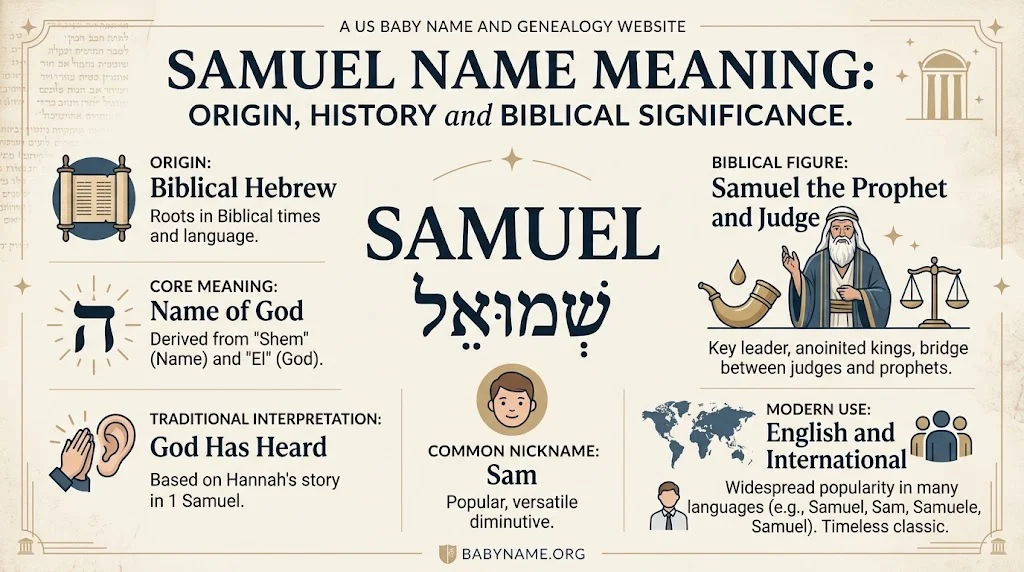
The name Samuel is a biblical Hebrew name commonly connected with “name of God” and traditionally interpreted as “God has heard.” It appears in the Old Testament and is associated with the prophet Samuel, a judge who anointed Saul and David.
Samuel’s name meaning is rooted in ancient Hebrew and carries strong biblical significance. The name is traditionally written as שְׁמוּאֵל, transliterated as Shemuʾel. Most etymological references connect it with the Hebrew elements shem, meaning “name,” and El, meaning “God.” Another traditional interpretation connects Samuel with the idea that God has heard a prayer.
Samuel has remained familiar across generations. It is used in English and many other languages, including French, German, Spanish, Portuguese, Dutch, Swedish, Norwegian, Polish, and several others.
The name also has a powerful biblical association. In the Books of Samuel, Samuel serves as a prophet, judge, and religious leader. He played an important role during Israel’s transition from the period of judges to the monarchy. He later anoints Saul and David as kings.
However, the exact linguistic explanation deserves some care. The biblical account connects Samuel’s name with Hannah’s prayer for a child. Yet scholarly notes on the Hebrew text explain that this is a wordplay rather than a strict linguistic derivation. The strongest etymological explanation connects the name with “name of God,” while “God has heard” remains a widely recognized traditional interpretation.
That distinction matters for parents, genealogy researchers, students, and anyone exploring biblical names. A name can carry both a linguistic meaning and a cultural or religious interpretation.
QUICK ANSWER BOX
| Meaning | Context | Primary Platforms | Example | Tone |
| Name of God; traditionally also “God has heard” | Biblical Hebrew name | Baby naming, genealogy, religious studies, social profiles | “Samuel is a classic biblical name.” | Classic, traditional, dignified |
What Does Samuel’s name mean?
The simplest answer is that Samuel is a Hebrew biblical name commonly explained as “name of God.” The Hebrew form is שְׁמוּאֵל, commonly transliterated as Shemuʾel.
The name has also been traditionally explained as “God has heard” or “heard by God.” That interpretation comes from the biblical story surrounding Samuel’s birth. Hannah prayed for a child and later named her son Samuel after receiving the child she had requested from the Lord.
The Hebrew Roots
The most common etymological explanation breaks the name into two elements.
| Hebrew element | General meaning | Role in the name |
| Shem | Name | First component |
| El | God | Divine component |
| Shemuʾel | Name of God | Common etymological interpretation |
The element El is a well known Hebrew term for God. It also appears in numerous ancient Hebrew personal names.
The first element creates the main point of discussion. Some sources connect it with shem, meaning “name.” Other traditional explanations associate the name with hearing or being heard by God.
Therefore, several English explanations can appear in baby name references. “Name of God,” “God has heard,” and “heard by God” may all appear.
These should not automatically be treated as identical linguistic claims. Instead, they represent different approaches to explaining the ancient name.
Why “God Has Heard” Is Associated With Samuel
The biblical story provides the cultural reason for this interpretation.
Hannah, Samuel’s mother, had prayed for a son. After Samuel was born, she connected his name with her request to God. The wording creates a sound association between Samuel’s name and the idea of asking or requesting from God.
Importantly, the NET Bible notes that this explanation is not a strict etymology. The Hebrew consonants do not fully support deriving Samuel from the verb meaning “to ask.” Instead, the biblical passage uses similar sounds to create a meaningful association.
Consequently, “God has heard” works especially well as a traditional or interpretive meaning, while “name of God” has stronger support as a direct etymological explanation.
Samuel as a Biblical Name
Samuel belongs to the group of names strongly associated with the Hebrew Bible. His story appears primarily in 1 Samuel and continues into the broader narrative surrounding Israel’s monarchy.
Samuel is described as a prophet and judge. He becomes an important religious leader during a major political transition.
First, he served Israel during the period of the judges. Later, he anoints Saul as king. He subsequently anoints David, who becomes one of the most significant figures in biblical history.
That history gives the name a broader symbolic association with leadership, devotion, calling, and spiritual responsibility.
Contextual Dynamics & Nuances of the Name
A name’s meaning does not exist in isolation. Culture, religion, language, and personal interpretation all influence how people understand a name.
Samuel demonstrates this especially well.
Religious Context
In Jewish and Christian contexts, Samuel is immediately recognizable as a biblical name. The name is connected with a major biblical figure and with the books that bear his name.
Samuel’s biblical story begins with his mother Hannah. She dedicates him to service after praying for a child. Later, Samuel becomes a prophetic figure and leader.
Therefore, families choosing Samuel for religious reasons may associate it with prayer, dedication, service, and divine calling.
Historical Context
Samuel is an ancient name, but it has not remained confined to ancient history.
The name became established as a Christian personal name after the Protestant Reformation. It has also remained widely recognized across English speaking societies.
As a result, Samuel occupies an interesting position. It sounds traditional without being limited to one historical period.
Modern American Context
In the United States, Samuel is familiar as both a given name and a surname.
Its recognition comes partly from biblical tradition. However, modern families may choose it for many reasons.
For example, parents may like:
The classic sound
The biblical background
The formal full name
The nickname Sam
- Its international familiarity
- Its connection with historical figures
- Its straightforward spelling
This makes Samuel flexible in modern naming culture.
Is Samuel a Religious Name?
Samuel has unmistakable biblical roots. Still, using the name does not automatically indicate a person’s religion.
Names often move between religious and secular settings. Samuel can appear in churches, schools, workplaces, universities, sports teams, entertainment, and popular culture.
Therefore, the name has a religious history without requiring a religious interpretation in every modern context.
Real Life Conversation Examples Using samuel name meaning
Because Samuel is a personal name rather than internet slang, people usually discuss its meaning in naming, genealogy, religious, or cultural conversations.
Here are five natural examples.
Conversation 1: Choosing a Baby Name
Mia: We are thinking about naming our son Samuel.
Jordan: That is a classic choice. Do you know the meaning?
Mia: Yes. It is usually explained as “name of God,” and people also connect it with “God has heard.”
Jordan: I like that. It has a meaningful biblical background without sounding old fashioned.
Conversation 2: Asking About a Name
Alex: What does Samuel mean?
Chris: It is a Hebrew biblical name. The most common etymological explanation is “name of God.”
Alex: I have also seen “God has heard.”
Chris: Right. That comes from the biblical story surrounding Hannah and Samuel.
Conversation 3: A Social Media Discussion
Taylor: Someone asked me about my son’s name today.
Morgan: Samuel?
Taylor: Yes. They wanted to know where it came from.
Morgan: You could mention the Hebrew origin and the biblical Samuel.
Taylor: That is what I did. I also told them we liked the nickname Sam.
Conversation 4: Genealogy Research
Daniel: I found Samuel in an old family record.
Rachel: Do you know which Samuel it was?
Daniel: Not yet. I am trying to trace the family line.
Rachel: The name was very established historically, so you may need the location and date too.
Daniel: Exactly. The first name alone is not enough to identify him.
Conversation 5: Religious Study
Ethan: Why is Samuel important in the Bible?
Noah: He is presented as a prophet and judge. He also anointed Saul and David.
Ethan: So the name carries more history than just its literal meaning.
Noah: Exactly. Its biblical associations are a major part of its cultural significance.
Platform Specific Breakdown
The phrase “Samuel name meaning” behaves differently across digital platforms because search intent changes by platform.
Search engines usually interpret it as a name research query. Social platforms often treat it as a conversation about names, babies, identity, or biblical culture.
How It Is Used on Snapchat
On Snapchat, people are unlikely to use “Samuel name meaning” as slang.
Instead, the concept may appear through direct conversations.
For example:
“What does your name mean?”
“Samuel is Hebrew. It is usually explained as ‘name of God.’”
Snapchat favors short exchanges. Therefore, a long historical explanation would normally be unnecessary.
A concise answer works better.
The Role of samuel name meaning on TikTok
TikTok can turn name meanings into short educational content.
A creator might make a video titled:
“Samuel name meaning explained”
The video could then cover the Hebrew origin, pronunciation, biblical Samuel, nickname options, and traditional interpretations.
Name content also fits genealogy, baby naming, religious education, and cultural history.
However, creators should avoid presenting uncertain etymologies as unquestionable facts. The distinction between “name of God” and “God has heard” is a good example.
Instagram and Texting Dynamics
Instagram can support more visual name content.
A post might include:
Samuel
Origin: Hebrew
Meaning: Name of God
Traditional interpretation: God has heard
Biblical association: Samuel, prophet and judge
Texting usually requires even less information.
A natural response might be:
“Samuel is Hebrew and is usually explained as ‘name of God.’ It is also traditionally linked with ‘God has heard.’”
That answer is accurate, compact, and easy to understand.
Alternative Meanings
Search engines and language models may encounter many variations of the same query.
Common variations include:
“what does Samuel mean”
“Samuel meaning”
“meaning of Samuel”
- “Samuel name origin”
- “Samuel biblical meaning”
- “Samuel Hebrew meaning”
- “Samuel baby name meaning”
“what is the origin of Samuel”
“Samuel meaning in Hebrew”
“Samuel biblical name”
These queries express similar search intent.
However, they can produce different results because search systems examine context.
For example, “Samuel meaning in Hebrew” emphasizes etymology. Meanwhile, “Samuel biblical meaning” emphasizes religious context.
“Samuel baby name meaning” usually indicates parental research.
“Samuel name origin” focuses more strongly on historical linguistics.
Name Meaning Versus Name Symbolism
These concepts should remain separate.
Meaning concerns linguistic interpretation.
Origin concerns the language and historical source.
Biblical significance concerns the role of Samuel in scripture.
Symbolism concerns qualities people associate with the name.
For example, leadership may be associated with Samuel because of his biblical role. However, leadership is not the literal dictionary meaning of the name.
This distinction improves accuracy.
Samuel Pronunciation
In standard American English, Samuel is commonly pronounced approximately:
SAM yoo uhl
A phonetic representation is often given as:
SAM yoo əl
The exact sound can vary slightly by accent and speaking speed.
The common short form is Sam.
Other related forms exist across languages. Behind the Name lists Samuel as a form used in English, French, German, Dutch, Spanish, Portuguese, Polish, Czech, Slovak, Romanian, Swedish, Norwegian, Danish, Finnish, Jewish, Amharic, and biblical usage.
Common Nicknames
The most familiar nickname is Sam.
Other informal forms may appear in individual families, although they are less standardized.
| Full name | Common short form | Style |
| Samuel | Sam | Classic and universal |
| Samuel | Sammy | Friendly and informal |
| Samuel | Samu | More culturally dependent |
| Samuel | Samuel | Formal and traditional |
Nickname preferences are personal. Not every Samuel will use a shortened form.
Misinterpretations:
The biggest mistake is treating Samuel as internet slang.
It is not a standard slang term.
It is a personal name with Hebrew and biblical roots.
Therefore, phrases such as “What does Samuel mean on Snapchat?” should not automatically lead to a slang definition.
The platform does not change the basic meaning of the personal name.
Do Not Present One Interpretation as the Only Possible Answer
“Name of God” is strongly supported as an etymological interpretation. However, “God has heard” is also deeply connected with the biblical naming story.
A careful explanation should acknowledge both.
Do Not Confuse Biblical Association With Literal Meaning
Samuel is associated with prophecy, judgment, leadership, and anointing kings.
Those are features of the biblical character.
They are not literal translations of the name.
This distinction prevents exaggerated name descriptions.
Do Not Treat Baby Name Symbolism as Linguistic Fact
Baby naming websites sometimes attach personality traits to names.
For example, a site might associate Samuel with wisdom or leadership.
Such descriptions are symbolic.
They should not be presented as evidence that every person named Samuel possesses those traits.
How to Respond in Chat Comfortably
When someone asks about Samuel, the best response depends on what they actually want to know.
If They Ask for the Meaning
A concise answer is enough:
“Samuel is a Hebrew biblical name usually explained as ‘name of God.’ It is also traditionally connected with ‘God has heard.’”
If They Ask About the Biblical Connection
You can add:
“In the Bible, Samuel was a prophet and judge who later anointed Saul and David as kings.”
That provides useful context without turning a simple question into a lecture.
If They Ask Whether Samuel Is a Hebrew Name
A natural answer is:
“Yes. Samuel comes from the Hebrew name שְׁמוּאֵל, commonly transliterated as Shemuʾel.”
If Someone Says the Meaning Is “Asked of God”
That interpretation has a biblical basis through the naming story. However, it is better to explain the distinction.
You could say:
“‘Asked of God’ reflects the biblical wordplay around Hannah’s prayer. The stricter etymological explanation is generally connected with ‘name of God.’”
This is more precise than simply declaring one version correct and ignoring the other.
If Someone Asks About Personality
Avoid claiming that the name determines personality.
Instead, say:
“Names do not determine personality. Samuel does have traditional associations with biblical leadership and devotion because of the biblical figure.”
That keeps cultural symbolism separate from personal identity.
FAQs
1. What is the Samuel name meaning?
The most common etymological explanation is “name of God.” Samuel is also traditionally associated with “God has heard,” especially because of the biblical story of Hannah and Samuel.
2. Is Samuel a Hebrew name?
Yes. Samuel comes from the Hebrew name שְׁמוּאֵל, commonly transliterated as Shemuʾel.
3. What does the name Samuel mean in the Bible?
The biblical story connects Samuel with Hannah’s prayer for a son. The name is therefore traditionally associated with the idea of asking God and being heard by God. However, biblical translation notes distinguish this wordplay from the name’s strict linguistic etymology.
4. Is Samuel a biblical boy’s name?
Yes. Samuel is the name of a major biblical figure and appears prominently in the Books of Samuel.
5. What is the origin of Samuel?
Samuel has Hebrew, specifically biblical Hebrew, origins. It became established as a Christian given name and later spread widely through European languages.
6. Is Sam short for Samuel?
Yes. Sam is one of the most common short forms of Samuel.
7. Is Samuel a popular American name?
Samuel has a long history of use in the United States. Behind the Name notes that it has remained within the US top 100 recorded names since 1880.
8. What are common nicknames for Samuel?
Sam is the most familiar nickname. Sammy is another common informal form.
9. Is Samuel a religious name?
Samuel has a strong biblical and religious history. Still, the name is also used in secular settings and does not by itself establish a person’s religious beliefs.
10. What qualities are associated with Samuel?
Cultural and biblical associations may include devotion, leadership, service, and prophetic responsibility. These are associations with the biblical character, not personality traits guaranteed by the name.
Conclusion:
Despite the way modern search queries can place the topic alongside slang and social media terminology, Samuel is not internet slang. It is an ancient personal name with a well established Hebrew and biblical history.
The core linguistic explanation connects Samuel with the Hebrew elements associated with “name” and “God.” This produces the widely cited meaning “name of God.”
At the same time, the biblical story gives the name another important layer. Hannah named her son Samuel after receiving the child for whom she had prayed. The biblical wording creates a sound based association with her request to God.
That is why readers may encounter several explanations.
“Name of God” describes the commonly cited etymological origin.
“God has heard” reflects a traditional interpretation connected with the biblical narrative.
“Asked of God” can describe the wordplay surrounding Hannah’s prayer.
These explanations belong to different layers of interpretation. Treating them separately produces a clearer and more accurate understanding.
Samuel also has remarkable linguistic reach. It appears across numerous languages and cultures while retaining a recognizable form.
In the United States, the name remains familiar because it combines historical depth with everyday usability. Samuel works as a formal given name, while Sam provides a short and approachable alternative.
Ultimately, the enduring appeal of Samuel comes from the combination of language, history, scripture, and cultural continuity. It is an ancient name that remains easy to recognize in modern life.
For anyone researching its origin, the most precise short answer is simple: Samuel is a biblical Hebrew name commonly explained as “name of God,” with “God has heard” serving as a traditional interpretation connected to the biblical story of Hannah and Samuel.
