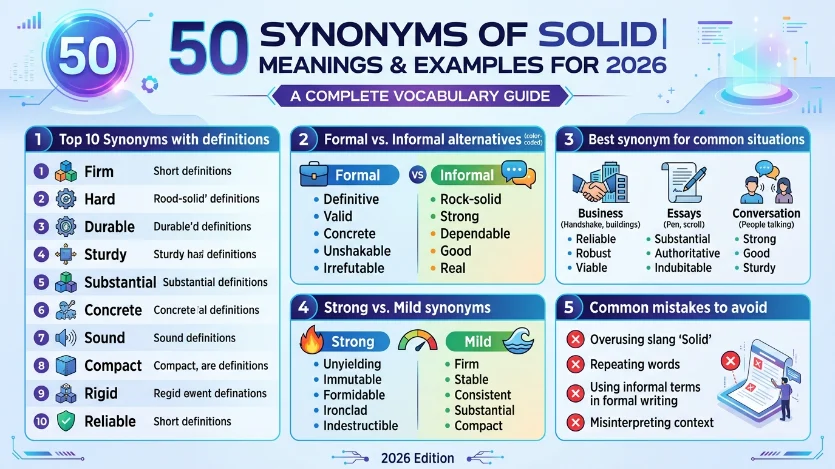
“Solid” means firm, strong, and not liquid or gas. It can also mean reliable, well-made, or dependable. The best synonyms are firm, stable, strong, sturdy, and substantial. “Firm” is the most common natural alternative. Each synonym has a slightly different meaning and context.
Top 10 Synonyms
- Firm
- Stable
- Strong
- Sturdy
- Substantial
- Durable
- Reliable
- Hard
- Solidified
- Sound
Solid is one of those words you use constantly. It can describe something physical, such as ice, wood, metal, or rock. In the solid not soft meaning, it means firm rather than liquid, soft, or flexible. But solid can also describe an argument, plan, reputation, or even a person.
So, what is the synonym of solid? It depends on the context. Words such as firm, sturdy, strong, stable, reliable, sound, substantial, and robust can work, but they are not always interchangeable. A language learner may also search for a solid synonym formal when writing at work or in academic settings.
In this guide, based on practical English usage and careful word-choice analysis, you’ll discover 35 solid synonyms in English, including another word for solid, formal alternatives, and context-specific choices. We’ll also explain how each word differs, so you can choose the synonym that sounds natural not simply the one listed in a solid thesaurus.
Whether you mean “stands for being a solid individual” or need the right synonym of solid for writing, this guide makes the choice simple.
What Does “Solid” Mean?
Definition
Solid” has two main meanings. First, it means firm and hard in shape, not liquid or gas. Second, it means strong, reliable, and well-made. A solid object keeps its shape. A solid person is trustworthy and dependable. A solid plan is well-thought-out and likely to succeed.
Pronunciation
| Feature | Value |
|---|---|
| US IPA | /ˈsɑlɪd/ |
| UK IPA | /ˈsɒlɪd/ |
| Syllables | 2 (sol-id) |
| Tip | Stress the first syllable: “SOL-id” |
Grammar
| Grammar Feature | Information |
|---|---|
| Part of Speech | Adjective and Noun |
| Common Position | Before a noun or after a linking verb |
| Typical Pattern | Solid + noun / Subject + be + solid |
Examples:
- “The table is made of solid wood.” (physical)
- “She has a solid reputation.” (figurative)
- “Ice becomes solid at zero degrees.” (physical)
Grammar Note: “Solid” can be an adjective describing things or a noun meaning a solid object or substance. As an adjective, it’s very common.
Word Family
| Word | Part of Speech | Meaning |
|---|---|---|
| Solid | Adjective/Noun | Firm, hard, or reliable |
| Solidly | Adverb | In a solid manner |
| Solidity | Noun | The quality of being solid |
| Solidify | Verb | To become solid or firm |
15 Synonyms of “Solid”
Firm
Meaning: Not soft, giving way, or moving; steady and strong.
Best Used For: Physical objects, handshakes, decisions, mattress.
Formality: Neutral
Tone: Strong, Steady
Frequency: ⭐⭐⭐⭐⭐ (Very Common)
CEFR Level: A2
Example Sentence 1: “The mattress is firm and comfortable.”
Example Sentence 2: “She gave a firm handshake.”
Usage Tip: “Firm” is the most direct synonym for physical solidity. It also describes strong decisions (a firm stance) or steady hands.
Common Confusion: Firm vs Solid. “Firm” suggests some slight give but overall strength. “Solid” suggests no give at all.
Stable
Meaning: Not likely to change, move, or fail; steady and secure.
Best Used For: Structures, relationships, economies, mental health.
Formality: Neutral
Tone: Secure, Steady
Frequency: ⭐⭐⭐⭐⭐ (Very Common)
CEFR Level: B1
Example Sentence 1: “The table is stable on the floor.”
Example Sentence 2: “He has a stable job and a good income.”
Usage Tip: “Stable” emphasizes steadiness and security. Use it for things that won’t fall or change unexpectedly.
Strong
Meaning: Having great power, strength, or durability.
Best Used For: People, materials, arguments, relationships.
Formality: Neutral
Tone: Powerful, Durable
Frequency: ⭐⭐⭐⭐⭐ (Very Common)
CEFR Level: A2
Example Sentence 1: “The wood is strong enough to hold the weight.”
Example Sentence 2: “She presented a strong argument.”
Usage Tip: “Strong” is very versatile. Use it for physical power, emotional strength, or convincing arguments.
Sturdy
Meaning: Strongly built and not likely to break or fall.
Best Used For: Furniture, buildings, shoes, equipment.
Formality: Neutral
Tone: Well-built, Durable
Frequency: ⭐⭐⭐⭐ (Common)
CEFR Level: B1
Example Sentence 1: “These sturdy boots will last for years.”
Example Sentence 2: “The bridge is sturdy and safe.”
Usage Tip: “Sturdy” emphasizes being well-built and durable. Use it for objects that are made to last.
Substantial
Meaning: Large in size, value, or importance; solid and real.
Best Used For: Evidence, amounts, meals, structures.
Formality: Formal
Tone: Important, Significant
Frequency: ⭐⭐⭐ (Moderate)
CEFR Level: B2
Example Sentence 1: “There is substantial evidence to prove his guilt.”
Example Sentence 2: “She had a substantial meal before the race.”
Usage Tip: “Substantial” suggests something is solid, real, and often large or important.
Durable
Meaning: Able to last a long time without wearing out.
Best Used For: Clothing, furniture, tools, materials.
Formality: Neutral
Tone: Long-lasting, Tough
Frequency: ⭐⭐⭐⭐ (Common)
CEFR Level: B1
Example Sentence 1: “These jeans are durable and well-made.”
Example Sentence 2: “We need durable materials for the construction.”
Usage Tip: “Durable” focuses on the ability to last. Use it for products that resist wear and tear.
Reliable
Meaning: Consistently good and trustworthy.
Best Used For: People, information, cars, systems.
Formality: Neutral
Tone: Trustworthy, Dependable
Frequency: ⭐⭐⭐⭐⭐ (Very Common)
CEFR Level: B1
Example Sentence 1: “She is a reliable employee who never misses work.”
Example Sentence 2: “This car is reliable and rarely breaks down.”
Usage Tip: “Reliable” emphasizes dependability and trustworthiness. Use it for people and things you can count on.
Hard
Meaning: Firm and solid, not soft or easy to break.
Best Used For: Materials, surfaces, rocks.
Formality: Neutral
Tone: Unyielding, Tough
Frequency: ⭐⭐⭐⭐⭐ (Very Common)
CEFR Level: A2
Example Sentence 1: “The diamond is the hardest natural substance.”
Example Sentence 2: “The bread became hard after a few days.”
Usage Tip: “Hard” is the simplest synonym for physical solidity. It’s the opposite of soft.
Solidified
Meaning: Made or become solid from a liquid or gas state.
Best Used For: Scientific contexts, lava, melted materials.
Formality: Formal
Tone: Scientific, Factual
Frequency: ⭐⭐⭐ (Moderate)
CEFR Level: B2
Example Sentence 1: “The lava solidified into rock.”
Example Sentence 2: “The melted chocolate solidified as it cooled.”
Usage Tip: “Solidified” is a technical term for the process of becoming solid. Use it in scientific or descriptive contexts.
Sound
Meaning: In good condition; solid, strong, and reliable.
Best Used For: Advice, decisions, buildings, health.
Formality: Neutral
Tone: Sensible, Trustworthy
Frequency: ⭐⭐⭐⭐ (Common)
CEFR Level: B1
Example Sentence 1: “She gave me sound advice about my career.”
Example Sentence 2: “The building is structurally sound.”
Usage Tip: “Sound” emphasizes being strong and reliable, often in non-physical contexts like advice or reasoning.
Concrete
Meaning: Specific, definite, and real; not abstract.
Best Used For: Evidence, examples, plans, objects.
Formality: Formal
Tone: Definite, Real
Frequency: ⭐⭐⭐ (Moderate)
CEFR Level: B2
Example Sentence 1: “We need concrete evidence to prove the case.”
Example Sentence 2: “The plan is concrete and actionable.”
Usage Tip: “Concrete” means real and specific. It’s the opposite of abstract. Use it for definite, tangible things.
Robust
Meaning: Strong, healthy, and able to withstand difficulties.
Best Used For: Systems, health, economies, arguments.
Formality: Formal
Tone: Strong, Resilient
Frequency: ⭐⭐⭐ (Moderate)
CEFR Level: C1
Example Sentence 1: “The economy is robust and growing.”
Example Sentence 2: “The system is robust enough to handle any error.”
Usage Tip: “Robust” is a formal word for something strong, healthy, and resilient. Use it in professional contexts.
Unyielding
Meaning: Not giving way or bending; firm and determined.
Best Used For: People, principles, materials.
Formality: Formal
Tone: Strong, Determined
Frequency: ⭐⭐ (Rare)
CEFR Level: C1
Example Sentence 1: “His unyielding determination helped him succeed.”
Example Sentence 2: “The unyielding metal held the weight.”
Usage Tip: “Unyielding” is a strong, formal word. Use it for things that won’t bend or people who won’t change their mind.
Impregnable
Meaning: Impossible to break or defeat.
Best Used For: Defenses, arguments, positions.
Formality: Formal
Tone: Unbeatable, Secure
Frequency: ⭐ (Very Rare)
CEFR Level: C1
Example Sentence 1: “The castle was considered impregnable.”
Example Sentence 2: “Her argument was impregnable.”
Usage Tip: “Impregnable” is a very strong, formal word. Use it for things that are impossible to break or defeat.
Compact
Meaning: Closely and neatly packed together; solid and dense.
Best Used For: Objects, soil, cars, data.
Formality: Neutral
Tone: Neat, Dense
Frequency: ⭐⭐⭐ (Moderate)
CEFR Level: B2
Example Sentence 1: “The soil was compact and hard to dig.”
Example Sentence 2: “The compact design saves space.”
Usage Tip: “Compact” emphasizes density and being tightly packed. Use it for space-saving or densely structured things.
Synonyms Comparison Table
| Synonym | Best Context | Formality | Tone | Frequency |
|---|---|---|---|---|
| Firm | Physical strength | Neutral | Steady | ⭐⭐⭐⭐⭐ |
| Stable | Security, steadiness | Neutral | Secure | ⭐⭐⭐⭐⭐ |
| Strong | General strength | Neutral | Powerful | ⭐⭐⭐⭐⭐ |
| Reliable | Trustworthiness | Neutral | Dependable | ⭐⭐⭐⭐⭐ |
| Hard | Physical solidity | Neutral | Unyielding | ⭐⭐⭐⭐⭐ |
| Sturdy | Well-built objects | Neutral | Durable | ⭐⭐⭐⭐ |
| Durable | Long-lasting | Neutral | Tough | ⭐⭐⭐⭐ |
| Sound | Reliability | Neutral | Sensible | ⭐⭐⭐⭐ |
| Substantial | Importance, size | Formal | Significant | ⭐⭐⭐ |
| Robust | Resilience | Formal | Strong | ⭐⭐⭐ |
| Concrete | Specific, real | Formal | Definite | ⭐⭐⭐ |
Best Synonyms by Situation
| Situation | Best Synonym | Why It Works |
|---|---|---|
| Daily Conversation | Firm | Natural and common |
| Business Email | Sound | Professional and reliable |
| Academic Writing | Substantial | Formal and precise |
| School Assignment | Strong | Clear and understandable |
| Professional Meeting | Robust | Impressive and confident |
| Presentation | Concrete | Clear and specific |
| Creative Writing | Unyielding | Adds literary depth |
| Social Media | Solid | Casual and relatable |
| Physical Objects | Sturdy | Practical and descriptive |
Formal vs Informal Synonyms
Formal Alternatives
| Synonym | Best Used For |
|---|---|
| Substantial | Evidence, amounts, importance |
| Robust | Systems, economies, resilience |
| Concrete | Evidence, examples, plans |
| Impregnable | Defenses, arguments |
| Solidified | Scientific contexts |
Neutral Alternatives
| Synonym | Best Used For |
|---|---|
| Firm | Physical and figurative strength |
| Stable | Steadiness, security |
| Strong | General strength |
| Sturdy | Well-built objects |
| Durable | Long-lasting items |
| Sound | Reliability, advice |
Informal Alternatives
| Synonym | Best Used For |
|---|---|
| Hard | Physical solidity |
| Solid | General use |
| Tough | Strong and resilient |
Choosing the Right Level: Use “substantial” and “robust” for professional contexts. Use “firm” and “sturdy” for most everyday situations. Use “hard” for physical solidity.
Strong vs Mild Synonyms
Mild
Suitable for everyday situations with less intensity.
- Hard
- Firm
- Compact
Moderate
More reliable or significant alternatives.
- Strong
- Sturdy
- Durable
- Stable
Strong
High-intensity alternatives suggesting great strength or importance.
- Robust (strong resilience)
- Substantial (significant importance)
- Impregnable (impossible to break)
- Unyielding (will not bend)
How Intensity Changes Meaning: “It’s a strong table” is simple. “It’s a robust system” sounds more impressive. Choose stronger words when you want to emphasize great strength or reliability.
Real-Life Examples
School: “The student presented a solid argument in the debate.”
Office: “We need a robust strategy for the upcoming quarter.”
Business Email: “Please provide concrete evidence to support your claim.”
Meetings: “Our relationship with the client is stable and strong.”
Presentations: “The data shows a substantial increase in sales.”
Daily Conversations: “This table is sturdy enough to hold everything.”
Social Media: “That’s a solid point you made!”
Academic Writing: “The study provides substantial evidence for the theory.”
Common Collocations
| Common Phrase | Better Alternative |
|---|---|
| Solid foundation | Firm foundation |
| Solid evidence | Concrete evidence |
| Solid plan | Sound plan |
| Solid relationship | Stable relationship |
| Solid work | Substantial work |
Common Phrases
Solid as a rock: Very strong and dependable. (e.g., “Their friendship is solid as a rock.”)
On solid ground: In a safe, secure position. (e.g., “After the contract was signed, we were on solid ground.”)
Solid gold: Genuine and valuable. (e.g., “Her advice was solid gold.”)
A solid citizen: A reliable, trustworthy person. (e.g., “He’s a solid citizen who always pays his taxes.”)
Stand firm: To refuse to change your position. (e.g., “She stood firm on her decision.”)
Context Guide
| Situation | Best Synonym | Reason |
|---|---|---|
| Essay | Substantial | Academic and formal |
| Speech | Robust | Strong and confident |
| Business Email | Sound | Professional and reliable |
| Novel | Unyielding | Adds literary depth |
| Presentation | Concrete | Clear and specific |
| Conversation | Firm | Natural and relatable |
| Academic Writing | Substantial | Precise and formal |
| Marketing Copy | Robust | Strong and impressive |
Related Words
Near Synonyms
- Rigid: Stiff and not bending. (e.g., “The rigid steel held its shape.”)
- Dense: Thick and compact. (e.g., “The dense wood was difficult to cut.”)
- Resilient: Able to recover from difficulties. (e.g., “The resilient economy bounced back.”)
- Tenacious: Holding on firmly. (e.g., “She has a tenacious grip on her goals.”)
Antonyms
- Liquid: Flowing and not solid.
- Soft: Easy to press or bend.
- Weak: Lacking strength.
- Unstable: Likely to change or fail.
- Fragile: Easily broken.
Related Adjectives
- Strong: Having great power.
- Stable: Not likely to change.
- Sturdy: Well-built and strong.
- Durable: Able to last.
- Reliable: Trustworthy and dependable.
Related Nouns
- Solidity: The quality of being solid.
- Strength: The quality of being strong.
- Stability: The state of being stable.
- Durability: The ability to last.
Related Verbs
- Solidify: To become solid.
- Strengthen: To make stronger.
- Stabilize: To make stable.
- Firm: To make firm.
Frequently Asked Questions
What is another word for solid?
Common synonyms include firm, stable, strong, sturdy, and substantial. “Firm” is the most common and direct alternative.
Which synonym sounds the most professional?
Substantial and robust sound very professional. “Sound” is also excellent for business contexts.
What is the strongest synonym for solid?
Impregnable is one of the strongest synonyms. It suggests something is impossible to break or defeat. “Robust” is also strong for resilience.
Which synonym is best for essays?
Substantial is the best choice for academic essays. It suggests significance and importance. Concrete” is also excellent for evidence and examples.
What’s the difference between solid and firm?
Solid” means completely hard with no give. “Firm” means strong but may have a little give. A mattress can be firm but not completely solid.
Which synonym is most common in everyday English?
“Firm” and “strong” are very common in everyday speech. “Sturdy” and “reliable” are also frequently used.
What is the opposite of solid?
Common opposites are liquid, soft, weak, and unstable. These words describe things that are not solid.
Conclusion
“Solid” is a versatile and useful word, but now you have 35 fantastic alternatives. Each synonym adds a different shade of meaning to your language.
Remember, the key is understanding the context. Use “firm” for physical strength and steady decisions. Use “stable” for security and steadiness. Use “sturdy” for well-built objects. Use “substantial” for importance and significance. Use “reliable” for trustworthiness.
The best way to improve is practice. Try using one or two new synonyms each day. Listen for these words in conversations and books. Your vocabulary will become richer and more expressive with time.
