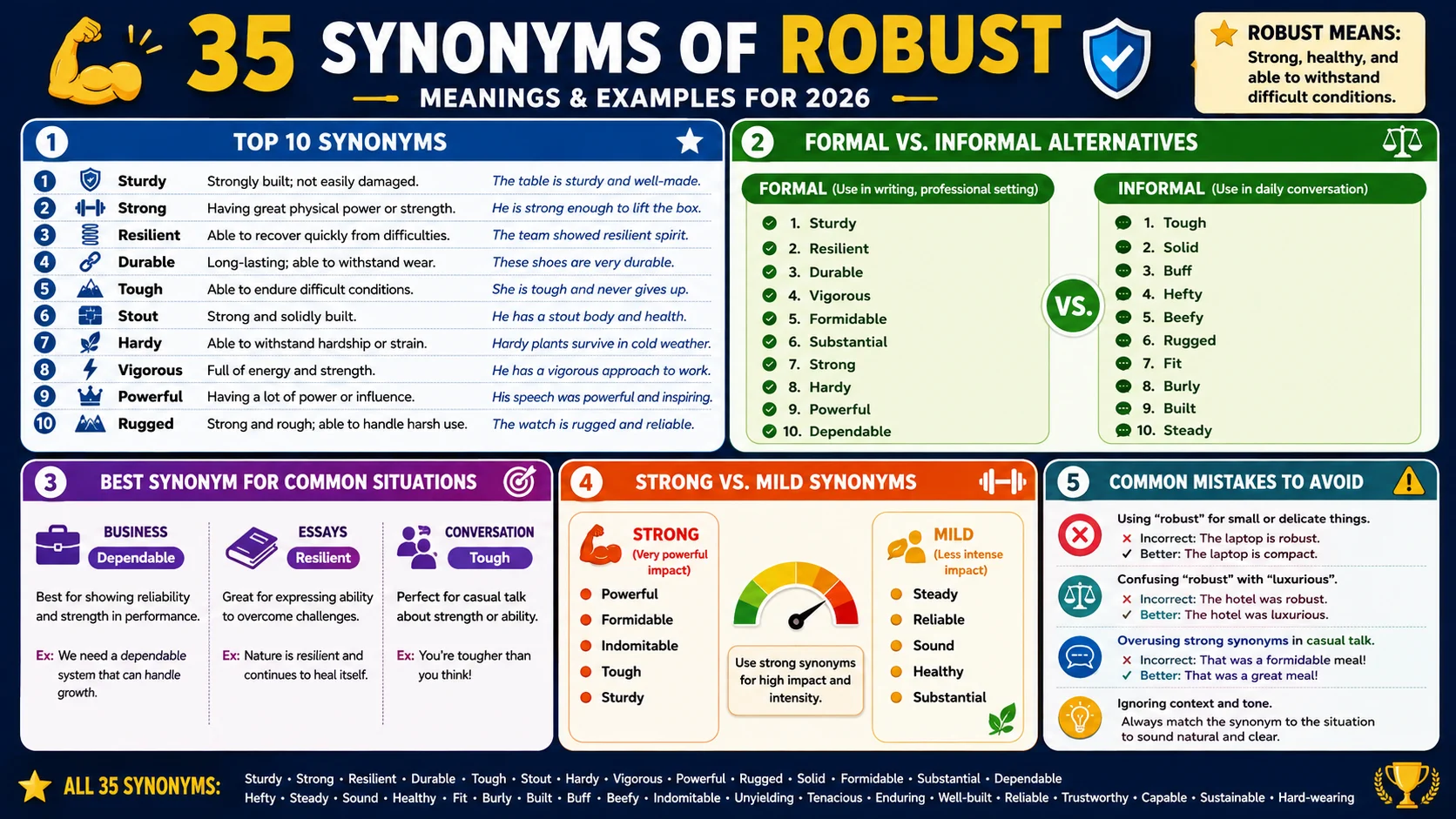
“Robust” means strong, healthy, and able to handle challenges. The best synonyms are strong, sturdy, vigorous, resilient, and hardy. “Strong” is the most common natural alternative. Each synonym has a slightly different meaning and context where it fits best.
Top 10 Synonyms
- Strong
- Sturdy
- Vigorous
- Resilient
- Hardy
- Solid
- Tough
- Powerful
- Durable
- Healthy
“Robust” is a powerful word. It describes strength, health, and the ability to withstand challenges. But using it too often can make your English feel repetitive and overly technical.
Think about it. You can describe robust health, a robust economy, a robust system, or a robust person. Each situation might need a different word that captures the specific type of strength.
In this guide, you’ll learn 35 powerful synonyms for “robust.” You’ll discover exactly when to use each one, how formal they are, and what common mistakes to avoid. Let’s begin!
What Does “Robust” Mean?
Definition
Robust” means strong, healthy, and able to handle difficult situations. A robust person is physically strong and healthy. A robust system works well even under pressure. When something is robust, it’s built to last and can handle challenges.
Pronunciation
| Feature | Value |
|---|---|
| US IPA | /roʊˈbʌst/ |
| UK IPA | /rəʊˈbʌst/ |
| Syllables | 2 (ro-bust) |
| Tip | Stress the second syllable: “ro-BUST” |
Grammar
| Grammar Feature | Information |
|---|---|
| Part of Speech | Adjective |
| Common Position | Before a noun or after a linking verb |
| Typical Pattern | Robust + noun / Subject + be + robust |
Examples:
- “She has robust health.” (before noun)
- “The economy is robust.” (after verb)
- “We need a robust system.” (before noun)
Grammar Note: “Robust” can be used with words like “extremely,” “very,” and “highly” to emphasize strength.
Word Family
| Word | Part of Speech | Meaning |
|---|---|---|
| Robust | Adjective | Strong and healthy |
| Robustly | Adverb | In a robust way |
| Robustness | Noun | The quality of being robust |
| Robustious | Adjective | Boisterous and strong (rare) |
15 Synonyms of “Robust”
Strong
Meaning: Having great physical power or strength.
Best Used For: People, materials, arguments, systems.
Formality: Neutral
Tone: Powerful, Capable
Frequency: ⭐⭐⭐⭐⭐ (Very Common)
CEFR Level: A2
Example Sentence 1: “He is a strong and capable leader.”
Example Sentence 2: “We need strong evidence to support our case.
Usage Tip: “Strong” is the most direct and common synonym. Use it for almost any context where strength is needed.
Common Confusion: Strong vs Robust. “Strong” is broader. “Robust” suggests strength that can handle challenges.
Sturdy
Meaning: Strongly built and not easily damaged.
Best Used For: Furniture, buildings, equipment.
Formality: Neutral
Tone: Durable, Solid
Frequency: ⭐⭐⭐⭐ (Common)
CEFR Level: B2
Example Sentence 1: “This table is sturdy enough to hold heavy books.”
Example Sentence 2: “The building has a sturdy foundation.”
Usage Tip: “Sturdy” is great for physical objects that are well-built and durable.
Vigorous
Meaning: Full of energy, strength, and enthusiasm.
Best Used For: People, activities, health.
Formality: Formal
Tone: Energetic, Active
Frequency: ⭐⭐⭐ (Moderate)
CEFR Level: B2
Example Sentence 1: “She leads a vigorous exercise routine.
Example Sentence 2: “He gave a vigorous defense of his position.”
Usage Tip: “Vigorous” emphasizes energy and active strength. Use it for people and activities.
Resilient
Meaning: Able to recover quickly from difficulties.
Best Used For: People, systems, materials.
Formality: Formal
Tone: Strong, Adaptable
Frequency: ⭐⭐⭐⭐ (Common)
CEFR Level: B2
Example Sentence 1: “She is a resilient person who never gives up.”
Example Sentence 2: “The economy has proven to be resilient.”
Usage Tip: “Resilient” emphasizes the ability to bounce back from challenges.
Hardy
Meaning: Strong and able to survive difficult conditions.
Best Used For: Plants, people, animals.
Formality: Neutral
Tone: Tough, Durable
Frequency: ⭐⭐⭐ (Moderate)
CEFR Level: B2
Example Sentence 1: “These plants are hardy and survive in cold weather.”
Example Sentence 2: “Hardy explorers can survive in extreme conditions.
Usage Tip: “Hardy” is often used for things that survive harsh conditions.
Solid
Meaning: Strong, reliable, and well-built.
Best Used For: Structures, arguments, people.
Formality: Neutral
Tone: Reliable, Strong
Frequency: ⭐⭐⭐⭐ (Common)
CEFR Level: B2
Example Sentence 1: “The company has a solid reputation.
Example Sentence 2: “She gave a solid performance.”
Usage Tip: “Solid” suggests reliability and strength. It’s a versatile word.
Tough
Meaning: Strong and able to handle difficult situations.
Best Used For: People, materials, situations.
Formality: Informal
Tone: Strong, Resilient
Frequency: ⭐⭐⭐⭐⭐ (Very Common)
CEFR Level: A2
Example Sentence 1: “He is a tough negotiator.”
Example Sentence 2: “These boots are tough and durable.”
Usage Tip: “Tough” is informal and suggests strength and resilience.
Powerful
Meaning: Having great strength or influence.
Best Used For: People, machines, arguments.
Formality: Neutral
Tone: Strong, Influential
Frequency: ⭐⭐⭐⭐⭐ (Very Common)
CEFR Level: A2
Example Sentence 1: “She gave a powerful speech.
Example Sentence 2: “The engine is very powerful.”
Usage Tip: “Powerful” emphasizes strength and influence. It’s a very common synonym.
Durable
Meaning: Able to last a long time without being damaged.
Best Used For: Products, materials, equipment.
Formality: Neutral
Tone: Long-lasting, Reliable
Frequency: ⭐⭐⭐⭐ (Common)
CEFR Level: B2
Example Sentence 1: “This phone has a durable design.”
Example Sentence 2: “Durable materials are used in construction.”
Usage Tip: “Durable” focuses on long-lasting strength and resistance to wear.
Healthy
Meaning: In good physical condition; strong.
Best Used For: People, lifestyles, organizations.
Formality: Neutral
Tone: Positive, Well
Frequency: ⭐⭐⭐⭐⭐ (Very Common)
CEFR Level: A2
Example Sentence 1: “She has a healthy body.”
Example Sentence 2: “The company is financially healthy.”
Usage Tip: “Healthy” emphasizes good condition and strength, often related to health or finances.
Stalwart
Meaning: Loyal, reliable, and hardworking.
Best Used For: People, supporters, allies.
Formality: Formal
Tone: Loyal, Dependable
Frequency: ⭐⭐ (Rare)
CEFR Level: C1
Example Sentence 1: “He is a stalwart supporter of the cause.”
Example Sentence 2: “Her stalwart dedication is admirable.
Usage Tip: “Stalwart” is a formal word for loyal and reliable strength.
Sinewy
Meaning: Lean and strong, with visible muscles.
Best Used For: Physical bodies, athletes.
Formality: Literary/Formal
Tone: Lean, Muscular
Frequency: ⭐ (Very Rare)
CEFR Level: C1
Example Sentence 1: “He has a sinewy build from years of training.”
Example Sentence 2: “The athlete’s sinewy arms showed his strength.”
Usage Tip: “Sinewy” is a descriptive word for physically strong, lean bodies. Use it in literary writing.
Rugged
Meaning: Strong and able to survive rough conditions.
Best Used For: People, terrain, vehicles.
Formality: Neutral
Tone: Tough, Rough
Frequency: ⭐⭐⭐ (Moderate)
CEFR Level: B2
Example Sentence 1: “The rugged landscape is beautiful.”
Example Sentence 2: “He is a rugged outdoorsman.”
Usage Tip: “Rugged” suggests toughness and ability to handle rough conditions.
Flourishing
Meaning: Growing and developing in a strong, healthy way.
Best Used For: Businesses, communities, health.
Formality: Formal
Tone: Thriving, Growing
Frequency: ⭐⭐⭐ (Moderate)
CEFR Level: B2
Example Sentence 1: “The business is flourishing.”
Example Sentence 2: “She is in flourishing health.”
Usage Tip: “Flourishing” emphasizes growth and thriving strength.
Athletic
Meaning: Physically strong, fit, and active.
Best Used For: People, bodies, abilities.
Formality: Neutral
Tone: Fit, Active
Frequency: ⭐⭐⭐⭐ (Common)
CEFR Level: B1
Example Sentence 1: “She has an athletic build.”
Example Sentence 2: “His athletic ability is impressive.”
Usage Tip: “Athletic” suggests physical fitness and strength from sports or exercise.
Synonyms Comparison Table
| Synonym | Best Context | Formality | Tone | Frequency |
|---|---|---|---|---|
| Strong | General use | Neutral | Powerful | ⭐⭐⭐⭐⭐ |
| Healthy | Health, finances | Neutral | Positive | ⭐⭐⭐⭐⭐ |
| Tough | Resilience | Informal | Strong | ⭐⭐⭐⭐⭐ |
| Sturdy | Physical objects | Neutral | Durable | ⭐⭐⭐⭐ |
| Solid | Reliability | Neutral | Strong | ⭐⭐⭐⭐ |
| Durable | Long-lasting | Neutral | Reliable | ⭐⭐⭐⭐ |
| Vigorous | Energy | Formal | Energetic | ⭐⭐⭐ |
| Resilient | Bouncing back | Formal | Adaptable | ⭐⭐⭐⭐ |
| Hardy | Surviving conditions | Neutral | Tough | ⭐⭐⭐ |
| Powerful | Strength, influence | Neutral | Influential | ⭐⭐⭐⭐⭐ |
Best Synonyms by Situation
| Situation | Best Synonym | Why It Works |
|---|---|---|
| Daily Conversation | Strong | Natural and common |
| Business Email | Robust | Professional and clear |
| Academic Writing | Vigorous | Formal and precise |
| School Assignment | Strong | Clear and simple |
| Professional Meeting | Resilient | Sounds adaptable |
| Presentation | Strong | Clear and effective |
| Creative Writing | Sinewy | Adds descriptive depth |
| Social Media | Tough | Casual and relatable |
| Health Context | Healthy | Natural and clear |
Formal vs Informal Synonyms
Formal Alternatives
| Synonym | Best Used For |
|---|---|
| Vigorous | Energy, health, activity |
| Resilient | Recovery, adaptation |
| Flourishing | Growth, health |
| Stalwart | Loyalty, support |
| Sinewy | Physical strength (literary) |
Neutral Alternatives
| Synonym | Best Used For |
|---|---|
| Strong | Most general situations |
| Healthy | Health, finances |
| Sturdy | Physical objects |
| Solid | Reliability |
| Durable | Long-lasting things |
Informal Alternatives
| Synonym | Best Used For |
|---|---|
| Tough | Resilience, casual contexts |
| Rugged | Rough conditions |
| Powerful | Strength, influence |
Choosing the Right Level: Use “vigorous” and “resilient” for formal writing. Use “strong” and “healthy” for most situations. Use “tough” and “rugged” with friends.
Strong vs Mild Synonyms
Mild
Suitable for everyday situations with less intensity.
- Strong
- Healthy
- Solid
Moderate
More specific or noticeable alternatives.
- Sturdy
- Durable
- Hardy
- Athletic
Strong
High-intensity alternatives suggesting exceptional strength.
- Vigorous (energetic strength)
- Resilient (bouncing back)
- Stalwart (unyielding loyalty)
- Sinewy (lean physical strength)
How Intensity Changes Meaning: “He is strong” is general. “He is vigorous” suggests active, energetic strength. Choose stronger words when you want to emphasize exceptional robustness.
Real-Life Examples
School: “Regular exercise keeps students healthy and robust.”
Office: “The company’s robust growth is impressive.”
Business Email: “We need a robust system that can handle high traffic.”
Meetings: “The team showed resilient performance despite challenges.”
Presentations: “Our product is sturdy and built to last.”
Daily Conversations: “She’s tough—she never gives up.”
Social Media: “Feeling strong and healthy today!”
Academic Writing: “The study shows vigorous growth in the sector.”
Common Collocations
| Common Phrase | Better Alternative |
|---|---|
| Robust health | Vigorous health |
| Robust economy | Strong economy |
| Robust system | Sturdy system |
| Robust growth | Flourishing growth |
| Robust person | Resilient person |
Common Phrases
Built like a rock: Very strong and solid. (e.g., “He’s built like a rock.”)
Tough as nails: Very strong and resilient. (e.g., “She’s tough as nails.”)
In good shape: Strong and healthy. (e.g., “I’m in good shape.”)
Bounce back: To recover quickly. (e.g., “She always bounces back.”)
Raring to go: Full of energy. (e.g., “He’s raring to go.”)
Context Guide
| Situation | Best Synonym | Reason |
|---|---|---|
| Essay | Vigorous | Academic and formal |
| Speech | Strong | Inspiring and clear |
| Business Email | Robust | Professional and clear |
| Novel | Sinewy | Adds literary depth |
| Presentation | Strong | Clear and effective |
| Conversation | Tough | Natural and relatable |
| Academic Writing | Resilient | Precise and formal |
| Marketing Copy | Durable | Attractive and trustworthy |
Related Words
Near Synonyms
- Hale: Healthy and strong (old-fashioned).
- Hearty: Strong and healthy.
- Temperate: Moderate and balanced.
- Tenacious: Holding on firmly.
- Indomitable: Impossible to defeat.
Antonyms
- Weak: Lacking strength.
- Frail: Delicate and weak.
- Fragile: Easily broken.
- Vulnerable: Easily hurt.
- Feeble: Lacking strength.
Related Adjectives
- Strong: Having great power.
- Healthy: In good physical condition.
- Sturdy: Strongly built.
- Durable: Long-lasting.
- Resilient: Able to recover.
Related Nouns
- Strength: The quality of being strong.
- Health: The state of being well.
- Durability: The ability to last.
- Resilience: The ability to recover.
- Vigour: Energy and strength.
Related Verbs
- Strengthen: To make stronger.
- Fortify: To strengthen against attack.
- Bolster: To support and strengthen.
- Reinforce: To strengthen with additional support.
Frequently Asked Questions
What is another word for robust?
Common synonyms include strong, sturdy, vigorous, resilient, and hardy. “Strong” is the most common and direct alternative.
Which synonym sounds the most professional?
Vigorous and resilient sound very professional. “Robust” itself is also excellent for business contexts.
What is the strongest synonym for robust?
Vigorous and stalwart are among the strongest synonyms. “Sinewy” is also strong but used for physical bodies.
Which synonym is best for essays?
Vigorous is the best choice for academic essays. It’s formal and precise. “Resilient” is also excellent.
What’s the difference between robust and strong?
Strong” is broader and can mean physical, mental, or emotional strength. “Robust” specifically suggests strength that can handle challenges.
Which synonym is most common in everyday English?
“Strong” and “tough” are the most common in everyday speech. “Healthy” is also frequently used.
What is the opposite of robust?
Common opposites are weak, frail, fragile, and vulnerable. These words describe a lack of strength.
Conclusion
“Robust” is a powerful word, but now you have 35 fantastic alternatives. Each synonym adds a different shade of meaning to your language.
Remember, the key is understanding the context. Use “strong” for general strength. Use “sturdy” for physical objects. Use “vigorous” for energetic strength. Use “resilient” for the ability to bounce back.
The best way to improve is practice. Try using one or two new synonyms each day. Listen for these words in conversations and books. Your vocabulary will become richer and more impressive with time.
