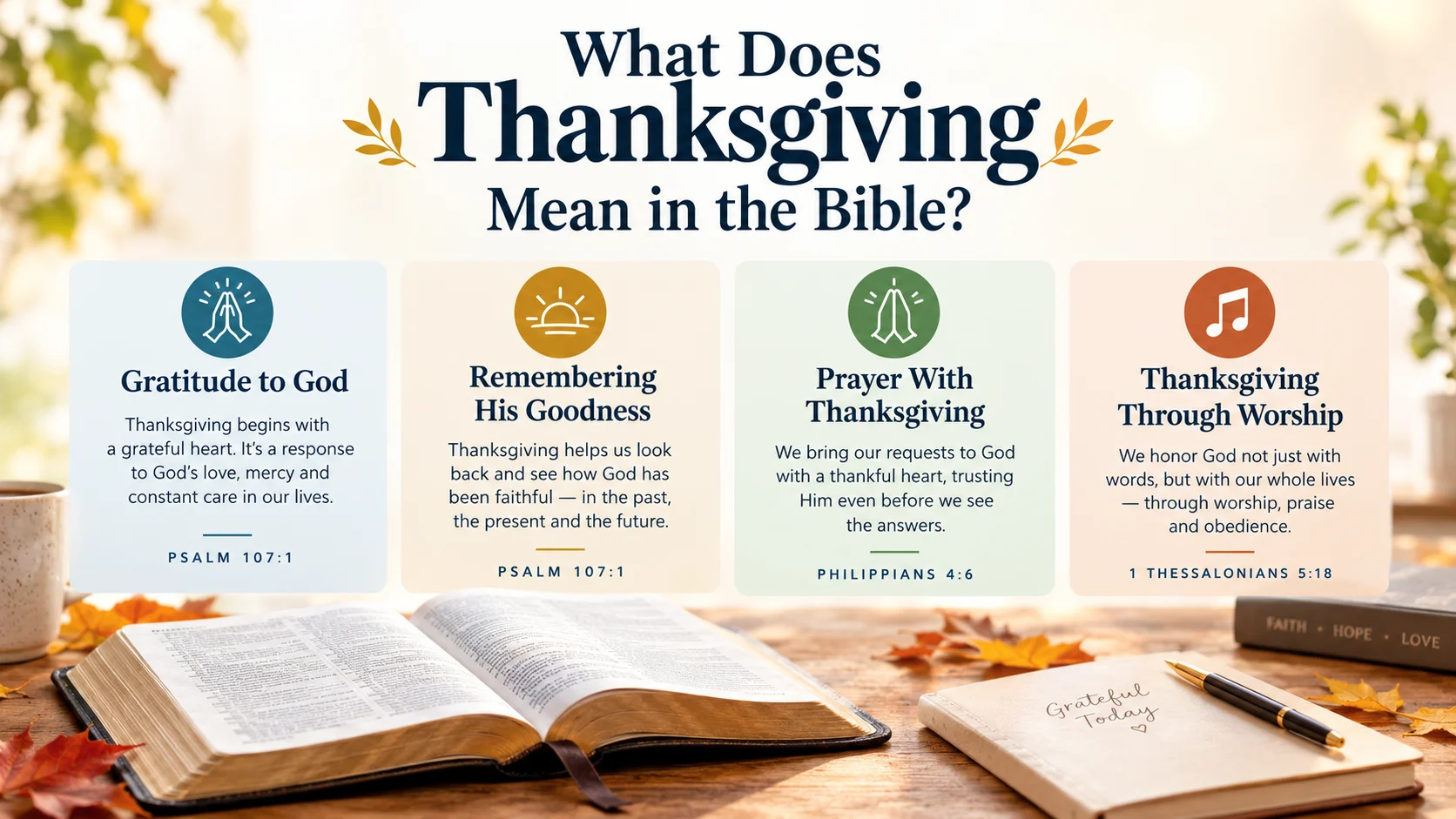
What does thanksgiving mean in the Bible? It means expressing grateful worship to God for who He is, His goodness, His provision, His faithfulness, and His works. Biblical thanksgiving involves both an inner attitude of gratitude and an outward response through prayer, praise, obedience, and worship.
What does thanksgiving mean in the Bible? It means recognizing God as the source of His people’s blessings and responding with gratitude, praise, worship, and trust. Biblical thanksgiving goes deeper than saying “thank you.” It points the heart toward God and remembers His character and actions.
Throughout Scripture, thanksgiving appears in prayer, songs, worship, meals, community life, and moments of hardship. The Psalms repeatedly call God’s people to give thanks. The New Testament also connects thanksgiving with prayer, spiritual maturity, generosity, and Christian worship.
Importantly, biblical gratitude does not require pretending that pain does not exist. Scripture contains both thanksgiving and lament. A person can acknowledge suffering while still trusting God.
The central idea is simple: thanksgiving turns attention toward God and His goodness.
The Bible also presents gratitude as an active practice. For example, Philippians 4:6 connects thanksgiving with prayer and presenting requests to God. Therefore, thanksgiving does not mean that Christians stop asking for help. Instead, gratitude becomes part of how they approach God.
QUICK ANSWER BOX
| Meaning | Context | Primary Platforms | Example | Tone |
| Gratitude toward God | Worship and prayer | Church, Bible study, prayer, everyday conversation | “I thank God for His faithfulness.” | Reverent |
| Remembering God’s goodness | Personal reflection | Journaling, devotionals, prayer | “I’m grateful for how God carried me through this.” | Reflective |
| Praising God for His works | Worship | Psalms, songs, church services | “Give thanks to the Lord, for He is good.” | Joyful |
| Gratitude during difficulty | Faith and perseverance | Prayer, counseling, Christian community | “This season is hard, but I still trust God.” | Honest |
| Everyday appreciation | Christian living | Family, texts, social media | “Thankful for God’s provision today.” | Warm |
What Does Thanksgiving Mean in the Bible?
Biblically, thanksgiving is a deliberate response of gratitude toward God. It recognizes His goodness, mercy, provision, faithfulness, and saving work.
The concept appears throughout both the Old and New Testaments. In the Old Testament, Hebrew vocabulary connects thanksgiving with praise, confession, acknowledgment, and worship. One important term is todah, which can refer to thanksgiving, praise, confession, or a thank offering.
Another Hebrew verb, yadah, carries the sense of giving thanks or praising. These terms show that biblical gratitude could involve spoken words, songs, public worship, and tangible offerings.
The New Testament uses Greek vocabulary such as eucharistia, meaning thanksgiving or gratitude, and eucharisteō, meaning to give thanks or be thankful.
Therefore, biblical thanksgiving is not merely a feeling.
It is something a person does.
A believer can feel grateful internally. However, Scripture also describes people expressing that gratitude through words, prayer, worship, generosity, and faithful living.
Thanksgiving Is Directed Toward God
Modern gratitude can focus on circumstances, people, achievements, or possessions.
Biblical thanksgiving frequently directs attention beyond the gift toward the Giver.
Psalm 107:1 provides a clear example. It calls people to give thanks to the Lord because He is good and His love endures forever.
That distinction matters.
A Christian might say:
“I’m thankful for my family.”
That is a valid expression of gratitude.
A more explicitly biblical expression might be:
“I thank God for my family and for the love He has given us.”
The second statement identifies God as the ultimate focus of thanksgiving.
Thanksgiving Includes God’s Character
The Bible does not only encourage gratitude for material blessings.
It repeatedly points people toward God’s character.
People give thanks because God is:
- Good
- Faithful
- Merciful
- Loving
- Just
- Holy
- Powerful
- Generous
- Worthy of praise
This explains why biblical thanksgiving can continue even when circumstances change.
A person may lose a job, experience disappointment, or face uncertainty. Yet the biblical practice of thanksgiving can still focus on God’s character rather than claiming that every circumstance is pleasant.
Thanksgiving and Praise Are Closely Related
Thanksgiving and praise overlap, but they are not identical.
Thanksgiving often emphasizes what God has done or given.
Praise can emphasize who God is.
For example:
| Thanksgiving | Praise |
| “Thank You for providing for me.” | “You are faithful.” |
| “Thank You for answering my prayer.” | “You are good.” |
| “Thank You for helping my family.” | “You are worthy of honor.” |
| “Thank You for forgiveness.” | “Your mercy is great.” |
In practice, the two frequently appear together.
Contextual Dynamics & Nuances of the Term
The biblical meaning becomes clearer when thanksgiving is placed within different contexts.
Thanksgiving in Prayer
Prayer and thanksgiving often work together.
Philippians 4:6 instructs believers to bring their requests to God with prayer, petition, and thanksgiving.
This creates an important pattern.
A person does not have to choose between asking and thanking.
They can do both.
For example:
“God, I need wisdom for this decision. Thank You for guiding me so far. Please help me understand what to do next.”
The prayer contains a request and gratitude.
Thanksgiving During Difficulty
One of the most discussed passages appears in 1 Thessalonians 5:18. The NIV says believers should give thanks “in all circumstances” and connects this practice with God’s will in Christ Jesus.
The wording matters.
The passage says thanksgiving should occur in all circumstances. It does not require a person to call every painful event good.
That distinction prevents a common misunderstanding.
Biblical gratitude does not mean:
“Everything that happened to me is good.”
Instead, it can mean:
“This situation is painful, but I can still recognize God’s faithfulness.”
That approach leaves room for grief, honesty, prayer, and hope.
Thanksgiving as Worship
Thanksgiving can become an act of worship.
The Bible frequently places gratitude inside corporate worship. Psalms invite communities to praise and thank God together. The concept of todah also connects thanksgiving with worship and thank offerings.
Therefore, thanksgiving can be personal and communal.
A person might pray privately.
A congregation might sing together.
A family might thank God before a meal.
All three can express the same basic orientation of gratitude.
Thanksgiving and Contentment
Gratitude can also reshape how believers view what they already have.
However, biblical thanksgiving should not be confused with passive acceptance of every situation.
A grateful person can still work for improvement.
They can still seek justice.
They can still ask for healing.
They can still make responsible plans.
Gratitude changes the posture of the heart without eliminating legitimate action.
Thanksgiving and Generosity
The New Testament also connects thanksgiving with generosity.
Paul describes generosity producing thanksgiving to God in 2 Corinthians 9. In that context, giving benefits others while also producing gratitude toward God.
This creates a powerful biblical pattern:
God gives → people receive → people give → others benefit → thanksgiving increases.
Gratitude therefore does not always stop with words.
It can become generosity.
Real Life Conversation Examples Using the Phrase
The phrase can appear naturally in Christian conversations, Bible studies, messages, and personal reflections. It should sound sincere rather than forced.
Example 1: A Bible Study Conversation
Maya: We talked about gratitude tonight. What stood out to you?
Jordan: I kept thinking about how Scripture connects thanksgiving with prayer.
Maya: Same. It seems like gratitude changes how we approach our requests.
Jordan: Exactly. We can ask God for help while still remembering what He has already done.
Example 2: A Difficult Season
Alex: How are you holding up?
Chris: Honestly, this week has been difficult.
Alex: I’m sorry. Is there anything I can do?
Chris: Please pray for me. I’m trying to stay grateful even though things are uncertain.
Alex: Absolutely. You don’t have to pretend everything is easy. I’ll pray with you.
Example 3: A Family Conversation
Mom: Before we eat, does anyone want to share something they’re thankful for?
Daughter: I’m thankful that everyone is together.
Dad: I’m thankful for God’s provision this year.
Son: I’m thankful for my family.
Mom: Those are all good reasons to give thanks.
Example 4: A Text Message
Friend 1: How did the appointment go?
Friend 2: Better than I expected.
Friend 1: That’s great!
Friend 2: Yeah. I’m really thankful to God for helping me through it.
Friend 1: I’m glad to hear that. Praise God.
Example 5: A Social Media Caption
Person A: I saw your post. Sounds like you’ve had a big month.
Person B: I have. There were challenges, but there were also so many blessings.
Person A: What are you most grateful for?
Person B: God’s faithfulness. That’s what I keep coming back to.
Platform Specific Breakdown
The phrase is fundamentally a biblical and religious expression, not conventional internet slang. However, people may discuss biblical thanksgiving across modern digital platforms.
The meaning remains dependent on context.
How It Is Used on Snapchat
Snapchat messages tend to be short and informal.
A Christian user might write:
“Thankful for God today 🙏”
Or:
“God really came through.”
The message usually relies on shared religious context.
However, Snapchat does not create a special biblical definition. The platform simply provides a communication environment where the phrase can appear.
Context matters more than the application.
A message between close friends may be highly personal. A public story may use broader language.
The Role of Thanksgiving on TikTok
TikTok encourages short videos, captions, commentary, and storytelling.
Christian creators may discuss gratitude through:
- Bible verses
- Personal testimonies
- Prayer videos
- Worship clips
- Christian encouragement
- Thanksgiving challenges
- Faith based reflections
For example, a creator might discuss 1 Thessalonians 5:18 and explain the difference between being grateful for every circumstance and giving thanks in every circumstance.
That distinction can make educational Christian content more precise.
TikTok trends can change quickly. Therefore, users should not assume that a phrase has a special slang definition simply because it appears frequently in videos.
Instagram and Texting Dynamics
Instagram often combines visual content with short captions.
A Christian caption might say:
“Grateful for another day. God is faithful.”
Another might say:
“Counting my blessings and thanking God.”
Texting tends to be even more direct.
Examples include:
“Thank God for today.”
“So thankful for His provision.”
“Praying with thanksgiving.”
These expressions can be sincere religious statements rather than slang.
That distinction is important for SEO content because the search phrase itself asks about a biblical concept.
Alternative Meanings & NLP Variations of the Phrase
Search engines and AI systems may encounter many related expressions.
Understanding semantic variations helps clarify the topic.
| Search Phrase | Likely Meaning |
| Biblical meaning of thanksgiving | Scriptural definition |
| Meaning of giving thanks in Scripture | Biblical practice of gratitude |
| What does the Bible say about gratitude? | Broader biblical teaching |
| Thanksgiving meaning in Christianity | Christian theological context |
| Bible verses about thanksgiving | Relevant Scripture passages |
| Spiritual meaning of thanksgiving | Faith based interpretation |
| Giving thanks to God meaning | God directed gratitude |
| Biblical gratitude | Broader concept of grateful living |
| Thanksgiving prayer meaning | Gratitude expressed through prayer |
| Thanksgiving and praise in the Bible | Related worship concepts |
Thanksgiving vs Gratitude
The words are closely related.
Gratitude often describes the inner attitude of being thankful.
Thanksgiving can describe the expression of that gratitude.
Biblical usage frequently involves both.
A person recognizes God’s goodness internally.
Then they express that recognition through words or actions.
Thanksgiving vs Praise
Praise focuses strongly on honoring God for who He is and what He has done.
Thanksgiving emphasizes grateful acknowledgment.
The concepts overlap significantly.
Therefore, a prayer can contain both:
“Lord, You are faithful and holy. Thank You for carrying me through this difficult season.”
The first statement expresses praise.
The second expresses thanksgiving.
Thanksgiving vs Appreciation
Appreciation usually describes recognizing the value of something or someone.
Biblical thanksgiving can include appreciation, but it often goes further by directing gratitude toward God.
For example:
“I appreciate your help.”
is different from:
“I thank God for bringing someone like you into my life.”
Both statements express appreciation.
The second adds an explicitly theological dimension.
Misinterpretations: When NOT to Use the Phrase
Understanding biblical language also means knowing when a statement can become misleading.
Do Not Treat It as Internet Slang
The phrase is not inherently slang.
It is a religious expression rooted in biblical vocabulary and Christian practice.
Therefore, describing it as ordinary internet slang can create confusion.
It may appear on social media, but its origin and meaning remain biblical.
Do Not Assume Thanksgiving Means Happiness
A person can be thankful while grieving.
They can experience sadness and gratitude at the same time.
The Psalms frequently demonstrate emotional complexity. Biblical faith does not require emotional simplicity.
Therefore, avoid statements such as:
“If you are truly thankful, you should never feel sad.”
That idea goes beyond what biblical thanksgiving requires.
Do Not Use It to Dismiss Someone’s Pain
Telling someone to “just be thankful” can sound insensitive.
For example, someone facing serious loss may need compassion before instruction.
A better response might be:
“I’m sorry you’re going through this. I’m praying for you, and I hope you can experience God’s presence in this season.”
This acknowledges pain without abandoning faith.
Do Not Confuse Gratitude With Approval
Giving thanks does not mean approving every event.
A Christian can oppose wrongdoing while remaining grateful for God’s character and faithfulness.
That distinction is especially important when discussing injustice, suffering, or difficult personal circumstances.
Do Not Force Gratitude
Authentic thanksgiving cannot be manufactured through pressure.
Biblical gratitude grows from recognizing God’s goodness.
Therefore, spiritual encouragement should invite gratitude rather than weaponize it.
How to Respond in Chat Comfortably
When someone uses biblical thanksgiving language in a message, your response should match the context.
If Someone Says They Are Thankful
You can respond:
“That’s wonderful. What are you most thankful for?”
This keeps the conversation open.
If Someone Says God Helped Them
A natural response could be:
“I’m glad things worked out. Praise God.”
Or:
“That’s encouraging to hear.”
The best choice depends on your relationship and shared beliefs.
If Someone Shares a Difficult Situation
Avoid immediately giving a lecture.
Instead, acknowledge their experience.
For example:
“I’m sorry you’re dealing with that. I’ll keep you in my prayers.”
Then, if appropriate, you can discuss gratitude.
If Someone Sends a Bible Verse
You can respond directly to the verse.
For example:
“That verse is a good reminder that gratitude can be part of prayer, even when we’re asking God for help.”
This works especially well when discussing Philippians 4:6.
If You Are Unsure What the Person Means
Ask a simple question:
“Do you mean that in a biblical sense?”
This prevents unnecessary assumptions.
FAQs
1. What does thanksgiving mean in the Bible?
It means expressing gratitude to God while recognizing His goodness, faithfulness, provision, mercy, and works. Scripture presents thanksgiving as both an attitude and an active response through prayer, praise, worship, and faithful living.
2. Does biblical thanksgiving mean being thankful for everything?
Not necessarily in the sense that every event itself is good. First Thessalonians 5:18 speaks about giving thanks in all circumstances. This can be understood as maintaining gratitude and trust toward God even during difficult circumstances.
3. What is the Hebrew word for thanksgiving?
One important Hebrew term is todah, which can mean thanksgiving, praise, confession, or a thank offering. It appears in contexts involving worship, praise, and offerings.
4. What is the Greek word for thanksgiving?
A key New Testament noun is eucharistia, meaning thanksgiving, gratitude, or the giving of thanks. The related verb eucharisteō means to give thanks or be thankful.
5. Is Thanksgiving the same as praise?
No. They overlap, but they emphasize different ideas. Thanksgiving highlights grateful acknowledgment, while praise emphasizes honoring God for His character and works.
6. Why does the Bible emphasize giving thanks?
Thanksgiving directs attention toward God rather than only toward circumstances. It also appears alongside prayer, worship, generosity, and Christian community.
7. Can someone be thankful while suffering?
Yes. Biblical thanksgiving does not require denying grief. Scripture can hold gratitude, lament, prayer, and trust together.
8. Is Thanksgiving in the Bible connected to prayer?
Yes. Philippians 4:6 explicitly connects prayer and petition with thanksgiving.
9. What is a simple example of biblical thanksgiving?
A simple example is:
“God, thank You for providing for me today. Help me trust you tomorrow.”
This recognizes provision while expressing continued dependence on God.
10. Is the phrase commonly used as Christian slang?
It can appear in informal Christian conversations and social media, but it is more accurate to describe it as biblical or religious language rather than slang. Its meaning comes from Scripture and Christian worship rather than from internet culture.
Conclusion
What does thanksgiving mean in the Bible? At its core, it means responding to God with grateful acknowledgment, praise, worship, and trust.
The concept reaches far beyond modern social media.
The Old Testament presents thanksgiving through words, songs, worship, offerings, and public acknowledgment of God’s goodness. Hebrew terms such as todah demonstrate the broad relationship between thanksgiving, praise, confession, and worship.
The New Testament continues that theme. The Greek word eucharistia describes thanksgiving and gratitude, while eucharisteō describes the action of giving thanks.
The Bible also places gratitude within ordinary Christian life.
Believers are encouraged to pray with thanksgiving. They are called to give thanks in difficult circumstances. They are encouraged to express gratitude through worship and generosity.
Modern platforms have changed how people communicate.
Snapchat, TikTok, Instagram, texting, and other digital spaces make religious language shorter and more conversational. However, the underlying biblical meaning does not depend on the platform.
A caption can say:
“Thank God for today.”
A text can say:
“God has been faithful.”
A prayer can say:
“Thank You for carrying me through this.”
Each expression can communicate the same fundamental response: recognizing God’s goodness and responding with gratitude.
The most important distinction is that biblical thanksgiving does not demand artificial positivity. A person can hurt and still pray. They can grieve and still trust. They can ask for help and still give thanks.
That balance captures the depth of the biblical concept.
Thanksgiving is not simply about having a good day.
It is about remembering who God is, what He has done, and why He remains worthy of gratitude.
