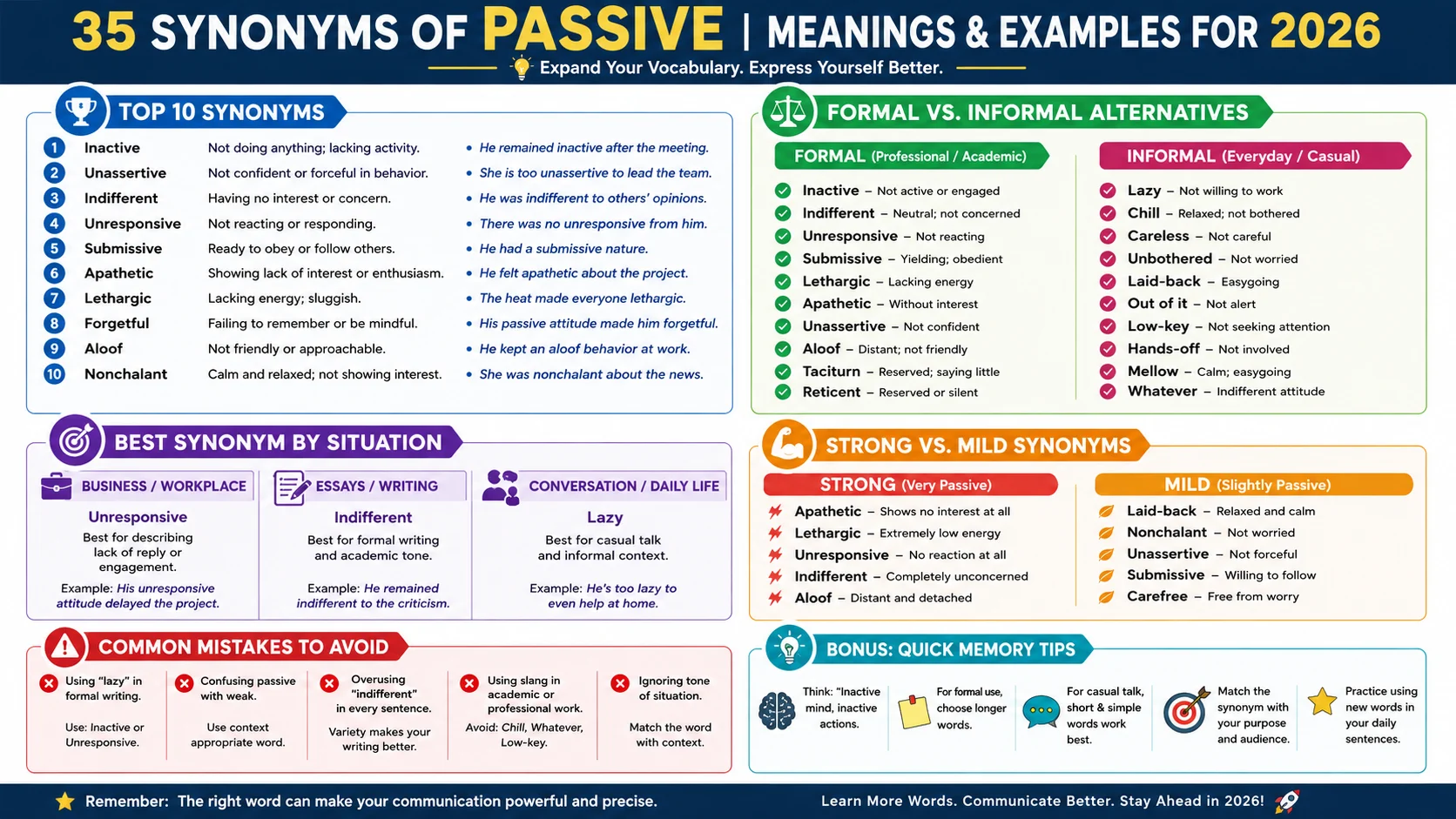
“Passive” means not taking action, being inactive, or letting things happen without resistance. The best synonyms are inactive, submissive, compliant, docile, and reserved. “Inactive” is the most common natural alternative. Each synonym has a slightly different meaning and context where it fits best.
Top 10 Synonyms
- Inactive
- Submissive
- Compliant
- Docile
- Reserved
- Subdued
- Unassertive
- Meek
- Acquiescent
- Unresponsive
“Passive” is a word that describes a lack of action or resistance. It’s useful in many contexts from describing personality types to explaining grammar. But using it too often can make your English feel repetitive and limited.
Think about it. You can describe a passive person, a passive attitude, passive resistance, or passive behavior. Each situation might need a different word that captures the specific type of passivity.
In this guide, you’ll learn 35 powerful synonyms for “passive.” You’ll discover exactly when to use each one, how formal they are, and what common mistakes to avoid. Let’s begin!
What Does “Passive” Mean?
Definition
Passive” means not taking active action, being submissive, or letting things happen without resistance. A passive person doesn’t assert themselves. A passive approach means not taking control. When you’re passive, you let others take the lead.
Pronunciation
| Feature | Value |
|---|---|
| US IPA | /ˈpæsɪv/ |
| UK IPA | /ˈpæsɪv/ |
| Syllables | 2 (pas-sive) |
| Tip | Stress the first syllable: “PASS-iv” |
Grammar
| Grammar Feature | Information |
|---|---|
| Part of Speech | Adjective (also noun) |
| Common Position | Before a noun or after a linking verb |
| Typical Pattern | Passive + noun / Subject + be + passive |
Examples:
- “He has a passive personality.” (before noun)
- “She was passive during the argument.” (after verb)
- “Passive behavior is not always bad.” (before noun)
Grammar Note: “Passive” is also used in grammar to describe the passive voice (e.g., “The ball was thrown”).
Word Family
| Word | Part of Speech | Meaning |
|---|---|---|
| Passive | Adjective | Not taking action |
| Passively | Adverb | In a passive way |
| Passivity | Noun | The quality of being passive |
| Passiveness | Noun | The state of being passive |
15 Synonyms of “Passive”
Inactive
Meaning: Not taking action; doing nothing.
Best Used For: Lifestyle, behavior, physical state.
Formality: Neutral
Tone: Neutral, Describing
Frequency: ⭐⭐⭐⭐⭐ (Very Common)
CEFR Level: B1
Example Sentence 1: “He leads an inactive lifestyle.”
Example Sentence 2: “The inactive volcano hasn’t erupted in years.”
Usage Tip: “Inactive” is the most direct synonym. Use it for anything that’s not taking action.
Common Confusion: Passive vs Inactive. “Inactive” simply means not doing anything. “Passive” often implies letting others control.
Submissive
Meaning: Willing to obey others; not asserting yourself.
Best Used For: Personality, behavior, relationships.
Formality: Neutral
Tone: Obedient, Yielding
Frequency: ⭐⭐⭐⭐ (Common)
CEFR Level: B2
Example Sentence 1: “She is submissive in her relationships.”
Example Sentence 2: “The submissive dog obeyed every command.”
Usage Tip: “Submissive” emphasizes obedience and yielding to others. Use it for personalities and behavior.
Compliant
Meaning: Willing to follow rules, requests, or commands.
Best Used For: Rules, requests, authority.
Formality: Formal
Tone: Obedient, Cooperative
Frequency: ⭐⭐⭐ (Moderate)
CEFR Level: B2
Example Sentence 1: “The compliant students followed all instructions.”
Example Sentence 2: “The company is compliant with regulations.”
Usage Tip: “Compliant” is a formal word for following rules or requests.
Docile
Meaning: Quiet and easy to control or influence.
Best Used For: Animals, children, behavior.
Formality: Neutral
Tone: Calm, Manageable
Frequency: ⭐⭐⭐ (Moderate)
CEFR Level: B2
Example Sentence 1: “The docile horse was easy to ride.”
Example Sentence 2: “He has a docile personality.”
Usage Tip: “Docile” suggests being calm and easy to handle. Use it for animals and quiet people.
Reserved
Meaning: Keeping your feelings or thoughts to yourself; not outgoing.
Best Used For: Personality, behavior.
Formality: Neutral
Tone: Quiet, Restrained
Frequency: ⭐⭐⭐⭐ (Common)
CEFR Level: B2
Example Sentence 1: “She is very reserved around strangers.”
Example Sentence 2: “He has a reserved nature.”
Usage Tip: “Reserved” emphasizes quietness and self-restraint. Use it for personalities.
Subdued
Meaning: Quiet and less active or intense.
Best Used For: Atmosphere, mood, behavior.
Formality: Formal
Tone: Quiet, Restrained
Frequency: ⭐⭐⭐ (Moderate)
CEFR Level: B2
Example Sentence 1: “The subdued lighting created a relaxing atmosphere.”
Example Sentence 2: “He was subdued after the bad news.”
Usage Tip: “Subdued” suggests lowered energy or intensity. Use it for moods and atmospheres.
Unassertive
Meaning: Not confident in expressing yourself.
Best Used For: Personality, communication.
Formality: Formal
Tone: Hesitant, Quiet
Frequency: ⭐⭐⭐ (Moderate)
CEFR Level: C1
Example Sentence 1: “She is unassertive in meetings.”
Example Sentence 2: “His unassertive nature holds him back.”
Usage Tip: “Unassertive” emphasizes a lack of confidence in expressing opinions.
Meek
Meaning: Quiet and humble; not fighting back.
Best Used For: Personality, behavior.
Formality: Neutral
Tone: Humble, Quiet
Frequency: ⭐⭐⭐ (Moderate)
CEFR Level: B2
Example Sentence 1: “He is meek and never complains.”
Example Sentence 2: “The meek child sat quietly in the corner.”
Usage Tip: “Meek” suggests humility and a lack of aggression or resistance.
Acquiescent
Meaning: Accepting things without resistance.
Best Used For: Behavior, decision-making.
Formality: Formal
Tone: Accepting, Compliant
Frequency: ⭐⭐ (Rare)
CEFR Level: C1
Example Sentence 1: “She was acquiescent to the new rules.”
Example Sentence 2: “His acquiescent nature made him easy to manage.”
Usage Tip: “Acquiescent” is a formal word for accepting things without resistance.
Unresponsive
Meaning: Not reacting or responding.
Best Used For: Communication, situations.
Formality: Neutral
Tone: Detached, Unfeeling
Frequency: ⭐⭐⭐ (Moderate)
CEFR Level: B2
Example Sentence 1: “He was unresponsive to my questions.”
Example Sentence 2: “The audience was unresponsive to the joke.”
Usage Tip: “Unresponsive” emphasizes a lack of reaction or response.
Indifferent
Meaning: Not caring or not interested.
Best Used For: Attitudes, opinions, behavior.
Formality: Neutral
Tone: Unconcerned, Detached
Frequency: ⭐⭐⭐ (Moderate)
CEFR Level: B2
Example Sentence 1: “She was indifferent to the news.”
Example Sentence 2: “His indifferent attitude annoyed everyone.”
Usage Tip: “Indifferent” suggests a lack of interest or concern.
Yielding
Meaning: Giving way to others; not resisting.
Best Used For: Behavior, arguments.
Formality: Formal
Tone: Flexible, Surrendering
Frequency: ⭐⭐ (Rare)
CEFR Level: C1
Example Sentence 1: “She was yielding to his demands.”
Example Sentence 2: “His yielding personality avoids conflict.”
Usage Tip: “Yielding” suggests giving in to others. It’s a formal word.
Pliable
Meaning: Easily influenced or controlled.
Best Used For: People, behavior.
Formality: Formal
Tone: Easily influenced
Frequency: ⭐⭐ (Rare)
CEFR Level: C1
Example Sentence 1: “She is pliable and easily led by others.”
Example Sentence 2: “The pliable employee agreed to everything.”
Usage Tip: “Pliable” suggests being easily controlled or influenced.
Trapped
Meaning: Feeling stuck and unable to act.
Best Used For: Emotions, situations.
Formality: Neutral
Tone: Stuck, Helpless
Frequency: ⭐⭐⭐ (Moderate)
CEFR Level: B2
Example Sentence 1: “She felt trapped in the situation.”
Example Sentence 2: “He was trapped by his own passivity.”
Usage Tip: “Trapped” emphasizes a feeling of being stuck and unable to act.
Apathetic
Meaning: Showing no interest or concern.
Best Used For: Attitudes, behavior.
Formality: Formal
Tone: Uninterested, Unconcerned
Frequency: ⭐⭐⭐ (Moderate)
CEFR Level: B2
Example Sentence 1: “The students were apathetic about the election.”
Example Sentence 2: “His apathetic response was frustrating.”
Usage Tip: “Apathetic” suggests a complete lack of interest or concern.
Synonyms Comparison Table
| Synonym | Best Context | Formality | Tone | Frequency |
|---|---|---|---|---|
| Inactive | Physical state | Neutral | Describing | ⭐⭐⭐⭐⭐ |
| Reserved | Personality | Neutral | Quiet | ⭐⭐⭐⭐ |
| Submissive | Relationships | Neutral | Obedient | ⭐⭐⭐⭐ |
| Compliant | Rules, laws | Formal | Cooperative | ⭐⭐⭐ |
| Docile | Animals, children | Neutral | Manageable | ⭐⭐⭐ |
| Unassertive | Communication | Formal | Hesitant | ⭐⭐⭐ |
| Meek | Personality | Neutral | Humble | ⭐⭐⭐ |
| Subdued | Mood, atmosphere | Formal | Restrained | ⭐⭐⭐ |
| Indifferent | Attitude | Neutral | Detached | ⭐⭐⭐ |
| Unresponsive | Communication | Neutral | Detached | ⭐⭐⭐ |
Best Synonyms by Situation
| Situation | Best Synonym | Why It Works |
|---|---|---|
| Daily Conversation | Inactive | Natural and common |
| Business Email | Compliant | Professional and clear |
| Academic Writing | Submissive | Formal and precise |
| School Assignment | Reserved | Clear and simple |
| Professional Meeting | Cooperative | Sounds positive |
| Presentation | Inactive | Clear and direct |
| Creative Writing | Meek | Adds literary depth |
| Social Media | Chill | Casual and relatable |
| Legal Context | Compliant | Professional and precise |
Formal vs Informal Synonyms
Formal Alternatives
| Synonym | Best Used For |
|---|---|
| Compliant | Rules, regulations |
| Acquiescent | Accepting without resistance |
| Pliable | Easily controlled |
| Yielding | Giving in to others |
| Apathetic | Lack of interest |
Neutral Alternatives
| Synonym | Best Used For |
|---|---|
| Inactive | General situations |
| Reserved | Personality |
| Submissive | Relationships |
| Docile | Animals, quiet people |
Informal Alternatives
| Synonym | Best Used For |
|---|---|
| Chill | Casual contexts |
| Laid-back | Relaxed personality |
| Go with the flow | Easygoing attitude |
Choosing the Right Level: Use “compliant” and “acquiescent” for formal writing. Use “inactive” and “reserved” for most situations. Use “chill” with friends.
Strong vs Mild Synonyms
Mild
Suitable for everyday situations with less intensity.
- Inactive
- Reserved
- Indifferent
Moderate
More noticeable or specific alternatives.
- Submissive
- Compliant
- Docile
- Unassertive
Strong
High-intensity alternatives suggesting extreme passivity.
- Subdued (very restrained)
- Yielding (giving in completely)
- Acquiescent (total acceptance)
- Trapped (feeling stuck)
How Intensity Changes Meaning: “He is inactive” is mild. “He is submissive” suggests more passive behavior. Choose stronger words when you want to emphasize a lack of action.
Real-Life Examples
School: “The passive student never answered questions in class.”
Office: “She was submissive and never voiced her opinions.”
Business Email: “The company is compliant with all regulations.”
Meetings: “The subdued atmosphere made everyone quiet.”
Presentations: “The audience was unresponsive to the presentation.”
Daily Conversations: “He’s very reserved around new people.”
Social Media: “I feel so inactive today—just relaxing.”
Academic Writing: “The subject displayed passive behavior during the study.”
Common Collocations
| Common Phrase | Better Alternative |
|---|---|
| Passive person | Reserved person |
| Passive attitude | Submissive attitude |
| Passive behavior | Inactive behavior |
| Passive resistance | Quiet resistance |
| Passive approach | Cautious approach |
Common Phrases
Go with the flow: To be passive and accept things. (e.g., “She just goes with the flow.”)
Take a back seat: To let others lead. (e.g., “He took a back seat in the project.”)
Keep your head down: To avoid attention. (e.g., “She kept her head down at work.”)
Stay out of the way: To avoid being involved. (e.g., “He stayed out of the way.”)
Fade into the background: To be unnoticed. (e.g., “She faded into the background.”)
Context Guide
| Situation | Best Synonym | Reason |
|---|---|---|
| Essay | Submissive | Academic and formal |
| Speech | Inactive | Clear and direct |
| Business Email | Compliant | Professional and clear |
| Novel | Meek | Adds literary depth |
| Presentation | Inactive | Clear and direct |
| Conversation | Reserved | Natural and relatable |
| Academic Writing | Submissive | Precise and formal |
| Marketing Copy | Passive | Engaging and clear |
Related Words
Near Synonyms
- Tractable: Easy to control.
- Amenable: Open and responsive.
- Placable: Easy to calm.
- Resigned: Accepting without resistance.
- Timid: Lacking confidence.
Antonyms
- Active: Taking action.
- Assertive: Confident and direct.
- Aggressive: Taking control.
- Proactive: Acting in advance.
- Dominant: Controlling.
Related Adjectives
- Inactive: Not active.
- Submissive: Obedient.
- Compliant: Following rules.
- Docile: Easy to manage.
- Reserved: Keeping to oneself.
Related Nouns
- Passivity: The state of being passive.
- Submissiveness: Obedience.
- Compliance: Following rules.
- Reserve: Self-restraint.
- Inaction: Lack of action.
Related Verbs
- Submit: To give in.
- Comply: To follow rules.
- Yield: To give way.
- Acquiesce: To accept without resistance.
Frequently Asked Questions
What is another word for passive?
Common synonyms include inactive, submissive, compliant, docile, and reserved. “Inactive” is the most common and direct alternative.
Which synonym sounds the most professional?
Compliant and acquiescent sound very professional. “Submissive” is also acceptable in formal contexts.
What is the strongest synonym for passive?
Subdued and yielding are among the strongest synonyms. They suggest complete passivity or giving in.
Which synonym is best for essays?
Submissive is the best choice for academic essays about behavior. “Compliant” is excellent for legal or regulatory contexts.
What’s the difference between passive and inactive?
“Inactive” simply means not doing anything. “Passive” often implies letting others control or dominate.
Which synonym is most common in everyday English?
“Inactive” and “reserved” are very common in everyday speech. “Submissive” is also frequently used.
What is the opposite of passive?
Common opposites are active, assertive, proactive, and dominant. These words describe taking action.
Conclusion
“Passive” is a useful word, but now you have 35 fantastic alternatives. Each synonym adds a different shade of meaning to your language.
Remember, the key is understanding the context. Use “inactive” for doing nothing. Use “submissive” for obeying others. Use “reserved” for quiet personalities. Use “compliant” for following rules.
The best way to improve is practice. Try using one or two new synonyms each day. Listen for these words in conversations and books. Your vocabulary will become richer and more expressive with time.
