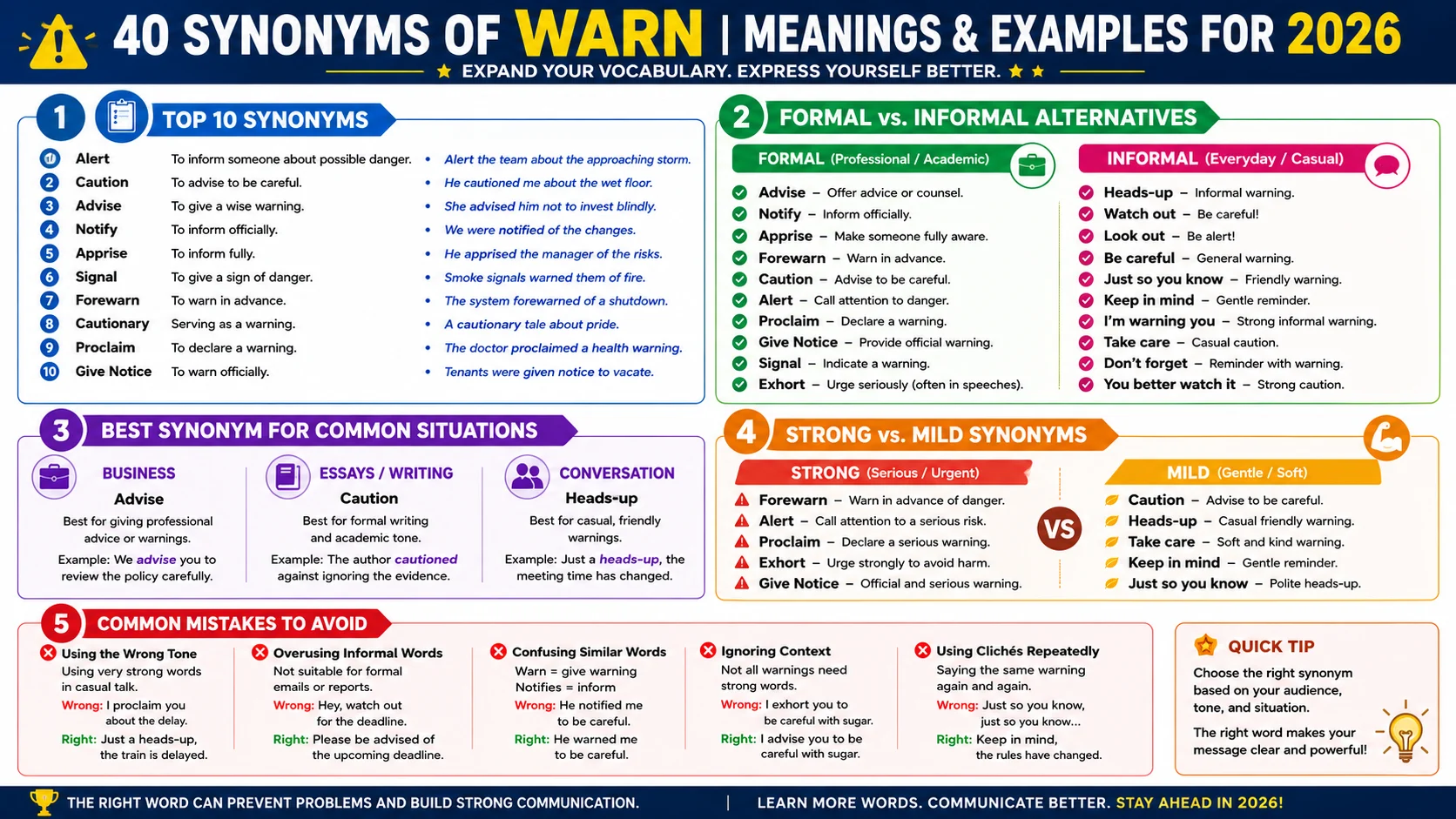
“Warn” means to tell someone about a possible danger or problem so they can be careful. The best synonyms are alert, caution, advise, inform, and notify. “Alert” is the most common natural alternative. Each synonym has a slightly different meaning and context where it fits best.
Top 10 Synonyms
- Alert
- Caution
- Advise
- Inform
- Notify
- Forewarn
- Tip off
- Put on guard
- Give notice
- Sound the alarm
“Warn” is a word we use to keep each other safe. We warn people about dangers, bad weather, and potential problems. But using it too often can make your English feel repetitive.
Think about it. You can warn someone about a storm, warn them about a dangerous person, warn them about a bad decision, or warn them about a scam. Each situation might need a different word that captures the specific type of warning.
In this guide, you’ll learn 35 powerful synonyms for “warn.” You’ll discover exactly when to use each one, how formal they are, and what common mistakes to avoid. Let’s begin!
What Does “Warn” Mean?
Definition
Warn” means to tell someone about a possible danger, problem, or unpleasant situation so they can be prepared. When you warn someone, you give them information that helps them avoid trouble. It’s about protecting others through information.
Pronunciation
| Feature | Value |
|---|---|
| US IPA | /wɔrn/ |
| UK IPA | /wɔːn/ |
| Syllables | 1 |
| Tip | Rhymes with “horn” and “corn” |
Grammar
| Grammar Feature | Information |
|---|---|
| Part of Speech | Verb |
| Common Position | After the subject |
| Typical Pattern | Subject + warn + someone + about/against/of + something |
Examples:
- “She warned him about the dangerous road.”
- “The sign warns drivers of sharp turns.”
- “I warned you not to touch that!”
Grammar Note: “Warn” is often used with “about,” “against,” or “of” to show what the danger is.
Word Family
| Word | Part of Speech | Meaning |
|---|---|---|
| Warn | Verb | To tell about danger |
| Warning | Noun | A message about danger |
| Warned | Adjective | Having been warned |
| Warned | Verb (past) | Past tense of warn |
15 Synonyms of “Warn”
Alert
Meaning: To make someone aware of danger or a problem.
Best Used For: Emergency situations, quick notifications.
Formality: Neutral
Tone: Urgent, Attentive
Frequency: ⭐⭐⭐⭐⭐ (Very Common)
CEFR Level: B2
Example Sentence 1: “The police alerted residents to the flood risk.”
Example Sentence 2: “Please alert me if anything changes.”
Usage Tip: “Alert” suggests urgency and the need for immediate attention. Use it for emergencies and important updates.
Common Confusion: Alert vs Warn. “Alert” often suggests a quick, urgent notification. “Warn” is broader.
Caution
Meaning: To advise someone to be careful.
Best Used For: Safety instructions, formal warnings.
Formality: Formal
Tone: Careful, Formal
Frequency: ⭐⭐⭐⭐ (Common)
CEFR Level: B2
Example Sentence 1: “The doctor cautioned him about his diet.”
Example Sentence 2: “The sign cautions visitors about the slippery floor.”
Usage Tip: “Caution” is formal and emphasizes being careful. Use it for safety and formal advice.
Advise
Meaning: To tell someone what they should do.
Best Used For: Giving recommendations, professional advice.
Formality: Formal
Tone: Professional, Helpful
Frequency: ⭐⭐⭐⭐⭐ (Very Common)
CEFR Level: B1
Example Sentence 1: “I advise you to check the weather before leaving.
Example Sentence 2: “The lawyer advised her client not to speak.”
Usage Tip: “Advise” is professional and suggests giving helpful recommendations, including warnings.
Inform
Meaning: To give someone information about something.
Best Used For: News, updates, notifications.
Formality: Neutral
Tone: Neutral, Factual
Frequency: ⭐⭐⭐⭐⭐ (Very Common)
CEFR Level: B1
Example Sentence 1: “Please inform me of any changes.”
Example Sentence 2: “The announcement informed passengers of the delay.”
Usage Tip: “Inform” is factual and neutral. Use it when sharing information that may be a warning.
Notify
Meaning: To formally tell someone about something.
Best Used For: Official notifications, formal announcements.
Formality: Formal
Tone: Official, Formal
Frequency: ⭐⭐⭐⭐ (Common)
CEFR Level: B2
Example Sentence 1: “The school notified parents about the closure.”
Example Sentence 2: “We will notify you when the results are ready.”
Usage Tip: “Notify” is formal and official. Use it for important announcements.
Forewarn
Meaning: To warn someone before something happens.
Best Used For: Future dangers, predictions.
Formality: Neutral
Tone: Advising, Anticipating
Frequency: ⭐⭐⭐ (Moderate)
CEFR Level: B2
Example Sentence 1: “I forewarned him about the difficult exam.”
Example Sentence 2: “She had been forewarned of the company’s financial problems.”
Usage Tip: “Forewarn” emphasizes warning in advance. It suggests you gave the warning before the event.
Tip off
Meaning: To give someone secret or helpful information.
Best Used For: Crime, sports, informal situations.
Formality: Informal
Tone: Secretive, Helpful
Frequency: ⭐⭐⭐ (Moderate)
CEFR Level: B2
Example Sentence 1: “Someone tipped off the police about the robbery.
Example Sentence 2: “He tipped me off about the surprise party.
Usage Tip: “Tip off” is informal and often implies giving secret information. Use it in casual contexts.
Put on guard
Meaning: To make someone alert to possible danger.
Best Used For: Safety, suspicious situations.
Formality: Neutral
Tone: Cautious, Alert
Frequency: ⭐⭐ (Rare)
CEFR Level: B2
Example Sentence 1: “The strange noise put me on guard.”
Example Sentence 2: “His warning put everyone on guard.”
Usage Tip: “Put on guard” is a phrase that means to make someone cautious or suspicious.
Give notice
Meaning: To inform someone officially about something.
Best Used For: Resignations, announcements, formal matters.
Formality: Formal
Tone: Official, Serious
Frequency: ⭐⭐⭐ (Moderate)
CEFR Level: B2
Example Sentence 1: “She gave notice of her resignation.”
Example Sentence 2: “We need to give notice about the changes.”
Usage Tip: “Give notice” is formal. Use it for official announcements.
Sound the alarm
Meaning: To warn people about a serious danger.
Best Used For: Emergencies, crises.
Formality: Neutral
Tone: Urgent, Serious
Frequency: ⭐⭐⭐ (Moderate)
CEFR Level: B2
Example Sentence 1: “She sounded the alarm about the fire.”
Example Sentence 2: “Environmentalists are sounding the alarm about climate change.”
Usage Tip: “Sound the alarm” is a vivid phrase for a serious, urgent warning.
Put someone on alert
Meaning: To make someone ready for possible danger.
Best Used For: Security, emergencies.
Formality: Formal
Tone: Prepared, Careful
Frequency: ⭐⭐⭐ (Moderate)
CEFR Level: B2
Example Sentence 1: “The police put the community on alert.”
Example Sentence 2: “We’re on alert for any problems.”
Usage Tip: “Put on alert” means to make someone ready for a possible danger.
Make aware
Meaning: To help someone know or understand something.
Best Used For: General awareness, education.
Formality: Neutral
Tone: Informative, Helpful
Frequency: ⭐⭐⭐⭐ (Common)
CEFR Level: B1
Example Sentence 1: “We need to make people aware of the risks.”
Example Sentence 2: “The campaign made consumers aware of the dangers.
Usage Tip: “Make aware” focuses on giving knowledge. It’s a gentle way to warn.
Flag
Meaning: To mark or point out something important.
Best Used For: Issues, problems, concerns.
Formality: Neutral
Tone: Identifying, Cautioning
Frequency: ⭐⭐⭐ (Moderate)
CEFR Level: B2
Example Sentence 1: “The report flagged several issues.”
Example Sentence 2: “He flagged the problem early.”
Usage Tip: “Flag” is a modern, business-friendly way to warn about issues.
Red flag
Meaning: A warning sign or to warn about a problem.
Best Used For: Potential problems, suspicious situations.
Formality: Informal
Tone: Warning, Cautioning
Frequency: ⭐⭐⭐ (Moderate)
CEFR Level: B2
Example Sentence 1: “The behavior raised a red flag.”
Example Sentence 2: “She red-flagged the suspicious transaction.”
Usage Tip: “Red flag” is both a noun and a verb (informal). It means to indicate a problem.
Counsel
Meaning: To advise someone about what to do.
Best Used For: Professional advice, serious matters.
Formality: Formal
Tone: Supportive, Professional
Frequency: ⭐⭐⭐ (Moderate)
CEFR Level: C1
Example Sentence 1: “The therapist counseled him to be careful.”
Example Sentence 2: “She counseled against making hasty decisions.”
Usage Tip: “Counsel” is formal. It suggests professional or serious advice.
Synonyms Comparison Table
| Synonym | Best Context | Formality | Tone | Frequency |
|---|---|---|---|---|
| Alert | Emergencies | Neutral | Urgent | ⭐⭐⭐⭐⭐ |
| Advise | Professional advice | Formal | Helpful | ⭐⭐⭐⭐⭐ |
| Inform | General information | Neutral | Factual | ⭐⭐⭐⭐⭐ |
| Notify | Official announcements | Formal | Official | ⭐⭐⭐⭐ |
| Caution | Safety warnings | Formal | Careful | ⭐⭐⭐⭐ |
| Forewarn | Advance warnings | Neutral | Anticipating | ⭐⭐⭐ |
| Tip off | Informal secrets | Informal | Secretive | ⭐⭐⭐ |
| Sound the alarm | Serious dangers | Neutral | Urgent | ⭐⭐⭐ |
Best Synonyms by Situation
| Situation | Best Synonym | Why It Works |
|---|---|---|
| Daily Conversation | Warn/Tell | Natural and common |
| Business Email | Advise/Inform | Professional and clear |
| Academic Writing | Caution | Formal and precise |
| School Assignment | Caution | Shows seriousness |
| Professional Meeting | Advise | Sounds professional |
| Presentation | Alert | Clear and urgent |
| Creative Writing | Forewarn | Adds literary depth |
| Social Media | Warn | Casual and relatable |
| Emergency | Alert | Urgent and clear |
Formal vs Informal Synonyms
Formal Alternatives
| Synonym | Best Used For |
|---|---|
| Advise | Professional recommendations |
| Notify | Official announcements |
| Caution | Safety warnings |
| Counsel | Serious, professional advice |
| Give notice | Formal notifications |
Neutral Alternatives
| Synonym | Best Used For |
|---|---|
| Alert | General warnings |
| Inform | General information |
| Warn | Most situations |
| Forewarn | Advance warnings |
Informal Alternatives
| Synonym | Best Used For |
|---|---|
| Tip off | Secret information |
| Red flag | Indicating a problem |
| Give a heads up | Casual warning |
Choosing the Right Level: Use “advise” and “notify” for formal writing. Use “alert” and “warn” for most situations. Use “tip off” and “heads up” with friends.
Strong vs Mild Synonyms
Mild
Suitable for everyday situations with less intensity.
- Inform
- Make aware
- Advise
Moderate
More serious or purposeful alternatives.
- Warn
- Alert
- Caution
- Notify
Strong
High-intensity alternatives suggesting serious danger.
- Sound the alarm (serious urgency)
- Forewarn (advance warning)
- Put on guard (preparing for danger)
How Intensity Changes Meaning: “I told her” is mild. “I alerted the authorities” is serious. Choose stronger words when you want to emphasize the urgency of the warning.
Real-Life Examples
School: “The teacher warned students about the upcoming test.”
Office: “The manager advised everyone to check their work carefully.”
Business Email: “We need to notify all employees about the policy change.”
Meetings: “The report flagged several potential issues.”
Presentations: “The speaker sounded the alarm about climate change.”
Daily Conversations: “I told you to be careful on the road.”
Social Media: “Just a heads up the store closes early today.”
Academic Writing: “The study cautions against drawing conclusions too quickly.”
Common Collocations
| Common Phrase | Better Alternative |
|---|---|
| Warn about | Alert about |
| Warn against | Caution against |
| Warn someone | Advise someone |
| Warn of danger | Sound the alarm |
| Warn in advance | Forewarn |
Common Phrases
Heads up: A warning or notice. (e.g., “Just a heads up we’re changing the schedule.”)
Give a heads up: To warn in advance. (e.g., “Give me a heads up before you arrive.”)
Red flag: A warning sign. (e.g., “That behavior is a red flag.”)
Raise a red flag: To warn about a problem. (e.g., “The data raised a red flag.”)
Take caution: To be careful. (e.g., “Take caution when driving in the rain.”)
Context Guide
| Situation | Best Synonym | Reason |
|---|---|---|
| Essay | Caution | Formal and academic |
| Speech | Alert | Urgent and clear |
| Business Email | Advise/Notify | Professional and clear |
| Novel | Forewarn | Adds literary depth |
| Presentation | Alert | Clear and effective |
| Conversation | Tell/Warn | Natural and relatable |
| Academic Writing | Caution | Precise and formal |
| Marketing Copy | Alert | Engaging and urgent |
Related Words
Near Synonyms
- Notice: To observe or become aware.
- Cue: A signal or hint.
- Hint: A slight suggestion.
- Signal: A sign or indication.
- Directive: An official instruction.
Antonyms
- Ignore: To pay no attention to.
- Misguide: To give wrong advice.
- Deceive: To mislead.
- Conceal: To hide information.
- Neglect: To fail to warn.
Related Adjectives
- Warning: Giving a warning.
- Cautionary: Serving as a warning.
- Advisory: Giving advice.
- Precautionary: Done to prevent danger.
- Alarming: Causing fear or worry.
Related Nouns
- Warning: A message about danger.
- Caution: Carefulness.
- Alert: A warning signal.
- Advice: A recommendation.
- Notification: An official notice.
Related Verbs
- Alert: To warn urgently.
- Caution: To advise caution.
- Advise: To recommend.
- Notify: To inform officially.
- Forewarn: To warn in advance.
Frequently Asked Questions
What is another word for warn?
Common synonyms include alert, caution, advise, inform, and notify. “Alert” is the most common and direct alternative.
Which synonym sounds the most professional?
Advise and notify sound very professional. “Caution” is also excellent for formal contexts.
What is the strongest synonym for warn?
Sound the alarm is one of the strongest synonyms. It suggests serious, urgent danger. “Forewarn” is also strong for advance warnings.
Which synonym is best for essays?
Caution is the best choice for academic essays. It’s formal and precise.
What’s the difference between warn and alert?
“Alert” suggests urgent, quick notification. “Warn” is broader and can be less urgent.
Which synonym is most common in everyday English?
“Warn” itself is most common, but “alert” and “tell” are also very common in everyday speech.
What is the opposite of warn?
Common opposites are ignore, misguide, and conceal. These words describe not telling or telling wrong information.
Conclusion
“Warn” is an important word for keeping people safe and informed. Now you have 35 fantastic alternatives. Each synonym adds a different shade of meaning to your language.
Remember, the key is understanding the context. Use “alert” for urgent warnings. Use “advise” for professional recommendations. Use “caution” for formal safety warnings. Use “forewarn” for advance warnings.
The best way to improve is practice. Try using one or two new synonyms each day. Listen for these words in conversations and books. Your vocabulary will become richer and more expressive with time.
