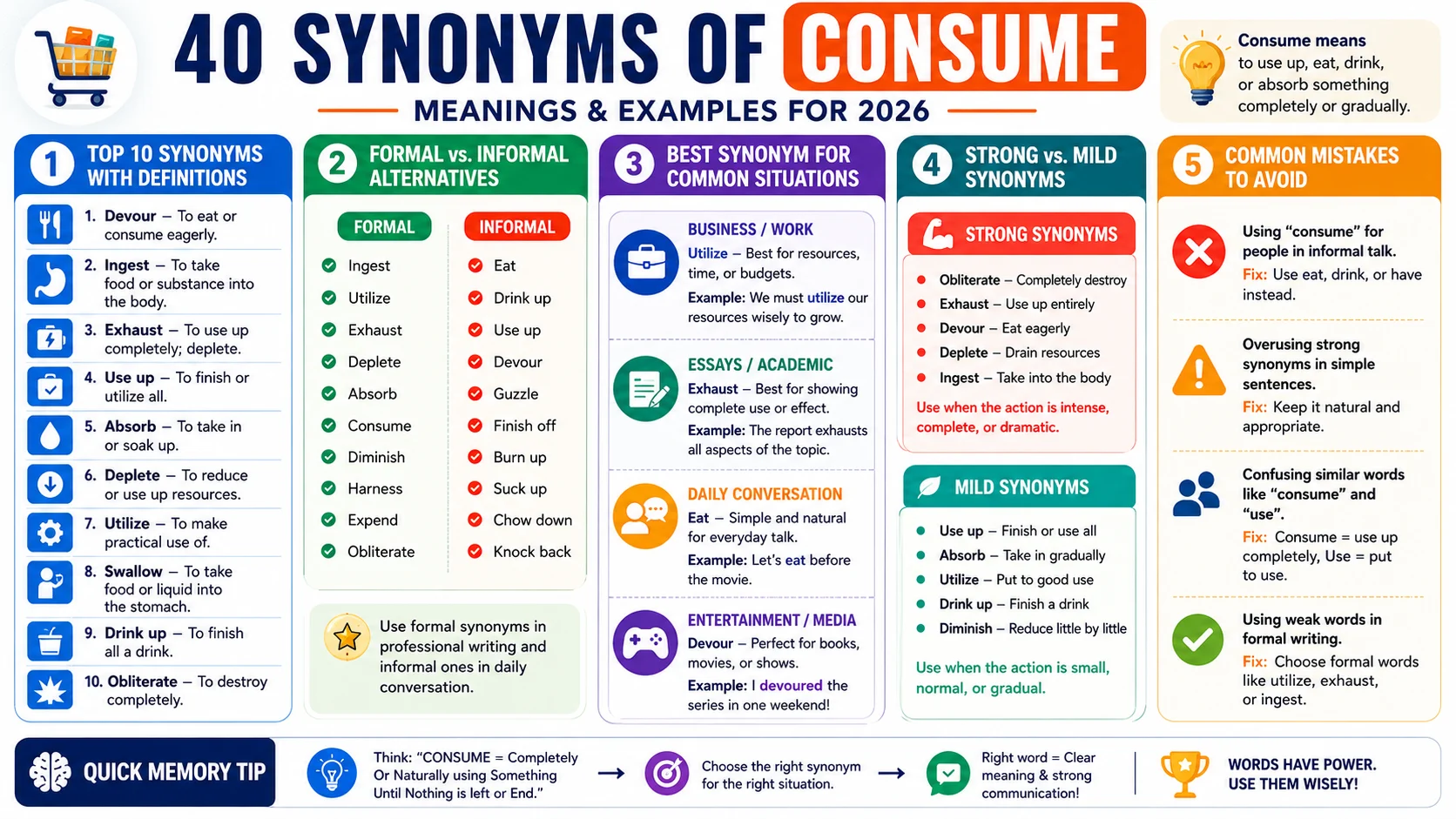
“Consume” means to eat, drink, or use something up. The best synonyms are eat, drink, use, devour, and absorb. “Eat” is the most common natural alternative. Each synonym has a slightly different meaning and context where it fits best.
Top 10 Synonyms
- Eat
- Drink
- Use
- Devour
- Absorb
- Ingest
- Swallow
- Guzzle
- Utilize
- Expend
“Consume” is a word we use a lot. We consume food, consume energy, consume information, and consume products. It’s useful, but using it too often can make your English feel repetitive and overly formal.
Think about it. You can consume a meal, consume electricity, consume time, or consume news. Each situation might need a different word that captures the specific type of consumption.
In this guide, you’ll learn 35 powerful synonyms for “consume.” You’ll discover exactly when to use each one, how formal they are, and what common mistakes to avoid. Let’s begin!
What Does “Consume” Mean?
Definition
Consume” means to eat, drink, or use something up completely. It can mean eating food, using resources, or absorbing information. When you consume something, you take it in and often use it up. It can also mean destroying or using entirely.
Pronunciation
| Feature | Value |
|---|---|
| US IPA | /kənˈsuːm/ |
| UK IPA | /kənˈsjuːm/ |
| Syllables | 2 (con-sume) |
| Tip | Stress the second syllable: “kuhn-SOOM” |
Grammar
| Grammar Feature | Information |
|---|---|
| Part of Speech | Verb |
| Common Position | After the subject |
| Typical Pattern | Subject + consume + object |
Examples:
- “The fire consumed the building.” (destroy)
- “She consumes a lot of coffee.” (drink)
- “We consume too much energy.” (use)
Grammar Note: “Consume” is a transitive verb, so it always needs an object. You can’t just say “I consume.”
Word Family
| Word | Part of Speech | Meaning |
|---|---|---|
| Consume | Verb | To eat, drink, or use up |
| Consumer | Noun | A person who consumes |
| Consumption | Noun | The act of consuming |
| Consumable | Adjective | Able to be consumed |
| Consumerism | Noun | The protection of consumer interests |
15 Synonyms of “Consume”
Eat
Meaning: To take food into your body through your mouth.
Best Used For: Food, meals, snacks.
Formality: Neutral
Tone: Basic, Direct
Frequency: ⭐⭐⭐⭐⭐ (Very Common)
CEFR Level: A1
Example Sentence 1: “She eats breakfast at 7 AM every day.”
Example Sentence 2: “We need to eat more vegetables.”
Usage Tip: “Eat” is the most direct and common synonym for consuming food. Use it for almost any food consumption.
Common Confusion: Eat vs Consume. “Eat” is for food. “Consume” is broader and includes drink, use, and destruction.
Drink
Meaning: To take liquid into your body through your mouth.
Best Used For: Beverages, liquids.
Formality: Neutral
Tone: Basic, Direct
Frequency: ⭐⭐⭐⭐⭐ (Very Common)
CEFR Level: A1
Example Sentence 1: “She drinks tea every morning.”
Example Sentence 2: “We need to drink more water.”
Usage Tip: “Drink” is the most direct synonym for consuming liquids.
Use
Meaning: To put something into service or employ for a purpose.
Best Used For: Resources, tools, energy.
Formality: Neutral
Tone: Practical, Direct
Frequency: ⭐⭐⭐⭐⭐ (Very Common)
CEFR Level: A2
Example Sentence 1: “We use too much electricity.”
Example Sentence 2: “He uses his phone constantly.”
Usage Tip: “Use” is the most direct synonym for consuming resources or energy.
Devour
Meaning: To eat something quickly and hungrily.
Best Used For: Food, reading, consuming with passion.
Formality: Neutral
Tone: Hungry, Intense
Frequency: ⭐⭐⭐⭐ (Common)
CEFR Level: B2
Example Sentence 1: “He devoured his dinner in minutes.”
Example Sentence 2: “She devoured the book in one night.”
Usage Tip: “Devour” suggests eating or consuming with great intensity or enthusiasm.
Absorb
Meaning: To take in and understand information, or to soak up liquid.
Best Used For: Information, liquids, knowledge.
Formality: Formal
Tone: Learning, Soaking
Frequency: ⭐⭐⭐⭐ (Common)
CEFR Level: B2
Example Sentence 1: “She absorbs information quickly.”
Example Sentence 2: “The sponge absorbed the water.”
Usage Tip: “Absorb” suggests taking in and retaining. Use it for learning or soaking up liquids.
Ingest
Meaning: To take food, drink, or substances into your body.
Best Used For: Medicine, food, science.
Formality: Formal
Tone: Medical, Scientific
Frequency: ⭐⭐⭐ (Moderate)
CEFR Level: B2
Example Sentence 1: “The patient needs to ingest the medicine.”
Example Sentence 2: “We ingest food through our mouths.”
Usage Tip: “Ingest” is formal and often used in medical or scientific contexts.
Swallow
Meaning: To cause food or drink to pass down your throat.
Best Used For: Food, drinks, emotions.
Formality: Neutral
Tone: Physical, Basic
Frequency: ⭐⭐⭐⭐⭐ (Very Common)
CEFR Level: A2
Example Sentence 1: “She swallowed the pill with water.”
Example Sentence 2: “He swallowed his pride and apologized.”
Usage Tip: “Swallow” is the physical action of consuming. It can also be used metaphorically.
Guzzle
Meaning: To drink something quickly and in large amounts.
Best Used For: Drinks, beer, alcohol.
Formality: Informal
Tone: Quick, Excessive
Frequency: ⭐⭐⭐ (Moderate)
CEFR Level: B2
Example Sentence 1: “He guzzled the bottle of water.”
Example Sentence 2: “They were guzzling soda at the party.”
Usage Tip: “Guzzle” is informal. Use it for drinking quickly and a lot, often in a negative way.
Utilize
Meaning: To use something effectively.
Best Used For: Resources, skills, tools.
Formality: Formal
Tone: Professional, Efficient
Frequency: ⭐⭐⭐ (Moderate)
CEFR Level: B2
Example Sentence 1: “We need to utilize our resources better.”
Example Sentence 2: “She utilizes her skills effectively.”
Usage Tip: “Utilize” is formal and suggests using something in a practical or effective way.
Expend
Meaning: To spend or use up resources or time.
Best Used For: Energy, money, time, effort.
Formality: Formal
Tone: Spending, Using
Frequency: ⭐⭐⭐ (Moderate)
CEFR Level: B2
Example Sentence 1: “The project expended all our energy.”
Example Sentence 2: “We expended too much time on details.”
Usage Tip: “Expend” suggests using up something finite, like time, energy, or money.
Deplete
Meaning: To reduce the amount of something by using it.
Best Used For: Resources, supplies, reserves.
Formality: Formal
Tone: Reducing, Draining
Frequency: ⭐⭐⭐ (Moderate)
CEFR Level: B2
Example Sentence 1: “We depleted our supplies.”
Example Sentence 2: “The drought depleted the water reserves.”
Usage Tip: “Deplete” suggests using something until there’s little left.
Drain
Meaning: To use up something completely or cause it to flow out.
Best Used For: Energy, resources, liquids.
Formality: Neutral
Tone: Exhausting, Emptying
Frequency: ⭐⭐⭐⭐ (Common)
CEFR Level: B2
Example Sentence 1: “The long day drained my energy.”
Example Sentence 2: “The project drained our budget.”
Usage Tip: “Drain” suggests consuming until emptiness or exhaustion.
Exhaust
Meaning: To use something completely.
Best Used For: Resources, patience, energy.
Formality: Formal
Tone: Complete, Tiring
Frequency: ⭐⭐⭐⭐ (Common)
CEFR Level: B2
Example Sentence 1: “We exhausted our supplies.”
Example Sentence 2: “The task exhausted all our resources.”
Usage Tip: “Exhaust” suggests using something completely up.
Gobble
Meaning: To eat food quickly and greedily.
Best Used For: Food, eating.
Formality: Informal
Tone: Greedy, Quick
Frequency: ⭐⭐⭐ (Moderate)
CEFR Level: B2
Example Sentence 1: “He gobbled his lunch in five minutes.”
Example Sentence 2: “The children gobbled up the candy.”
Usage Tip: “Gobble” is informal. Use it for eating quickly and eagerly.
Sip
Meaning: To drink slowly in small amounts.
Best Used For: Drinks, hot liquids.
Formality: Neutral
Tone: Gentle, Slow
Frequency: ⭐⭐⭐⭐ (Common)
CEFR Level: B1
Example Sentence 1: “She sipped her tea slowly.”
Example Sentence 2: “He sipped the hot soup carefully.”
Usage Tip: “Sip” is the opposite of “guzzle.” Use it for slow, small amounts of drinking.
Synonyms Comparison Table
| Synonym | Best Context | Formality | Tone | Frequency |
|---|---|---|---|---|
| Eat | Food | Neutral | Direct | ⭐⭐⭐⭐⭐ |
| Drink | Liquids | Neutral | Direct | ⭐⭐⭐⭐⭐ |
| Use | Resources, energy | Neutral | Practical | ⭐⭐⭐⭐⭐ |
| Swallow | Physical action | Neutral | Basic | ⭐⭐⭐⭐⭐ |
| Devour | Intense eating/reading | Neutral | Intense | ⭐⭐⭐⭐ |
| Absorb | Information, liquids | Formal | Learning | ⭐⭐⭐⭐ |
| Utilize | Effective use | Formal | Professional | ⭐⭐⭐ |
| Expend | Spending resources | Formal | Using | ⭐⭐⭐ |
| Deplete | Using up reserves | Formal | Draining | ⭐⭐⭐ |
| Drain | Exhausting | Neutral | Emptying | ⭐⭐⭐⭐ |
Best Synonyms by Situation
| Situation | Best Synonym | Why It Works |
|---|---|---|
| Daily Conversation | Eat/Drink | Natural and common |
| Business Email | Utilize | Professional and clear |
| Academic Writing | Absorb/Ingest | Formal and precise |
| School Assignment | Use | Clear and simple |
| Professional Meeting | Utilize | Sounds professional |
| Presentation | Use/Utilize | Clear and effective |
| Creative Writing | Devour | Adds literary depth |
| Social Media | Eat/Drink | Casual and relatable |
Formal vs Informal Synonyms
Formal Alternatives
| Synonym | Best Used For |
|---|---|
| Absorb | Information, knowledge |
| Ingest | Medicine, substances |
| Utilize | Resources, skills |
| Expend | Time, energy, money |
| Deplete | Supplies, reserves |
Neutral Alternatives
| Synonym | Best Used For |
|---|---|
| Eat | Food |
| Drink | Liquids |
| Use | Most general situations |
| Swallow | Physical action |
Informal Alternatives
| Synonym | Best Used For |
|---|---|
| Devour | Eating quickly |
| Guzzle | Drinking quickly |
| Gobble | Eating greedily |
| Sip | Drinking slowly |
Choosing the Right Level: Use “absorb” and “utilize” for formal writing. Use “eat,” “drink,” and “use” for most situations. Use “devour” and “guzzle” with friends.
Strong vs Mild Synonyms
Mild
Suitable for everyday situations with less intensity.
- Eat
- Drink
- Use
- Sip
Moderate
More descriptive or noticeable alternatives.
- Swallow
- Devour
- Absorb
- Utilize
Strong
High-intensity alternatives suggesting significant consumption.
- Guzzle (excessive drinking)
- Gobble (greedy eating)
- Deplete (using up)
- Exhaust (completely using)
How Intensity Changes Meaning: “He ate lunch” is mild. “He devoured lunch” suggests he ate quickly and hungrily. Choose stronger words when you want to emphasize intensity.
Real-Life Examples
School: “Students should consume a healthy breakfast.”
Office: “We need to utilize our resources efficiently.”
Business Email: “The project consumed more time than expected.”
Meetings: “We’ve expended all our budget for this quarter.”
Presentations: “The company consumes a lot of energy.”
Daily Conversations: “I need to eat something.”
Social Media: “She devoured the book in one day!”
Academic Writing: “Patients were instructed to ingest the medication daily.”
Common Collocations
| Common Phrase | Better Alternative |
|---|---|
| Consume food | Eat food |
| Consume water | Drink water |
| Consume energy | Use energy |
| Consume time | Spend time |
| Consume resources | Utilize resources |
Common Phrases
Eat like a horse: To eat a lot. (e.g., “He eats like a horse.”)
Drink like a fish: To drink a lot. (e.g., “She drinks like a fish.”)
Gobble up: To eat quickly. (e.g., “The kids gobbled up the pizza.”)
Sip on: To drink slowly. (e.g., “She sipped on her coffee.”)
Devour a book: To read quickly. (e.g., “She devoured the novel in one night.”)
Context Guide
| Situation | Best Synonym | Reason |
|---|---|---|
| Essay | Absorb/Ingest | Academic and formal |
| Speech | Use | Clear and relatable |
| Business Email | Utilize | Professional and clear |
| Novel | Devour | Adds literary depth |
| Presentation | Use | Clear and effective |
| Conversation | Eat/Drink | Natural and relatable |
| Academic Writing | Ingest | Precise and formal |
| Marketing Copy | Use/Enjoy | Engaging and effective |
Related Words
Near Synonyms
- Sample: To try a small amount.
- Taste: To try the flavor.
- Nibble: To eat small bites.
- Quench: To satisfy thirst.
- Partake: To eat or drink.
Antonyms
- Create: To make something.
- Produce: To make.
- Generate: To create.
- Save: To keep.
- Preserve: To protect.
Related Adjectives
- Consumable: Able to be consumed.
- Edible: Safe to eat.
- Drinkable: Safe to drink.
- Durable: Lasting a long time.
- Inexhaustible: Cannot be used up.
Related Nouns
- Consumer: A person who consumes.
- Consumption: The act of consuming.
- Resource: A supply that can be used.
- Product: Something that is consumed.
- Food: Something to eat.
Related Verbs
- Eat: To take in food.
- Drink: To take in liquid.
- Use: To put to service.
- Absorb: To take in.
- Swallow: To cause to go down the throat.
Frequently Asked Questions
What is another word for consume?
Common synonyms include eat, drink, use, devour, and absorb. “Eat” is the most common and direct alternative.
Which synonym sounds the most professional?
Utilize and expend sound very professional. “Absorb” is also excellent for academic contexts.
What is the strongest synonym for consume?
Devour, guzzle, and deplete are among the strongest synonyms. They suggest intense or complete consumption.
Which synonym is best for essays?
Absorb is the best choice for academic essays. It’s formal and precise.
What’s the difference between consume and eat?
“Eat” is specifically for food. “Consume” is broader and includes drink, use, and destruction.
Which synonym is most common in everyday English?
“Eat,” “drink,” and “use” are very common in everyday speech. “Swallow” is also frequently used.
What is the opposite of consume?
Common opposites are create, produce, and save. These words describe making or keeping rather than using.
Conclusion
“Consume” is a useful word, but now you have 35 fantastic alternatives. Each synonym adds a different shade of meaning to your language.
Remember, the key is understanding the context. Use “eat” and “drink” for food and liquids. Use “use” for resources. Use “absorb” for information. Use “devour” for intense consumption.
The best way to improve is practice. Try using one or two new synonyms each day. Listen for these words in conversations and books. Your vocabulary will become richer and more expressive with time.
