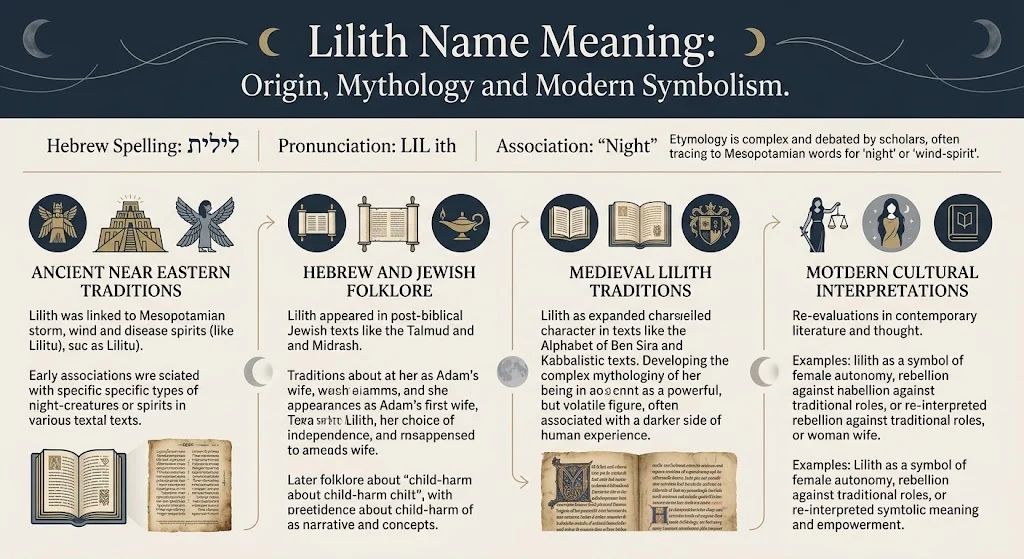
The lilith name meaning is commonly connected with “of the night” and an ancient night spirit. Its history spans Mesopotamian traditions, Jewish folklore, medieval mythology, literature, and modern culture, where Lilith can also symbolize independence, mystery, strength, and feminine autonomy.
lilith name meaning has a long and complicated history that reaches far beyond modern baby name lists. The name is linked to ancient Near Eastern traditions and later Jewish folklore. Over time, its meaning and symbolism changed across languages, texts, and cultures.
The name is written as לילית in Hebrew. It is commonly rendered in English as Lilith and pronounced approximately LIL ith.
However, one important detail deserves attention. Scholars do not agree on every part of the name’s earliest etymology. Some sources connect Lilith with Akkadian Lilith and related spirits. Others emphasize an association with Hebrew laylah, meaning “night.”
Therefore, a responsible explanation should avoid presenting one disputed etymology as absolute fact.
The name also carries a powerful mythological history. In later Jewish folklore, Lilith became associated with a story about Adam’s first wife. That story does not appear in the Hebrew Bible as a narrative about Adam’s wife. Instead, the famous version developed in later Jewish literature, especially medieval tradition.
Today, the name can sound mysterious, dramatic, literary, ancient, or unconventional. Its interpretation often depends on whether someone is discussing linguistics, mythology, religion, literature, astrology, entertainment, or baby naming.
QUICK ANSWER BOX
| Meaning | Context | Primary Platforms | Example | Tone |
| Often linked with “of the night” | Ancient language and mythology | Google, TikTok, Instagram | “What does Lilith mean?” | Curious |
| Ancient night spirit or demon | Mesopotamian and Jewish traditions | Reddit, forums, social media | “Lilith has a fascinating history.” | Mythological |
| Independence and autonomy | Modern cultural interpretation | TikTok, Instagram | “Lilith represents independence.” | Empowered |
| A feminine given name | Modern naming | Baby name sites, social media | “We chose Lilith for our daughter.” | Personal |
| A mythological figure | Literature and entertainment | Books, games, television | “Lilith appears in several fictional worlds.” | Cultural |
What Does Lilith Name Mean?
The simplest answer is that Lilith is traditionally associated with night, a night spirit, or a female supernatural being. Yet linguistic history is more complicated than a single dictionary definition suggests.
The ancient linguistic background
The name is commonly connected with the Akkadian term lilitu. Historical sources describe lilitu as a type of female supernatural being or night spirit. Related terminology appears in ancient Mesopotamian traditions.
Some explanations connect the name with words associated with night. However, other scholarly discussions question a simple direct connection between Lilith and the Hebrew word for night. The exact linguistic pathway remains debated.
That distinction matters because online baby name pages often simplify the history.
A simplified definition might say:
Lilith means “of the night.”
A more historically careful explanation would say:
Lilith is an ancient name associated with a supernatural female figure and has long been connected with night imagery.
The second explanation better reflects the complexity of the evidence.
Lilith in Jewish tradition
Lilith became increasingly prominent in Jewish folklore and later mystical traditions. Different texts portray her in different ways.
In some traditions, she appears as a dangerous female demon. In later medieval folklore, she becomes associated with Adam and the Garden of Eden.
The famous story describes Lilith as Adam’s first wife. According to that later legend, she refused to accept a subordinate position and left Eden. This story is associated particularly with the Alphabet of Ben Sira, a medieval Jewish text.
Importantly, this is not a story found in the Genesis account of Adam and Eve.
That distinction is essential when explaining the name accurately.
Is Lilith in the Bible?
The answer requires nuance.
The figure known from the later Adam and Lilith legend does not appear in the Hebrew Bible as Adam’s first wife. However, the Hebrew term lilit appears in Isaiah 34:14 in a passage describing creatures associated with a devastated landscape. Translators have interpreted the term in different ways.
Consequently, saying “Lilith is Adam’s first wife in the Bible” is inaccurate.
A better statement is:
Lilith is a figure from later Jewish folklore whose mythology developed around older Near Eastern traditions and a biblical term whose interpretation is debated.
Pronunciation and spelling
In contemporary American English, Lilith is usually pronounced approximately:
LIL ith
It has two syllables.
The Hebrew spelling is:
לילית
Related forms exist in other languages and cultures. For example, Lilit is an Armenian form of the name.
The spelling Lillith also appears occasionally. However, Lilith is the established spelling associated with the mythological figure.
Contextual Dynamics & Nuances of the Term
A name can carry different meanings depending on context. Lilith is a particularly strong example because its history crosses religion, mythology, literature, naming culture, and popular entertainment.
Historical context
In historical discussions, Lilith usually refers to a supernatural female figure connected with ancient Near Eastern and Jewish traditions.
The emphasis is therefore on mythology rather than personal identity.
For example:
“Lilith appears in later Jewish folklore.”
That sentence makes a historical claim.
Baby name context
In baby naming, the conversation changes.
Parents may encounter Lilith because they want a distinctive name with an ancient background. Some may focus on its associations with night, mystery, independence, or strength.
Others may avoid it because of its demonological associations.
Neither reaction changes the historical record. Instead, it shows how people interpret historical names differently.
Symbolic context
Modern interpretations sometimes use Lilith as a symbol of autonomy or resistance to traditional gender roles.
That interpretation has an identifiable modern history. Feminist writers and artists have reclaimed Lilith in ways that differ sharply from older demonological traditions.
Therefore, modern symbolic meanings should not automatically be projected backward onto ancient sources.
Literary context
Writers often use Lilith because the name already carries dramatic associations.
It can suggest:
| Association | Why it appears |
| Night | Longstanding connection with darkness and nocturnal spirits |
| Mystery | The figure has multiple traditions |
| Rebellion | Later legends emphasize refusal and independence |
| Danger | Older folklore portrays Lilith as threatening |
| Femininity | Lilith is consistently represented as female |
| Transformation | Modern works often reinterpret the myth |
The meaning therefore depends heavily on the speaker’s intention.
Real Life Conversation Examples Using lilith name meaning
Example 1: Asking about a baby name
Maya: We are considering Lilith for our daughter.
Jordan: That is beautiful. Do you know the history behind it?
Maya: I know it has something to do with night.
Jordan: Yes. It has ancient connections with supernatural night figures, although the exact etymology is debated.
Maya: I like the mysterious history.
This conversation treats the name as a naming choice rather than as a slang term.
Example 2: Asking about mythology
Alex: Who exactly was Lilith?
Sam: She is a figure connected with ancient Near Eastern and Jewish traditions.
Alex: Was she really Adam’s first wife?
Sam: That comes from later Jewish folklore. It is not the Genesis story.
Alex: That makes the history much more interesting.
Here, the important distinction is between biblical text and later folklore.
Example 3: Discussing symbolism
Nina: Why do people associate Lilith with independence?
Chris: Modern writers and artists have reinterpreted her as a symbol of autonomy.
Nina: So that is different from the older demon stories?
Chris: Exactly. The symbolism changed over time.
This is a useful example because it avoids treating one modern interpretation as the only meaning.
Example 4: Social media discussion
Taylor: I keep seeing people mention Lilith on TikTok.
Morgan: Are they talking about mythology?
Taylor: Usually. Some posts explain the name, while others use Lilith as a symbol of independence.
Morgan: So the meaning depends on the post.
Taylor: Pretty much.
That is often the safest way to understand social media references.
Example 5: Choosing a character name
Writer: I need a name for a mysterious female character.
Editor: What about Lilith?
Writer: What does it suggest?
Editor: It has associations with night, mythology, danger, and independence.
Writer: That fits the character perfectly.
In fiction, the name can deliberately evoke several historical layers at once.
Platform Specific Breakdown
The meaning of a historical name can shift when users discuss it on social platforms. Search behavior also affects which interpretation people encounter first.
How It Is Used on Snapchat
Snapchat conversations tend to be informal and personal.
Someone might mention Lilith while discussing:
| Situation | Possible meaning |
| A baby name | Interest in the name’s origin |
| A costume | A mythological or supernatural theme |
| A television character | A fictional reference |
| A friend’s name | Personal curiosity |
| A mythology post | Historical discussion |
If someone sends “Lilith?” in a message, context becomes important.
They could be asking about the person, the mythological character, or the name itself.
Therefore, a natural response might be:
“Do you mean the name or the mythology?”
That short question prevents unnecessary confusion.
The Role of lilith name meaning on TikTok
TikTok can compress complicated historical subjects into short explanations.
A creator may describe Lilith as meaning “of the night.” Another may focus on the Adam legend. A third may discuss feminist reinterpretations.
All three can be discussing different layers of the same cultural history.
However, short videos can blur the difference between established evidence and modern interpretation.
When a TikTok claims that a particular story comes directly from the Bible, it is worth checking the original textual context.
The safest approach is to separate:
Ancient evidence
Later folklore
Modern interpretation
Popular culture
That framework makes social media explanations easier to evaluate.
Instagram and Texting Dynamics
Instagram often presents names visually.
A user might post:
“Considering Lilith for our baby.”
Comments may then focus on pronunciation, mythology, symbolism, or personal associations.
Texting is usually even more contextual.
For example:
“I love Lilith.”
This could mean the person loves:
The name.
A fictional character.
A mythological figure.
A person named Lilith.
A symbolic interpretation.
Therefore, the surrounding conversation determines the intended meaning.
Alternative Meanings
Search engines and AI systems rarely interpret one phrase in isolation. They connect it with related concepts.
For this topic, common semantic variations include:
| Search variation | Likely intent |
| Lilith meaning | Basic definition |
| What does Lilith mean? | Direct answer |
| Lilith name origin | Etymology |
| Lilith Hebrew meaning | Language context |
| Lilith biblical meaning | Religious context |
| Lilith mythology | Historical research |
| Lilith baby name | Naming intent |
| Lilith symbolism | Cultural interpretation |
| Lilith pronunciation | Language intent |
| Lilith in Judaism | Religious and historical context |
| Lilith first wife of Adam | Folklore research |
| Lilith meaning in Hebrew | Linguistic research |
These variations should not be treated as identical queries.
For example, someone searching for “Lilith baby name” may want pronunciation and symbolism. Someone searching for “Lilith mythology” may want historical sources.
Semantic relationship with “night”
Night is one of the strongest associations surrounding the name.
Yet “night” should not be treated as a complete historical definition.
The name’s development involves ancient supernatural traditions, linguistic uncertainty, Jewish folklore, and later interpretation.
Semantic relationship with “demon”
The word “demon” frequently appears in descriptions of Lilith.
This reflects historical folklore. It does not mean that every modern use of the name carries a demonic intention.
A person can choose the name for its sound, literary history, cultural symbolism, or association with independence.
Semantic relationship with independence
Modern discussions frequently connect Lilith with independence.
That association largely comes from later reinterpretations of the Adam story and modern feminist readings.
It should therefore be presented as an interpretation rather than as the sole ancient definition.
Misinterpretations: When NOT to Use lilith name meaning
Some statements about Lilith appear frequently online but require qualification.
Do not call the Adam story a biblical story
The Genesis narrative describes Adam and Eve. It does not tell the later folklore story in which Lilith becomes Adam’s first wife.
That legend developed in later Jewish literature.
Do not present “of the night” as an uncontested etymology
Many naming sources use this translation.
However, historical and linguistic sources discuss competing explanations. Some connect the name to Akkadian supernatural beings rather than treating it as a straightforward Hebrew word meaning “night.”
Do not assume every modern use is religious
A person named Lilith may simply like the sound of the name.
A fictional character may use it for atmosphere.
A social media user may use it as a symbolic reference.
Context matters.
Do not treat modern symbolism as ancient doctrine
Modern ideas about female autonomy can be meaningful cultural interpretations.
However, they belong to later reinterpretations of the figure.
Historical descriptions should remain separate from modern symbolism.
How to Respond in Chat Comfortably
When someone asks about Lilith, the best response depends on what they actually want to know.
If they ask about the name
You can say:
“Lilith is an ancient name associated with night spirits and Jewish folklore. Its exact linguistic origin is debated.”
That answer is short but accurate.
If they ask whether it is a biblical name
You can say:
“The name appears in a debated passage in Isaiah, but the famous story about Lilith as Adam’s first wife comes from later Jewish folklore, not Genesis.”
This provides useful context without overcomplicating the conversation.
If they ask whether the name is negative
A balanced answer works better:
“It has older associations with supernatural beings, but modern people also use Lilith as a name connected with independence, mystery, and mythology.”
That approach recognizes both historical and modern meanings.
If someone says they want to name their child Lilith
Avoid assuming their motivation.
Instead, explain the associations:
| Consideration | Context |
| Pronunciation | Usually LIL ith |
| History | Ancient Near Eastern and Jewish traditions |
| Folklore | Strong association with Lilith mythology |
| Modern symbolism | Often connected with independence |
| Popular culture | Frequently used in fiction and entertainment |
| Religious sensitivity | Some people may recognize the demonological associations |
The final naming decision belongs to the family.
If someone sends only “Lilith?”
Ask for context.
A simple response works:
“Do you mean the name, the mythology, or a character?”
That is clearer than guessing.
FAQs
1. What does the lilith name’s meaning refer to?
It refers to the meaning and historical associations of the name Lilith. The name is connected with ancient supernatural traditions and is often associated with night. However, its precise etymology remains debated.
2. Is Lilith a Hebrew name?
Lilith appears in Hebrew as לילית. However, describing it as purely Hebrew in origin can oversimplify its much older Near Eastern linguistic and mythological background.
3. Is Lilith actually in the Bible?
A related Hebrew term appears in Isaiah 34:14, but the later story of Lilith as Adam’s first wife is not part of Genesis. That narrative comes from later Jewish folklore.
4. What does Lilith symbolize today?
Modern interpretations can associate Lilith with independence, autonomy, mystery, feminine power, and resistance to traditional expectations. These are later cultural interpretations rather than one universal historical definition.
5. Is Lilith a demon?
In several historical traditions, Lilith is described as a female supernatural being or demon. However, modern uses of the name can be completely secular, literary, artistic, or personal.
6. Is Lilith a good baby name?
Whether the name works for a family depends on personal preference and cultural context. Parents may appreciate its distinctive sound and ancient history, while others may consider its supernatural associations important.
7. How do you pronounce Lilith?
In common American English, Lilith is generally pronounced LIL ith, with two syllables.
8. Is Lillith the same name?
Usually, Lillith is treated as a spelling variation of Lilith. The standard spelling associated with the mythological figure is Lilith.
9. Why is Lilith associated with independence?
The association comes largely from later versions of the Adam legend. In the medieval story, Lilith refuses to accept subordination and leaves Adam. Modern writers later developed that theme into broader ideas about autonomy and independence.
10. Is Lilith a common slang word?
No. Lilith is primarily a personal name and mythological reference. Online users may use it symbolically, but it is not a standard English slang term with one fixed meaning.
Conclusion:
The history behind the lilith name’s meaning is far richer than a single translation.
The name connects ancient Near Eastern traditions with Jewish folklore, medieval storytelling, literature, and modern culture. Its history also demonstrates how names can change meaning as they move between languages and generations.
The phrase “of the night” remains a common explanation. However, responsible researchers should acknowledge that linguistic history is debated. Sources differ on whether the name should be directly connected with words for night or primarily understood through older supernatural terminology.
The famous image of Lilith as Adam’s first wife also requires historical context. That story belongs to later Jewish folklore rather than the Genesis account itself.
Modern culture has added another layer.
Today, Lilith can represent mythology, mystery, independence, feminine autonomy, darkness, literature, fantasy, or simply a distinctive personal name. The intended meaning depends on context.
That flexibility explains why the name continues to attract attention.
For researchers, Lilith offers a case study in linguistic evolution.
For parents, it offers an ancient name with strong cultural associations.
For writers, it provides an instantly recognizable mythological reference.
For social media users, it can become a compact symbol carrying several meanings at once.
Ultimately, understanding Lilith requires separating ancient language, historical folklore, later religious tradition, and modern interpretation.
That distinction makes the name easier to understand and prevents popular internet summaries from turning a complex history into a single oversimplified definition.
