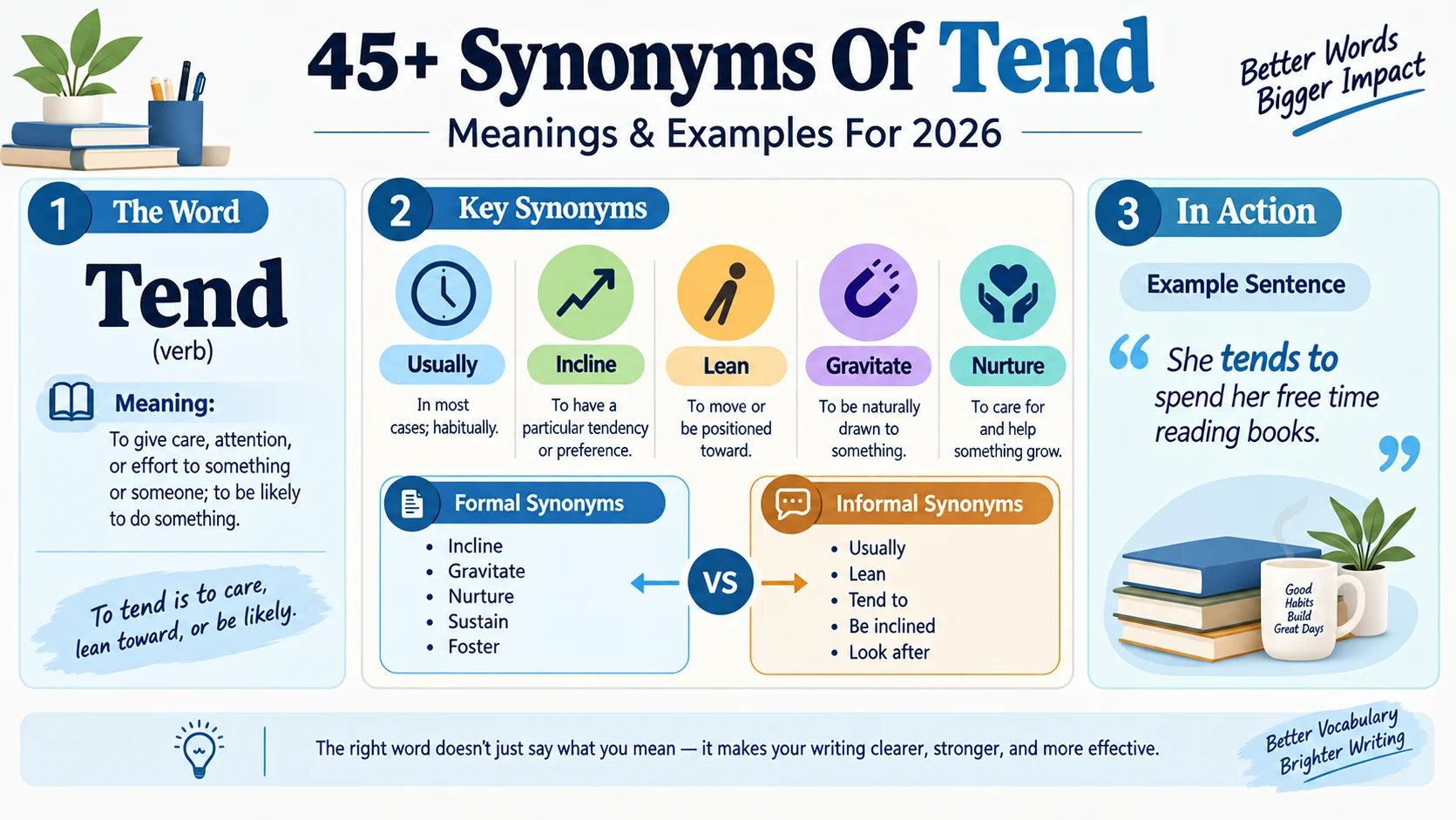
“Tend” means to be likely to do something or to usually behave in a certain way. It also means to care for or manage something. The best synonyms depend on context. For likelihood, use incline, lean, or gravitate. For caring, use nurture, manage, or oversee.
Meaning, Tone and Context
The word “tend” is a versatile verb with two main meanings. Its core function is to describe a habitual action or to describe the act of caring for something. The tone is generally neutral, but it can shift depending on the specific meaning and the synonym you choose.
1. Simple Definition: Tend means to frequently or likely do something, or to care for and manage something or someone.
2. Part of Speech: Tend is primarily a verb.
- Verb (likelihood): “She tends to arrive early.”
- Verb (caring): “He tends to the garden every morning.”
3. Tone: The tone is usually neutral. It can be positive when describing care and nurturing. It can be neutral when describing habits or tendencies.
4. Formality: “Tend” is a neutral word. It is appropriate for both casual conversation and professional writing. For very formal contexts, you might use “incline” or “exhibit a tendency.”
5. Common Use Cases: You will encounter “tend” in many situations.
- Describing Habits: “I tend to drink coffee in the morning.”
- Describing Likelihood: “Prices tend to rise during the holidays.”
- Caring for Others: “She tends to her elderly parents.”
- Managing Tasks: “He tends to his duties without complaint.”
6. Important Word Forms:
- Verb: tend, tends, tended, tending. “She tends the garden.”
- Noun: tendency. “He has a tendency to be late.”
- Noun: tender. “The tender of the garden was his responsibility.”
- Adjective: tending. “The tending nurse was very kind.”
When and How to Use “Tend”
Knowing when to use “tend” is about understanding its two main meanings. It can describe a habit or the act of caring. Here are several scenarios where it is the perfect choice.
- Academic Context: To describe patterns or general trends.
Example: “Studies show that students tend to perform better when they get enough sleep.” - Professional Context: To describe typical behavior or outcomes.
Example: “In our experience, clients tend to prefer the premium package.” - Personal Context: To describe your own habits.
Example: “I tend to be shy when I meet new people.” - Casual Conversation: To describe common occurrences.
Example: “People tend to eat more during the winter months.” - Creative Writing: To describe a character’s habits.
Example: “He tended to his roses with great care.” - Email Context: To describe a common outcome politely.
Example: “Emails tend to get lost in spam folders, so please follow up.” - Resume Context: To describe your responsibilities.
Example: “Tended to customer inquiries and resolved issues promptly.” - Storytelling Context: To describe care and attention.
Example: “She tended the fire throughout the cold night.”
Another Word for “Tend”
Choosing the best replacement for “tend” depends entirely on the context. Here are the most effective alternatives categorized by use.
- Professional Writing: “Incline” or “demonstrate a tendency.” “Our data indicates that customers incline toward eco friendly products.”
- Academic Writing: “Exhibit a tendency” or “are likely to.” “Children exhibit a tendency to imitate adult behavior.”
- Casual Conversation: “Usually” or “often.” “I usually drink tea in the afternoon.”
- Emotional Writing: “Lean” or “gravitate.” “She leans toward optimism even in hard times.”
- Creative Writing: “Nurture” or “cultivate.” “He nurtured the young plants with patience.”
- Resume or Workplace: “Manage” or “oversee.” “Managed daily operations and oversaw staff schedules.”
- Social Media Captions: “Always” or “tend to.” “I always tend to overthink things.”
- Stronger Meaning: “Have a propensity for.” “He has a propensity for taking risks.”
- Softer Meaning: “May” or “might.” “She may arrive late.”
When Not to Use “Tend”
While “tend” is a versatile word, it can be too vague in certain situations. Using a more precise synonym can improve clarity and impact.
- When You Need Specificity: If you are talking about a specific habit, use a more precise word. “He tends to be late” is vague. “He is always late” is much clearer.
- When Discussing Frequency: “Tend” is general. “I tend to exercise” is less specific than “I exercise three times a week.”
- When Describing Strong Habits: “Tend” is weak. “She tends to interrupt” is softer than “She constantly interrupts.”
Example of Precision: Compare these two sentences.
- Vague: “He tends to be forgetful.”
- Precise: “He frequently forgets appointments.”
The second sentence is more specific and provides a clearer picture of the behavior.
Words Commonly Confused With “Tend”
Understanding the differences between these related words will significantly refine your English.
- Tend vs. Incline: “Tend” is a general word for habits and likelihood. “Incline” is more formal and suggests a slight preference or leaning. You tend to do something regularly, but you incline toward a belief or choice.
- Tend vs. Lean: “Lean” is similar to “incline” but often used in business or decision making contexts. “The committee leans toward approval.” It suggests a directional preference.
- Tend vs. Gravitate: “Gravitate” suggests a natural, almost magnetic attraction. “People gravitate toward leaders who listen.” It is more emotional and less about habit.
- Tend vs. Care For: “Tend” can mean to care for something, but “care for” is more personal and emotional. You tend a garden, but you care for a loved one.
- Tend vs. Manage: “Manage” is about organization and control. “Tend” is about giving attention and care. You manage a team, but you tend a garden.
- Tend vs. Usually: “Usually” is an adverb, not a verb. It describes frequency. “Tend” describes a tendency. “I usually walk” and “I tend to walk” mean similar things, but the grammar is different.
Best Synonym by Context for “Tend”
| Context | Best Synonym | Why It Works | Example |
|---|---|---|---|
| Formal Writing | Incline | It sounds sophisticated and precise. | “Customers incline toward premium products.” |
| Academic Writing | Exhibit a tendency | It is precise and research oriented. | “Children exhibit a tendency to mimic peers.” |
| Professional/Business | Demonstrate a pattern | It is data driven and professional. | “Our data demonstrates a pattern of seasonal demand.” |
| Resume | Manage | It highlights leadership and responsibility. | “Managed daily operations and staff schedules.” |
| Casual Conversation | Usually | It is simple and natural. | “I usually take the bus to work.” |
| Creative Writing | Nurture | It adds warmth and care. | “She nurtured the young seedlings.” |
| Emotional Tone | Gravitate | It suggests a natural attraction. | “He gravitates toward creative work.” |
| Strong Intensity | Have a propensity for | It is formal and emphasizes a strong tendency. | “He has a propensity for risk taking.” |
| Soft/Moderate Tone | May | It is gentle and non committal. | “She may arrive later than expected.” |
| Social Media Captions | Always | It is simple and relatable. | “I always tend to overthink things.” |
| US/UK Usage | Tend (both) | Both dialects use “tend” commonly. | US: “I tend to agree.” UK: “I tend to agree.” |
Which Synonym Should You Choose?
Choosing the right word can seem difficult, but this simple guide will help you decide. It is all about matching the word to your goal, audience, and the message you want to send.
- Is your goal to describe a habit? Use “usually,” “often,” or “typically.” These are simple and clear.
- Is your goal to describe a preference or leaning? Use “incline,” “lean,” or “gravitate.” These are more formal and precise.
- Is your goal to describe care or management? Use “nurture,” “manage,” or “oversee.” These are specific to responsibility.
- Are you writing for an academic audience? Use “exhibit a tendency” or “demonstrate a pattern.” These sound research oriented.
- Are you writing for social media? Use “always” or “tend to.” These are casual and engaging.
- Do you want to emphasize a strong tendency? Use “have a propensity for” or “constantly.” Be careful with these, as they are strong.
Real Life Examples of “Tend” in Sentences
Here are examples of how “tend” and its stronger synonyms can be used in different real world scenarios.
- School: “Students tend to do better when they review their notes regularly.” Stronger: “Students exhibit a tendency to perform better when they review notes regularly.”
- Workplace: “Managers tend to delegate tasks to their team.” Stronger: “Managers typically delegate tasks to their team.”
- Writing: “The author tends to use vivid imagery in her novels.” Stronger: “The author leans toward vivid imagery in her novels.”
- Conversation: “I tend to forget names quickly.” Stronger: “I usually forget names quickly.”
- Social Media: “People tend to share happy moments online.” Stronger: “People often share happy moments online.”
- Resume: “Tended to customer needs and resolved complaints.” Stronger: “Managed customer relations and resolved complaints.”
- Email: “We tend to receive more inquiries on Mondays.” Stronger: “We typically receive more inquiries on Mondays.”
- Storytelling: “She tended the fire while the storm raged outside.” Stronger: “She nurtured the fire while the storm raged outside.”
45Synonyms for “Tend”
The following table lists 25 accurate and practical synonyms for “tend.
| Synonym | Simple Meaning | Best Used For | Example Sentence |
|---|---|---|---|
| Usually | In most cases. | Casual, general. | “I usually walk to work.” |
| Often | Frequently. | Casual, general. | “She often reads before bed.” |
| Typically | In a typical manner. | Professional, academic. | “Customers typically prefer fast service.” |
| Generally | In most cases. | Formal, academic. | “People generally agree on this point.” |
| Incline | To have a preference. | Formal, professional. | “He inclines toward conservative investments.” |
| Lean | To have a preference. | Business, decision making. | “The board leans toward approval.” |
| Gravitate | To be naturally attracted. | Emotional, social. | “Children gravitate toward playful activities.” |
| Nurture | To care for and encourage growth. | Creative, emotional. | “She nurtured her students with patience.” |
| Manage | To be in charge of. | Professional, resume. | “He manages a team of ten people.” |
| Oversee | To supervise. | Professional, resume. | “She oversees the entire department.” |
| Care for | To look after. | Personal, emotional. | “He cares for his elderly parents.” |
| Look after | To take care of. | Casual, personal. | “Can you look after my dog this weekend?” |
| Attend to | To deal with. | Formal, professional. | “The nurse attended to the patient.” |
| Watch over | To protect and supervise. | Emotional, personal. | “The shepherd watched over the flock.” |
| Cultivate | To grow and improve. | Creative, agricultural. | “He cultivates rare orchids.” |
| Foster | To encourage development. | Professional, academic. | “The program fosters creativity in children.” |
| Have a tendency | To be likely to do something. | Formal, academic. | “He has a tendency to exaggerate.” |
| Exhibit a tendency | To show a pattern. | Academic, research. | “The data exhibits a tendency toward growth.” |
| Demonstrate a pattern | To show a repeated behavior. | Professional, data. | “Sales demonstrate a pattern of seasonal spikes.” |
| Are likely to | To be probable. | General, formal. | “Prices are likely to rise.” |
| Have a propensity for | To have a strong natural tendency. | Formal, academic. | “He has a propensity for taking risks.” |
| Be prone to | To be likely to suffer from. | Medical, formal. | “She is prone to headaches.” |
| Be apt to | To be likely to. | Formal, slightly old fashioned. | “He is apt to forget details.” |
| Be disposed to | To be inclined to. | Very formal. | “She is disposed to agree with the proposal.” |
| Be given to | To have a habit of. | Formal, literary. | “He is given to long walks at dawn.” |
Synonym Groups and Usage Differences
Professional vs. Personal Synonyms
In a professional setting, like a business report or a resume, choose “typically,” “manage,” or “oversee.” These words sound polished and appropriate. In a personal setting, “usually,” “often,” or “care for” are more natural and friendly. For example, you would write “Customers typically prefer…” in a report, but say “I usually prefer…” to a friend.
Formal vs. Conversational Synonyms
Formal Synonyms: “Incline,” “exhibit a tendency,” and “have a propensity for” are perfect for academic papers, legal documents, or formal speeches.
Conversational Synonyms: “Usually,” “often,” and “tend to” are the best choices for everyday conversations and emails to friends.
Academic Synonyms
In essays and research papers, “exhibit a tendency” and “demonstrate a pattern” are powerful and precise terms. “Are likely to” is also useful for describing probable outcomes. These words sound research oriented and objective.
Professional and Business Synonyms
“Typically” is a safe and professional choice for almost any workplace communication. “Manage” and “oversee” are effective for describing responsibilities. “Demonstrate a pattern” is great for data analysis.
Creative or Literary Synonyms
These words add a layer of artistry to your descriptions.
- Nurture: Suggests care, growth, and patience.
- Cultivate: Evokes a sense of deliberate care and improvement.
- Watch over: Suggests protection and guardianship.
Slang or Modern Synonyms
Always” is a modern and casual synonym. It is acceptable in social media captions and informal writing. It should be avoided in formal academic writing where “typically” or “generally” is more appropriate.
Strongest vs. Weaker Synonyms
Here is an intensity scale from mild to strongest:
- May, Might: Very mild, suggesting possibility.
- Usually, Often: Mild, describing frequency.
- Tend to, Incline: Moderate, describing a tendency.
- Have a propensity for, Be prone to: Strong, suggesting a deep seated tendency.
- Constantly, Always: Strongest, suggesting a consistent behavior.
Emotional vs. Neutral Synonyms
Emotional Synonyms: “Nurture,” “gravitate,” and “care for” carry emotional weight, suggesting warmth and personal connection.
Neutral Synonyms: “Typically,” “usually,” and “generally” are factual and free of emotional charge.
Antonyms of “Tend”
Here are 15 clear antonyms for “tend,” which are words that mean the opposite: to avoid, neglect, or act inconsistently.
| Antonym | Meaning | Example Sentence |
|---|---|---|
| Avoid | To keep away from. | “He avoids crowded places.” |
| Neglect | To fail to care for. | “She neglected her health for years.” |
| Ignore | To pay no attention to. | He ignored the warning signs.” |
| Disregard | To pay no attention to. | “She disregarded the advice of her doctor.” |
| Shun | To deliberately avoid. | “He shunned social gatherings.” |
| Abandon | To leave completely. | “They abandoned the project.” |
| Forsake | To renounce or give up. | “He forsook his old habits.” |
| Refrain | To stop oneself from doing something. | “She refrained from commenting.” |
| Abstain | To choose not to do something. | “He abstains from alcohol.” |
| Resist | To oppose or withstand. | “She resisted the urge to interrupt.” |
| Seldom | Rarely. | “He seldom visits his hometown.” |
| Rarely | Not often. | “She rarely eats meat.” |
| Never | Not at any time. | “He never arrives on time.” |
| Inconsistently | In an unpredictable way. | “He performs inconsistently.” |
| Irregularly | Not regularly. | “She exercises irregularly.” |
Comparison: “Tend” vs. Similar Words
Tend vs. Incline
Main Difference: “Tend” is a general word for habits and likelihood. “Incline” is more formal and suggests a slight preference or leaning.
Which One Is Stronger: “Incline” is more formal and specific.
Which One Is More Formal: “Incline” is more formal.
Example Sentence with Tend: “She tends to arrive early.”
Example Sentence with Incline: “She inclines toward early arrival.”
Tend vs. Lean
Main Difference: “Lean” is similar to “incline” but often used in business or decision making contexts. It suggests a directional preference.
Which One Is Stronger: “Lean” is more decisive.
Which One Is More Formal: Both are formal, but “lean” is more common in business.
Example Sentence with Tend: “The committee tends to approve such requests.”
Example Sentence with Lean: “The committee leans toward approval.”
Tend vs. Gravitate
Main Difference: “Gravitate” suggests a natural, almost magnetic attraction. It is more emotional and less about habit.
Which One Is Stronger: “Gravitate” is more emotional and descriptive.
Which One Is More Formal: “Gravitate” is neutral.
Example Sentence with Tend: “People tend to gather in the square.”
Example Sentence with Gravitate: “People gravitate toward the lively square.”
Tend vs. Care For
Main Difference: “Tend” can mean to care for something, but “care for” is more personal and emotional. You tend a garden, but you care for a loved one.
Which One Is Stronger: “Care for” is more personal and emotional.
Which One Is More Formal: Both are neutral, but “care for” is more intimate.
Example Sentence with Tend: “He tends the garden every morning.”
Example Sentence with Care For: “He cares for his elderly mother.”
Tend vs. Manage
Main Difference: “Manage” is about organization and control. “Tend” is about giving attention and care. You manage a team, but you tend a garden.
Which One Is Stronger: “Manage” is more authoritative.
Which One Is More Formal: Both are professional, but “manage” is more common in business.
Example Sentence with Tend: “She tends to the needs of her patients.
Example Sentence with Manage: “She manages a team of ten nurses.”
Tend vs. Usually
Main Difference: “Usually” is an adverb, not a verb. It describes frequency. “Tend” describes a tendency.
Which One Is Stronger: They are similar in meaning, but “usually” is simpler.
Which One Is More Formal: “Usually” is neutral.
Example Sentence with Tend: “I tend to walk to work.”
Example Sentence with Usually: “I usually walk to work.”
Common Phrases and Expressions with “Tend”
1. Tend to
Meaning: To usually do something or to care for something.
Example Sentence: “I tend to wake up early on weekends.”
2. Tend toward
Meaning: To have a preference for something.
Example Sentence: “He tends toward minimalist design.”
3. Tend the garden
Meaning: To care for a garden.
Example Sentence: “She tends the garden every Saturday morning.”
4. Tend bar
Meaning: To work as a bartender.
Example Sentence: “He tends bar at a local restaurant.”
5. Tend to business
Meaning: To focus on important matters.
Example Sentence: “Let us tend to business before we relax.”
6. Tend to one’s needs
Meaning: To care for someone’s requirements.
Example Sentence: “The nurse tended to the patient’s needs.”
7. Tend a fire
Meaning: To keep a fire burning.
Example Sentence: “He tended the fire throughout the night.”
8. Tend to agree
Meaning: To mostly agree.
Example Sentence: “I tend to agree with your assessment.”
Common Mistakes to Avoid
1. Using “Tend” When a More Precise Synonym Is Better
Mistake: “He tends to be late.”
Better: “He is frequently late.” This is more specific and direct.
2. Confusing “Tend” with “Incline”
Mistake: “I tend toward the blue option.”
Better: “I incline toward the blue option.” “Incline” is more appropriate for preferences.
3. Using a Casual Synonym in Formal Writing
Mistake: “The report says customers always buy premium.”
Better: “The report indicates customers typically buy premium.” “Always” is too absolute for formal writing.
4. Using an Overly Dramatic Synonym for a Simple Situation
Mistake: “She has a propensity for forgetting her keys.”
Better: “She often forgets her keys.” “Propensity” is too formal for a simple habit.
5. Repeating the Same Word Too Often
Mistake: “He tends to be late. She tends to be early. They tend to be on time.”
Better: “He tends to be late. She is usually early. They are typically on time.” This variation makes the writing more engaging.
6. Choosing a Synonym with the Wrong Emotional Tone
Mistake: “I nurture my email inbox every morning.”
Better: “I manage my email inbox every morning.” “Nurture” is for living things, not inboxes.
7. Using Slang in Academic or Professional Writing
Mistake: “The data shows people always do this.”
Better: “The data indicates people typically do this.” “Always” is too casual and absolute for academic writing.
FAQs
1. What is the best synonym for tend?
The best synonym depends on your context.
2. What is a formal synonym for tend?
A formal synonym for tend is “incline” or “exhibit a tendency.” Both are appropriate for formal writing and professional communication.
3. What is an informal synonym for tend?
An informal synonym for tend is “usually” or “often.” These words are perfect for everyday conversation and friendly emails.
4. What is another word for tend in professional writing?
In professional writing, “typically” is an excellent choice. “Demonstrate a pattern” is also effective when discussing data. “Manage” is useful for describing responsibilities.
5. What is the difference between tend and incline?
“Tend” is a general word for habits and likelihood. “Incline” is more formal and suggests a slight preference or leaning. You tend to do something regularly, but you incline toward a belief or choice.
6. What is the opposite of tend?
The opposite of tend is “avoid,” “neglect,” or “rarely.” These words describe a lack of tendency or a failure to care for something.
Conclusion
The word “tend” is a simple but versatile verb. It can describe a habit, a likelihood, or the act of caring for something. Choosing the right synonym depends entirely on your context, audience, and the tone you wish to convey.
For a professional setting, “typically” or “manage” work well. For a formal academic context, “incline” or “exhibit a tendency” are excellent choices. In casual conversation, “usually” or “often” are natural and friendly. For creative writing, “nurture” or “cultivate” add a literary touch.
The best advice is to think about your purpose and your audience before you choose a word. Do you want to be specific, professional, casual, or creative? Matching your word to your intention will make your communication more effective and your English more precise.
A practical vocabulary tip: Try replacing “tend” with a more specific synonym in your writing this week. If you are describing a habit, use “usually.” If you are describing a preference, use “incline.” This small change will significantly improve the clarity and sophistication of your English.
