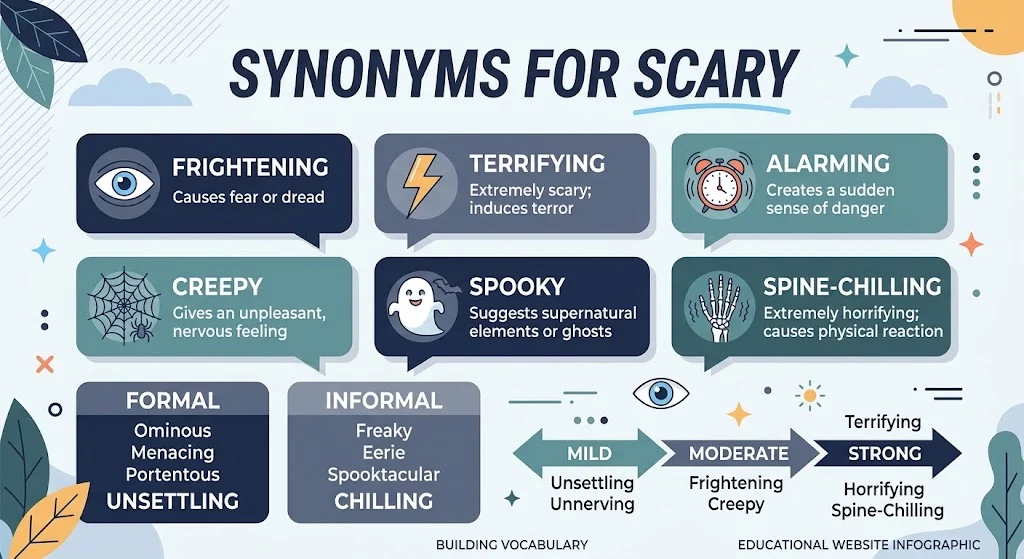
“Scary” is an adjective that describes something or someone that causes fear, alarm, or unease . For a professional setting, choose “alarming.” For casual conversation, go with “spooky” or “creepy.” In academic writing, “disturbing” or “unsettling” works best. For a stronger, more emotional impact, use “terrifying.”
Meaning, Tone and Context
Understanding the core meaning and tone of “scary” helps you choose the right substitute.
- Simple Definition: Causing fear or fright . If you feel afraid because of something, that thing is scary .
- Part of Speech: Adjective.
- Tone: Generally negative. “Scary” evokes feelings of unease, anxiety, or terror.
- Formality Level: Informal to neutral. “Scary” is acceptable in many contexts but is often seen as too casual for professional or academic writing .
- Common Use Cases: Describing movies, situations, people, news, or experiences that cause fear.
- Important Word Forms: The noun is “scare,” and the verb is also “to scare.” “Scared” is the past tense and the feeling you get from a scary thing .
When and How to Use “Scary”
The word “scary” should be used when you need a general, widely understood term for something that causes fear. It works best in informal situations, like talking to friends or posting on social media. For more formal contexts, consider a more precise synonym.
Here are some realistic examples:
- Professional Context: “The quarterly report revealed some scary trends in customer satisfaction.” (Could be improved to “alarming.”)
- Personal Context: “Walking home alone last night was a little bit scary.”
- Academic Context: “The novel explores the scary reality of a dystopian future.” (Could be improved to “disturbing.”)
- Creative Context: “The protagonist in the story had a scary realization about his past.” (Could be improved to “harrowing.”)
- Social Media Caption: “Just finished a scary movie and now I can’t sleep! 😱”
- Casual Conversation: “It was so scary when the roller coaster stopped at the top.”
- Another Word for “Scary”
The best synonym for “scary” depends completely on the context. Here are the best replacements, broken down by situation.
- Professional Writing: Alarming. “The sudden drop in sales was alarming.”
- Academic Writing: Disturbing. “The study presented disturbing evidence about pollution.”
- Casual Conversation: Spooky. “That old house on the corner is so spooky.”
- Emotional Writing: Frightening. “The thought of losing her job was frightening.”
- Creative Writing: Eerie. “An eerie silence fell over the forest.”
- Stronger Meaning: Terrifying. “The monster in the movie was terrifying.”
- Softer Meaning: Unsettling. “His comment was a bit unsettling.”
- When Not to Use “Scary”
Using “scary” in the wrong context can make you sound unprofessional, childish, or vague.
- Example of Vague Use: “The financial situation is scary.” (Better: “The financial situation is precarious.”)
- Example of Too Casual: “Our new competitor is scary.” (Better: “Our new competitor is formidable.”)
- Example of Too Weak: “The effects of climate change are scary.” (Better: “The effects of climate change are alarming.”)
- Example of Too General: “That was a scary movie.” (Better: “That was a horrifying movie.”)
- Words Commonly Confused With “Scary”
Many words describe fear, but each has a specific nuance. Here is how they compare to “scary.”
- Scary vs. Frightening: “Frightening” suggests a deeper, more sustained fear, while “scary” is often used for a quick, sharp shock . A jump scare is “scary,” while the underlying suspense of a film is “frightening.”
- Scary vs. Terrifying: “Terrifying” is much stronger. It implies an overwhelming fear that can leave you feeling paralyzed . A scary movie might make you yelp; a terrifying one makes you hide behind a cushion.
- Scary vs. Creepy: “Creepy” involves a sense of unease or disgust, often feeling unnatural. “Scary” is a more direct fear . A haunted house is scary; a clown standing silently in a dark room is creepy.
- Scary vs. Alarming: “Alarming” means a warning of danger. It is more formal and intellectual. “Scary” is an emotional reaction. An alarming report suggests a problem; a scary event causes fear.
- Scary vs. Spooky: “Spooky” is more playful and suggests a supernatural element, often used around Halloween. “Scary” is a general term for fear. A ghost story is spooky; an actual threat is scary.
- Scary vs. Intimidating: “Intimidating” means causing you to feel less confident or fearful, often related to a person or challenge. A difficult exam is intimidating; a horror film is scary.
- Best Synonym by Context for “Scary”
This table gives you the single best word to use in various situations, with a clear reason why and a sample sentence.
| Context | Best Synonym | Why It Works | Example |
|---|---|---|---|
| Formal Writing | Alarming | It conveys concern in a professional tone. | The alarming economic data caused stocks to fall. |
| Academic Writing | Disturbing | It describes a troubling finding or trend. | The study presented disturbing evidence about pollution. |
| Professional Use | Daunting | It describes a challenging task or project. | The project seemed like a daunting challenge for the new team. |
| Casual Conversation | Spooky | It’s a lighthearted and common word for fear. | That old house on the corner is so spooky. |
| Creative Writing | Eerie | It creates an atmosphere of mystery and unease. | An eerie silence fell over the abandoned mansion. |
| Emotional Tone | Frightening | It describes a feeling of deep, personal fear. | The thought of losing her job was frightening. |
| Strong Intensity | Terrifying | It suggests an overwhelming and paralyzing fear. | Being lost in the woods at night was terrifying. |
| Soft/Moderate Tone | Unsettling | It suggests a mild but persistent sense of unease. | His strange comment made everyone feel a bit unsettled. |
| Social Media Captions | Creepy | It is a popular, casual term for something odd. | That new statue in the park is a little bit creepy. |
| US/UK Usage | Frightening | “Frightening” is the most direct synonym in both varieties. | The news from the hurricane was frightening. |
- Which Synonym Should You Choose?
Choosing the right word is simple if you ask yourself a few questions.
- Who is your audience? Is this a report for your boss, a text to a friend, or a letter to a professor? If it is professional, lean toward formal synonyms like “alarming.” For a friend, “spooky” or “creepy” is perfect.
- What is the emotional intensity? Are you describing a mild feeling of unease or a moment of pure terror? For mild, use “unsettling.” For maximum fear, use “terrifying” .
- What is the source of fear? Is it a monster, a social situation, or a potential threat? A monster is “horrifying,” a social situation can be “intimidating,” and a potential threat is “alarming.”
- Real Life Examples of “Scary” in Sentences
See these synonyms in action across different real-world situations.
- School: “The amount of homework this weekend was truly alarming.” (Instead of “scary”)
- Workplace: “His boss had an intimidating presence in the office.” (Instead of “scary”)
- Writing: “The novel’s unsettling atmosphere kept me reading.” (Instead of “scary”)
- Conversation: “I felt a bit spooked walking through the dark parking lot.” (Instead of “scary”)
- Email: “The manager was impressed by how I handled the daunting task.” (Instead of “scary”)
- Storytelling: “The eerie sound of footsteps echoed in the empty hallway.” (Instead of “scary”)
- 25 Synonyms for “Scary”
Here is a list of 25 accurate synonyms for “scary” with their meanings and usage.
Synonym Groups and Usage Differences
Professional vs. Personal Synonyms
In a professional context, you need words that convey importance without being dramatic. Words like “alarming,” “daunting,” and “intimidating” are perfect . In personal contexts, “scary,” “spooky,” and “creepy” are fine.
Formal vs. Conversational Synonyms
For formal writing (essays, reports), use “disturbing,” “alarming,” or “disquieting.” For conversational writing (texts, casual emails), use “scary,” “spooky,” or “creepy.”
Academic Synonyms
In academic writing, precision is key. “Disturbing,” “alarming,” and “unsettling” are strong choices. “Terrifying” and “horrifying” are often too emotional for this context.
Professional and Business Synonyms
In the workplace, describe challenges as “daunting,” risks as “alarming,” and competitors as “formidable” or “intimidating.”
Creative or Literary Synonyms
Creative writing thrives on vivid imagery. Use “eerie,” “macabre,” “ominous,” “harrowing,” or “ghastly” to paint a powerful picture .
Slang or Modern Synonyms
Words like “creepy,” “spooky,” and “freaky” are common in modern casual speech. They are acceptable with friends but should be avoided in professional writing.
Strongest vs. Weaker Synonyms
Intensity Scale (Mild to Strongest):
Unsettling -> Unnerving -> Frightening -> Terrifying -> Horrifying
Emotional vs. Neutral Synonyms
Emotional synonyms like “terrifying” and “horrifying” describe the feeling of fear. Neutral synonyms like “alarming” and “daunting” describe the situation objectively .
Antonyms of “Scary”
Here are 15 antonyms or near-antonyms that mean the opposite of scary.
Comparison: Scary vs. Similar Words
- Scary vs. Alarming
- Main Difference: “Alarming” is more formal and intellectual. “Scary” is more emotional and personal.
- Which is Stronger? “Alarming” is typically stronger in a professional context.
- Which is More Formal? “Alarming” is more formal.
- Example with Scary: “It’s scary to think we might lose our jobs.” (Casual)
- Example with Alarming: “The job loss statistics are alarming.” (Professional)
- Scary vs. Daunting
- Main Difference: “Daunting” describes a challenging task or person. “Scary” describes anything that causes fear.
- Which is Stronger? “Daunting” is stronger in describing a challenge.
- Which is More Formal? “Daunting” is more formal.
- Example with Scary: “The exam was scary.” (General fear)
- Example with Daunting: “The exam was a daunting prospect.” (A challenging task)
- Scary vs. Terrifying
- Main Difference: “Terrifying” is much more extreme and implies a paralyzing fear .
- Which is Stronger? “Terrifying” is much stronger.
- Which is More Formal? Neither is highly formal, but “terrifying” is more descriptive.
- Example with Scary: “The movie was scary.” (Casual)
- Example with Terrifying: “The thought of failing was terrifying.” (Intense)
- Scary vs. Creepy
- Main Difference: “Creepy” involves unease and a sense of something being “off.” “Scary” is more direct and intense fear .
- Which is Stronger? “Scary” is generally stronger.
- Which is More Formal? Neither is formal.
- Example with Scary: “The dark alley looked scary.” (Fearful)
- Example with Creepy: “The abandoned doll had a creepy smile.” (Unnatural)
- Scary vs. Spooky
- Main Difference: “Spooky” is more playful and often suggests the supernatural.
- Which is Stronger? “Scary” is stronger.
- Which is More Formal? Neither is formal.
- Example with Scary: “The film was very scary.” (Intense)
- Example with Spooky: “The film had a few spooky moments.” (Lighthearted)
Scary vs. Frightening
- Main Difference: “Frightening” suggests a deeper, more sustained fear, while “scary” is often for a quick, sharp shock .
- Which is Stronger? “Frightening” is a slightly more formal and sustained word.
- Which is More Formal? “Frightening” is more formal .
- Example with Scary: “The jump scare was scary.” (Quick shock)
- Example with Frightening: “The constant suspense was frightening.” (Sustained)
Common Phrases and Expressions with “Scary”
1. Scary movie
Meaning: A film designed to frighten audiences, typically in the horror genre. Many people enjoy the experience of being scared in a safe environment.
Example sentence: I am planning to watch a scary movie this weekend with my friends.
2. Scary thought
Meaning: An idea or concept that is frightening or concerning to consider.
Example sentence: The thought of losing all my savings is a truly scary thought.
3. Scary place
Meaning: A location that is frightening, dangerous, or associated with fear.
Example sentence: That old abandoned factory is a very scary place.
4. Scary person
Meaning: An individual who causes fear or appears threatening.
Example sentence: He seems like a scary person, but he is actually quite friendly.
Common Mistakes to Avoid
- Using “scary” in a formal report. Replace with “alarming” or “disturbing.”
- Confusing “scary” with “scared.” “Scary” describes the thing causing fear; “scared” describes the feeling.
- Using a casual synonym in professional writing. Avoid “creepy” and “spooky” in a business email. Use “daunting” or “intimidating.”
- Using an overly dramatic synonym for a simple situation. Don’t call a small bug “terrifying.”
- Repeating the same word too often. If you are writing about a haunted house, use “eerie,” “spooky,” and “creepy” to vary your vocabulary.
- Choosing the wrong emotional tone. Using “horrifying” for a mild fear is an exaggeration.
- Using slang in academic writing. Words like “freaky” are not appropriate in an academic essay.
FAQs
What is the best synonym for “scary”?
The best synonym depends on your context. For general use, “frightening” is a perfect alternative. For professional writing, “alarming” is often the best choice .
What is a formal synonym for “scary”?
Excellent formal synonyms include “alarming,” “disturbing,” “disquieting,” and “ominous.” These words are suitable for essays, reports, and professional communication.
What is an informal synonym for “scary”?
Informal synonyms include “creepy,” “spooky,” and “eerie.” These are perfect for casual conversations, social media, or text messages.
What is another word for “scary” in professional writing?
In professional writing, you should use words like “alarming,” “daunting,” or “intimidating.” These sound more sophisticated and appropriate for a work setting .
What is the difference between “scary” and “terrifying”?
“Terrifying” is much stronger than “scary.” While “scary” means causing fear, “terrifying” means causing overwhelming, paralyzing fear .
What is the opposite of “scary”?
Antonyms for “scary” include “reassuring,” “comforting,” “soothing,” and “unthreatening” .
Conclusion
The word “scary” is a useful but very general term. To make your writing and speech more compelling, you need to move beyond it. Start thinking about the specific kind of fear you want to describe.
Is it a professional concern? Use “alarming.” Is it a spooky atmosphere? Use “eerie.” Is it a challenging task? Use “daunting.” By carefully selecting your vocabulary, you will sound more fluent, professional, and creative.
Start by replacing “scary” in one email or post today with a more precise word. Once you see how much better it sounds, you will want to keep improving.
