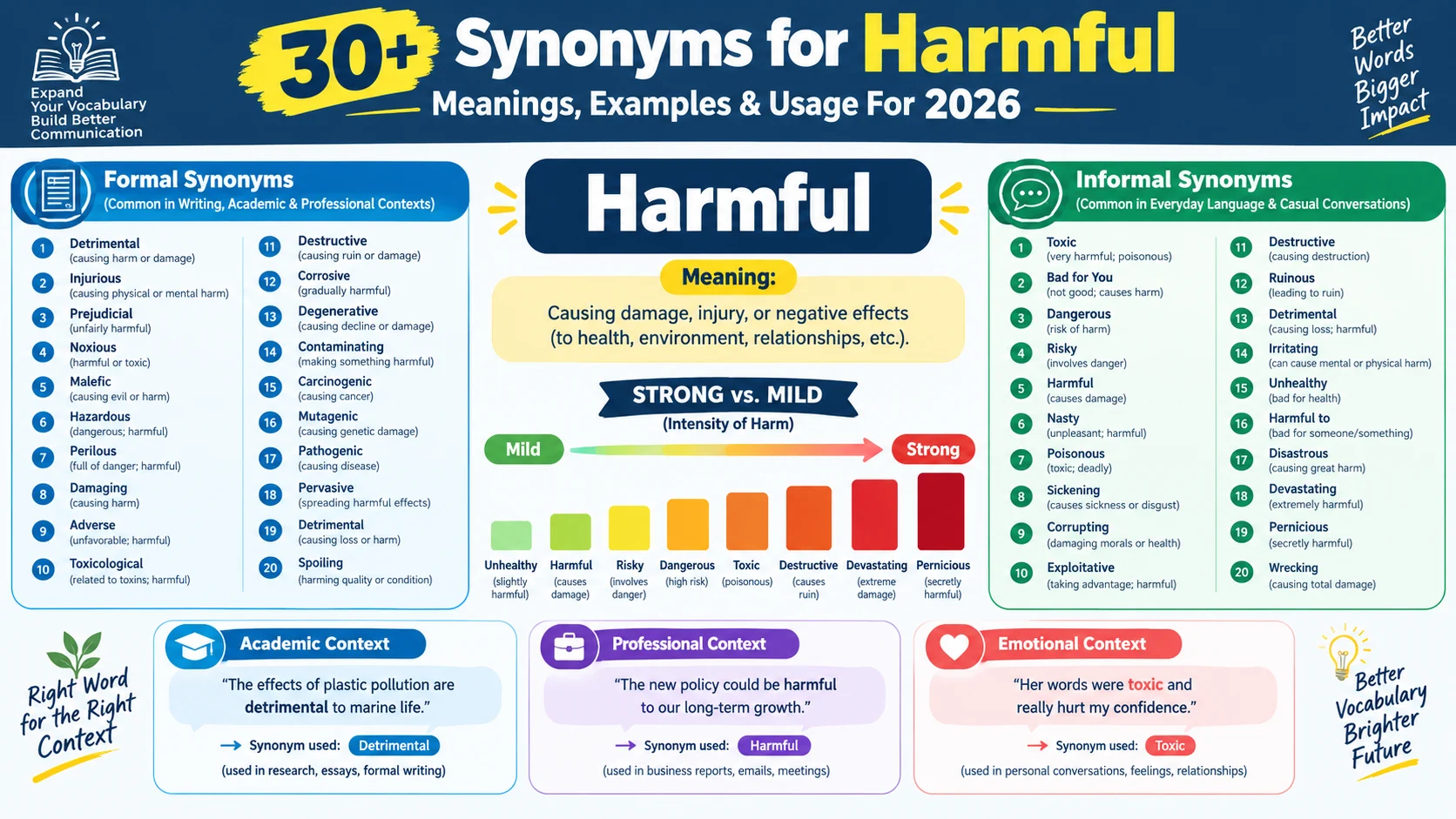
Harmful is an adjective that describes something that causes or is capable of causing damage, injury, or negative effects . The best synonym depends on your context: use detrimental for formal writing, damaging for professional use, hurtful for emotional contexts, and dangerous for physical risks .
Meaning, Tone and Context
Definition: Causing or likely to cause harm, damage, or injury to someone or something .
Part of Speech: Adjective.
Tone: Generally negative, but can be neutral or formal depending on the context.
Formality Level: Neutral to formal. It is a common word used in everyday conversation, academic writing, and professional communication. More formal synonyms include “detrimental” and “deleterious” .
Common Use Cases: We use “harmful” to describe things that pose a risk to our health, the environment, relationships, or even our careers. Common collocations include “harmful effects,” “harmful chemicals,” and “harmful behavior” .
Important Word Forms:
- Noun: Harm
- Adjective: Harmful, harmless
- Adverb: Harmfully
- Verb: Harm
When and How to Use “Harmful”
You should use “harmful” when you need a direct, general word to describe something that causes damage. It is a versatile and widely understood term. Here are a few realistic examples across different contexts.
Professional: “The new policy could be harmful to employee morale if not implemented carefully.”
Academic: “The study concluded that prolonged screen time has a harmful effect on adolescent sleep patterns.”
Personal / Health: “Smoking is harmful to your lungs and can lead to serious health issues.”
Environmental: “Burning fossil fuels is harmful to the environment.”
Emotional: “Spreading rumors can be harmful to someone’s reputation and emotional well-being.”
Creative: “The poison spread through the land, a harmful miasma that withered all it touched.”
Social Media: “Fake news can be harmful because it spreads misinformation and causes confusion.”
Resume / Career: “A toxic work environment is harmful to professional growth.”
Another Word for “Harmful”
Finding the perfect single replacement for “harmful” depends entirely on your context. Here are direct suggestions based on common situations:
- Professional Writing: Detrimental
- “Budget cuts could be detrimental to the project’s success.”
- Academic Writing: Deleterious
- “The study examined the deleterious effects of air pollution.”
- Casual Conversation: Bad for you
- “Eating too much sugar is just bad for you.”
- Emotional Writing: Hurtful
- “Her comments were incredibly hurtful.”
- Creative Writing: Pernicious
- “A pernicious influence was spreading through the kingdom.”
- Resume or Workplace: Damaging
- “A scandal would be damaging to the company’s reputation.”
- Stronger Meaning: Devastating
- “The hurricane had a devastating impact on the coast.”
- Softer Meaning: Unhealthy
- “It is unhealthy to sit at a desk all day without a break.”
When Not to Use “Harmful”
While “harmful” is a useful word, sometimes a more precise synonym can significantly improve your writing. It is too vague when you need to describe the type or intensity of the damage.
- Too Vague: “The chemical was harmful.” (What kind of harm? Was it toxic, corrosive, or poisonous?)
- More Precise: “The chemical was toxic to aquatic life.”
- Too Casual: “His argument was harmful to the debate.” (This sounds a bit weak.)
- Too Weak: “A major scandal would be harmful to the politician.”
Words Commonly Confused with “Harmful”
Many words are similar to “harmful,” but each has a specific nuance. Understanding these differences will help you choose the right word.
1. Harmful vs. Detrimental
Main Difference: “Detrimental” often implies a negative effect on a desired outcome, whereas “harmful” implies direct damage . For example, “Smoking is detrimental to your health” sounds like it negatively affects your long-term health goal. “Smoking is harmful to your lungs” sounds like it directly damages them. “Detrimental” is generally more formal.
2. Harmful vs. Damaging
Main Difference: “Damaging” often suggests physical destruction or a negative impact on something that is important, like a reputation or a structure . “The scandal was damaging to her career” is more impactful than “The scandal was harmful to her career.”
3. Harmful vs. Pernicious
Main Difference: “Pernicious” describes something that is not just harmful, but subtle and gradually destructive . It has a much stronger and more literary tone. You would say “a pernicious rumor” rather than “a harmful rumor” if the rumor was slowly destroying someone’s reputation.
4. Harmful vs. Adverse
Main Difference: “Adverse” often describes an effect or condition that is unfavorable and is typically used with events or circumstances . “Harmful” is more general. For example, “adverse weather conditions” and “harmful weather conditions” have a different feel. “Adverse” focuses on the difficulty it causes.
Best Synonym by Context for “Harmful”
Which Synonym Should You Choose?
Choosing the right synonym involves considering your audience, your purpose, and the specific nuance you want to convey.
- Audience and Formality: If you are writing a formal report or an academic paper, opt for formal words like detrimental or deleterious. For a conversation or a social media post, a more casual word like toxic or even “bad for you” is better.
- Intensity: Are you describing a mild negative effect or a severe one? For a mild effect, choose unhealthy or counterproductive. For a severe effect, use devastating or pernicious.
- Type of Harm: Is the harm physical, emotional, or societal? Use hurtful for emotional, toxic for chemical or emotional, and counterproductive for processes.
- Professional Value: In a resume, avoid overly emotional words. Instead, describe a previous employer as “not conducive to growth” rather than “toxic.”
Real Life Examples of “Harmful” in Sentences
- School: In health class, we learned about the detrimental effects of smoking on the human body. (Using a stronger synonym)
- Workplace: The manager’s micromanagement created a toxic environment that decreased productivity. (Using a strong synonym for a negative social environment)
- Writing: Many thesauruses suggest “injurious” as a synonym, but it sounds too formal for a casual blog post.
- Conversation: You should avoid getting into that habit; it’s not healthy.
- Social Media: We need to stop the spread of fake news because it can be really hurtful and damaging.
- Email: Please be aware that the chemicals in this area are hazardous and require protective gear.
25 Synonyms for “Harmful”
Here are 25 accurate synonyms with unique explanations and natural examples.
Synonym Groups and Usage Differences
Professional vs. Personal Synonyms
In professional settings, clarity and formality are key. Words like detrimental, damaging, and counterproductive are excellent choices. They convey a sense of seriousness without being overly emotional. In personal conversations, words like toxic, unhealthy, and hurtful are more relatable and expressive.
Formal vs. Conversational Synonyms
- Formal (Reports, Essays, Speeches): Words like detrimental, deleterious, adverse, and injurious sound sophisticated and precise.
- Conversational (Texts, Emails, Casual Writing): Words like toxic, hurtful, unhealthy, and even “bad for you” are perfect for everyday communication.
Academic Synonyms
For research-based writing, precision is paramount. Deleterious, injurious, noxious, and adverse are all appropriate academic choices that convey specific types of harm .
Professional and Business Synonyms
In business, the focus is often on negative impacts to a company’s success, reputation, or goals. Detrimental, damaging, counterproductive, and prejudicial (in a legal sense) are ideal for emails, reviews, and presentations .
Creative or Literary Synonyms
Creative writers can draw from a rich vocabulary of descriptive synonyms. Pernicious, baneful, maleficent, insidious, and catastrophic add depth, emotion, and vivid imagery to narratives .
Slang or Modern Synonyms
While “toxic” is a widespread and accepted modern term, many “harmful” synonyms are not slang. “Toxic” is acceptable in informal and even some professional contexts, but avoid it in formal academic writing.
Strongest vs. Weaker Synonyms
- Mild: Unhealthy, counterproductive.
- Moderate: Detrimental, damaging, adverse.
- Strong: Pernicious, devastating, catastrophic, ruinous.
- Extreme: Maleficent, baneful, noxious.
Emotional vs. Neutral Synonyms
- Emotional: Hurtful, painful, maleficent (evil), devastating (saddening).
- Neutral: Detrimental, adverse, injurious, deleterious. These words focus on the outcome rather than the feeling.
Antonyms of “Harmful”
Understanding the opposite of a word helps us grasp its full meaning. Here are 15 antonyms for “harmful.”
Comparison: Harmful vs. Similar Words
Harmful vs. Detrimental
Main Difference: “Detrimental” is often more formal and implies harm to a specific goal or outcome . “Harmful” is more general and suggests direct damage. “Detrimental” is generally used with “to.”
Which is Stronger: Both are moderate, but “detrimental” can sound more serious in formal contexts.
Which is More Formal: Detrimental.
Example for Harmful: “Smoking is harmful to your lungs.”
Example for Detrimental: “The budget cuts are detrimental to our project’s success.”
Harmful vs. Dangerous
Main Difference: “Dangerous” implies a risk of harm or injury, whereas “harmful” implies an actual capacity to cause harm . A situation can be dangerous (risky) but not harmful (if you avoid the danger).
Which is Stronger: Dangerous.
Which is More Formal: Harmful is more neutral; “dangerous” is common in both formal and informal contexts.
Harmful vs. Pernicious
Main Difference: “Pernicious” describes a subtle, gradual, and highly destructive effect . “Harmful” is more straightforward and immediate .
Which is Stronger: Pernicious is much stronger and more literary.
Which is More Formal: Pernicious is formal and dramatic.
Harmful vs. Toxic
Main Difference: “Toxic” specifically refers to poison, but it is now widely used to describe negative people or environments . “Harmful” is a more general term.
Which is Stronger: Toxic implies a level of danger often seen as immediate or severe.
Which is More Formal: Harmful is neutral; “toxic” is slightly less formal.
Common Phrases and Expressions with “Harmful”
1. “Harmful effects”
Meaning: The negative outcomes or consequences of an action.
Example sentence: The harmful effects of the oil spill are still being felt in the coastal communities.
2. “Potentially harmful”
Meaning: Having the capacity to cause damage, but not certain to.
Example sentence: The food additive was labeled potentially harmful if consumed in large quantities.
3. “Harmful substances”
Meaning: Materials that can cause injury or illness.
Example sentence: Factory workers must be protected from harmful substances.
4. “Harmless fun”
Meaning: Entertainment that does not pose any risk.
Example sentence: We decided it was just harmless fun and not to worry about it.
5. “Do more harm than good”
Meaning: To have a detrimental effect, outweighing any benefit.
Example sentence: This policy might do more harm than good, so we should reconsider.
Common Mistakes to Avoid
- Being Too General: Using “harmful” when a more precise synonym would be better. Instead of “The chemical is harmful,” say “The chemical is toxic” or “corrosive.”
- Confusing “Harmful” with “Hurtful”: “Hurtful” is typically for emotional pain. You would not say “The economic policy was hurtful,” you would say “damaging” or “detrimental.”
- Using Casual Synonyms in Formal Writing: Saying “The toxic working environment” in a formal report may be fine, but “the detrimental working conditions” sounds more academic.
- Using an Overly Dramatic Synonym: Describing a mild headache as “devastating” is a clear exaggeration. Use “unpleasant” or “painful” instead.
- Repeating the Same Word: Overuse is a key problem. If you find yourself writing “harmful” multiple times, use a synonym to improve the flow.
- Choosing the Wrong Emotional Tone: If you are writing a neutral business report, “hurtful” is too emotional. If you are writing about psychological trauma, “damaging” might be too weak.
- Using Slang in Professional Writing: Words like “toxic” can be acceptable in modern business writing, but avoid overly trendy or casual slang in serious reports.
FAQs
What is the best synonym for harmful?
The best synonym depends on context. “Detrimental” is excellent for formal writing, “damaging” for professional contexts, and “hurtful” for emotional situations .
What is a formal synonym for harmful?
Formal synonyms include detrimental, deleterious, and injurious . These words are commonly used in academic and legal documents.
What is an informal synonym for harmful?
Informal synonyms include toxic and “bad for you.” These are perfect for casual conversation and social media .
What is another word for harmful in professional writing?
Damaging, counterproductive, and prejudicial are strong choices for professional contexts, such as business emails and performance reviews .
What is the difference between harmful and detrimental?
“Detrimental” is more formal and often implies harm to a specific goal or outcome. “Harmful” is more general and suggests direct damage .
What is the opposite of harmful?
The main opposites are beneficial, helpful, and harmless .
Conclusion
The adjective “harmful” is a powerful tool in the English language, but relying on it too much can make your writing feel dull and imprecise. By understanding the subtle differences between synonyms like detrimental, damaging, pernicious, and hurtful, you can choose the perfect word for any situation. Remember to consider the context: a formal report demands formal language, while a personal email allows for more casual terms. Start by replacing just one instance of “harmful” in your next piece of writing with a more specific synonym and notice the immediate improvement in clarity and impact.
