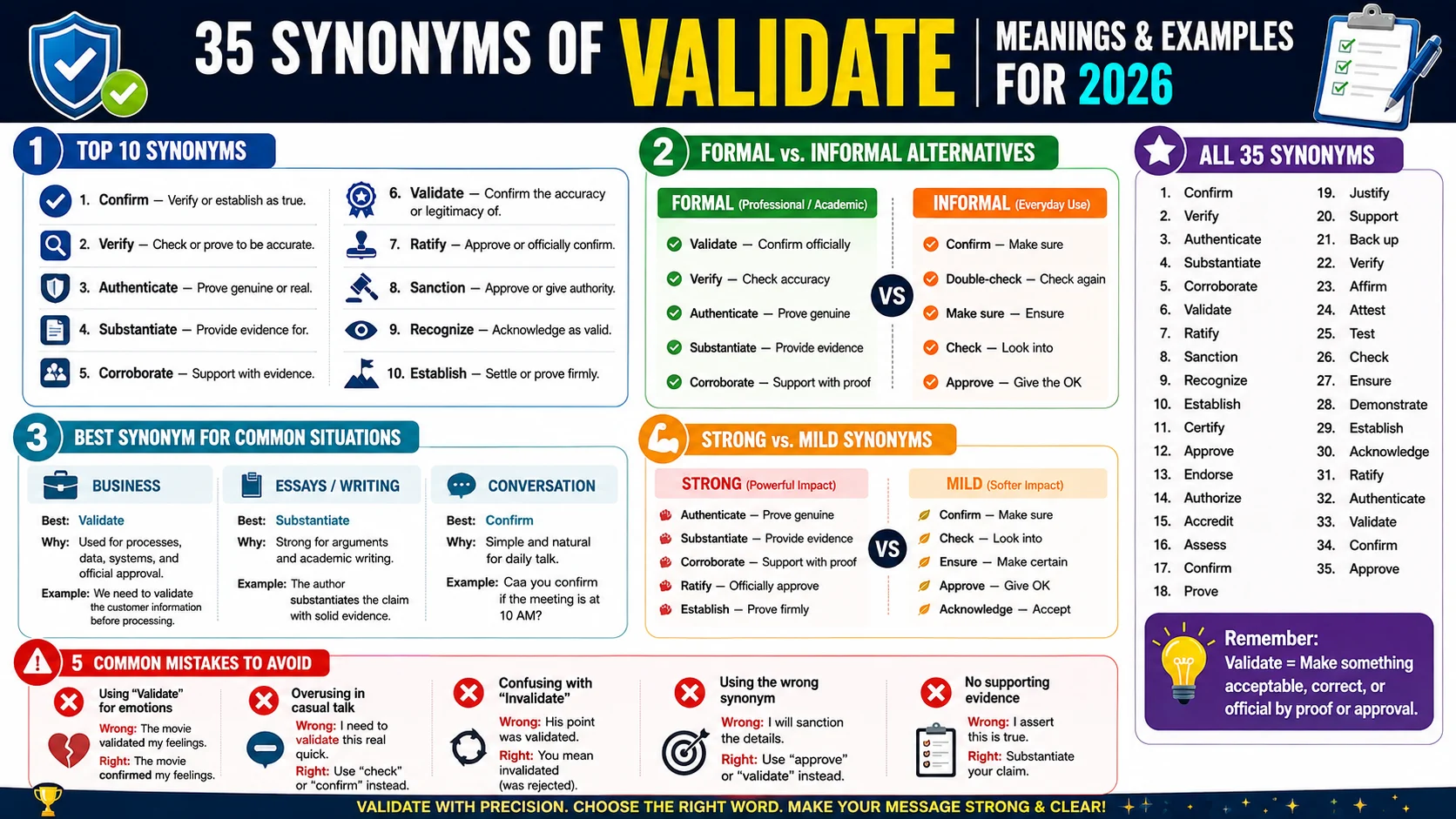
“Validate” means to confirm, prove, or show that something is true, correct, or acceptable. The best synonyms are confirm, verify, substantiate, authenticate, and certify. “Confirm” is the most common natural alternative. Each synonym has a slightly different meaning and context where it fits best.
Top 10 Synonyms
- Confirm
- Verify
- Substantiate
- Authenticate
- Certify
- Corroborate
- Prove
- Justify
- Support
- Uphold
“Validate” is a word we use in many situations. We validate parking, validate a theory, validate someone’s feelings, or validate a document. But using it too often can make your English feel repetitive and formal.
Think about it. You can validate an argument, validate a claim, validate identity, or validate an experience. Each situation might need a different word that captures the specific type of confirmation.
In this guide, you’ll learn 35 powerful synonyms for “validate.” You’ll discover exactly when to use each one, how formal they are, and what common mistakes to avoid. Let’s begin!
What Does “Validate” Mean?
Definition
“Validate” means to prove that something is true, correct, or acceptable. It can mean checking facts, confirming identity, or showing that someone’s feelings are understood. When you validate something, you make it official, accepted, or proven.
Pronunciation
| Feature | Value |
|---|---|
| US IPA | /ˈvælədeɪt/ |
| UK IPA | /ˈvælɪdeɪt/ |
| Syllables | 3 (val-i-date) |
| Tip | Stress the first syllable: “VAL-ih-date” |
Grammar
| Grammar Feature | Information |
|---|---|
| Part of Speech | Verb (transitive) |
| Common Position | After the subject |
| Typical Pattern | Subject + validate + object |
Examples:
- “The scientist validated the results with more experiments.”
- “Please validate your ticket at the machine.”
- “She felt validated when her boss praised her work.”
Grammar Note: “Validate” is a transitive verb, so it always needs an object. You validate something—a claim, a document, or a feeling.
Word Family
| Word | Part of Speech | Meaning |
|---|---|---|
| Validate | Verb | To confirm or prove correct |
| Validation | Noun | The act of validating |
| Valid | Adjective | Legally or logically acceptable |
| Invalid | Adjective | Not valid |
| Validator | Noun | A person or machine that validates |
15 Synonyms of “Validate”
Confirm
Meaning: To state or show that something is definitely true or correct.
Best Used For: Appointments, facts, information, decisions.
Formality: Neutral
Tone: Certain, Clear
Frequency: ⭐⭐⭐⭐⭐ (Very Common)
CEFR Level: B1
Example Sentence 1: “Please confirm your attendance by Friday.”
Example Sentence 2: “The tests confirmed our hypothesis.”
Usage Tip: “Confirm” is the most common and versatile synonym. Use it for checking facts, appointments, and information.
Verify
Meaning: To check and prove that something is true, accurate, or genuine.
Best Used For: Documents, data, identity, facts.
Formality: Formal
Tone: Thorough, Careful
Frequency: ⭐⭐⭐⭐ (Common)
CEFR Level: B2
Example Sentence 1: “The bank will verify your identity before opening an account.”
Example Sentence 2: “We need to verify the accuracy of these figures.
Usage Tip: “Verify” suggests a careful checking process. Use it when accuracy is important.
Common Confusion: Verify vs Confirm. “Verify” suggests a thorough check. “Confirm” is more about agreeing or making certain.
Substantiate
Meaning: To provide evidence that proves something is true.
Best Used For: Arguments, claims, theories, research.
Formality: Formal
Tone: Academic, Evidentiary
Frequency: ⭐⭐⭐ (Moderate)
CEFR Level: C1
Example Sentence 1: “He couldn’t substantiate his claims with any evidence.”
Example Sentence 2: “New data substantiates the theory.”
Usage Tip: “Substantiate” is a formal academic word. Use it when you need to back up an argument with proof.
Authenticate
Meaning: To prove that something is genuine, real, or valid.
Best Used For: Documents, artwork, identity, products.
Formality: Formal
Tone: Official, Genuine
Frequency: ⭐⭐⭐ (Moderate)
CEFR Level: C1
Example Sentence 1: “Experts authenticated the painting as a genuine Picasso.”
Example Sentence 2: “You need to authenticate your account with a password.”
Usage Tip: “Authenticate” is used for proving something is real or original. It’s common in security and art contexts.
Certify
Meaning: To officially declare that something is true, genuine, or acceptable.
Best Used For: Documents, qualifications, products, standards.
Formality: Formal
Tone: Official, Authoritative
Frequency: ⭐⭐⭐ (Moderate)
CEFR Level: B2
Example Sentence 1: “The accountant certified the financial statements.”
Example Sentence 2: “The product is certified as safe for children.”
Usage Tip: “Certify” is official and formal. Use it for official declarations and qualifications.
Corroborate
Meaning: To support or confirm a statement with additional evidence.
Best Used For: Legal contexts, research, witness statements.
Formality: Formal
Tone: Supporting, Evidentiary
Frequency: ⭐⭐ (Rare)
CEFR Level: C1
Example Sentence 1: “Her testimony was corroborated by two witnesses.
Example Sentence 2: “The new data corroborates our findings.”
Usage Tip: “Corroborate” is a legal and academic word for confirming with extra evidence.
Prove
Meaning: To show that something is true using facts or evidence.
Best Used For: Arguments, theories, criminal cases.
Formality: Neutral
Tone: Certain, Strong
Frequency: ⭐⭐⭐⭐⭐ (Very Common)
CEFR Level: A2
Example Sentence 1: “You need to prove your identity with an ID card.”
Example Sentence 2: “The evidence proved his innocence.”
Usage Tip: “Prove” is a strong word for showing something is definitely true. It’s very common and direct.
Justify
Meaning: To show that something is right, reasonable, or necessary.
Best Used For: Decisions, actions, spending, behavior.
Formality: Formal
Tone: Logical, Explanatory
Frequency: ⭐⭐⭐⭐ (Common)
CEFR Level: B2
Example Sentence 1: “She had to justify her decision to the board.
Example Sentence 2: “The results justify the investment.
Usage Tip: “Justify” is about explaining why something is reasonable. Use it for decisions and actions.
Support
Meaning: To provide evidence that helps prove something.
Best Used For: Arguments, claims, theories.
Formality: Neutral
Tone: Supportive, Helpful
Frequency: ⭐⭐⭐⭐⭐ (Very Common)
CEFR Level: A2
Example Sentence 1: “The data supports our theory.”
Example Sentence 2: “Her research supports the idea that exercise improves mental health.”
Usage Tip: “Support” is very common and versatile. Use it when evidence backs up a claim.
Uphold
Meaning: To confirm and maintain something like a decision, law, or principle.
Best Used For: Legal decisions, principles, values.
Formality: Formal
Tone: Authoritative, Strong
Frequency: ⭐⭐⭐ (Moderate)
CEFR Level: B2
Example Sentence 1: “The court upheld the decision.”
Example Sentence 2: “She always upholds the highest standards.
Usage Tip: “Uphold” suggests maintaining and confirming something, often in legal contexts.
Ratify
Meaning: To officially approve and confirm a document or agreement.
Best Used For: Treaties, contracts, agreements.
Formality: Formal
Tone: Official, Legal
Frequency: ⭐⭐ (Rare)
CEFR Level: C1
Example Sentence 1: “The treaty was ratified by all member countries.”
Example Sentence 2: “The board ratified the contract.”
Usage Tip: “Ratify” is a formal legal term for approving agreements.
Endorse
Meaning: To declare approval or support for something.
Best Used For: Products, candidates, ideas.
Formality: Formal
Tone: Supportive, Approving
Frequency: ⭐⭐⭐ (Moderate)
CEFR Level: B2
Example Sentence 1: “The celebrity endorsed the new product.”
Example Sentence 2: “The committee endorsed the proposal.”
Usage Tip: “Endorse” suggests public approval. It’s common in politics and marketing.
Affirm
Meaning: To state positively that something is true.
Best Used For: Beliefs, statements, decisions.
Formality: Formal
Tone: Firm, Positive
Frequency: ⭐⭐⭐ (Moderate)
CEFR Level: B2
Example Sentence 1: “She affirmed her commitment to the project.”
Example Sentence 2: “The court affirmed the previous ruling.”
Usage Tip: “Affirm” suggests a firm, positive statement. It’s formal but not overly technical.
Bolster
Meaning: To support or strengthen something.
Best Used For: Arguments, confidence, morale.
Formality: Formal
Tone: Strengthening, Supporting
Frequency: ⭐⭐⭐ (Moderate)
CEFR Level: B2
Example Sentence 1: “The new evidence bolstered his argument.”
Example Sentence 2: “The success bolstered her confidence.
Usage Tip: “Bolster” suggests making something stronger. It’s often used for arguments or morale.
Sanction
Meaning: To officially approve or allow something.
Best Used For: Official permissions, approvals.
Formality: Formal
Tone: Official, Permissive
Frequency: ⭐⭐⭐ (Moderate)
CEFR Level: C1
Example Sentence 1: “The government sanctioned the new project.”
Example Sentence 2: “The use of the funds was sanctioned by the board.”
Usage Tip: “Sanction” means official approval. Be careful—it can also mean a penalty in other contexts.
Synonyms Comparison Table
| Synonym | Best Context | Formality | Tone | Frequency |
|---|---|---|---|---|
| Confirm | General confirmation | Neutral | Certain | ⭐⭐⭐⭐⭐ |
| Prove | Strong evidence | Neutral | Strong | ⭐⭐⭐⭐⭐ |
| Support | Backing claims | Neutral | Supportive | ⭐⭐⭐⭐⭐ |
| Verify | Checking accuracy | Formal | Thorough | ⭐⭐⭐⭐ |
| Justify | Explaining reasons | Formal | Logical | ⭐⭐⭐⭐ |
| Authenticate | Proving genuineness | Formal | Official | ⭐⭐⭐ |
| Substantiate | Providing evidence | Formal | Academic | ⭐⭐⭐ |
| Certify | Official declaration | Formal | Authoritative | ⭐⭐⭐ |
| Corroborate | Legal evidence | Formal | Evidentiary | ⭐⭐ |
| Ratify | Approving agreements | Formal | Official | ⭐⭐ |
Best Synonyms by Situation
| Situation | Best Synonym | Why It Works |
|---|---|---|
| Daily Conversation | Confirm | Natural and common |
| Business Email | Verify | Professional and careful |
| Academic Writing | Substantiate | Formal and precise |
| School Assignment | Support | Clear and direct |
| Legal Context | Corroborate | Precise and professional |
| Official Documents | Authenticate | Professional and specific |
| Job Interview | Justify | Shows reasoning |
| Social Media | Support | Clear and relatable |
Formal vs Informal Synonyms
Formal Alternatives
| Synonym | Best Used For |
|---|---|
| Substantiate | Academic, research, arguments |
| Authenticate | Documents, identity, products |
| Certify | Official declarations |
| Corroborate | Legal, witness statements |
| Ratify | Official approvals |
Neutral Alternatives
| Synonym | Best Used For |
|---|---|
| Confirm | Most general contexts |
| Verify | Checking and proving |
| Prove | Strong evidence |
| Support | Backing claims |
| Justify | Explaining decisions |
Informal Alternatives
| Synonym | Best Used For |
|---|---|
| Back up | Casual evidence |
| Check out | Informal verification |
| OK | Casual approval |
Choosing the Right Level: Use “substantiate” and “authenticate” for formal contexts. Use “confirm” and “verify” for most professional situations. Use “back up” only with friends.
Strong vs Mild Synonyms
Mild
Suitable for everyday situations with less intensity.
- Confirm
- Support
- Verify
Moderate
More thorough or formal alternatives.
- Substantiate
- Certify
- Justify
- Affirm
Strong
High-intensity alternatives suggesting rigorous proof.
- Corroborate (with strong evidence)
- Authenticate (proving genuine)
- Ratify (official approval)
- Uphold (maintaining validity)
How Intensity Changes Meaning: “I confirmed the results” is basic. “I substantiated the results with evidence” sounds much more thorough. Choose stronger words when you want to emphasize rigor or official status.
Real-Life Examples
School: “The student’s research was validated by multiple sources.”
Office: “Please verify the sales figures before the meeting.”
Business Email: “Can you confirm your availability for next Tuesday?”
Meetings: “The results justify our investment in this project.”
Presentations: “Our findings are supported by recent studies.”
Daily Conversations: “I need to confirm my flight details.”
Social Media: “Her success proves that hard work pays off.”
Academic Writing: “The data substantiates our hypothesis.”
Common Collocations
| Common Phrase | Better Alternative |
|---|---|
| Validate results | Confirm results |
| Validate identity | Verify identity |
| Validate a claim | Substantiate a claim |
| Validate feelings | Acknowledge feelings |
| Validate a document | Certify a document |
Common Phrases
Back up: To support or confirm. (e.g., “Can you back up your argument with evidence?”)
Check out: To verify informally. (e.g., “Check out the details before you submit.”)
Hold water: To be valid or true. (e.g., “His excuse doesn’t hold water.”)
Stand up: To remain valid under scrutiny. (e.g., “The evidence stood up in court.”)
Ring true: To seem true or authentic. (e.g., “His story doesn’t ring true.”)
Context Guide
| Situation | Best Synonym | Reason |
|---|---|---|
| Essay | Substantiate | Academic and formal |
| Speech | Support | Clear and relatable |
| Business Email | Verify | Professional and careful |
| Novel | Affirm | Adds depth to dialogue |
| Presentation | Justify | Logical and persuasive |
| Conversation | Confirm | Natural and clear |
| Academic Writing | Substantiate | Precise and formal |
| Marketing Copy | Support | Engaging and convincing |
Related Words
Near Synonyms
- Vindicate: To prove that someone was right. (e.g., “The evidence vindicated him.”)
- Validate: To confirm correctness.
- Legitimize: To make something acceptable.
- Sanction: To approve officially.
Antonyms
- Invalidate: To make not valid.
- Disprove: To show something is false.
- Contradict: To go against.
- Refute: To prove false.
- Discredit: To damage reputation.
Related Adjectives
- Valid: Legally or logically correct.
- Invalid: Not correct or acceptable.
- Verified: Confirmed as true.
- Authentic: Genuine and real.
- Certified: Officially approved.
Related Nouns
- Validation: The act of confirming.
- Verification: The process of checking.
- Evidence: Proof that confirms something.
- Authentication: Proof of genuineness.
- Certification: Official approval.
Related Verbs
- Confirm: To make certain.
- Verify: To check accuracy.
- Prove: To show truth.
- Support: To back up.
- Justify: To show reason.
Frequently Asked Questions
What is another word for validate?
Common synonyms include confirm, verify, substantiate, authenticate, and certify. “Confirm” is the most common and versatile alternative.
Which synonym sounds the most professional?
Substantiate and verify sound very professional. “Authenticate” is excellent for official contexts.
What is the strongest synonym for validate?
Substantiate and corroborate are among the strongest. They suggest providing solid evidence. “Prove” is also strong and direct.
Which synonym is best for essays?
Substantiate is the best choice for academic essays. “Support” is also widely used and accepted.
What’s the difference between validate and verify?
“Verify” suggests checking for accuracy. “Validate” is broader and can mean confirming, proving, or showing acceptance.
Which synonym is most common in everyday English?
“Confirm” and “support” are the most common in everyday speech. “Prove” is also frequently used.
What is the opposite of validate?
Common opposites are invalidate, disprove, contradict, and refute. These words mean to show something is not true or acceptable.
Conclusion
“Validate” is a powerful word, but now you have 35 fantastic alternatives. Each synonym adds a different shade of meaning to your language.
Remember, the key is understanding the context. Use “confirm” for general certainty. Use “verify” for careful checking. Use “substantiate” for academic rigor. Use “authenticate” for proving genuineness. Use “justify” for explaining decisions.
The best way to improve is practice. Try using one or two new synonyms each day. Listen for these words in conversations and books. Your vocabulary will become richer and more impressive with time.
