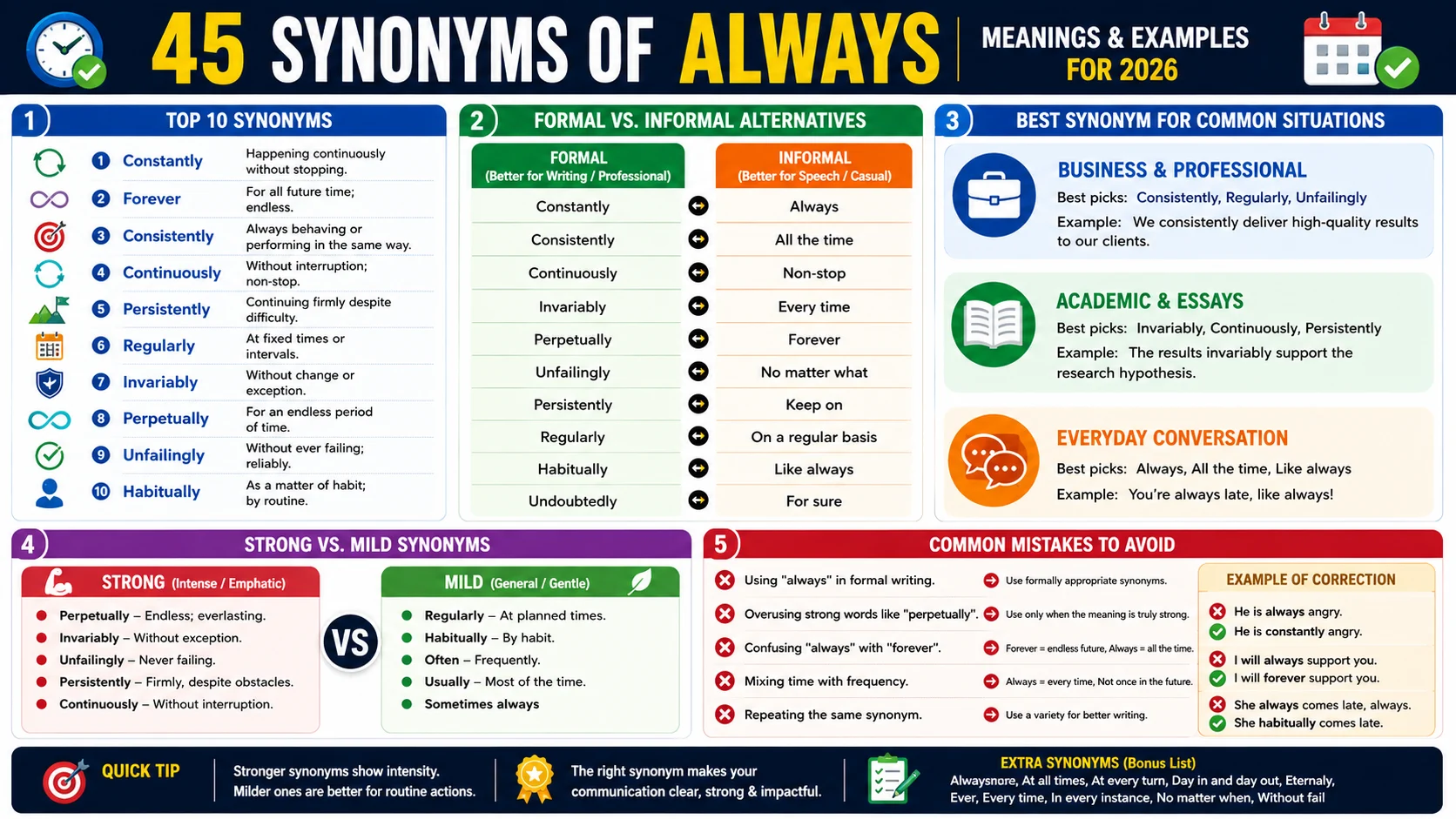
Always” means at all times, on every occasion, or forever. The best synonyms are constantly, continuously, perpetually, eternally, and invariably. “Constantly” is the most common natural alternative. Each synonym has a slightly different meaning and context where it fits best.
Top 10 Synonyms
- Constantly
- Continuously
- Perpetually
- Eternally
- Invariably
- Consistently
- Unfailingly
- Repeatedly
- Forever
- Relentlessly
“Always” is one of the most common words in English. We use it constantly to describe habits, promises, and universal truths. But using it too often can make your English feel repetitive and one-dimensional.
Think about it. You can say “I always drink coffee,” “She always smiles,” “He’s always late,” or “I’ll always love you.” Each situation might need a different word that captures the specific type of “always.”
In this guide, you’ll learn 35 powerful synonyms for “always.” You’ll discover exactly when to use each one, how formal they are, and what common mistakes to avoid. Let’s begin!
What Does “Always” Mean?
Definition
Always” means at all times, on every occasion, or forever. It can describe something that happens regularly, something that is permanent, or a commitment that never ends. When something is always true, it never changes.
Pronunciation
| Feature | Value |
|---|---|
| US IPA | /ˈɔlweɪz/ |
| UK IPA | /ˈɔːlweɪz/ |
| Syllables | 2 (al-ways) |
| Tip | Stress the first syllable: “AL-ways” |
Grammar
| Grammar Feature | Information |
|---|---|
| Part of Speech | Adverb |
| Common Position | Before the main verb or after “be” |
| Typical Pattern | Subject + always + verb / Subject + be + always + adjective |
Examples:
- “I always drink coffee in the morning.” (before verb)
- “She is always happy.” (after “be”)
- “We will always be friends.” (after modal verb)
Grammar Note: “Always” is usually placed before the main verb but after auxiliary verbs like “be,” “have,” and “will.”
Word Family
| Word | Part of Speech | Meaning |
|---|---|---|
| Always | Adverb | At all times |
| Unchanging | Adjective | Not changing |
| Permanent | Adjective | Lasting forever |
| Eternal | Adjective | Without end |
15 Synonyms of “Always”
Constantly
Meaning: Happening all the time or very often.
Best Used For: Habits, repeated actions, ongoing situations.
Formality: Neutral
Tone: Persistent, Frequent
Frequency: ⭐⭐⭐⭐⭐ (Very Common)
CEFR Level: B2
Example Sentence 1: “She constantly checks her phone during meetings.”
Example Sentence 2: “The weather is constantly changing.”
Usage Tip: “Constantly” is the most common synonym. Use it for things that happen regularly without stopping.
Common Confusion: Constantly vs Always. “Constantly” suggests frequency, sometimes with a sense of being excessive. “Always” is more absolute.
Continuously
Meaning: Without stopping or interruption.
Best Used For: Ongoing actions, processes, streams of information.
Formality: Neutral
Tone: Uninterrupted, Steady
Frequency: ⭐⭐⭐⭐ (Common)
CEFR Level: B2
Example Sentence 1: “The machine runs continuously for 24 hours.”
Example Sentence 2: “She worked continuously to finish the project.”
Usage Tip: “Continuously” suggests no breaks or pauses. Use it for uninterrupted actions.
Perpetually
Meaning: Continuing forever or for a very long time.
Best Used For: Ongoing cycles, endless situations, literary contexts.
Formality: Formal
Tone: Literary, Enduring
Frequency: ⭐⭐⭐ (Moderate)
CEFR Level: C1
Example Sentence 1: “The two countries are perpetually at war.”
Example Sentence 2: “He is perpetually late to meetings.”
Usage Tip: “Perpetually” is formal and suggests something that seems to last forever. Use it in literary or formal writing.
Eternally
Meaning: Forever, without end.
Best Used For: Promises, love, spiritual contexts.
Formality: Formal
Tone: Poetic, Emotional
Frequency: ⭐⭐⭐ (Moderate)
CEFR Level: C1
Example Sentence 1: “I will eternally love you.”
Example Sentence 2: “His loyalty is eternally appreciated.”
Usage Tip: “Eternally” is dramatic and emotional. Use it for promises and permanent commitments.
Invariably
Meaning: Always, without exception.
Best Used For: Predictable outcomes, scientific facts.
Formality: Formal
Tone: Certain, Unchanging
Frequency: ⭐⭐⭐ (Moderate)
CEFR Level: C1
Example Sentence 1: “Spring invariably brings flowers.”
Example Sentence 2: “He invariably arrives exactly on time.”
Usage Tip: “Invariably” suggests something that never changes. Use it for predictable patterns.
Consistently
Meaning: Always behaving in the same way.
Best Used For: Performance, behavior, results.
Formality: Neutral
Tone: Reliable, Steady
Frequency: ⭐⭐⭐⭐ (Common)
CEFR Level: B2
Example Sentence 1: “She consistently performs well in her exams.
Example Sentence 2: “The quality has been consistently high.”
Usage Tip: “Consistently” suggests reliability and predictability. Use it for performance and results.
Unfailingly
Meaning: Always, without ever failing.
Best Used For: Support, loyalty, reliability.
Formality: Formal
Tone: Loyal, Dependable
Frequency: ⭐⭐⭐ (Moderate)
CEFR Level: C1
Example Sentence 1: “She has been unfailingly kind to everyone.”
Example Sentence 2: “He unfailingly supports his friends.”
Usage Tip: “Unfailingly” suggests never letting anyone down. Use it for reliability and loyalty.
Repeatedly
Meaning: Again and again.
Best Used For: Actions that happen many times.
Formality: Neutral
Tone: Frequent, Sometimes Annoying
Frequency: ⭐⭐⭐⭐ (Common)
CEFR Level: B2
Example Sentence 1: “She repeatedly asked the same question.”
Example Sentence 2: “He repeatedly ignored the warnings.”
Usage Tip: “Repeatedly” suggests something happens many times. It can sometimes suggest frustration.
Forever
Meaning: For all time, never ending.
Best Used For: Promises, emotions, permanent states.
Formality: Neutral
Tone: Emotional, Poetic
Frequency: ⭐⭐⭐⭐⭐ (Very Common)
CEFR Level: A2
Example Sentence 1: “I will forever remember this day.”
Example Sentence 2: “They lived happily ever after.”
Usage Tip: “Forever” is emotional and commonly used in promises and romantic contexts.
Relentlessly
Meaning: In a continuous, determined, and often exhausting way.
Best Used For: Effort, pursuit, pressure.
Formality: Neutral
Tone: Determined, Intense
Frequency: ⭐⭐⭐ (Moderate)
CEFR Level: C1
Example Sentence 1: “She worked relentlessly to achieve her goal.”
Example Sentence 2: “The sun beat down relentlessly.”
Usage Tip: “Relentlessly” suggests effort that doesn’t stop, often with intensity.
Ceaselessly
Meaning: Without stopping.
Best Used For: Ongoing actions, noise, effort.
Formality: Formal
Tone: Literary, Persistent
Frequency: ⭐⭐ (Rare)
CEFR Level: C1
Example Sentence 1: “The rain fell ceaselessly for three days.”
Example Sentence 2: “She ceaselessly advocated for change.”
Usage Tip: “Ceaselessly” is a literary word. Use it in formal or creative writing.
Endlessly
Meaning: Without end.
Best Used For: Lengthy situations, repeated patterns.
Formality: Neutral
Tone: Frustrating, Lengthy
Frequency: ⭐⭐⭐ (Moderate)
CEFR Level: B2
Example Sentence 1: “He talks endlessly about his work.”
Example Sentence 2: “The possibilities are endless.”
Usage Tip: “Endlessly” suggests something that goes on and on. It can be negative or positive.
Incessantly
Meaning: Without interruption, in a way that is often annoying.
Best Used For: Noise, complaints, repetitive actions.
Formality: Formal
Tone: Annoying, Relentless
Frequency: ⭐⭐ (Rare)
CEFR Level: C1
Example Sentence 1: “The phone rang incessantly.”
Example Sentence 2: “He complained incessantly about the food.”
Usage Tip: “Incessantly” often has a negative connotation. Use it for annoying repetition.
Throughout
Meaning: In every part of a place or period of time.
Best Used For: Time periods, places, consistent presence.
Formality: Neutral
Tone: Widespread, Consistent
Frequency: ⭐⭐⭐⭐ (Common)
CEFR Level: B1
Example Sentence 1: “She remained cheerful throughout the day.”
Example Sentence 2: “The theme is present throughout the book.”
Usage Tip: “Throughout” is used for consistent presence across time or space.
All the time
Meaning: Very frequently or constantly.
Best Used For: Everyday conversation, habits.
Formality: Informal
Tone: Casual, Conversational
Frequency: ⭐⭐⭐⭐⭐ (Very Common)
CEFR Level: A2
Example Sentence 1: “She complains all the time.”
Example Sentence 2: “He checks his phone all the time.”
Usage Tip: “All the time” is very common in casual speech. Use it with friends and family.
Synonyms Comparison Table
| Synonym | Best Context | Formality | Tone | Frequency |
|---|---|---|---|---|
| Constantly | Frequent habits | Neutral | Persistent | ⭐⭐⭐⭐⭐ |
| Continuously | Uninterrupted | Neutral | Steady | ⭐⭐⭐⭐ |
| Consistently | Reliable performance | Neutral | Reliable | ⭐⭐⭐⭐ |
| Forever | Promises | Neutral | Emotional | ⭐⭐⭐⭐⭐ |
| Invariably | Predictable patterns | Formal | Certain | ⭐⭐⭐ |
| Perpetually | Long-lasting | Formal | Enduring | ⭐⭐⭐ |
| Eternally | Spiritual, love | Formal | Poetic | ⭐⭐⭐ |
| Unfailingly | Loyalty, support | Formal | Dependable | ⭐⭐⭐ |
| Repeatedly | Many times | Neutral | Frequent | ⭐⭐⭐⭐ |
| Relentlessly | Determined effort | Neutral | Intense | ⭐⭐⭐ |
Best Synonyms by Situation
| Situation | Best Synonym | Why It Works |
|---|---|---|
| Daily Conversation | Always / All the time | Natural and common |
| Business Email | Consistently | Professional and clear |
| Academic Writing | Invariably | Formal and precise |
| School Assignment | Constantly | Shows frequency |
| Professional Meeting | Consistently | Sounds reliable |
| Presentation | Consistently | Clear and professional |
| Creative Writing | Perpetually | Adds literary depth |
| Social Media | Always | Casual and relatable |
| Love Letter | Forever | Emotional and sincere |
Formal vs Informal Synonyms
Formal Alternatives
| Synonym | Best Used For |
|---|---|
| Invariably | Predictable outcomes |
| Perpetually | Long-lasting situations |
| Eternally | Spiritual, poetic contexts |
| Ceaselessly | Literary, ongoing action |
| Unfailingly | Reliability, loyalty |
Neutral Alternatives
| Synonym | Best Used For |
|---|---|
| Constantly | Most general situations |
| Consistently | Performance, behavior |
| Continuously | Uninterrupted actions |
| Repeatedly | Many times |
Informal Alternatives
| Synonym | Best Used For |
|---|---|
| All the time | Everyday conversation |
| Forever | Emotional contexts |
| Always | General use |
Choosing the Right Level: Use “invariably” and “perpetually” for formal writing. Use “constantly” and “consistently” for most situations. Use “all the time” with friends.
Strong vs Mild Synonyms
Mild
Suitable for everyday situations with less intensity.
- Always
- Repeatedly
- All the time
Moderate
More descriptive or specific alternatives.
- Constantly
- Consistently
- Continuously
- Throughout
Strong
High-intensity alternatives suggesting intensity or formality.
- Relentlessly (determined, intense)
- Incessantly (annoying)
- Perpetually (seemingly endless)
- Unfailingly (never failing)
How Intensity Changes Meaning: “She always works” is simple. “She works relentlessly” suggests intense effort. Choose stronger words when you want to emphasize determination or intensity.
Real-Life Examples
School: “She always completes her homework on time.”
Office: “He consistently meets his targets.”
Business Email: “Our team consistently delivers high-quality work.”
Meetings: “The problem arises repeatedly.”
Presentations: “The sun consistently rises in the east.”
Daily Conversations: “I always drink coffee in the morning.”
Social Media: “Forever grateful for my followers!”
Academic Writing: “The results invariably support the hypothesis.”
Common Collocations
| Common Phrase | Better Alternative |
|---|---|
| Always late | Perpetually late |
| Always working | Constantly working |
| Always happy | Consistently happy |
| Always on time | Invariably on time |
| Always kind | Unfailingly kind |
Common Phrases
All the time: Constantly. (e.g., “She complains all the time.”)
Now and forever: Always. (e.g., “I’ll love you now and forever.”)
Every single time: Without exception. (e.g., “Every single time, he forgets.”)
Without fail: Reliably. (e.g., “She arrives at 9 AM without fail.”)
Time and again: Repeatedly. (e.g., “Time and again, he proved himself.”)
Context Guide
| Situation | Best Synonym | Reason |
|---|---|---|
| Essay | Invariably | Academic and formal |
| Speech | Always | Clear and universal |
| Business Email | Consistently | Professional and clear |
| Novel | Perpetually | Adds literary depth |
| Presentation | Consistently | Clear and professional |
| Conversation | Always | Natural and relatable |
| Academic Writing | Invariably | Precise and formal |
| Marketing Copy | Always | Engaging and clear |
Related Words
Near Synonyms
- Invariably: Without exception.
- Unceasingly: Without stopping.
- Religiously: Faithfully and regularly.
- Faithfully: Consistently and reliably.
- Diligently: With constant effort.
Antonyms
- Never: At no time.
- Rarely: Not often.
- Seldom: Not often.
- Occasionally: Sometimes.
- Intermittently: Stopping and starting.
Related Adjectives
- Permanent: Lasting forever.
- Constant: Not changing.
- Continual: Recurring frequently.
- Eternal: Lasting forever.
- Perpetual: Continuing forever.
Related Nouns
- Permanence: The state of lasting forever.
- Constancy: The quality of being constant.
- Consistency: The quality of being consistent.
- Reliability: Dependability.
- Certainty: The state of being sure.
Related Verbs
- Continue: To keep going.
- Persist: To continue firmly.
- Endure: To last over time.
- Remain: To stay the same.
- Stay: To continue to be.
Frequently Asked Questions
What is another word for always?
Common synonyms include constantly, continuously, perpetually, eternally, and invariably. “Constantly” is the most common natural alternative.
Which synonym sounds the most professional?
Consistently and invariably sound very professional. “Invariably” is excellent for formal writing.
What is the strongest synonym for always?
Relentlessly and perpetually are among the strongest synonyms. “Unfailingly” is also strong for reliability.
Which synonym is best for essays?
Invariably is the best choice for academic essays. It’s formal and precise.
What’s the difference between always and constantly?
“Always” is absolute—it means every time. “Constantly” suggests something happens very often, sometimes excessively.
Which synonym is most common in everyday English?
“Constantly” and “all the time” are very common in everyday speech. “Always” itself is also frequently used.
What is the opposite of always?
The direct opposite is “never.” Other opposites include “rarely,” “seldom,” and “occasionally.”
Conclusion
“Always” is a powerful word, but now you have 35 fantastic alternatives. Each synonym adds a different shade of meaning to your language.
Remember, the key is understanding the context. Use “constantly” for frequent actions. Use “consistently” for reliable performance. Use “invariably” for formal writing. Use “forever” for emotional promises.
The best way to improve is practice. Try using one or two new synonyms each day. Listen for these words in conversations and books. Your vocabulary will become richer and more expressive with time.
