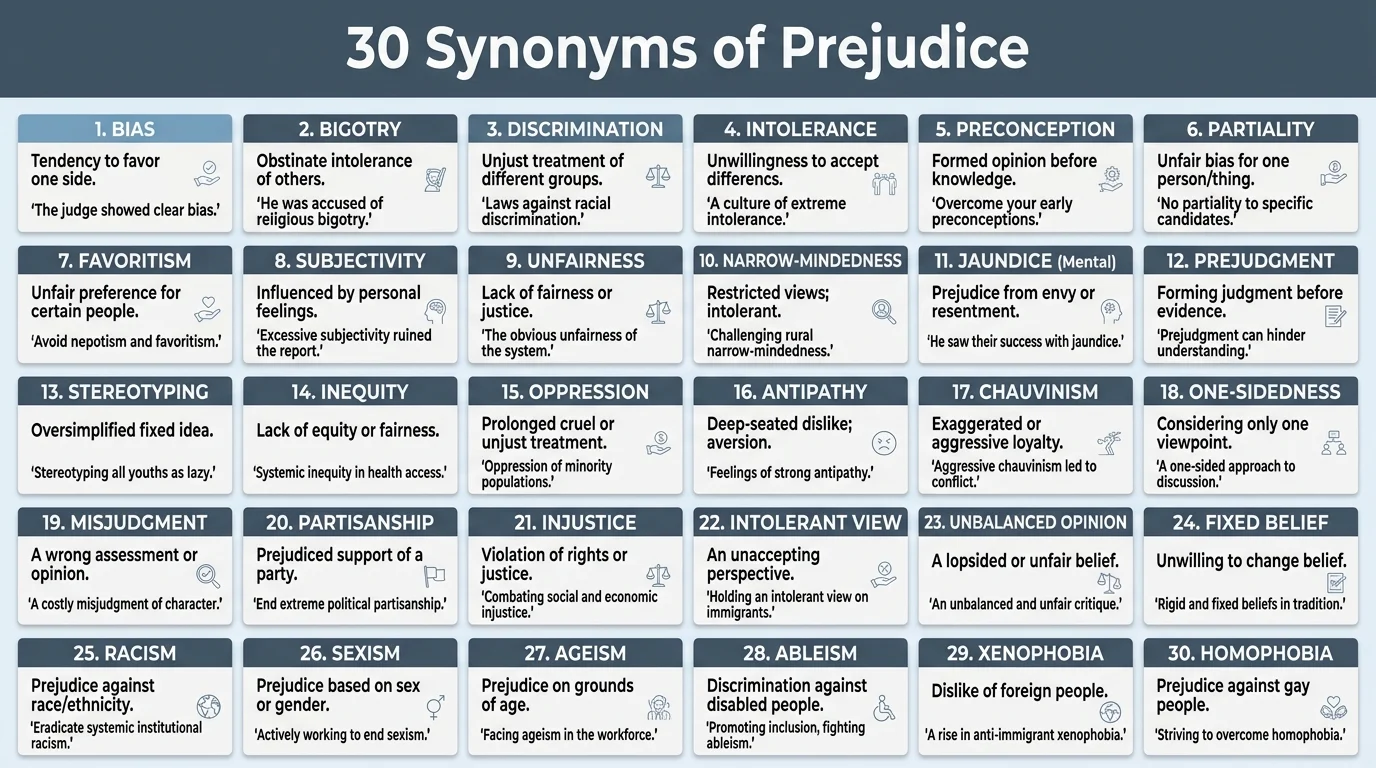
Prejudice is an unfair opinion or feeling about someone based on their group, not on facts. The best synonyms are bias, discrimination, bigotry, intolerance, and unfairness. “Bias” is the most common and natural choice. Each synonym carries a slightly different meaning, tone, or context.
Top 10 Synonyms
- Bias
- Discrimination
- Bigotry
- Intolerance
- Unfairness
- Preconception
- Prejudgment
- Racism
- Sexism
- Xenophobia
Have you ever heard someone say, “Don’t judge a book by its cover”? That’s exactly what prejudice is. It’s making a decision about someone before you know them.
Prejudice is a serious topic, and the words we use to discuss it matter. Using the right synonym can help you speak or write more clearly about important social issues. It also makes your English sound more sophisticated and thoughtful.
In this guide, you’ll learn 30 powerful synonyms for prejudice. You’ll discover which ones are formal, which are casual, and which are best for different situations. Let’s explore this important vocabulary together.
What Does “Prejudice” Mean?
Definition
Prejudice is an unfair and often negative opinion about a person or group that is formed without enough knowledge or facts. It is a pre-judgment that happens before you truly know someone. Prejudice can be based on race, gender, religion, age, or many other characteristics.
Pronunciation
| Feature | Value |
|---|---|
| US IPA | /ˈprɛdʒədɪs/ |
| UK IPA | /ˈprɛdʒʊdɪs/ |
| Syllables | 3 (prej-u-dice) |
| Tip | Stress the first syllable: “PREJ-uh-diss” |
Grammar
| Grammar Feature | Information |
|---|---|
| Part of Speech | Noun (also used as a verb) |
| Common Position | Subject or Object |
| Typical Pattern | Prejudice + against + someone/something |
Examples:
- “There is a lot of prejudice against immigrants in some countries.”
- “Her prejudice prevented her from seeing the truth.”
- “The judge showed no prejudice in the case.”
Grammar Note: As a verb, “prejudice” means to influence someone unfairly. (e.g., “The media coverage prejudiced people against the candidate.”)
Word Family
| Word | Part of Speech | Meaning |
|---|---|---|
| Prejudice | Noun/Verb | Unfair opinion formed without knowledge |
| Prejudiced | Adjective | Having an unfair opinion or bias |
| Prejudicial | Adjective | Harmful or damaging to someone’s rights |
| Prejudicially | Adverb | In a way that shows prejudice |
15 Synonyms of “Prejudice”
Bias
Meaning: A strong, often unfair, preference or opinion that influences judgment.
Best Used For: Everyday conversation, professional writing, psychology, media discussions.
Formality: Neutral
Tone: Analytical, Neutral
Frequency: ⭐⭐⭐⭐⭐ (Very Common)
CEFR Level: B2
Example Sentence 1: “The journalist showed a clear bias in favor of one political party.”
Example Sentence 2: “We all have unconscious biases that we don’t even realize.”
Usage Tip: “Bias” is the most common synonym and usually the best choice. It can be positive or negative, though it’s often used for unfair preferences.
Common Confusion: Bias vs Prejudice. Bias can be positive or neutral, but prejudice is always negative and harmful.
Discrimination
Meaning: The unfair treatment of people based on their group, such as race, gender, or age.
Best Used For: Legal contexts, human rights discussions, academic writing.
Formality: Formal
Tone: Serious, Legal
Frequency: ⭐⭐⭐⭐⭐ (Very Common)
CEFR Level: B2
Example Sentence 1: “Discrimination in the workplace is against the law.”
Example Sentence 2: “She experienced discrimination because of her accent.”
Usage Tip: “Discrimination” focuses on the action of treating people unfairly, not just having a bad opinion. Use it when discussing actual unfair treatment.
Bigotry
Meaning: Stubborn and unreasonable hatred or intolerance toward people with different beliefs or backgrounds.
Best Used For: Describing extreme prejudice, formal discussions about social issues.
Formality: Formal
Tone: Strong, Negative
Frequency: ⭐⭐⭐ (Moderate)
CEFR Level: C1
Example Sentence 1: “His bigotry prevented him from accepting people from other cultures.”
Example Sentence 2: “We must stand up against bigotry in all its forms.”
Usage Tip: “Bigotry” is a very strong word. Use it only when describing extreme, stubborn hatred that refuses to change.
Intolerance
Meaning: The refusal to accept beliefs, opinions, or behaviors that are different from your own.
Best Used For: Social discussions, describing closed-minded people.
Formality: Formal
Tone: Negative, Serious
Frequency: ⭐⭐⭐ (Moderate)
CEFR Level: B2
Example Sentence 1: “Religious intolerance has caused conflicts throughout history.”
Example Sentence 2: “Intolerance is the enemy of a peaceful society.”
Usage Tip: “Intolerance” means not being able to accept differences. It is the opposite of tolerance and understanding.
Unfairness
Meaning: The quality of not being fair or just; treating people unequally.
Best Used For: Everyday conversation, describing situations where people are treated badly.
Formality: Neutral
Tone: Negative, Emotional
Frequency: ⭐⭐⭐⭐ (Common)
CEFR Level: B1
Example Sentence 1: “The unfairness of the decision upset everyone.
Example Sentence 2: “She spoke out against the unfairness she witnessed.”
Usage Tip: “Unfairness” is a simple, everyday word. It’s not as strong as “prejudice” but works well in casual conversation.
Preconception
Meaning: An idea or opinion you form before you have enough information.
Best Used For: Academic writing, psychology, describing how people form opinions.
Formality: Formal
Tone: Analytical, Neutral
Frequency: ⭐⭐⭐ (Moderate)
CEFR Level: B2
Example Sentence 1: “Many people have preconceptions about foreign cultures.”
Example Sentence 2: “Try to let go of your preconceptions and listen with an open mind.”
Usage Tip: “Preconception” is about having an idea before you know the facts. It’s not always negative, but it can lead to prejudice.
Prejudgment
Meaning: Making a decision or judgment about someone before knowing the facts.
Best Used For: Formal writing, describing quick judgments.
Formality: Formal
Tone: Analytical, Neutral
Frequency: ⭐⭐ (Rare)
CEFR Level: C1
Example Sentence 1: “Prejudgment of a person’s character can be very harmful.”
Example Sentence 2: “The court warned against prejudgment before hearing all evidence.”
Usage Tip: “Prejudgment” is very close to the literal meaning of prejudice. It’s more common in formal or legal contexts.
Racism
Meaning: Prejudice, discrimination, or hatred directed against someone because of their race.
Best Used For: Social justice, political discussions, history.
Formality: Formal
Tone: Serious, Strong
Frequency: ⭐⭐⭐⭐⭐ (Very Common)
CEFR Level: B2
Example Sentence 1: “Racism remains a major problem in many societies.”
Example Sentence 2: “The organization is committed to fighting racism.
Usage Tip: “Racism” specifically refers to prejudice based on race. Use it when the issue is racial discrimination.
Sexism
Meaning: Prejudice, discrimination, or stereotyping based on gender, usually against women.
Best Used For: Gender equality discussions, workplace issues, social commentary.
Formality: Formal
Tone: Serious, Strong
Frequency: ⭐⭐⭐⭐ (Common)
CEFR Level: B2
Example Sentence 1: “Sexism in the workplace prevents women from advancing.”
Example Sentence 2: “The film explores sexism in the technology industry.”
Usage Tip: “Sexism” specifically refers to gender-based prejudice. It’s a very common word in modern discussions about equality.
Xenophobia
Meaning: Prejudice against people from foreign countries or strangers.
Best Used For: Political discussions, immigration debates, formal writing.
Formality: Formal
Tone: Serious, Academic
Frequency: ⭐⭐⭐ (Moderate)
CEFR Level: C1
Example Sentence 1: “Xenophobia often increases during times of economic hardship.”
Example Sentence 2: “Education is the best cure for xenophobia.”
Usage Tip: “Xenophobia” is a specific type of prejudice against foreigners. It’s a useful word in discussions about immigration.
Homophobia
Meaning: Prejudice, hatred, or fear against people who are attracted to the same sex.
Best Used For: LGBTQ+ discussions, human rights, social issues.
Formality: Formal
Tone: Serious, Strong
Frequency: ⭐⭐⭐ (Moderate)
CEFR Level: C1
Example Sentence 1: “Homophobia causes real harm to LGBTQ+ communities.”
Example Sentence 2: “Many countries have laws to protect against homophobia.”
Usage Tip: “Homophobia” specifically refers to prejudice against LGBTQ+ people. Use it in discussions about sexual orientation.
Chauvinism
Meaning: An extreme and unreasonable belief in the superiority of one group, especially men or one’s own nation.
Best Used For: Gender discussions, nationalism, formal writing.
Formality: Formal
Tone: Strong, Negative
Frequency: ⭐⭐ (Rare)
CEFR Level: C1
Example Sentence 1: “Male chauvinism is still present in some workplaces.”
Example Sentence 2: “National chauvinism can lead to dangerous conflicts.
Usage Tip: “Chauvinism” is often used for “male chauvinism” (sexism by men). It also refers to extreme patriotism.
Partisanship
Meaning: Strong, often unfair support of one group or side, especially in politics.
Best Used For: Political discussions, journalism, describing media bias.
Formality: Formal
Tone: Analytical, Neutral
Frequency: ⭐⭐⭐ (Moderate)
CEFR Level: B2
Example Sentence 1: “Partisanship has made politics more divisive than ever.”
Example Sentence 2: “The news channel was accused of partisanship.
Usage Tip: “Partisanship” focuses on unfair support for a political side or party. It’s a useful word for talking about politics.
Narrow-mindedness
Meaning: The inability or refusal to accept different ideas, beliefs, or people.
Best Used For: Everyday conversation, describing people who won’t change their views.
Formality: Informal
Tone: Negative, Casual
Frequency: ⭐⭐⭐ (Moderate)
CEFR Level: B1
Example Sentence 1: “His narrow-mindedness made it impossible to have a good discussion.
Example Sentence 2: “Narrow-mindedness prevents people from learning new things.”
Usage Tip: “Narrow-mindedness” is a casual, everyday word. Use it to describe people who refuse to consider different opinions.
Closed-mindedness
Meaning: The unwillingness to consider new ideas or other people’s opinions.
Best Used For: Everyday conversation, describing stubborn people.
Formality: Informal
Tone: Negative, Casual
Frequency: ⭐⭐⭐ (Moderate)
CEFR Level: B1
Example Sentence 1: “Closed-mindedness is the enemy of personal growth.”
Example Sentence 2: “I was frustrated by her closed-mindedness during the debate.”
Usage Tip: “Closed-mindedness” is very similar to narrow-mindedness. It means you have closed your mind to new ideas.
Synonyms Comparison Table
| Synonym | Best Context | Formality | Tone | Frequency |
|---|---|---|---|---|
| Bias | General use | Neutral | Analytical | ⭐⭐⭐⭐⭐ |
| Discrimination | Legal, human rights | Formal | Serious | ⭐⭐⭐⭐⭐ |
| Racism | Race issues | Formal | Strong | ⭐⭐⭐⭐⭐ |
| Preconception | Psychology | Formal | Analytical | ⭐⭐⭐ |
| Intolerance | Social issues | Formal | Negative | ⭐⭐⭐ |
| Bigotry | Extreme prejudice | Formal | Strong | ⭐⭐⭐ |
| Unfairness | Casual | Neutral | Emotional | ⭐⭐⭐⭐ |
| Sexism | Gender issues | Formal | Strong | ⭐⭐⭐⭐ |
| Xenophobia | Immigration | Formal | Academic | ⭐⭐⭐ |
| Partisanship | Politics | Formal | Analytical | ⭐⭐⭐ |
Best Synonyms by Situation
| Situation | Best Synonym | Why It Works |
|---|---|---|
| Daily Conversation | Bias | Simple and common |
| Business Email | Discrimination | Professional and clear |
| Academic Writing | Preconception | Precise and neutral |
| School Assignment | Intolerance | Shows depth of understanding |
| Professional Meeting | Unfairness | Direct and understandable |
| Presentation | Bias | Concise and clear |
| Creative Writing | Bigotry | Adds dramatic weight |
| Social Media | Bias | Casual and natural |
| Legal Context | Discrimination | Accurate legal term |
Formal vs Informal Synonyms
Formal Alternatives
| Synonym | Best Used For |
|---|---|
| Discrimination | Legal, human rights, workplace issues |
| Bigotry | Extreme, stubborn hatred |
| Xenophobia | Anti-foreigner prejudice |
| Partisanship | Political bias |
| Preconception | Psychology, academic writing |
Neutral Alternatives
| Synonym | Best Used For |
|---|---|
| Bias | Most everyday situations |
| Unfairness | General unfair treatment |
| Prejudgment | Making decisions too early |
Informal Alternatives
| Synonym | Best Used For |
|---|---|
| Narrow-mindedness | Describing stubborn people |
| Closed-mindedness | Refusing new ideas |
Choosing the Right Level: In academic or professional writing, use “discrimination” or “bias.” In everyday conversation, “bias” or “unfairness” are excellent choices.
Strong vs Mild Synonyms
Mild
Suitable for everyday situations and less severe opinions.
- Bias
- Preconception
- Prejudgment
- Unfairness
Moderate
More serious and expressive than the original word.
- Intolerance
- Discrimination
- Partisanship
Strong
High-intensity alternatives that should be used carefully.
- Bigotry (extreme hatred)
- Racism (race-based hatred)
- Xenophobia (fear of foreigners)
- Chauvinism (extreme group superiority)
How Intensity Changes Meaning: “Bias” is a mild preference, while “bigotry” is extreme, stubborn hatred. Choose carefully based on the severity of the situation.
Real-Life Examples
School: “The teacher addressed unconscious bias in the classroom.”
Office: “The company has strict policies against discrimination.”
Business Email: “We need to ensure our hiring process is free from bias.”
Meetings: “Partisanship in politics is damaging our democracy.”
Presentations: “Education is key to reducing intolerance.”
Daily Conversations: “I try to check my own biases regularly.”
Social Media: “Let’s call out sexism whenever we see it.”
Academic Writing: “The research explores how preconceptions affect decision-making.”
Common Collocations
| Common Phrase | Better Alternative |
|---|---|
| Strong prejudice | Deep-seated prejudice |
| Racial prejudice | Racism |
| Gender prejudice | Sexism |
| Unfair opinion | Bias |
| Hateful attitude | Bigotry |
Common Phrases
Unconscious bias: Biases you don’t realize you have. (e.g., “We all have unconscious biases.”)
Institutional racism: Racism built into systems and organizations. (e.g., “The report exposed institutional racism in the police force.”)
Prejudice against: Having a negative opinion about a group. (e.g., “There is still prejudice against women in some fields.”)
Overcome prejudice: To get rid of prejudice. (e.g., “It takes effort to overcome prejudice.”)
Context Guide
| Situation | Best Synonym | Reason |
|---|---|---|
| Essay | Discrimination | Formal and precise |
| Speech | Bias | Clear and impactful |
| Business Email | Unfairness | Direct and professional |
| Novel | Bigotry | Adds literary weight |
| Presentation | Bias | Concise and understandable |
| Conversation | Bias | Natural and common |
| Academic Writing | Preconception | Analytical and precise |
| Legal Writing | Discrimination | Accurate legal term |
Related Words
Near Synonyms
- Stereotype: A simplified, often unfair belief about a group. (e.g., “Relying on stereotypes is lazy.”)
- Stigma: A negative mark or shame attached to something. (e.g., “There is still a stigma attached to mental health.”)
- Aversion: A strong dislike. (e.g., “He has an aversion to change.”)
Antonyms
- Tolerance: Accepting and respecting differences.
- Open-mindedness: Willingness to consider new ideas.
- Acceptance: Embracing people as they are.
- Understanding: Empathy and insight into others.
- Fairness: Treating people equally and justly.
Related Adjectives
- Prejudiced: Having an unfair opinion. (e.g., “He’s a prejudiced person.”)
- Biased: Showing unfair preference. (e.g., “The article was biased.”)
- Bigoted: Extremely stubbornly prejudiced. (e.g., “Bigoted views have no place in our society.”)
- Tolerant: Accepting of differences. (e.g., “She’s very tolerant of others.”)
Related Nouns
- Prejudice itself is a noun.
- Bias is the most common alternative.
- Discrimination is the unfair treatment that results from prejudice.
- Stereotype is a simplified belief about a group.
- Racism is race-based prejudice.
Related Verbs
- Discriminate: To treat people unfairly based on their group. (e.g., “The law says you can’t discriminate.”)
- Prejudge: To judge before knowing the facts. (e.g., “Don’t prejudge him before you meet him.”)
- Stereotype: To believe unfair things about a group. (e.g., “It’s wrong to stereotype people.”)
- Marginalize: To push people to the edge of society. (e.g., “Certain groups are marginalized.”)
Frequently Asked Questions
What is another word for prejudice?
Common synonyms for prejudice include bias, discrimination, bigotry, intolerance, and unfairness. “Bias” is the most common and natural choice for everyday conversation.
Which synonym sounds the most professional?
Discrimination and bias sound the most professional, especially in legal, academic, or workplace contexts. “Bias” is more common, while “discrimination” is more specific to unfair treatment.
What is the strongest synonym for prejudice?
Bigotry is one of the strongest synonyms. It suggests extreme, stubborn hatred that refuses to change. “Racism” and “xenophobia” are also very strong when discussing specific types of prejudice.
Which synonym is best for essays?
Discrimination is often the best choice for essays because it is formal, precise, and well-understood. “Bias” is also excellent for more general discussions.
What’s the difference between bias and prejudice?
Bias is a general preference that may be positive or negative. Prejudice is always negative and harmful. Bias can be unconscious, while prejudice is often more conscious and active.
Which synonym is most common in everyday English?
Bias is the most common synonym in everyday English. “Unfairness” is also very common in casual conversation.
What is the opposite of prejudice?
The most common opposites are tolerance, acceptance, open-mindedness, and fairness. These all represent treating people equally and respectfully.
Conclusion
Prejudice is a powerful and important word. It describes a serious problem that affects people all over the world. By learning these 30 synonyms, you now have the vocabulary to discuss this topic with precision and sensitivity.
The most important thing to remember is that each synonym has its own weight. “Bias” is a general word for an unfair preference. “Discrimination” is about actual unfair treatment. “Bigotry” describes extreme, stubborn hatred. Choose your words carefully based on what you want to communicate.
The best way to improve is to practice. Read articles about social issues and notice how writers use these words. Listen to discussions and debates. Use new words in your own writing and speaking. Your vocabulary and your understanding of important issues will grow stronger every day.
