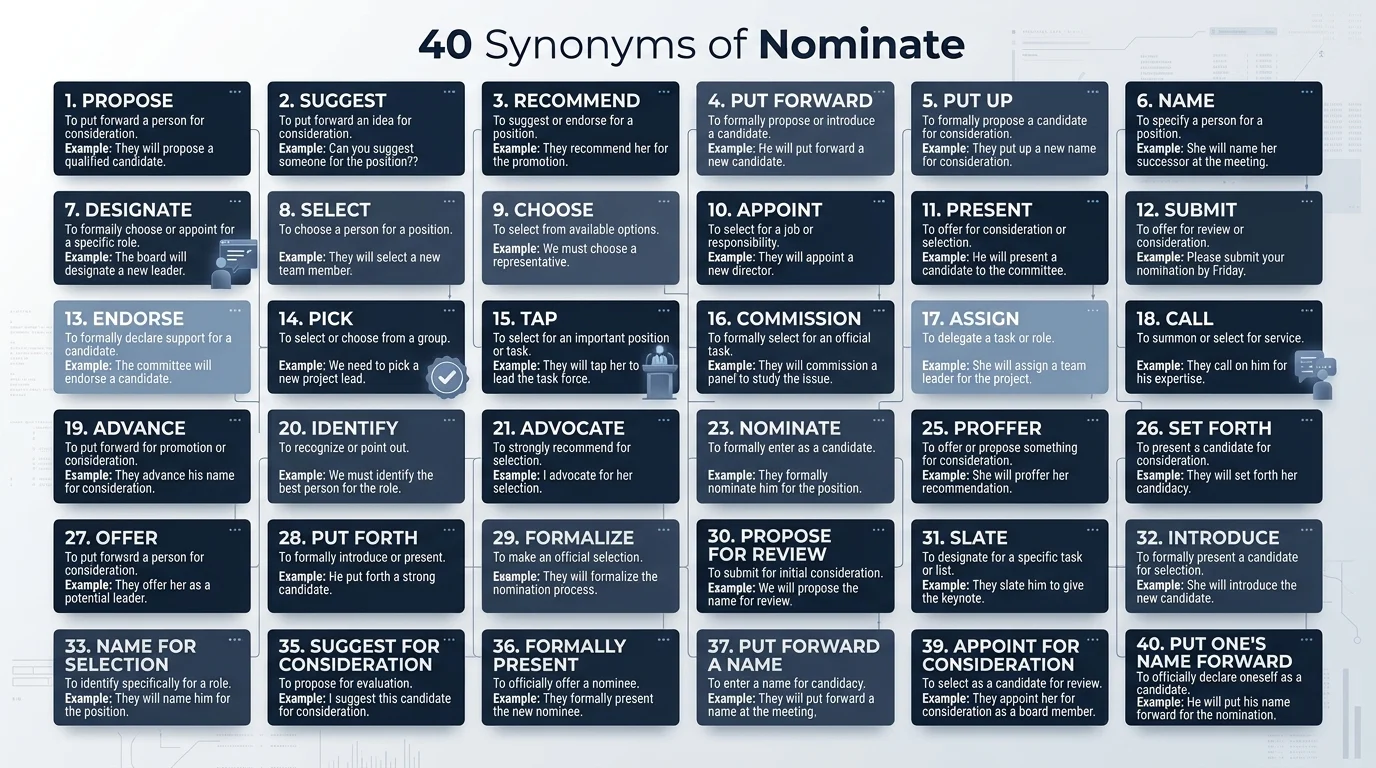
Nominate means to formally suggest someone for a position, award, or honor. The best synonyms are propose, suggest, put forward, recommend, and put up. “Propose” is the most common professional alternative, while “suggest” works well in everyday conversation.
Top 10 Synonyms
- Propose
- Suggest
- Put forward
- Recommend
- Put up
- Submit
- Name
- Designate
- Appoint
- Select
Have you ever wanted to talk about suggesting someone for a job or award but didn’t know which word to use? “Nominate” is a common word, but using it too often can feel repetitive and overly formal.
English offers many alternatives, each with its own flavor. Some are perfect for business meetings, others for casual conversations, and some for formal award ceremonies.
In this guide, you’ll learn 30 powerful synonyms for “nominate.” You’ll discover exactly when to use each one, how formal they are, and common mistakes to avoid. By the end, you’ll express yourself with confidence and variety.
What Does “Nominate” Mean?
Definition
Nominate means to formally suggest someone for a position, duty, award, or honor. It involves putting a person’s name forward for consideration. For example, you nominate someone for an award, a job position, or a leadership role. It is often a serious and official action.
Pronunciation
| Feature | Value |
|---|---|
| US IPA | /ˈnɒmɪneɪt/ |
| UK IPA | /ˈnɒmɪneɪt/ |
| Syllables | 3 (nom-i-nate) |
| Tip | Stress the first syllable: “NOM-ih-nate” |
Grammar
| Grammar Feature | Information |
|---|---|
| Part of Speech | Verb (transitive) |
| Common Position | After the subject, before an object |
| Typical Pattern | Subject + nominate + object + for/as |
Examples:
- “They nominated her for the award.”
- “The committee nominated him as the new chairperson.”
- “She was nominated for best actress.”
Grammar Note: “Nominate” is a transitive verb, so it always needs an object (someone you are nominating). You can nominate someone for something or as something.
Word Family
| Word | Part of Speech | Meaning |
|---|---|---|
| Nominate | Verb | To formally suggest someone for a position or honor |
| Nomination | Noun | The act of nominating someone |
| Nominee | Noun | A person who has been nominated |
| Nominator | Noun | A person who nominates someone |
| Nominative | Adjective | Relating to nomination (grammar) |
15 Synonyms of “Nominate”
Propose
Meaning: To put forward an idea or a person for someone to consider.
Best Used For: Business meetings, academic settings, formal suggestions.
Formality: Formal
Tone: Professional, Serious
Frequency: ⭐⭐⭐⭐⭐ (Very Common)
CEFR Level: B1
Example Sentence 1: “I propose Sarah for the position of team leader.”
Example Sentence 2: “The board proposed a new candidate for the vacancy.”
Usage Tip: “Propose” is very common and professional. Use it in meetings or formal written suggestions. It works for people, ideas, or plans.
Suggest
Meaning: To mention someone or something as a possible choice or idea.
Best Used For: Daily conversation, informal settings, friendly recommendations.
Formality: Informal
Tone: Friendly, Casual
Frequency: ⭐⭐⭐⭐⭐ (Very Common)
CEFR Level: A2
Example Sentence 1: “I suggest Maria for the project lead role.
Example Sentence 2: “She suggested her colleague for the promotion.”
Usage Tip: “Suggest” is less formal than “nominate” or “propose.” It’s perfect for everyday conversations when you want to recommend someone without being too official.
Common Confusion: Suggest vs Nominate. “Suggest” is informal and casual. “Nominate” is formal and official. Use “suggest” with friends, “nominate” in official settings.
Put forward
Meaning: To offer someone or an idea for others to consider.
Best Used For: Meetings, formal discussions, proposals.
Formality: Neutral/Formal
Tone: Proactive, Professional
Frequency: ⭐⭐⭐⭐ (Common)
CEFR Level: B1
Example Sentence 1: “The committee put forward three names for the position.”
Example Sentence 2: “She put forward her colleague for the award.”
Usage Tip: “Put forward” is a very natural phrasal verb. It’s common in British English and works well in both spoken and written professional contexts.
Recommend
Meaning: To say that someone is good for something and should be chosen.
Best Used For: Job references, academic applications, everyday suggestions.
Formality: Neutral
Tone: Supportive, Positive
Frequency: ⭐⭐⭐⭐⭐ (Very Common)
CEFR Level: B1
Example Sentence 1: “I highly recommend James for this position.”
Example Sentence 2: “Her teacher recommended her for the scholarship.”
Usage Tip: “Recommend” implies that you trust and believe in the person. It’s warmer and more personal than “nominate” or “propose.”
Put up
Meaning: To suggest someone for a position, especially in an election or competition.
Best Used For: Elections, competitions, informal contexts.
Formality: Informal
Tone: Casual, Direct
Frequency: ⭐⭐⭐ (Moderate)
CEFR Level: B1
Example Sentence 1: “The party put up a new candidate for mayor.”
Example Sentence 2: “We put up my brother for the club presidency.”
Usage Tip: “Put up” is an informal phrasal verb. It’s common in British English, especially in political contexts. Use it in casual conversations.
Submit
Meaning: To formally give or present something for consideration or judgment.
Best Used For: Formal written proposals, applications, official contexts.
Formality: Formal
Tone: Official, Professional
Frequency: ⭐⭐⭐⭐ (Common)
CEFR Level: B1
Example Sentence 1: “We need to submit the candidate’s name by Friday.”
Example Sentence 2: “She submitted her application for the teaching position.
Usage Tip: “Submit” is used when you formally present something for approval. It works for names, documents, applications, and proposals.
Name
Meaning: To officially choose someone for a position or say who someone is.
Best Used For: Appointments, formal announcements, official contexts.
Formality: Neutral/Formal
Tone: Official, Direct
Frequency: ⭐⭐⭐⭐ (Common)
CEFR Level: B1
Example Sentence 1: “The company named Tom as the new CEO.”
Example Sentence 2: “She was named the winner of the competition.”
Usage Tip: “Name” suggests a more decisive action than “nominate.” When you name someone, it often means the decision is already made, not just suggested.
Designate
Meaning: To officially choose someone for a particular purpose or role.
Best Used For: Official appointments, formal contexts, legal documents.
Formality: Formal
Tone: Official, Authoritative
Frequency: ⭐⭐⭐ (Moderate)
CEFR Level: B2
Example Sentence 1: “The principal designated Ms. Lee as the head of the department.”
Example Sentence 2: “The area was designated as a protected wildlife zone.”
Usage Tip: “Designate” is very formal. It implies an official choice or appointment. It’s often used for official roles, areas, or purposes.
Appoint
Meaning: To officially choose someone for a job or position.
Best Used For: Job appointments, official assignments, formal contexts.
Formality: Formal
Tone: Official, Authoritative
Frequency: ⭐⭐⭐⭐ (Common)
CEFR Level: B1
Example Sentence 1: “The university appointed a new dean.”
Example Sentence 2: “She was appointed to the board of directors.”
Usage Tip: “Appoint” means the decision is final. Unlike “nominate,” which suggests a proposal, “appoint” means the person has been chosen and will take the position.
Select
Meaning: To choose someone or something from a group.
Best Used For: Choosing from a group, everyday decisions, formal contexts.
Formality: Neutral
Tone: Practical, Decisive
Frequency: ⭐⭐⭐⭐⭐ (Very Common)
CEFR Level: B1
Example Sentence 1: “The committee selected Maria for the award.”
Example Sentence 2: “She was selected to represent her country.”
Usage Tip: “Select” is a safe, professional word for choosing someone from a group. It’s more formal than “pick” but less formal than “designate.”
Choose
Meaning: To decide which person or thing you want.
Best Used For: Daily conversation, decisions, informal contexts.
Formality: Informal
Tone: Simple, Direct
Frequency: ⭐⭐⭐⭐⭐ (Very Common)
CEFR Level: A2
Example Sentence 1: “We chose Emma to lead the project.”
Example Sentence 2: “He was chosen for the role because of his experience.”
Usage Tip: “Choose” is the most basic, everyday word for picking someone. Use it in casual conversations and simple decisions.
Elect
Meaning: To choose someone by voting.
Best Used For: Political contexts, organizations, official voting.
Formality: Formal
Tone: Democratic, Official
Frequency: ⭐⭐⭐⭐ (Common)
CEFR Level: B1
Example Sentence 1: “The members elected John as their president.”
Example Sentence 2: “She was elected to the city council.”
Usage Tip: “Elect” specifically involves voting. It’s the right word when people choose someone through a formal vote or election.
Put up for consideration
Meaning: To suggest someone or something for others to think about.
Best Used For: Business meetings, formal discussions, proposals.
Formality: Formal
Tone: Professional, Thoughtful
Frequency: ⭐⭐⭐ (Moderate)
CEFR Level: B2
Example Sentence 1: “I would like to put Sarah up for consideration for the award.”
Example Sentence 2: “Several names were put up for consideration.”
Usage Tip: “Put up for consideration” is a formal phrase. It’s often used in meetings to propose someone for a position or recognition.
Bring forward
Meaning: To suggest someone or something early in a discussion.
Best Used For: Meetings, formal contexts, introducing proposals.
Formality: Formal
Tone: Proactive, Professional
Frequency: ⭐⭐⭐ (Moderate)
CEFR Level: B2
Example Sentence 1: “The board brought forward the names of three candidates.”
Example Sentence 2: “She brought forward her suggestion for the committee.”
Usage Tip: “Bring forward” is a slightly formal phrasal verb. It means to introduce or suggest something at the beginning of a discussion.
Advance
Meaning: To suggest someone or something as a possible choice.
Best Used For: Formal contexts, professional discussions, suggestions.
Formality: Formal
Tone: Professional, Strategic
Frequency: ⭐⭐⭐ (Moderate)
CEFR Level: B2
Example Sentence 1: “The chairman advanced the name of a new board member.”
Example Sentence 2: “Several candidates were advanced for the position.”
Usage Tip: “Advance” is a formal word that means to put forward an idea or person. It’s often used in corporate or political settings.
Synonyms Comparison Table
| Synonym | Best Context | Formality | Tone | Frequency |
|---|---|---|---|---|
| Suggest | Daily conversation | Informal | Friendly | ⭐⭐⭐⭐⭐ |
| Propose | Business meetings | Formal | Professional | ⭐⭐⭐⭐⭐ |
| Recommend | Jobs, scholarships | Neutral | Supportive | ⭐⭐⭐⭐⭐ |
| Select | Choosing from a group | Neutral | Practical | ⭐⭐⭐⭐⭐ |
| Elect | Voting contexts | Formal | Democratic | ⭐⭐⭐⭐ |
| Appoint | Jobs, official roles | Formal | Official | ⭐⭐⭐⭐ |
| Designate | Official appointments | Formal | Authoritative | ⭐⭐⭐ |
| Put forward | Formal discussions | Neutral/Formal | Professional | ⭐⭐⭐⭐ |
| Name | Official announcements | Formal | Direct | ⭐⭐⭐⭐ |
Best Synonyms by Situation
| Situation | Best Synonym | Why It Works |
|---|---|---|
| Daily Conversation | Suggest | Casual, natural, and friendly |
| Business Email | Propose | Professional and clear |
| Academic Writing | Designate | Formal and precise |
| School Assignment | Recommend | Shows thoughtful support |
| Professional Meeting | Put forward | Professional and proactive |
| Award Ceremony | Nominate | The exact word for awards |
| Job Interview | Recommend | Shows confidence in the person |
| Political Context | Elect | Specifically for voting |
| Creative Writing | Nominate | Adds formal, official tone |
Formal vs Informal Synonyms
Formal Alternatives
| Synonym | Best Used For |
|---|---|
| Propose | Formal meetings, business proposals |
| Designate | Official appointments, legal contexts |
| Appoint | Job appointments, formal assignments |
| Submit | Formal applications, official proposals |
Neutral Alternatives
| Synonym | Best Used For |
|---|---|
| Recommend | Job references, supportive suggestions |
| Select | Choosing from a group |
| Name | Official announcements |
Informal Alternatives
| Synonym | Best Used For |
|---|---|
| Suggest | Casual conversations with friends |
| Choose | Everyday decisions |
| Put up | Informal contexts, British English |
Choosing the Right Level: Use formal words like “propose” and “designate” for official, serious situations. Use neutral words like “recommend” for supportive suggestions. Use informal words like “suggest” and “choose” for everyday conversations with friends.
Strong vs Mild Synonyms
Mild
Suitable for casual situations where the suggestion is not very official.
- Suggest
- Mention
- Recommend (mild version)
- Put up
Moderate
These suggest a more formal or official process.
- Propose
- Submit
- Put forward
- Select
Strong
High-intensity alternatives that suggest an official decision, not just a suggestion.
- Appoint (the decision is made)
- Designate (very official)
- Elect (involves voting)
- Name (official announcement)
- Nominate (official suggestion for honor)
How Intensity Changes Meaning: “I suggest John” is casual. “I nominate John” is official and formal. “John was appointed” means he got the job. “John was nominated” means he was suggested for it.
Real-Life Examples
School: “The students were asked to nominate a class president.”
Office: “I’d like to propose Maria as the new project manager.”
Business Email: “We would like to submit three candidates for your consideration.”
Meetings: “The committee put forward several names for the award.”
Award Ceremonies: “She was nominated for Best Actress at the Academy Awards.”
Daily Conversations: “I’d suggest Sarah for that role. She’d be perfect.”
Political Context: “The party elected a new leader yesterday.”
Academic Setting: “Her professor recommended her for the graduate program.”
Common Collocations
| Common Phrase | Better Alternative |
|---|---|
| Nominate someone for an award | Propose someone for an award |
| Nominate someone for a position | Recommend someone for a position |
| Nominate a candidate | Put forward a candidate |
| Get nominated | Get selected/Get chosen |
Common Phrases
Throw one’s hat in the ring: To enter a competition or election. (e.g., “She threw her hat in the ring for the leadership position.”)
Put someone’s name forward: To suggest someone for a role. (e.g., “We put his name forward for the board.”)
In the running: Being considered for something. (e.g., “She’s in the running for the award.”)
On the shortlist: Among the final candidates. (e.g., “He’s on the shortlist for the position.”)
Tip the scales: To make one candidate more likely to win. (e.g., “Her experience tipped the scales in her favor.”)
Context Guide
| Situation | Best Synonym | Reason |
|---|---|---|
| Essay | Designate / Propose | Formal and academic |
| Speech | Propose / Elect | Inspiring and official |
| Business Email | Submit / Propose | Professional and clear |
| Novel | Nominate / Appoint | Adds formal, literary tone |
| Presentation | Put forward | Professional and proactive |
| Conversation | Suggest / Choose | Casual and natural |
| Academic Writing | Designate / Select | Precise and formal |
| Award Ceremony | Nominate | The exact word used in awards |
Related Words
Near Synonyms
- Endorse: To publicly support someone. (e.g., “The senator endorsed the candidate.”)
- Back: To support someone financially or publicly. (e.g., “Several companies backed his campaign.”)
- Champion: To support something strongly. (e.g., “She championed the young artist.”)
- Advocate: To publicly support an idea or person.
Antonyms
- Reject: To refuse to accept someone.
- Dismiss: To decide that someone is not suitable.
- Oppose: To be against someone.
- Veto: To reject a proposal or nomination.
- Remove: To take someone out of a position.
Related Adjectives
- Nominal: Existing in name only.
- Nominee: The person who is nominated. (e.g., “The nominee gave a speech.”)
- Eligible: Qualified to be nominated. (e.g., “Only students with high grades are eligible.”)
- Unanimous: When everyone agrees on a nomination.
Related Nouns
- Nomination: The act of nominating someone. (e.g., “Her nomination was approved.”)
- Nominee: A person who has been nominated. (e.g., “The five nominees were announced.”)
- Candidate: A person who is being considered. (e.g., “There are three candidates for the job.”)
- Shortlist: A list of final candidates. (e.g., “She made the shortlist.”)
- Appointment: The act of appointing someone.
Related Verbs
- Appoint: To choose someone for a job.
- Elect: To choose someone by voting.
- Select: To choose from a group.
- Choose: To decide which person you want.
Frequently Asked Questions
What is another word for nominate?
Common synonyms for nominate include propose, suggest, put forward, recommend, and put up. The best choice depends on formality and context.
Which synonym sounds the most professional?
Propose and designate sound the most professional. “Propose” is a safe, formal choice for meetings, while “designate” is very official.
What is the strongest synonym for nominate?
Appoint and designate are the strongest. They suggest the decision is already made, not just suggested. “Nominate” itself means to suggest, not to choose.
Which synonym is best for essays?
Propose or designate are excellent for essays. They sound formal and academic. “Select” is also a good choice for more neutral writing.
What’s the difference between nominate and appoint?
“Nominate” means to suggest someone for a position or honor. “Appoint” means to officially choose someone for the position. A person is nominated, then appointed if chosen.
Which synonym is most common in everyday English?
Suggest is the most common synonym in everyday conversation. “Recommend” is also very common in both formal and informal contexts.
What is the opposite of nominate?
The most common opposites are reject, dismiss, and oppose. In official contexts, “veto” is also an opposite if the nomination is rejected.
Conclusion
“Nominate” is a powerful word, but it’s not the only one. By learning these synonyms, you now have more ways to express yourself in different situations.
The key to choosing the right word is understanding your context. For official awards and honors, “nominate” is perfect. For business proposals, use “propose” or “put forward.” For casual conversations with friends, “suggest” is your best bet.
The best way to improve is to practice. Try using one or two new synonyms each day. Listen for these words in meetings, award shows, and conversations. Your vocabulary will grow stronger and more natural.
