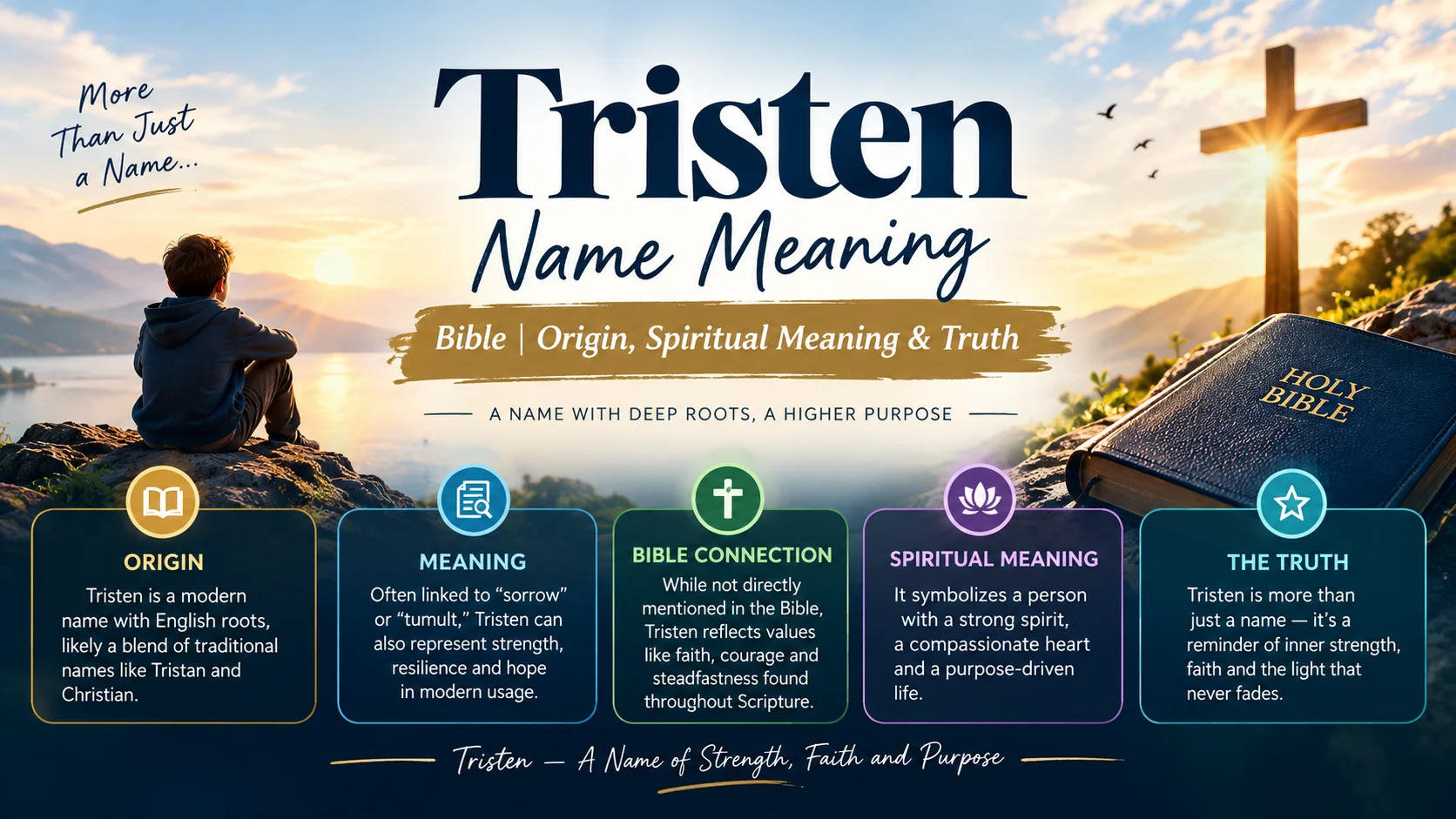
Tristen is not a biblical name and does not appear in Scripture. It is generally treated as a modern variant of Tristan, a name linked to Celtic and Welsh traditions. Its history also gained an association with sadness through medieval French literary tradition.
Tristen name meaning bible searches often come from parents, Christians, and name researchers who want to know whether this modern name has a direct connection to Scripture. The short answer is no. Tristen does not appear as a biblical personal name, and it does not have a Hebrew or Greek biblical origin.
However, that does not make the name meaningless.
Tristen is generally understood as a variant of Tristan. Major name references identify Tristen as a modern English variant of Tristan. The older name has a complicated history involving Celtic or Pictish forms and medieval French literary influence.
Most importantly, two ideas appear in discussions of its etymology. One connects the older name with a Celtic or Brittonic root associated with noise or tumult. Another association developed through Old French triste, meaning sad or sorrowful.
Therefore, it is important to separate historical meaning from personal spiritual interpretation.
A parent can give Tristen a faith-based significance. However, that spiritual interpretation should not be presented as the literal meaning assigned to the name by the Bible.
This distinction matters because many online baby-name pages attach biblical meanings to names that never appear in Scripture. A careful approach looks at historical linguistics first. Then, it considers how the name can be understood within a Christian worldview.
Quick Answer Box
| Meaning | Context | Primary Platforms | Example | Tone |
| Tristen is a variant of Tristan | Celtic, Welsh, Pictish, and medieval European naming history | Baby-name sites, social media, family naming discussions | “We chose Tristen because we liked its connection to Tristan.” | Personal and reflective |
| Often associated with “noise” or “tumult” | Proposed older Celtic or Brittonic connection | Name dictionaries and etymology resources | “Its older history is more complex than a simple Bible meaning.” | Historical |
| Later associated with sadness or sorrow | Medieval French literary influence | Name explanations and cultural discussions | “Some sources connect Tristan with the French triste.” | Literary |
| Not found in the Bible | Biblical name research | Bible study, Christian naming discussions | “Tristen is not a Hebrew or Greek biblical name.” | Factual |
| Can receive personal Christian significance | Modern faith context | Baby dedications, family traditions, prayer | “We associate the name with hope through difficult seasons.” | Spiritual |
What Does Tristen Name Meaning Bible Mean?
The most accurate answer is straightforward: Tristen is not a name found in the Bible.
There is no biblical passage that defines Tristen. There is also no established Hebrew or Greek root for the name. Instead, Tristen is normally treated as a variant spelling of Tristan.
The historical origin of Tristen
Tristen developed from the broader Tristan name family.
Behind the name Tristan, researchers point toward older forms such as Drust, Drustan, Drystan, and Trystan. These forms are associated with Pictish, Celtic, and Welsh naming traditions. The exact linguistic path remains complicated.
The medieval story of Tristan and Iseult also played a major role in the name’s history.
Tristan became a famous figure in medieval romance. Later traditions connected him with King Arthur’s world and the Knights of the Round Table. Consequently, the name developed a strong literary identity beyond its original linguistic roots.
Does Tristen mean “sad”?
The answer requires some nuance.
Many modern name sources list meanings such as “sad,” “sorrowful,” or “melancholy.” However, this does not necessarily represent the original meaning of the name.
Behind the Name explains that Tristan was probably derived from the older Pictish name Drustan. The spelling was later influenced by the Old French word triste, meaning “sad.”
Therefore, “sad” is better understood as part of the name’s historical development and literary association rather than as a simple original definition.
Does Tristen mean “noise” or “tumult”?
Some etymological sources connect the older Tristan family to a Brittonic or Celtic root associated with “noise,” “tumult,” or similar ideas. The precise reconstruction is debated, so readers should avoid treating one proposed root as an absolute fact.
This is why reputable name explanations often present several layers of history.
The spelling Tristen itself is comparatively modern. Behind the Name describes it as a variant of Tristan. Wiktionary likewise describes it as a rare nonstandard spelling of Tristan used as a modern given name.
Is Tristen Hebrew?
No.
Tristen is not generally classified as a Hebrew name. It is associated instead with the Tristan family of European names.
That distinction becomes important when someone claims that Tristen has a specific Hebrew biblical definition. There is no strong historical basis for presenting it as a Hebrew name.
Is Tristen Greek?
No.
Tristen does not originate as a Greek biblical name. Therefore, attempts to assign it a Greek New Testament definition should be treated carefully.
Is Tristen actually a Bible name?
No.
The Bible contains thousands of personal names. Tristen is not among them.
That does not make the name inappropriate for a Christian family. It simply means its origin should not be described as biblical.
Contextual Dynamics & Nuances of the Term
Understanding the name requires more than translating one word.
Names develop through languages, migration, storytelling, spelling changes, and cultural adoption. Tristen demonstrates this process particularly well.
Historical meaning versus spiritual meaning
These two concepts should remain separate.
Historical meaning asks where the name came from and what its linguistic roots may have meant.
Spiritual meaning asks what values or biblical themes a family chooses to associate with the name.
For example, a Christian family might connect the name with perseverance through sorrow. That can be a meaningful personal interpretation. However, it does not change the historical etymology.
This distinction protects readers from misleading claims.
Why the name can still have Christian significance
Christian naming does not require every name to appear in Scripture.
Many Christians use names from languages and cultures outside the biblical world. They may then connect those names with biblical virtues, prayers, family heritage, or personal testimony.
For example, parents might associate Tristen with:
| Personal theme | Possible Christian interpretation |
| Sorrow | God provides comfort during grief |
| Tumult | God brings peace during difficulty |
| Courage | Faith can remain strong during trials |
| Hope | Difficult seasons do not define the future |
| Compassion | Personal hardship can encourage empathy |
| Perseverance | Faith can continue during uncertainty |
These are interpretations, not dictionary definitions.
The importance of Psalm 30:5
Psalm 30:5 is sometimes chosen by Christian families because its message contrasts weeping with joy.
The verse is not a definition of Tristen. Instead, it can serve as a meaningful Scripture association for someone who connects the name with sorrow.
That distinction is especially useful when creating a baby-name dedication or family explanation.
A balanced spiritual interpretation
A balanced interpretation might be:
Tristen is a nonbiblical name with historical associations involving sorrow and older Celtic naming traditions. For a Christian family, those associations can inspire a message about hope, perseverance, comfort, and God’s presence during difficult seasons.
That statement respects both history and faith.
Real Life Conversation Examples Using Tristen Name Meaning Bible
People often encounter questions about names in conversations, baby-name forums, family discussions, and social media.
The following examples show how to discuss the subject naturally without overstating the evidence.
Conversation 1: A parent asks about the name
Parent: We are thinking about naming our son Tristen. Does it have a biblical meaning?
Friend: Tristen isn’t actually a biblical name. It’s generally considered a variant of Tristan.
Parent: So where does it come from?
Friend: Its history points toward older Celtic, Pictish, and Welsh forms. The Tristan tradition was also shaped by medieval French literature.
Parent: Can we still give it a Christian meaning?
Friend: Absolutely. You can connect it with a biblical theme such as hope, perseverance, or comfort. Just describe that as your family’s spiritual interpretation.
Conversation 2: Someone sees a misleading claim online
Friend: I saw that Tristen means “gift from God” in the Bible.
Reader: I would double-check that claim.
Friend: Why?
Reader: Tristen isn’t found in Scripture. Major name references identify it as a variant of Tristan instead.
Friend: So the “gift from God” meaning isn’t a direct biblical definition?
Reader: Correct. A family can personally associate the name with God’s blessing, but that is different from saying the Bible defines Tristen that way.
Conversation 3: Discussing the meaning “sad”
Person A: Isn’t Tristan supposed to mean sad?
Person B: That’s one commonly reported association.
Person A: Is that the original meaning?
Person B: Not necessarily. The history is more complicated. Tristan is probably connected to older names such as Drustan, while medieval French influence connected the name with triste, meaning sad.
Conversation 4: A Christian naming discussion
Parent: I love Tristen, but I’m worried because some sites say it means sorrowful.
Pastor: A name’s historical association does not determine a person’s character or future.
Parent: Could we still use it?
Pastor: Certainly. You can choose a Scripture that reflects the values you want to pray over your child.
Parent: So the verse would be a dedication rather than a translation?
Pastor: Exactly.
Conversation 5: Social media discussion
Commenter: Is Tristen a biblical name?
Reply: No. Tristen is generally considered a modern variant of Tristan, which has Celtic, Pictish, and Welsh connections.
Commenter: Does that mean Christians shouldn’t use it?
Reply: No. A name does not have to appear in the Bible to be used by a Christian family. The important thing is to distinguish its historical origin from any personal spiritual meaning.
Platform Specific Breakdown
The topic appears in several online environments. However, each platform encourages a slightly different style of discussion.
How It Is Used on Snapchat
Snapchat conversations tend to be informal and personal.
Someone might ask about a friend’s name after seeing a baby announcement. Another person may send a quick message about a name they heard at school or work.
A concise response works best:
“Tristen isn’t directly from the Bible. It’s a variant of Tristan with older Celtic and European roots.”
If the conversation continues, you can explain the connection with sorrow or tumult.
However, avoid presenting uncertain etymology as absolute fact.
Snapchat also rewards short messages. Therefore, a long historical explanation may feel unnatural in casual chat.
The Role of Tristen Name Meaning Bible on TikTok
TikTok often turns name meanings into short educational videos.
Creators may use phrases such as:
“Biblical meaning of Tristen.”
“Is Tristen a Christian name?”
“Tristen meaning and origin.”
The problem is that short-form content can remove important context.
A creator might say that Tristen means “sad.” Another might say “tumult.” A third might assign a completely different spiritual definition.
These differences do not necessarily mean that one source is deliberately misleading. Name etymology can involve competing theories and centuries of linguistic development.
Therefore, viewers should distinguish between:
| TikTok claim | Better interpretation |
| “Tristen is a Bible name.” | Not supported by standard biblical naming records |
| “Tristen means sad.” | A common later association |
| “Tristen means noise.” | Connected by some sources to older Celtic or Brittonic roots |
| “Tristen means blessed.” | A possible personal interpretation, not a documented biblical definition |
| “Tristen is Hebrew.” | Not supported by the standard etymology |
Instagram and Texting Dynamics
Instagram encourages visually attractive name explanations.
A birth announcement might say:
“Welcome, Tristen. A name chosen with faith, hope, and love.”
That wording is perfectly reasonable.
However, it does not claim that the Bible defines the name.
In texting, the discussion may be even shorter:
“Is Tristen biblical?”
“Not directly. It’s a Tristan variant with Celtic and medieval European history.”
“Can it still have a Christian meaning?”
“Yes. You can connect it with a verse or personal faith theme.”
This approach keeps the conversation accurate while respecting the family’s beliefs.
Alternative Meanings & NLP Variations of the Phrase
Search engines and AI systems may interpret several phrases as closely related to the same question.
Understanding those variations helps explain why different results appear.
Common search variations
People may search for:
“Tristen meaning in the Bible”
“Tristen biblical meaning”
“Does Tristen appear in the Bible?”
“Is Tristen a Christian name?”
“Tristen spiritual meaning”
“Tristen Hebrew meaning”
“Tristen origin”
“Tristan biblical meaning”
“What does the name Tristen mean?”
These queries overlap, but they do not ask exactly the same thing.
“Biblical meaning” versus “spiritual meaning”
A biblical meaning should come from Scripture or the linguistic traditions behind biblical languages.
A spiritual meaning can be a later interpretation.
For example, someone may say:
“I associate Tristen with hope after sorrow.”
That is a spiritual interpretation.
It would be inaccurate to rewrite that as:
“The Bible says Tristen means hope.”
The first statement describes a personal association. The second makes a historical claim without evidence.
“Tristen” versus “Tristan”
This spelling distinction matters.
Tristen is generally treated as a variant of Tristan.
Therefore, researching only the spelling “Tristen” may produce fewer historical sources.
Searching the broader Tristan family can reveal information about:
- Drust
- Drustan
- Drystan
- Trystan
- Tristan
- Tristen
- Tristin
- Triston
- Tristram
These forms are related, but they should not automatically be treated as identical names with identical histories.
Modern spelling and historical origin
Modern parents often choose alternative spellings.
The spelling Tristen gives the name a contemporary English appearance while retaining the pronunciation associated with Tristan.
Consequently, the modern spelling does not create a new biblical root.
Misinterpretations: When NOT to Use Tristen Name Meaning Bible
The phrase should not be used to imply that Scripture gives Tristen a direct definition.
Do not claim that Tristen is Hebrew
There is no strong basis for classifying Tristen as a Hebrew biblical name.
Do not invent a Bible verse for the name
No verse says, “Tristen means…” because Tristen does not appear as a biblical name.
Instead, choose a verse based on the qualities or message you want to associate with the child.
Do not confuse spiritual symbolism with etymology
A Christian family may connect the name with hope.
That does not mean hope is its historical translation.
Likewise, a family may connect it with God’s comfort.
That does not make it a biblical Hebrew name.
Do not treat one etymological theory as settled fact
The history of Tristan involves several languages and traditions.
Behind the Name describes the name as probably coming from the Pictish Drustan and notes later French influence from triste.
Other sources emphasize Celtic or Brittonic connections involving noise or tumult.
Therefore, responsible writing should acknowledge the layered history.
Do not assume “nonbiblical” means “un-Christian”
These concepts are different.
A name can have a Celtic, French, Germanic, Latin, or other cultural origin and still be used by Christian families.
The Bible does not require every Christian’s given name to originate in Hebrew or Greek.
How to Respond in Chat Comfortably
If someone asks you about the name, keep the answer direct.
Short response
“Tristen isn’t directly a biblical name. It’s generally considered a variant of Tristan, with older Celtic and Pictish connections and later French literary influence.”
Friendly response
“Tristen is a modern form of Tristan rather than a Bible name. Its history is connected with Celtic and medieval European traditions. You can still give it a personal Christian meaning.”
Detailed response
“Tristen doesn’t appear in the Bible or have a Hebrew or Greek biblical origin. It’s generally treated as a variant of Tristan. The older name has a complex Celtic and Pictish history, while medieval French influence helped create its association with sadness. If you’re choosing it for a Christian child, you can pair it with a Scripture about hope, comfort, courage, or perseverance.”
If someone says it means “gift from God”
A comfortable response is:
“I haven’t found reliable evidence that the historical name means ‘gift from God.’ It is better described as a variant of Tristan. A family can certainly use ‘gift from God’ as a personal message, but that isn’t the documented etymology.”
If someone asks whether it is suitable for Christians
You can say:
“Its origin isn’t biblical, but that doesn’t automatically make it unsuitable for Christians. The key distinction is between historical origin and the meaning your family chooses to attach to it.”
FAQs
1. Is Tristen a biblical name?
No. Tristen does not appear as a personal name in the Bible. Standard name references instead identify it as a variant of Tristan.
2. What does Tristen mean spiritually?
There is no official biblical spiritual definition. However, families may connect the name’s associations with sorrow or difficulty to themes such as hope, comfort, perseverance, and restoration.
3. Does Tristen mean “gift from God”?
There is no reliable evidence that this is the historical meaning of the name. It may be used as a personal spiritual interpretation, but it should not be presented as a biblical translation.
4. Is Tristen a Christian baby name?
It can be used by Christian families, but it is not a biblical name in the strict historical sense. Christian parents can choose nonbiblical names and give them personal significance through family tradition and faith.
5. Where does Tristen come from?
Tristen is generally treated as a variant of Tristan. Tristan has a complex history involving older Pictish, Celtic, and Welsh forms, followed by medieval French literary development.
6. Does the name have a connection with sadness?
Yes, sadness is a well-known association with Tristan. The association was strengthened by the Old French triste and the tragic medieval Tristan and Iseult tradition.
7. Does the name also mean “noise” or “tumult”?
Some etymological sources connect older forms of Tristan with Celtic or Brittonic terms associated with noise or tumult. Because the etymology is complex, this should be presented as a proposed historical connection rather than an unquestionable definition.
8. Is Tristen the same as Tristan?
Not exactly. Tristen is generally considered a variant spelling of Tristan. The names share the same broader naming tradition, but the spellings developed differently.
9. What Bible verse can go with the name?
There is no officially assigned verse. A family can choose Scripture according to the qualities they want to emphasize. Psalm 30:5 is one possible thematic choice because it contrasts sorrow with renewed joy.
10. Is Tristen a common American name?
Tristen has had measurable use in the United States, particularly as a masculine given name. Nameberry’s presentation of Social Security data shows that its U.S. ranking declined from the 2010s into the 2020s, reaching #1,512 for boys in 2025.
Conclusion
The most accurate answer to the Tristen name meaning bible question is simple: Tristen is not a biblical name.
It does not appear in Scripture. It does not have an established Hebrew or Greek biblical origin.
Instead, Tristen is generally recognized as a variant of Tristan. Tristan has a complex European history connected with older Pictish, Celtic, and Welsh forms. Medieval French influence also contributed to its association with sadness.
That history does not prevent a Christian family from choosing the name.
In fact, it creates an opportunity to distinguish between etymology and personal meaning.
Etymology explains where a name came from. Personal meaning explains why someone chooses it.
A family might choose Tristen because they love the sound. Another family might appreciate the Tristan literary tradition. Someone else might connect its themes of sorrow and difficulty with a Christian message of hope.
All three approaches can exist without changing the historical facts.
The most responsible explanation is therefore neither overly negative nor artificially religious.
Tristen is a modern name variant with a rich and complicated history. Its connection with biblical Scripture is indirect rather than literal. Its spiritual significance depends on how an individual or family chooses to interpret and dedicate the name.
For anyone researching the name, that distinction provides the clearest answer: Tristen is not a biblical name, but it can still carry personal Christian significance.
