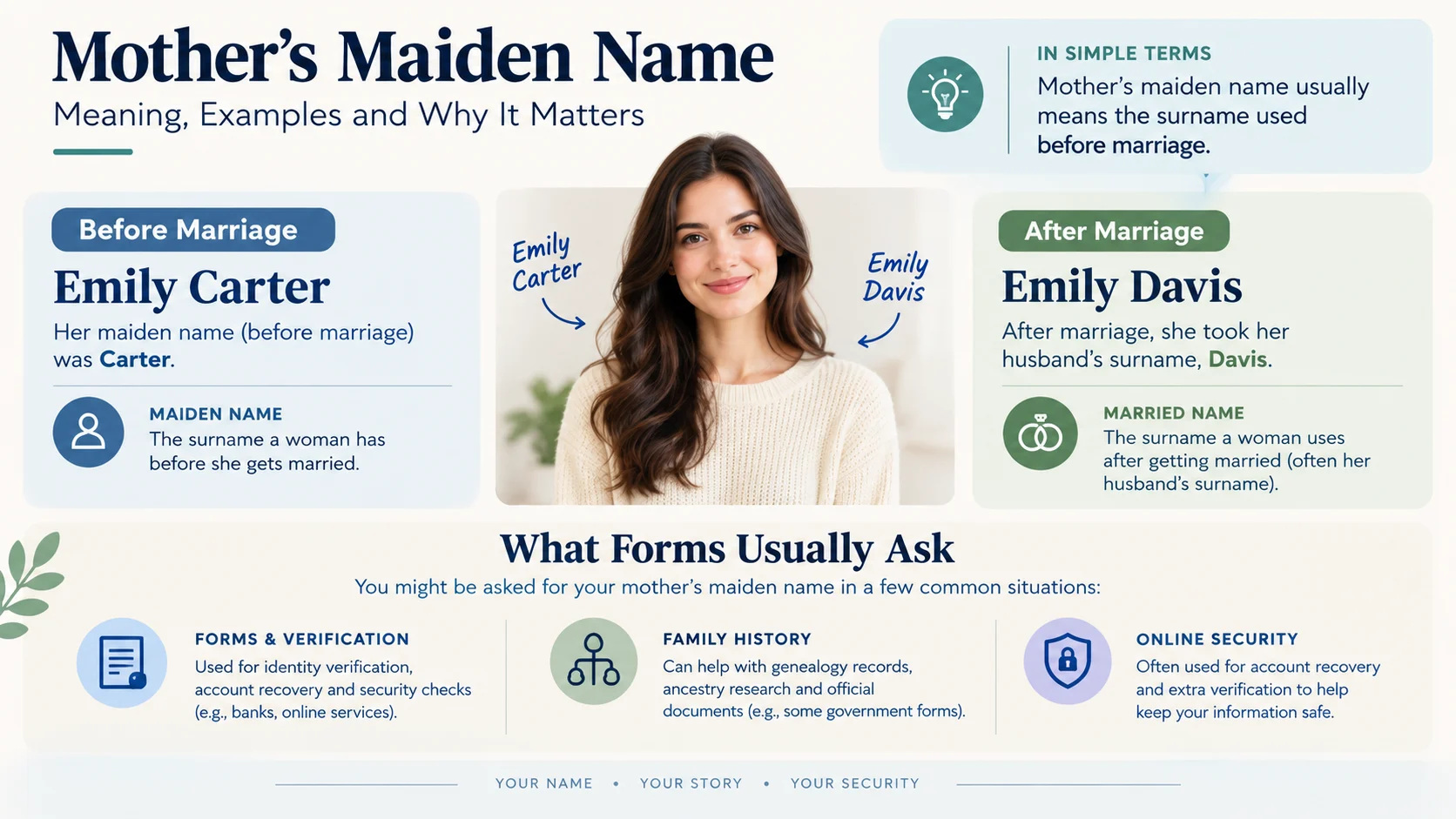
Mother maiden name meaning refers to a woman’s family name before marriage, commonly the surname she was born with or used before changing her name. Forms may request a mother’s maiden name for identification, family history, or account verification.
Mother maiden name meaning is a common question when completing forms, answering security questions, or researching family history. The phrase refers to a mother’s surname before marriage, although the exact information requested can depend on the context.
You may encounter this term while opening a bank account, recovering an online account, filling out an application, or discussing family backgrounds. For example, a form might ask, “What is your mother’s maiden name?” It usually wants the surname your mother used before marriage.
However, the answer is not always as straightforward as it appears. Some people keep their original surname after marriage. Others change their name more than once. Adoption, divorce, cultural naming traditions, and legal name changes can also affect which surname a form expects.
This guide explains the definition, practical uses, common misunderstandings, and ways to respond naturally in American English. It also covers how to interpret the question when a person has two surnames, no traditional maiden name, or a family naming arrangement that differs from the question’s assumptions.
Quick Answer Box
| Category | Explanation |
| Meaning | A mother’s surname before marriage or a relevant name change |
| Context | Security questions, forms, identity verification, and genealogy |
| Primary Platforms | Banking websites, government forms, online accounts, family history resources |
| Example | “What is your mother’s maiden name?” |
| Tone | Usually neutral, formal, or administrative |
The phrase is generally not internet slang. It is a conventional English expression used in personal information requests.
What Does Mother Maiden Name Meaning Refer To?
The expression describes a woman’s surname before marriage. In many traditional naming systems, a woman may use her family surname before marriage and adopt a spouse’s surname afterward. The original surname is then called her maiden name.
However, a maiden name is not necessarily a name that a woman has legally changed. Some women retain their birth surname throughout life. In that situation, the surname before marriage and the current surname may be identical.
FamilySearch defines a maiden name as a woman’s surname before marriage. Its naming guidance also recognizes that naming conventions vary across cultures and that some people have multiple surnames.
FamilySearch
+1
Understanding the Main Terms
| Term | Meaning |
| Maiden name | A woman’s surname before marriage |
| Mother’s maiden name | The mother’s surname before marriage |
| Birth surname | A surname associated with a person’s birth or original family record |
| Married name | A surname adopted after marriage, when applicable |
| Current legal surname | The surname a person currently uses in official legal records |
| Family name | Another term for a surname or last name |
These terms can overlap, but they are not always interchangeable.
For example, imagine a woman named Sarah Elizabeth Carter before marriage. After marriage, she uses Sarah Elizabeth Williams.
Her information could be represented as follows:
| Information | Example |
| First name | Sarah |
| Middle name | Elizabeth |
| Maiden surname | Carter |
| Married surname | Williams |
| Current legal surname | Williams, if legally adopted |
If a form asks for her maiden surname, the expected answer would generally be Carter, not Williams.
Why the Word “Maiden” Is Used
The word maiden has historically been used to refer to an unmarried woman. In the phrase “maiden name,” it identifies the surname associated with a woman before marriage.
Modern usage, however, does not mean every woman must change her surname after marriage. The expression remains common even when a person retains their original family name.
Is It the Same as a Mother’s Birth Name?
Not always.
In everyday forms, the question often refers to the surname your mother used before marriage. In some official contexts, the wording may instead specify the surname recorded on her birth certificate or another legal document.
For example, Manitoba’s vital statistics guidance explains that a mother’s maiden last name is generally the last name shown on her birth certificate. It also addresses cases where a mother retains the same surname after marriage.
Province of Manitoba
This distinction matters when completing a formal application. Always follow the form’s own instructions rather than assuming every organization uses the same definition.
Contextual Dynamics and Nuances of the Term
The meaning stays relatively consistent, but the correct answer can change depending on a person’s family history, cultural practices, and the wording of a form.
1. When a Mother Keeps Her Original Surname
Some women do not change their surname after marriage. Their original surname may remain their current legal surname.
Example:
The mother was named Maria Lopez before marriage. She continues using Lopez after marriage.
If a form asks for her maiden name, Lopez may still be the appropriate answer.
You do not need to invent a different surname simply because the question contains the word “maiden.”
2. When a Mother Changes Her Surname After Marriage
A woman may adopt her spouse’s surname after marriage. In that case, her previous surname is often the information requested.
Example:
Before marriage: Jennifer Taylor
After marriage: Jennifer Brown
Mother’s maiden surname: Taylor
The answer normally refers to Taylor, not Brown.
3. When a Mother Has Been Married More Than Once
This situation requires extra care.
A person may have used more than one surname during their lifetime. The relevant answer depends on how the question is written and what the organization defines as the requested information.
| Form wording | What to consider |
| Mother’s maiden name | Usually the surname before her first marriage |
| Mother’s birth surname | Usually the surname associated with her birth records |
| Mother’s previous last name | Could refer to a name used before a particular change |
| Mother’s current legal name | Her present official surname |
These expressions should not automatically be treated as identical. If the form is unclear, consult the organization rather than guessing.
4. Adoption and Name Changes
Adoption can create additional complexity. A person may have a birth surname, an adoptive family surname, and later legal name changes.
The correct response depends on the specific wording of the question and the relevant records. A form that asks for a biological mother’s maiden surname may not mean the same thing as a form asking for the legal surname of the mother who raised you.
For example, the National Library of Medicine’s Common Data Elements repository includes a field for a biological mother’s maiden name and defines it with reference to official records.
NIH Common Data Elements Repository
5. Cultural Naming Traditions
Not all families follow the same surname system.
Some cultures use more than one family name. Others may not traditionally use a hereditary surname in the same way as common American naming conventions.
FamilySearch notes that naming systems can include both the mother’s and father’s family names. In some traditions, the idea of a single maiden surname may not map neatly onto the family’s naming structure.
FamilySearch
Consequently, a person should not assume that every mother has one universally defined maiden name.
6. The Difference Between a Maiden Name and a Middle Name
A maiden name is usually a surname. A middle name is a separate part of a person’s name.
For example:
| Name part | Example |
| First name | Emily |
| Middle name | Rose |
| Maiden surname | Johnson |
| Married surname | Davis |
If a form asks for your mother’s maiden name, it generally does not want her middle name.
7. What If the Mother Never Married?
The term can still create confusion when a woman has never married.
If the form asks for her maiden name but she has never changed her surname, the relevant surname may be the one she has always used. However, the organization may define the field differently.
When the instructions specifically refer to a birth surname, use the name that matches those instructions.
Real Life Conversation Examples Using Mother’s Maiden Name
The following conversations demonstrate how people might discuss the term in everyday American English. The phrase is more common in forms and administrative situations than in casual social media slang.
Conversation 1: Filling Out a Bank Form
Alex: I’m completing my bank application. It asks for my mother’s maiden name.
Jordan: It usually means her last name before marriage.
Alex: So I should enter the surname she used before she married my dad?
Jordan: Yes, if that’s what the bank’s instructions mean.
Alex: Got it. I’ll check the form’s requirements first.
Why this works: The conversation explains the phrase without treating the answer as universal across every institution.
Conversation 2: Asking a Parent
Mia: Mom, I’m filling out a family history form. Do you remember your surname before marriage?
Mom: Yes, it was Anderson.
Mia: Thanks. The form calls it your maiden name.
Mom: That’s right.
Why this works: The speaker uses a polite, direct question. It avoids assuming that the requested information is automatically public.
Conversation 3: When the Mother Kept Her Surname
Chris: The application asks for my mother’s maiden name. My mom never changed her last name.
Taylor: Then her original surname may be the answer.
Chris: Even though it’s also her current name?
Taylor: Usually, yes, but check the form’s instructions if it asks for a specific legal record.
Why this works: The exchange distinguishes the meaning of the term from whether a surname changed.
Conversation 4: A Question About Family History
Sam: I’m researching my grandmother’s family. I found her married surname, but I can’t identify her maiden name.
Riley: You may need earlier records, such as a birth certificate or marriage record.
Sam: Would a family tree help?
Riley: It could, but you should verify information with reliable historical records.
Why this works: The conversation separates research leads from verified evidence.
Conversation 5: A Security Question
Taylor: A website asks for my mother’s maiden name to recover my account.
Morgan: Does it offer another verification method?
Taylor: Yes, it has an authentication app option.
Morgan: You may want to review the site’s security choices and use a stronger authentication method if available.
Why this works: The dialogue treats the question as a security concern rather than assuming that a family surname is a strong secret.
Platform Specific Breakdown
The phrase is not primarily a Snapchat, TikTok, or Instagram slang term. It appears across many types of digital forms and conversations. Its usage is determined more by the task than by a particular social media platform.
How It Is Used on Snapchat
On Snapchat, people may discuss personal information, family details, or online account security. However, the phrase itself does not have a recognized Snapchat specific slang definition established by the term’s conventional meaning.
For example:
User A: Why does this account recovery page ask for my mother’s maiden name?
User B: That’s a traditional identity verification question.
User A: Is there another way to verify my account?
User B: Check whether the service offers an authentication code or another recovery method.
The important distinction is between a platform’s interface and the ordinary definition of the phrase. A question appearing on Snapchat does not automatically give the phrase a new meaning.
The Role of Mother’s Maiden Name on TikTok
TikTok content may discuss family history, privacy, forms, or identity protection. A creator could explain the expression in an educational video, but the phrase does not inherently describe a TikTok trend, meme, or slang category.
For instance, a video might say:
“If a form asks for your mother’s maiden name, it usually wants her surname before marriage.”
This is an explanatory use of standard English.
A separate video might discuss why traditional security questions can create privacy risks. That discussion concerns account protection, not a new definition of the phrase.
Instagram and Texting Dynamics
On Instagram or in text messages, the phrase can appear when people share advice about paperwork or ask family members for historical information.
Example text message:
“Hey, I’m completing a form. It asks for Mom’s maiden name. Do you know which surname they mean?”
A natural reply might be:
They usually mean the last name she had before marriage. Check the form instructions, though.”
In casual messaging, shorter expressions may be more natural:
| Formal wording | Casual wording |
| What was your mother’s surname before marriage? | What was your mom’s last name before marriage? |
| The form requests your mother’s maiden name. | The form wants your mom’s old last name. |
| Please provide the requested surname. | Enter the last name the form asks for. |
The phrase “old last name” is understandable in informal speech, but it can be less precise. A surname used before marriage is not necessarily obsolete or invalid.
Alternative Meanings
Understanding related expressions helps readers interpret forms, search queries, and conversational questions more accurately.
Common Semantic Variations
| Phrase | Intended meaning |
| Mother’s maiden name | Mother’s surname before marriage |
| Mom’s maiden name | Informal version of the same phrase |
| Mother’s last name before marriage | Plain language explanation |
| Mother’s birth surname | Surname associated with birth records, depending on context |
| Mother’s previous surname | A surname used earlier, potentially before a specific name change |
| Maternal family name | A family name associated with the mother’s side |
| Mother’s original last name | Informal expression that may refer to an earlier surname |
These phrases are related, but they are not always exact substitutes.
For example, “mother’s birth surname” can be more precise than “mother’s maiden name” when a form explicitly requests the surname recorded at birth. Conversely, “previous surname” could refer to a name used before a later legal change.
Search Intent Behind the Keyword
People searching for the phrase may have different goals.
| Search intent | Likely need |
| Definition | Understand the meaning |
| Form completion | Know what information to enter |
| Security question | Understand why a website asks |
| Family history | Identify an earlier surname |
| Translation or language | Find a simpler English explanation |
| Personal situation | Interpret a naming arrangement |
A useful answer should address the specific goal rather than provide a single definition without context.
Related Questions Users Often Ask
The following questions reflect natural variations in how people seek clarification:
What does my mother’s maiden name mean?”
This asks for a definition in plain language.
“Is my mother’s maiden name her last name before marriage?”
This asks for confirmation of the usual meaning.
“What if my mom never changed her name?”
This asks about an exception to the traditional marriage name change pattern.
“Does maiden name mean middle name?”
This asks about the difference between a surname and another name component.
“Why does my bank ask for my mother’s maiden name?”
This asks about the purpose of a security or identity verification question.
Linguistic Comparison: Formal and Informal English
The expression appears in both formal and informal communication, but its surrounding language changes.
| Formal English | Informal English |
| Please enter your mother’s maiden name. | What’s your mom’s last name before marriage? |
| Provide the surname recorded before marriage. | Enter the name your mom used before she got married. |
| The application requests your mother’s maiden surname. | The form asks for your mom’s old last name. |
Formal wording is common in administrative documents. Informal wording is common in conversation.
However, informal expressions can be less exact. For example, “old last name” may refer to a previous surname after divorce, while “maiden name” conventionally refers to the surname before marriage.
Misinterpretations:
Although the phrase is widely understood, it is not appropriate for every naming situation. The most important step is to identify what the question actually asks.
Misinterpretation 1: Assuming It Means the Current Last Name
A mother may have changed her surname after marriage. If the form asks for her maiden name, entering her current surname could provide the wrong information.
Example:
Mother’s surname before marriage: Miller
Current surname: Thompson
Requested information: Miller, if the form uses the conventional definition.
The current surname is relevant only if the form specifically asks for it.
Misinterpretation 2: Assuming Every Woman Changes Her Name
Some women retain their original surname after marriage. Others use a hyphenated surname or another naming arrangement.
A person should not be pressured to identify a different surname simply because a form uses traditional wording.
Misinterpretation 3: Confusing Maiden Name With Birth Name
These terms can overlap, but the distinction matters in official records.
A person may have changed their surname through adoption, legal action, or another process. Therefore, a question about a birth surname may not be identical to a question about the surname before marriage.
Misinterpretation 4: Treating the Phrase as Internet Slang
The phrase is standard personal information terminology. It is not inherently a coded insult, meme, or secret slang expression.
If someone asks about it in a social media comment, the meaning still depends on the surrounding conversation. A person may be discussing paperwork, genealogy, or privacy.
Misinterpretation 5: Assuming It Is Always a Secure Secret
Historically, organizations have used family-based questions for identity verification. However, a mother’s surname may be discoverable through public records, family trees, or social media.
West Virginia’s privacy guidance has warned that a mother’s maiden name can be a weak security question because information may be available through public sources.
privacy.wv.gov
+1
Consequently, users should not treat this information as a strong password.
Misinterpretation 6: Providing Unnecessary Personal Information
If a website asks a personal question, first consider whether the request is legitimate and whether another verification method is available.
Do not share sensitive family information in a public comment or with an unknown person simply because they ask.
How to Respond in Chat Comfortably
The right response depends on whether someone is asking for a definition, requesting information, or discussing a form.
When Someone Asks for the Meaning
Question: “What does mother’s maiden name mean?”
Natural response:
It means your mother’s last name before she got married. If she never changed her surname, it may be the same as her current last name.
This answer is short, clear, and suitable for casual conversation.
When Someone Asks You to Complete a Form
Question: “What should I enter for my mother’s maiden name?”
Natural response:
Usually, you enter your mother’s surname before marriage. Check the form’s instructions if it asks for a specific legal or birth record.
This response avoids treating every form as identical.
When You Are Unsure of the Information
Question: “Do you know your mother’s maiden name?”
Natural response:
I’m not sure. I’ll need to check with my family or look at the relevant records.
You do not need to guess. Accuracy matters more than speed when completing official paperwork.
When You Want to Protect Your Privacy
Question: “What’s your mother’s maiden name?”
Natural response:
I prefer not to share personal family information.
Or:
What is the purpose of the question?
If the request is for an online account, look for a legitimate alternative verification method.
When the Question Is Ambiguous
You can ask a clarifying question:
Do you mean her surname before her first marriage, or the surname listed on her birth certificate?
This is especially helpful when completing a form with unusual or specific requirements.
Response Templates for Different Situations
| Situation | Suggested response |
| Definition request | It means your mother’s surname before marriage. |
| Form question | Check whether the form wants her pre marriage surname or a specific official record. |
| Family history | You may need to review earlier family records. |
| Unclear wording | Could you clarify which surname the form requests? |
| Privacy concern | I prefer not to share personal family details. |
| Security concern | Consider using a stronger authentication option if one is available. |
The goal is to respond accurately without sharing more personal information than necessary.
FAQs
1. What does mother’s maiden name mean?
It usually means the surname a mother used before marriage. The exact definition can depend on the wording of the form or record.
2. Is a maiden name the same as a last name?
A maiden name is a type of last name. It generally refers to a woman’s surname before marriage, rather than her current surname.
3. What if my mother never changed her surname?
Her original surname may also be her current surname. Follow the specific instructions on the form to determine what information is requested.
4. Is a mother’s maiden name the same as her birth surname?
They may be the same, but the terms are not always identical. A birth surname refers to the surname associated with birth records, while maiden name conventionally refers to the surname before marriage.
5. Why do banks ask for a mother’s maiden name?
Some institutions have historically used family information as a security question or identity verification factor. The practice has security limitations because the information may be discoverable through public sources.
privacy.wv.gov
+1
6. Can a mother have the same maiden name and married name?
Yes. A woman who retains her surname after marriage may have the same surname before and after marriage.
7. What should I enter if a form asks for my mother’s maiden name?
Enter the information that matches the form’s definition. If it asks for the surname before marriage, provide that surname. If the wording is unclear, contact the organization.
8. Is the phrase used on social media as slang?
It is primarily a standard term for a family surname before marriage. Its appearance on social media does not automatically create a separate slang meaning.
9. Can I find a mother’s maiden name in family records?
Potentially. Birth certificates, marriage records, family documents, and genealogy resources may contain relevant information. Availability depends on the jurisdiction, record type, and privacy restrictions.
10. Should I use my mother’s maiden name as a password?
Using personal information as a password is generally a poor security practice. Consider a unique, strong password and available multifactor authentication instead. Do not reuse a family surname as a secret across accounts.
Conclusion:
Mother maiden name meaning is straightforward in its conventional use. It generally refers to a mother’s surname before marriage. However, the correct interpretation depends on the wording of the form, family naming history, and relevant legal or cultural context.
The phrase is not primarily internet slang. It is a standard expression that appears in administrative documents, family history research, and online security questions.
Understanding the distinction between maiden name, birth surname, current surname, and previous surname helps prevent mistakes. It also makes everyday communication more precise.
For forms, follow the instructions carefully. For family research, verify information through reliable records. For online security, avoid treating personal family information as a strong secret.
The most useful rule is simple: identify the exact information being requested before providing an answer.
