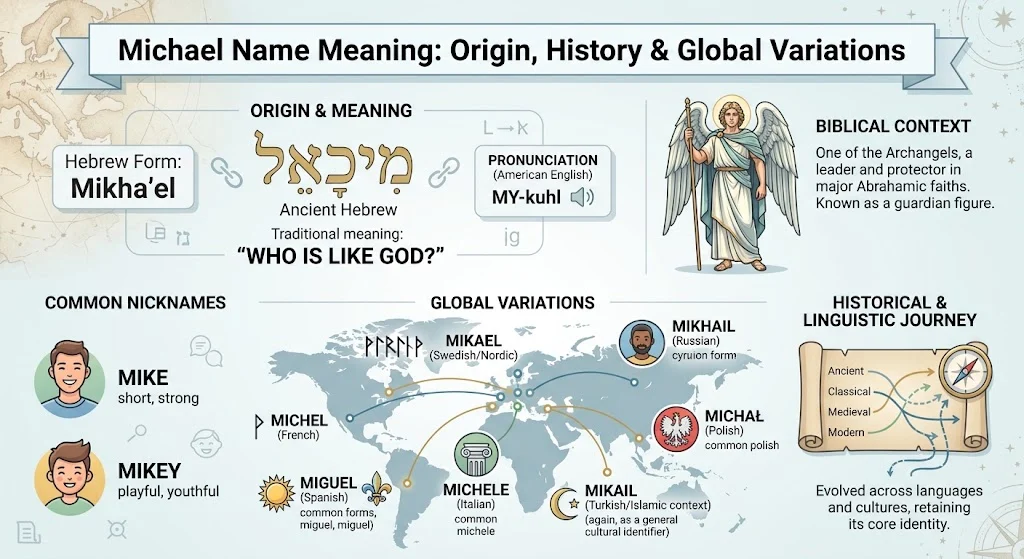
The michael name meaning comes from the Hebrew Mikha’el, meaning “Who is like God?” It is a rhetorical question expressing the belief that no one compares with God. The name also has strong biblical and historical associations.
Michael’s name meaning traces back to the Hebrew Mikha’el, a name traditionally understood as “Who is like God?”
The phrase is not a literal comparison. Instead, it works as a rhetorical question. Its traditional sense suggests that nobody is like God.
Michael has therefore carried religious, historical, and cultural significance for centuries. The name appears in Jewish, Christian, and Islamic traditions in related forms. It also became widespread across Europe and later became deeply established in American naming culture.
In the United States, Michael has an especially strong naming history. Social Security Administration data show that it ranked among America’s most frequently used boys’ names across much of the 20th and early 21st centuries. It ranked first for male births 44 times between 1926 and 2025.
However, historical popularity does not mean the name has the same position today. For births from 2020 through 2025, Michael ranked 16th among boys’ names in the Social Security Administration’s six-year dataset.
This guide explains the name from several angles. It covers its Hebrew roots, biblical references, pronunciation, international forms, nicknames, American popularity, cultural associations, and common questions.
QUICK ANSWER BOX
| Meaning | Context | Primary Platforms | Example | Tone |
| “Who is like God?” | Hebrew and biblical name | Baby names, genealogy, social profiles, naming discussions | “Michael is my son’s name.” | Traditional |
| Rhetorical question about God’s uniqueness | Religious tradition | Religious conversations and educational content | “The name points to God’s uniqueness.” | Reverent |
| Common male given name | Modern American English | Everyday conversation and online profiles | “Mike and Michael are related forms.” | Neutral |
| International biblical name | Global naming traditions | Multilingual naming contexts | Mikhail, Miguel, Mikael | Cultural |
What Does Michael’s Name Mean?
The core meaning is “Who is like God?” The name comes from the Hebrew מִיכָאֵל, commonly transliterated as Mikha’el or Mikhaʾel.
The Hebrew construction combines elements associated with “who,” “like,” and “God.” The final element, El, is a Hebrew term associated with God.
The meaning is a rhetorical question
This detail matters.
Michael does not mean that a particular person is “like God.” Instead, the traditional interpretation asks a question whose implied answer is that nobody is like God.
That gives the name a distinctly theological character.
The meaning can therefore be summarized in several closely related ways:
| Interpretation | Explanation |
| Who is like God? | Standard English rendering |
| Who can compare with God? | Interpretive paraphrase |
| No one is like God | Implied rhetorical answer |
| Who is equal to God? | Another explanatory rendering |
The first version is the most direct translation.
The other versions explain the idea rather than provide separate dictionary meanings.
Hebrew roots of the name
The original Hebrew form is important because later versions developed through different languages.
| Element | Traditional association |
| mi | Who |
| ke | Like |
| El | God |
| Mikha’el | Who is like God? |
Transliteration varies because Hebrew sounds do not always map perfectly onto English spelling.
Consequently, you may see forms such as Mikha’el, Mikhael, or Michael in historical and linguistic sources.
Biblical significance
Michael also has an important biblical identity.
In Daniel 12:1, Michael is described as a great prince associated with the protection of the people. In Revelation 12:7, Michael and his angels fight against the dragon.
These references helped give the name strong religious associations in Christian cultures.
However, the biblical meaning and the later cultural symbolism are not exactly the same thing. The name’s etymological meaning concerns God’s uniqueness. Its biblical associations also include protection, spiritual conflict, and heavenly authority.
Is Michael a religious name?
Yes, Michael has strong religious roots.
It originates in Biblical Hebrew. The name also appears in Christian and Islamic naming traditions through related forms. Behind the Name lists Mikha’il as the Arabic and Quranic form.
That said, modern use is not limited to religious families.
Michael is also a mainstream personal name in the United States. Many people use it as a traditional family name without attaching a specific religious meaning to it.
Contextual Dynamics & Nuances of the Term
The meaning of a personal name can change depending on context.
For Michael, three layers are especially useful: etymology, religious tradition, and modern naming culture.
Etymological context
At the etymological level, the answer is straightforward.
Michael comes from Hebrew Mikha’el.
Its traditional meaning is “Who is like God?”
This is the linguistic layer.
Religious context
The religious layer adds biblical associations.
Michael is presented as a powerful heavenly figure in biblical passages. Daniel identifies him as a great prince who protects the people. Revelation depicts him leading angels in a heavenly battle.
Therefore, people may associate the name with:
- Protection
- Strength
- Faith
- Courage
- Spiritual authority
- Devotion
These are associations, not additional literal translations.
Cultural context
Modern American naming culture adds another layer.
Michael became exceptionally common in the United States during the second half of the 20th century. According to the Social Security Administration, it held the number one position among boys’ names 44 times between 1926 and 2025.
The name’s historical popularity means it can feel familiar across generations.
A Michael might be a child, teenager, parent, grandparent, athlete, musician, executive, or student.
Consequently, the name carries less of a narrow age association than many newer names.
Formal versus casual usage
Michael is the formal name.
Mike and Mikey are common English short forms. Mick and Mickey are also documented variants or diminutives.
The choice depends on the person.
For example:
| Form | Typical impression |
| Michael | Formal or complete |
| Mike | Casual and familiar |
| Mikey | Informal or affectionate |
| Mick | Short and informal |
| Mickey | Informal or affectionate |
These impressions are cultural tendencies rather than fixed rules.
Michael as a baby name
Parents may choose Michael because of its history, family connections, religious significance, or familiarity.
The name also works well across different ages.
A child can be Michael.
An adult can be Michael.
A professional can use Michael formally while using Mike socially.
That flexibility is one reason the name has remained culturally recognizable.
Real-Life Conversation Examples Using michael name meaning
The following conversations show how people might naturally discuss the name.
Example 1: Choosing a baby name
Sarah: We’re thinking about naming our son Michael.
Jordan: That’s a classic choice. Do you like the meaning?
Sarah: Yes. I read that Michael’s name means “Who is like God?”
Jordan: That’s a strong traditional meaning.
Example 2: Asking about the origin
Alex: Where does Michael come from?
Chris: It’s originally Hebrew.
Alex: What does it mean?
Chris: “Who is like God?” It’s connected to the Hebrew name Mikha’el.
Example 3: Discussing a family name
Daniel: Why did your parents choose Michael?
Mike: It’s a family name. My grandfather was Michael too.
Daniel: So it has personal meaning as well as historical meaning.
Mike: Exactly.
Example 4: Discussing nicknames
Taylor: Is Michael usually shortened to Mike?
Sam: Often, yes. Mike is probably the most familiar short form.
Taylor: What about Mikey?
Sam: That’s common too, especially in childhood or informal settings.
Example 5: Discussing religious meaning
Emma: Does Michael have a biblical meaning?
Noah: It has Hebrew roots and appears in the Bible.
Emma: What does the name mean?
Noah: Traditionally, “Who is like God?” Michael is also a named heavenly figure in biblical passages.
Platform-Specific Breakdown
A name is not normally “slang” simply because it appears on social media.
Michael is primarily a personal name.
Therefore, its use on Snapchat, TikTok, Instagram, and texting usually depends on the person and conversation rather than a special platform definition.
How It Is Used on Snapchat
Snapchat does not give Michael a special universal meaning.
Someone named Michael may appear under the full name, a nickname, or a customized username.
Common examples include:
- Michael
- Mike
- Mikey
- Mick
- A personalized username containing Michael
The surrounding profile and conversation provide the relevant context.
For example, if someone writes “Michael added me,” the obvious interpretation is that Michael is a person’s name.
There is no established general Snapchat slang meaning that changes the name’s traditional definition.
Snapchat display names versus usernames
A display name can identify a person informally.
A username may be more creative.
Therefore, seeing “Mike” instead of “Michael” does not normally change the person’s name. It may simply reflect a preferred short form.
The Role of michael name meaning on TikTok
TikTok also does not assign a special slang definition to Michael.
Creators may use the name in usernames, captions, comments, videos, or hashtags.
For example:
“Michael’s reaction was hilarious.”
Here, Michael is simply a person’s name.
A creator might also explain the name’s origin in a baby-name video or cultural discussion.
TikTok and name meanings
Short-form video platforms often turn traditional subjects into searchable content.
That can include:
- Baby-name meanings
- Biblical names
- Name pronunciation
- Name origins
- Nicknames
- International variants
- Name popularity
Therefore, a search for the name can produce different types of content.
The presence of the word on TikTok does not automatically create a new definition.
Instagram and Texting Dynamics
Instagram usage follows the same basic principle.
Michael can appear as:
- A profile name
- A username
- A caption
- A comment
- A tagged person
- A nickname
- A family reference
Texting also keeps the meaning straightforward.
Consider this message:
“Ask Michael if he’s coming.”
Michael identifies the person.
Now consider:
“My parents chose Michael because of its meaning.”
Here, the name itself becomes the subject.
Context changes the conversational function, but not the underlying etymology.
Alternative Meanings
Search engines and language models may encounter several related forms.
These expressions can refer to the same underlying topic:
- Michael meaning
- meaning of Michael
- Michael name origin
- Michael name definition
- Michael biblical meaning
- Hebrew meaning of Michael
- Michael Hebrew name
- Michael baby name meaning
- what does Michael mean
- origin of the name Michael
- Michael etymology
- Michael biblical name
- Michael in Hebrew
- Mikha’el meaning
- Mikhael meaning
These are semantic variations rather than completely different meanings.
Why spelling matters
Michael has many international equivalents.
| Language or tradition | Related form |
| Biblical Hebrew | Mikha’el |
| Arabic | Mikha’il |
| Russian | Mikhail |
| Scandinavian languages | Mikael |
| Spanish | Miguel |
| Portuguese | Miguel |
| French | Michel |
| Italian | Michele |
| Polish | Michał |
| Greek | Michail |
| Turkish | Mikail |
| Georgian | Mikheil |
Behind the Name documents these forms across numerous languages and cultures.
Michael versus Mikhail
Mikhail is a related Russian and Belarusian form.
It shares the same historical roots.
However, the two names belong to different linguistic naming traditions.
Michael versus Miguel
Miguel is a Spanish and Portuguese form related to Michael.
It should not be treated as an unrelated name merely because the spelling and pronunciation differ.
Languages often adapt personal names to their own sound systems and spelling conventions.
Michael versus Mikael
Mikael appears in several Northern European naming traditions.
The form remains recognizable because the historical root is closely related.
Michael versus Mike
Mike is not a separate etymological name in this context.
It is a short form of Michael.
Therefore, someone named Michael may use Mike without changing the underlying name.
Misinterpretations:
The phrase is useful for discussing the meaning of the personal name.
However, it should not be treated as a universal description of every person named Michael.
Do not assume personality from a name
A name does not scientifically determine personality.
Therefore, it would be inaccurate to claim that every Michael is strong, protective, religious, intelligent, or courageous.
Those qualities may appear in cultural symbolism.
They do not automatically describe an individual.
Do not confuse meaning with destiny
A traditional name meaning is not a prediction.
“Who is like God?” describes the linguistic origin.
It does not predict someone’s future.
Do not treat religious associations as personal beliefs
Someone named Michael may be religious, nonreligious, or follow any number of traditions.
The name’s historical roots do not establish the beliefs of its bearer.
Do not assume every Michael uses Mike
Michael, Mike, Mikey, Mick, and Mickey are related forms.
However, individuals choose their own names and nicknames.
Always use the form the person prefers.
Do not confuse etymology with modern slang
A name can appear frequently in memes, videos, or online conversations.
That does not automatically give it a new dictionary meaning.
Context matters.
How to Respond in Chat Comfortably
If someone asks about Michael’s meaning, a short answer usually works best.
You can say:
“Michael comes from the Hebrew name Mikha’el and traditionally means ‘Who is like God?’”
For a casual conversation, you could say:
“It means ‘Who is like God?’ It’s a Hebrew name with biblical roots.”
For a baby-name discussion:
“Michael is a classic Hebrew name meaning ‘Who is like God?’ It also has strong biblical associations.”
For a religious discussion:
“The name comes from Hebrew and is traditionally understood as a rhetorical question meaning ‘Who is like God?’ Michael is also a prominent heavenly figure in biblical texts.”
When someone asks whether Michael is a good name
That question is subjective.
A useful response should focus on the person’s preferences.
You can discuss the name’s:
- Meaning
- History
- Pronunciation
- Nicknames
- Cultural familiarity
- Family significance
- Religious associations
- Popularity
However, the final choice belongs to the person naming the child.
When someone asks for a nickname
Common English short forms include:
- Mike
- Mikey
- Mick
- Mickey
Behind the Name identifies Mike as a short form of Michael and lists Mick, Mickey, Micky, and Mikey among related forms.
When someone asks whether Michael sounds modern
The answer depends on the comparison.
Michael is historically established rather than newly coined.
At the same time, it remains recognizable in contemporary America. The Social Security Administration’s 2020–2025 data place Michael at number 16 among boys’ names over that period.
So the name has both historical depth and continued modern use.
FAQs
1. What does Michael’s name mean?
The traditional meaning is “Who is like God?” It comes from the Hebrew name Mikha’el.
2. Is Michael a Hebrew name?
Yes. Michael comes from the Hebrew name מִיכָאֵל, commonly transliterated as Mikha’el.
3. What does Michael’s name mean?
The traditional meaning expresses a rhetorical question about God’s uniqueness. It is commonly understood to imply that nobody is like God.
4. Is Michael a biblical name?
Yes. Michael appears as a named figure in biblical texts. Daniel 12:1 describes Michael as a great prince, while Revelation 12:7 describes Michael and his angels fighting the dragon.
5. Is Michael a religious name?
Michael has strong religious origins and associations. However, its modern use extends well beyond religious settings.
6. What are common nicknames for Michael?
Common English forms include Mike and Mikey. Mick, Mickey, and Micky are also documented.
7. What are international versions of Michael?
Related forms include Mikhail, Mikael, Miguel, Michel, Michele, Michał, Michail, Mikail, and Mikheil.
8. Is Michael still popular in the United States?
Yes, although its current ranking is lower than during its peak period. The Social Security Administration’s 2020–2025 data rank Michael 16th among boys’ names for that six-year period.
9. How popular has Michael been historically in America?
Extremely popular over the long term. SSA data covering 1926–2025 show Michael as the second most common boys’ given name across that 100-year period, with more than 4.35 million occurrences in the dataset.
10. Does the name Michael determine someone’s personality?
No. A name’s etymology and cultural associations do not establish an individual’s personality or behavior.
Conclusion:
The story behind Michael begins with an ancient Hebrew name.
Its traditional meaning is “Who is like God?” The phrase functions as a rhetorical question and points to the uniqueness of God.
From that Hebrew origin, the name developed through Greek and Latin traditions and spread across Europe. Related forms later emerged in languages ranging from Russian and Arabic to Spanish, French, Scandinavian languages, and Polish.
Its biblical associations added another layer. Michael appears in Daniel as a protective heavenly figure and in Revelation as a leader in heavenly conflict.
In the United States, the name became particularly prominent during the 20th century. SSA records show that Michael occupied the top spot among boys’ names 44 times between 1926 and 2025.
Its modern position is different.
For births from 2020 through 2025, Michael ranked 16th among boys’ names in the Social Security Administration’s six-year data.
That history explains why Michael remains recognizable across generations.
The name can sound formal as Michael, casual as Mike, or affectionate as Mikey. Its international forms also show how names adapt across languages while retaining historical connections.
Most importantly, the meaning of a name should remain separate from assumptions about the person who carries it.
Michael has a rich linguistic and religious history.
Its meaning is traditional.
Its cultural associations are broad.
Its personal significance depends on the individual.
