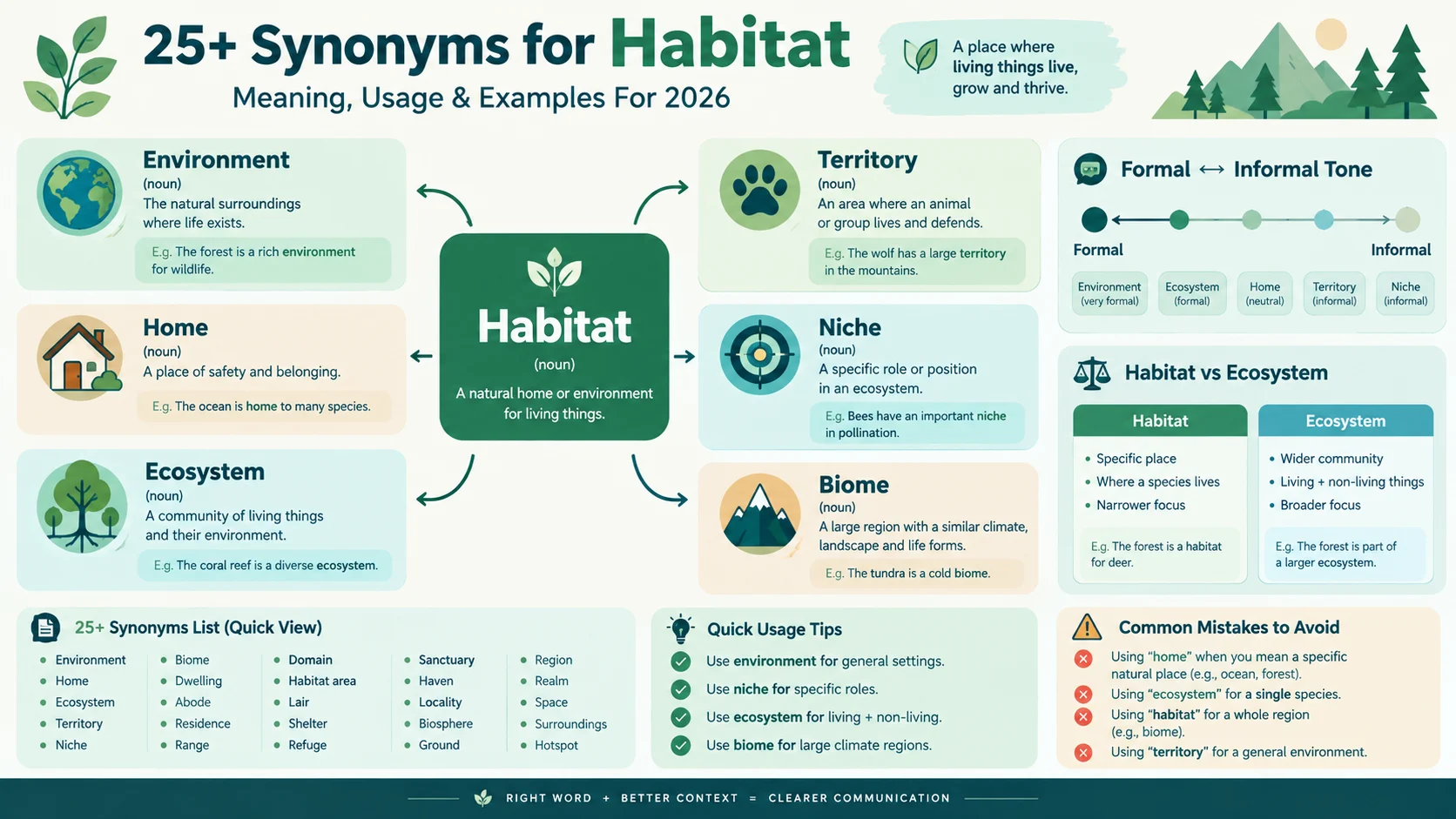
Habitat means the natural home or environment where a plant, animal, or other organism lives, grows, and finds what it needs to survive. The best synonyms depend on context: use environment for scientific writing, home for everyday speech, ecosystem for ecology, and niche for specialized academic discussions.
Top 10 Synonyms:
- Environment
- Home
- Ecosystem
- Dwelling
- Territory
- Domain
- Abode
- Surroundings
- Niche
- Locale
Every synonym has a slightly different meaning, tone, or context. Choosing the right one makes your writing more precise and natural.
Have you ever tried to explain where a particular animal lives and found yourself stuck repeating the word “habitat” in every sentence?
Maybe you are writing a science report about polar bears. Or preparing a presentation about rainforest conservation. Or simply describing your favorite hiking spot in a travel blog. In each case, “habitat” is useful, but repeating it makes your writing feel flat.
English offers many powerful alternatives. Some are formal and scientific. Others are warm and conversational. A few are poetic and creative.
This guide will show you exactly which synonym for habitat fits every situation. You will learn the subtle differences between environment, ecosystem, home, niche, and many more. By the end, you will know how to choose the perfect word with confidence.
What Does “Habitat” Mean?
Definition
A habitat is the specific place or type of environment where a living thing naturally lives and thrives. It provides the food, water, shelter, and conditions that an organism needs to survive.
In everyday language, people often use habitat to mean a natural home. In scientific writing, the word is more precise and refers to a defined set of environmental conditions.
The word works for animals, plants, and even microorganisms. You can talk about the habitat of a tiger, a rare orchid, or a tiny bacterium.
Pronunciation
US IPA: /ˈhæb.ɪ.tæt/
UK IPA: /ˈhæb.ɪ.tæt/
Syllables: 3 (hab-i-tat)
Tip: Stress the first syllable “HAB.” The word sounds almost identical in American and British English.
Grammar
| Grammar Feature | Information |
|---|---|
| Part of Speech | Noun (countable) |
| Common Position | Subject, object, or object of a preposition |
| Typical Pattern | Habitat of + noun OR adjective + habitat |
Example sentences:
- “The habitat of the snow leopard is high in the mountains.”
- “Deforestation destroys the natural habitat of countless species.”
- “Scientists studied how the habitat changed over ten years.”
Grammar note: Habitat is countable. You can say “a habitat,” “the habitat,” or “habitats.” It is often paired with adjectives like “natural,” “native,” or “marine.”
Word Family
| Word | Part of Speech | Meaning |
|---|---|---|
| Habitat | Noun | The natural home of a plant or animal |
| Inhabit | Verb | To live in a particular place |
| Inhabitant | Noun | A person or animal that lives in a place |
| Inhabited | Adjective | Lived in by people or animals |
| Uninhabited | Adjective | Not lived in by anyone |
| Habitation | Noun | The act of living in a place |
12 Synonyms of “Habitat”
Environment
Meaning: The surrounding conditions, land, air, and water in which a person, animal, or plant lives.
Best Used For: Scientific writing, academic essays, environmental discussions.
Formality: Neutral to Formal
Tone: Academic, Neutral
Frequency: ⭐⭐⭐⭐⭐ Very Common
CEFR Level: B1
Example Sentence 1: “The polar bear’s environment is shrinking because of climate change.”
Example Sentence 2: “We must protect the environment for future generations.”
Usage Tip: Environment is broader than habitat. It can refer to the entire natural world, not just one species’ home. Use it when discussing conditions or surroundings in general.
Home
Meaning: The place where a person, animal, or plant lives and feels safe.
Best Used For: Daily conversation, storytelling, children’s writing, creative writing.
Formality: Informal to Neutral
Tone: Warm, Emotional, Casual
Frequency: ⭐⭐⭐⭐⭐ Very Common
CEFR Level: A2
Example Sentence 1: “The forest is home to thousands of species of birds.”
Example Sentence 2: “After the storm, the rabbits searched for a new home.”
Usage Tip: Home is warm and simple. Native speakers love it in storytelling and casual science writing. Avoid it in formal ecological reports where precision matters more than emotion.
Ecosystem
Meaning: A community of living things interacting with each other and their physical surroundings.
Best Used For: Ecology, biology, environmental science, academic writing.
Formality: Formal
Tone: Scientific, Academic
Frequency: ⭐⭐⭐⭐ Common
CEFR Level: B2
Example Sentence 1: “The coral reef is a fragile ecosystem that supports thousands of species.”
Example Sentence 2: “Wildfires can destroy an entire ecosystem in just a few days.”
Usage Tip: Ecosystem is broader than habitat. A habitat is one species’ home, but an ecosystem includes all species and their interactions. Use it in scientific and environmental contexts.
Dwelling
Meaning: A place where a person or animal lives, often used in formal or literary writing.
Best Used For: Literary writing, historical descriptions, formal documents.
Formality: Formal
Tone: Literary, Neutral
Frequency: ⭐⭐⭐ Moderate
CEFR Level: B2
Example Sentence 1: “The ancient dwelling was carved into the side of the cliff.”
Example Sentence 2: “Bears often choose caves as their winter dwelling.”
Usage Tip: Dwelling usually refers to human homes but works for animals in literary writing. It sounds more formal than “home” and less scientific than “habitat.”
Territory
Meaning: An area of land that an animal or group defends and considers its own.
Best Used For: Zoology, behavioral science, animal documentaries.
Formality: Neutral to Formal
Tone: Scientific, Neutral
Frequency: ⭐⭐⭐⭐ Common
CEFR Level: B2
Example Sentence 1: “Male lions fiercely protect their territory from intruders.”
Example Sentence 2: “The wolves marked their territory along the riverbank.”
Usage Tip: Territory focuses on ownership and defense, not just residence. Use it when discussing animal behavior rather than the physical environment.
Domain
Meaning: An area or range where a particular species or thing is found.
Best Used For: Academic writing, formal reports, biological classification.
Formality: Formal
Tone: Academic, Neutral
Frequency: ⭐⭐⭐ Moderate
CEFR Level: B2
Example Sentence 1: “The Arctic is the natural domain of the polar bear.”
Example Sentence 2: “These plants thrive in the tropical domain of Southeast Asia.”
Usage Tip: Domain is abstract and formal. It can also mean “field of expertise,” so use it carefully. Best for academic writing about geographic ranges.
Abode
Meaning: A place where someone or something lives, often used in poetic or old-fashioned writing.
Best Used For: Poetry, literature, formal writing, humor.
Formality: Formal
Tone: Literary, Poetic
Frequency: ⭐⭐ Rare
CEFR Level: C1
Example Sentence 1: “The eagle made its abode high on the rocky peak.”
Example Sentence 2: “Welcome to my humble abode,” she said with a smile.”
Usage Tip: Abode sounds old-fashioned and slightly poetic. Native speakers often use it humorously for human homes. Avoid it in scientific writing about animals.
Surroundings
Meaning: Everything around a person, animal, or thing.
Best Used For: Daily conversation, descriptive writing, general contexts.
Formality: Neutral
Tone: Neutral, Descriptive
Frequency: ⭐⭐⭐⭐ Common
CEFR Level: B1
Example Sentence 1: “The bird adapted quickly to its new surroundings.”
Example Sentence 2: “The fish rely on clean surroundings to stay healthy.”
Usage Tip: Surroundings is more general than habitat. It refers to anything nearby, not just the natural home. Use it when you want a broad, simple word.
Niche
Meaning: The specific role or position an organism occupies within its environment.
Best Used For: Ecology, academic writing, biology research.
Formality: Formal
Tone: Academic, Scientific
Frequency: ⭐⭐⭐ Moderate
CEFR Level: C1
Example Sentence 1: “Each species fills a unique niche in the rainforest.”
Example Sentence 2: “The owl occupies a nocturnal niche that few other birds share.”
Usage Tip: Niche is not exactly a synonym for habitat. It describes an organism’s role, not just its home. Use it in advanced academic writing about ecology.
Locale
Meaning: A particular place or location, often used in formal or literary writing.
Best Used For: Formal writing, travel writing, journalism.
Formality: Formal
Tone: Neutral, Descriptive
Frequency: ⭐⭐⭐ Moderate
CEFR Level: B2
Example Sentence 1: “The locale is famous for its rare bird population.”
Example Sentence 2: “Scientists visited the locale to study local wildlife.”
Usage Tip: Locale emphasizes the specific location rather than the natural conditions. Use it when describing where something is found.
Biome
Meaning: A large natural area with a specific climate and particular types of plants and animals.
Best Used For: Geography, ecology, academic writing.
Formality: Formal
Tone: Scientific, Academic
Frequency: ⭐⭐⭐ Moderate
CEFR Level: B2
Example Sentence 1: “The tundra biome is home to animals adapted to extreme cold.”
Example Sentence 2: “Each biome supports a unique community of life.”
Usage Tip: Biome is much larger than habitat. A biome contains many habitats. Use it when talking about climate zones like deserts, forests, or grasslands.
Nest
Meaning: A structure or place where a bird, insect, or small animal lives and raises its young.
Best Used For: Nature writing, casual descriptions, children’s education.
Formality: Informal to Neutral
Tone: Warm, Natural, Casual
Frequency: ⭐⭐⭐⭐ Common
CEFR Level: A2
Example Sentence 1: “The swallows built their nest under the roof.”
Example Sentence 2: “Ants create complex nests beneath the soil.”
Usage Tip: Nest is specific to animals that build homes for their young. It is not a general synonym for habitat. Great for nature writing and simple explanations.
Synonyms Comparison Table
| Synonym | Best Context | Formality | Tone | Frequency |
|---|---|---|---|---|
| Environment | Science, general | Neutral | Academic | ⭐⭐⭐⭐⭐ |
| Home | Daily, storytelling | Informal | Warm | ⭐⭐⭐⭐⭐ |
| Ecosystem | Ecology, biology | Formal | Scientific | ⭐⭐⭐⭐ |
| Territory | Zoology, behavior | Neutral | Scientific | ⭐⭐⭐⭐ |
| Surroundings | Daily, general | Neutral | Descriptive | ⭐⭐⭐⭐ |
| Nest | Nature writing | Informal | Warm | ⭐⭐⭐⭐ |
| Dwelling | Literary, formal | Formal | Literary | ⭐⭐⭐ |
| Domain | Academic, formal | Formal | Academic | ⭐⭐⭐ |
| Niche | Ecology, research | Formal | Scientific | ⭐⭐⭐ |
| Locale | Journalism, formal | Formal | Descriptive | ⭐⭐⭐ |
| Biome | Geography, ecology | Formal | Scientific | ⭐⭐⭐ |
| Abode | Poetry, humor | Formal | Poetic | ⭐⭐ |
Best Synonyms by Situation
| Situation | Best Synonym | Why It Works |
|---|---|---|
| Daily Conversation | Home | Warm and easy to understand |
| Business Email | Environment | Professional and broad |
| Academic Writing | Ecosystem or Niche | Demonstrates scientific precision |
| School Assignment | Home or Environment | Clear and appropriate for students |
| Professional Meeting | Environment | Sounds competent and clear |
| Presentation | Ecosystem | Engaging and educational |
| Creative Writing | Dwelling or Abode | Adds literary richness |
| Social Media | Home | Friendly and relatable |
| Movie Review | Environment | Describes setting naturally |
| Book Review | Locale or Dwelling | Adds descriptive depth |
| Nature Documentary | Territory or Biome | Scientific and cinematic |
Formal vs Informal Synonyms
Formal Alternatives
| Synonym | Best Used For |
|---|---|
| Ecosystem | Scientific reports, ecology papers |
| Niche | Academic research, biology essays |
| Biome | Geography and environmental science |
| Domain | Formal academic descriptions |
| Locale | Journalism and formal travel writing |
Neutral Alternatives
| Synonym | Best Used For |
|---|---|
| Environment | All general and scientific contexts |
| Territory | Animal behavior and geography |
| Surroundings | General descriptions |
| Habitat | Standard use in all contexts |
Informal Alternatives
| Synonym | Best Used For |
|---|---|
| Home | Daily conversation, storytelling |
| Nest | Nature writing for children |
| Abode | Humorous or poetic references |
Choosing the right level of formality: Match your word choice to your audience. Use scientific terms like ecosystem and biome in academic writing. Save home and nest for casual or creative contexts. When in doubt, environment is the safest, most versatile choice.
Strong vs Mild Synonyms
Mild
These are gentle and easy for anyone to understand.
- Home
- Surroundings
- Nest
Moderate
These are balanced and suitable for most situations.
- Environment
- Territory
- Locale
Strong
These are intense and carry scientific or literary weight.
- Ecosystem
- Biome
- Niche
- Domain
How intensity changes meaning: Strong synonyms add precision and authority. They sound scientific or literary. Mild synonyms sound friendly and simple. Choose based on your purpose and audience.
Real-Life Examples
School Context:
“In our science class, we learned that a habitat provides everything an animal needs. The teacher explained how a pond is the habitat for frogs, fish, and insects.”
Office Context:
“Our environmental consulting firm studies how construction affects the natural habitat of local wildlife. We recommend ways to protect these environments.”
Business Email:
“I am attaching the report on how the new development might impact the surrounding habitat. Please review it before our meeting on Thursday.”
Professional Meeting:
“We need to consider the ecosystem as a whole, not just individual species. Protecting one habitat often means protecting many others.”
Presentation:
“Today I will show you how climate change is altering the natural habitat of Arctic animals. The changes are happening faster than scientists predicted.”
Creative Writing:
“The heron stood motionless in its watery dwelling, watching for fish. This quiet corner of the marsh had been its home for many seasons.”
Daily Conversation:
“We saw so many birds on our hike. That forest must be an amazing habitat for wildlife.”
Social Media:
“Just visited the local wildlife sanctuary. It is incredible how much life thrives in such a small habitat.”
Common Collocations
| Common Phrase | Better Alternative |
|---|---|
| Natural habitat | Native environment, Wild home |
| Habitat loss | Environmental destruction, Ecosystem decline |
| Habitat destruction | Environmental damage, Ecosystem ruin |
| Marine habitat | Ocean environment, Underwater ecosystem |
| Wildlife habitat | Animal home, Native surroundings |
| Habitat restoration | Environmental recovery, Ecosystem repair |
| Habitat fragmentation | Environmental splitting, Landscape division |
Common Phrases
Natural habitat
Meaning: The environment where a species normally lives.
Better alternative: Native environment.
Example: “Zoos try to recreate the natural habitat of the animals they house.”
Habitat loss
Meaning: The disappearance or destruction of a species’ natural home.
Better alternative: Environmental destruction.
Example: “Habitat loss is the biggest threat to endangered species worldwide.”
In its natural habitat
Meaning: In the place where something normally lives or belongs.
Better alternative: In its element.
Example: “The photographer finally captured the rare bird in its natural habitat.”
Context Guide
| Situation | Best Synonym | Reason |
|---|---|---|
| Essay | Ecosystem or Niche | Academic and precise |
| Speech | Environment or Home | Clear and engaging |
| Business Email | Environment | Professional and broad |
| Novel | Dwelling or Abode | Literary and descriptive |
| Presentation | Ecosystem | Scientific and educational |
| Conversation | Home | Natural and friendly |
| Academic Writing | Biome or Niche | Demonstrates scientific expertise |
| Marketing Copy | Home or Environment | Warm and relatable |
Related Words
Near Synonyms
Environment, surroundings, ecosystem, territory, and locale all describe the place where something lives, but each has a slightly different focus.
Antonyms
- Barren land
- Wasteland
- Desert (when referring to a lifeless area)
Related Adjectives
- Habitable
- Inhabitable
- Native
- Indigenous
- Natural
Related Nouns
- Inhabitant
- Population
- Species
- Ecology
Related Verbs
- Inhabit
- Occupy
- Thrive
- Dwell
Frequently Asked Questions
What is another word for habitat?
The best synonyms for habitat include environment, home, ecosystem, and territory. Use environment for scientific writing, home for casual contexts, and ecosystem for ecological discussions.
Which synonym sounds the most professional?
Ecosystem and biome sound most professional in scientific contexts. Environment is professional but broader. Choose ecosystem when discussing interactions between living things.
What is a formal synonym for habitat?
Niche and biome are formal alternatives. Niche refers to an organism’s role within an environment, while biome describes a large ecological area with a specific climate.
What is the difference between habitat and ecosystem?
A habitat is the specific home of one species. An ecosystem includes all living things and their interactions with each other and the physical environment.
What is the opposite of habitat?
The opposite of habitat is barren land or wasteland, referring to places where life cannot easily survive. There is no single direct antonym in English.
Which synonym is best for essays?
Ecosystem works best for academic essays about ecology. Environment suits broader environmental topics. Home is too casual for formal academic writing.
What is another word for habitat in a nature documentary?
Territory and biome work beautifully in nature documentaries. Territory emphasizes animal behavior, while biome describes the broader climate zone.
Conclusion
Habitat is a rich, useful word that describes the natural home of living things. But English offers many powerful alternatives that let you write with more precision and style.
Choose environment for general and scientific use. Choose home for warm, everyday language. Choose ecosystem or biome for advanced ecological writing. Choose territory for animal behavior. Choose niche for specialized academic discussions.
Paying attention to formality and tone is essential. Formal writing prefers scientific terms. Creative writing welcomes poetic words like dwelling and abode. Conversation thrives on simple words like home.
The next time you describe where an animal lives, pause and choose the synonym that fits your message best. Your writing will become clearer, richer, and more natural.
