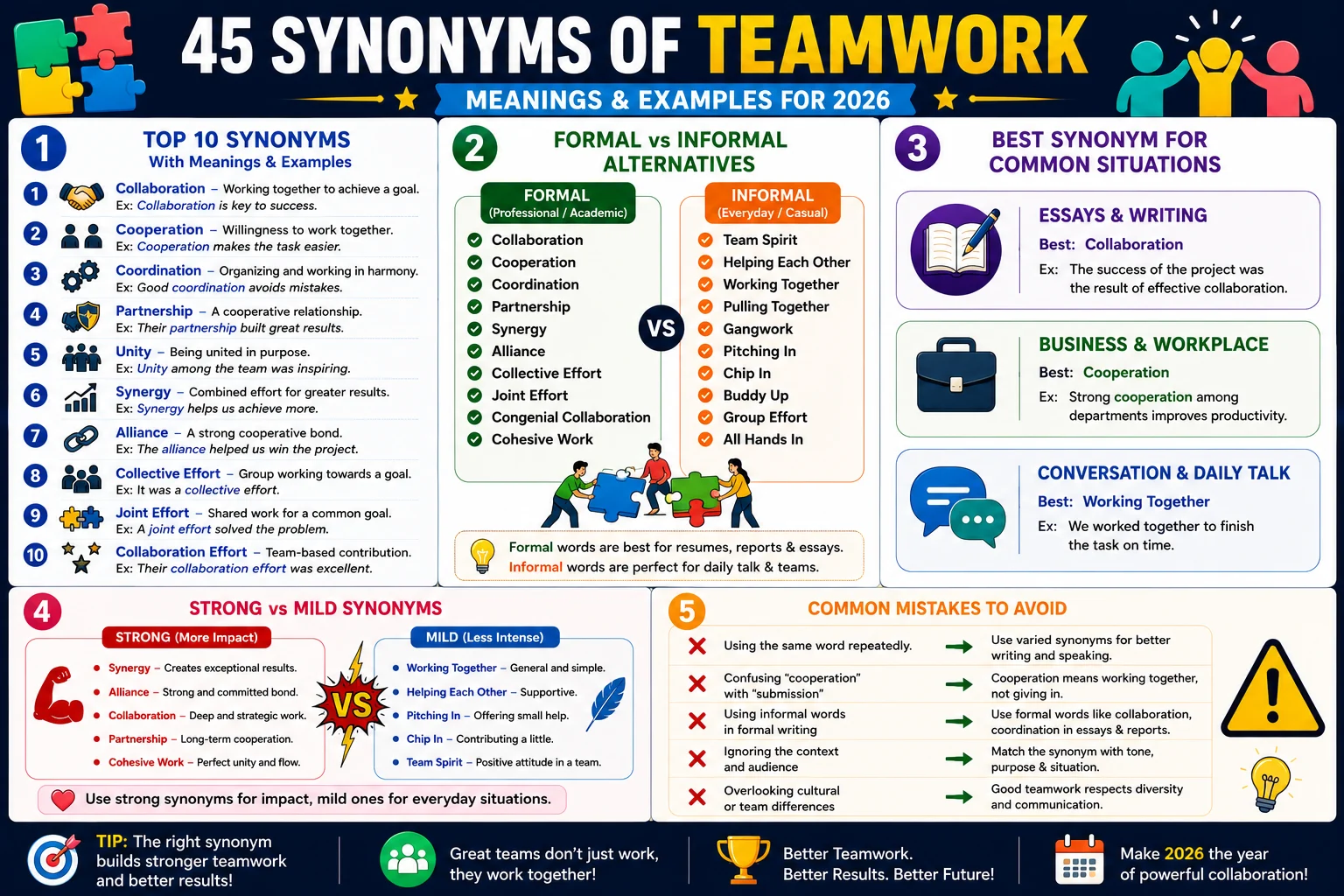
“Teamwork” means people working together to achieve a common goal. The best synonyms are collaboration, cooperation, partnership, coordination, and unity. “Collaboration” is the most common and natural alternative. Each synonym has a slightly different meaning and context.
Top 10 Synonyms
- Collaboration
- Cooperation
- Partnership
- Coordination
- Unity
- Alliance
- Synergy
- Teaming
- Joint effort
- Collective work
What’s another word for teamwork when you want your writing to sound clearer, stronger, and more precise?
Teamwork is a word we hear everywhere. It appears in workplaces, classrooms, sports, businesses, and community projects. But repeating the same word can make your writing feel basic or predictable. The right teamwork synonym can add more meaning and match the situation better.
For example, collaboration may fit a professional setting, while cooperation can describe people working toward a shared goal. Other teamwork synonyms may emphasize unity, partnership, coordination, or mutual support.
In this guide, you’ll explore 35 carefully selected synonyms for teamwork, including another word for teamwork, a synonym for teamwork, and useful alternatives for working as a team. You’ll also learn how a teamwork thesaurus can help you choose the right word for different contexts.
What Does “Teamwork” Mean?
Definition
Teamwork” means a group of people working together to achieve a common goal. It involves cooperation, communication, and combining individual strengths. When you have teamwork, everyone contributes and supports each other to get things done.
Pronunciation
| Feature | Value |
|---|---|
| US IPA | /ˈtimˌwɜrk/ |
| UK IPA | /ˈtiːmwɜːk/ |
| Syllables | 2 (team-work) |
| Tip | Stress the first syllable: “TEEM-wurk” |
Grammar
| Grammar Feature | Information |
|---|---|
| Part of Speech | Noun (uncountable) |
| Common Position | Subject or object |
| Typical Pattern | Teamwork + between/among + people |
Examples:
- “Teamwork is essential for success.”
- “Good teamwork between departments is important.”
- “The project required excellent teamwork.”
Grammar Note: “Teamwork” is usually uncountable. We don’t say “teamworks” unless we’re talking about different types.
Word Family
| Word | Part of Speech | Meaning |
|---|---|---|
| Team | Noun | A group working together |
| Teamwork | Noun | Working together as a team |
| Teammate | Noun | A member of the same team |
| Team player | Noun | Someone who works well in a team |
15 Synonyms of “Teamwork”
Collaboration
Meaning: Working together with others to create or achieve something.
Best Used For: Business, creative projects, academic contexts.
Formality: Formal
Tone: Cooperative, Creative
Frequency: ⭐⭐⭐⭐⭐ (Very Common)
CEFR Level: B2
Example Sentence 1: “The success of the project was due to excellent collaboration.
Example Sentence 2: “Collaboration between artists and designers produced amazing results.”
Usage Tip: “Collaboration” is the most common professional synonym. It suggests working together creatively and productively.
Common Confusion: Collaboration vs Teamwork. “Collaboration” often implies creative work or joint projects. “Teamwork” is broader and includes any working together.
Cooperation
Meaning: People working together and helping each other.
Best Used For: General situations, work, community projects.
Formality: Neutral
Tone: Helpful, Cooperative
Frequency: ⭐⭐⭐⭐⭐ (Very Common)
CEFR Level: B1
Example Sentence 1: “Cooperation between team members made the task easier.”
Example Sentence 2: “International cooperation is needed to solve climate change.
Usage Tip: “Cooperation” emphasizes helping and working together willingly. It’s a very common and natural alternative.
Partnership
Meaning: A relationship where two or more people or groups work together.
Best Used For: Business, organizations, joint ventures.
Formality: Formal
Tone: Professional, Strategic
Frequency: ⭐⭐⭐⭐ (Common)
CEFR Level: B2
Example Sentence 1: “The partnership between the two companies was highly successful.”
Example Sentence 2: “They formed a partnership to develop new technology.”
Usage Tip: “Partnership” often suggests a formal, equal relationship. Use it for business and organizational contexts.
Coordination
Meaning: Organizing and arranging different activities or people to work smoothly.
Best Used For: Events, large projects, logistics.
Formality: Formal
Tone: Organized, Efficient
Frequency: ⭐⭐⭐⭐ (Common)
CEFR Level: B2
Example Sentence 1: “Good coordination among team members is essential.”
Example Sentence 2: “The coordination of volunteers was handled perfectly.”
Usage Tip: “Coordination” emphasizes organizing different parts to work together smoothly.
Unity
Meaning: The state of being joined together and working for the same purpose.
Best Used For: Groups, teams, organizations, nations.
Formality: Formal
Tone: United, Strong
Frequency: ⭐⭐⭐ (Moderate)
CEFR Level: B2
Example Sentence 1: “Team unity was the key to their victory.
Example Sentence 2: “The community showed great unity after the disaster.”
Usage Tip: “Unity” emphasizes togetherness and a common purpose. It’s more emotional than “teamwork.”
Alliance
Meaning: A union or agreement between people or groups to work together.
Best Used For: Organizations, countries, political groups.
Formality: Formal
Tone: Strategic, Official
Frequency: ⭐⭐⭐ (Moderate)
CEFR Level: B2
Example Sentence 1: “The alliance between the two nations strengthened trade.
Example Sentence 2: “They formed an alliance to compete with larger companies.
Usage Tip: “Alliance” is a formal word for groups working together, often in business or politics.
Synergy
Meaning: The combined power of a group that is greater than individual efforts.
Best Used For: Business, creative projects, teamwork benefits.
Formality: Formal
Tone: Powerful, Positive
Frequency: ⭐⭐⭐ (Moderate)
CEFR Level: C1
Example Sentence 1: “The team achieved great synergy on the project.”
Example Sentence 2: “Synergy between departments improved productivity.
Usage Tip: “Synergy” emphasizes that the group achieves more together than separately. It’s a buzzword in business.
Teaming
Meaning: Working together as a team.
Best Used For: Modern business, informal contexts.
Formality: Informal
Tone: Modern, Active
Frequency: ⭐⭐⭐ (Moderate)
CEFR Level: B2
Example Sentence 1: “Teaming across different departments improved results.”
Example Sentence 2: “The new project required extensive teaming.
Usage Tip: “Teaming” is a more modern, informal way to say teamwork. It’s common in business slang.
Joint effort
Meaning: A project where people work together toward a common goal.
Best Used For: Projects, events, community work.
Formality: Neutral
Tone: Cooperative, Practical
Frequency: ⭐⭐⭐⭐ (Common)
CEFR Level: B1
Example Sentence 1: “The charity event was a joint effort by the whole community.
Example Sentence 2: “The report was a joint effort between three departments.
Usage Tip: “Joint effort” is a versatile phrase. It emphasizes shared responsibility and work.
Collective work
Meaning: Work done by a group rather than individuals.
Best Used For: Projects, art, creative endeavors.
Formality: Formal
Tone: Collaborative, Group-focused
Frequency: ⭐⭐⭐ (Moderate)
CEFR Level: B2
Example Sentence 1: “The mural was a collective work by the art students.”
Example Sentence 2: “Collective work often produces better results than individual effort.”
Usage Tip: “Collective work” emphasizes the group nature of the work, often in creative or academic contexts.
Mutual effort
Meaning: Effort where people help each other equally.
Best Used For: Relationships, small teams, partnerships.
Formality: Neutral
Tone: Equal, Supportive
Frequency: ⭐⭐ (Rare)
CEFR Level: B2
Example Sentence 1: “The success was the result of mutual effort from both sides.”
Example Sentence 2: “Mutual effort between parents and teachers helped the students.”
Usage Tip: “Mutual effort” emphasizes equal contribution from all parties.
Combined effort
Meaning: The total effort of everyone working together.
Best Used For: Large projects, campaigns, organizational goals.
Formality: Neutral
Tone: Strong, United
Frequency: ⭐⭐⭐ (Moderate)
CEFR Level: B1
Example Sentence 1: “The combined effort of the team led to outstanding results.”
Example Sentence 2: “Combined effort across all departments made the launch successful.”
Usage Tip: “Combined effort” focuses on the total effort of everyone involved.
Interdependence
Meaning: Mutual reliance where everyone depends on each other.
Best Used For: Teams, ecosystems, organizations.
Formality: Formal
Tone: Connected, Reliant
Frequency: ⭐⭐ (Rare)
CEFR Level: C1
Example Sentence 1: “The team’s interdependence made them work more carefully.”
Example Sentence 2: “Interdependence among departments improved communication.”
Usage Tip: “Interdependence” highlights that everyone relies on each other. It’s a formal, analytical word.
Collusion
Meaning: Secret cooperation for a negative purpose.
Best Used For: Negative contexts, conspiracies.
Formality: Formal
Tone: Negative, Secretive
Frequency: ⭐⭐ (Rare)
CEFR Level: C1
Example Sentence 1: “They were accused of collusion to fix prices.
Example Sentence 2: “The collusion between the two companies was illegal.”
Usage Tip: “Collusion” is teamwork for bad purposes. Be careful—it’s always negative.
Concerted effort
Meaning: A coordinated and determined effort by everyone.
Best Used For: Big projects, campaigns, difficult challenges.
Formality: Formal
Tone: Determined, Coordinated
Frequency: ⭐⭐⭐ (Moderate)
CEFR Level: C1
Example Sentence 1: “A concerted effort by all staff saved the company.”
Example Sentence 2: “The charity required a concerted effort from volunteers.”
Usage Tip: “Concerted effort” emphasizes determination and coordination. It’s formal and powerful.
Synonyms Comparison Table
| Synonym | Best Context | Formality | Tone | Frequency |
|---|---|---|---|---|
| Collaboration | Creative work | Formal | Creative | ⭐⭐⭐⭐⭐ |
| Cooperation | General help | Neutral | Helpful | ⭐⭐⭐⭐⭐ |
| Partnership | Business | Formal | Professional | ⭐⭐⭐⭐ |
| Coordination | Organizing | Formal | Efficient | ⭐⭐⭐⭐ |
| Unity | Group spirit | Formal | United | ⭐⭐⭐ |
| Alliance | Formal groups | Formal | Strategic | ⭐⭐⭐ |
| Synergy | Business, power | Formal | Powerful | ⭐⭐⭐ |
| Joint effort | Projects | Neutral | Practical | ⭐⭐⭐⭐ |
| Teaming | Modern business | Informal | Active | ⭐⭐⭐ |
| Collective work | Creative | Formal | Collaborative | ⭐⭐⭐ |
Best Synonyms by Situation
| Situation | Best Synonym | Why It Works |
|---|---|---|
| Daily Conversation | Cooperation | Natural and common |
| Business Email | Collaboration | Professional and clear |
| Academic Writing | Collaboration | Formal and precise |
| School Assignment | Cooperation | Shows working together |
| Professional Meeting | Partnership | Sounds professional |
| Presentation | Synergy | Impressive and modern |
| Creative Writing | Unity | Adds emotional depth |
| Social Media | Teaming | Casual and modern |
| Community Work | Joint effort | Inclusive and practical |
Formal vs Informal Synonyms
Formal Alternatives
| Synonym | Best Used For |
|---|---|
| Collaboration | Creative and business contexts |
| Partnership | Business and formal relationships |
| Alliance | Formal agreements between groups |
| Synergy | Business, power of combined effort |
| Coordination | Organizing people and activities |
Neutral Alternatives
| Synonym | Best Used For |
|---|---|
| Cooperation | Most general situations |
| Unity | Group spirit and togetherness |
| Joint effort | Shared projects and work |
Informal Alternatives
| Synonym | Best Used For |
|---|---|
| Teaming | Modern business slang |
| Working together | Simple and clear |
| Pulling together | Friendly and encouraging |
Choosing the Right Level: Use “collaboration” and “partnership” in business and professional contexts. Use “cooperation” for most everyday situations. Use “teaming” only in casual modern contexts.
Strong vs Mild Synonyms
Mild
Suitable for everyday situations with less intensity.
- Cooperation
- Working together
- Joint effort
Moderate
More professional or specific alternatives.
- Collaboration
- Partnership
- Coordination
- Teaming
Strong
High-intensity alternatives suggesting powerful collaboration.
- Synergy (greater than individual efforts)
- Unity (strong emotional togetherness)
- Alliance (formal strategic relationship)
- Concerted effort (determined coordination)
How Intensity Changes Meaning: “We worked together” is simple. “We achieved synergy” sounds much more powerful. Choose stronger words when you want to emphasize the power of the collaboration.
Real-Life Examples
School: “The teacher encouraged cooperation among students.”
Office: “Collaboration between teams led to innovative solutions.”
Business Email: “We value partnership with our clients.”
Meetings: “Synergy between departments will drive growth.”
Presentations: “Teamwork is the foundation of our success.”
Daily Conversations: “We worked together to finish the project.”
Social Media: “Great teamwork everyone—we did it!”
Academic Writing: “Collective work was essential to the research project.”
Common Collocations
| Common Phrase | Better Alternative |
|---|---|
| Teamwork skills | Collaboration skills |
| Good teamwork | Excellent collaboration |
| Teamwork makes the dream work | Cooperation leads to success |
| Strong teamwork | Strong synergy |
| Teamwork culture | Collaborative culture |
Common Phrases
Pull together: To work as a team. (e.g., “We need to pull together to finish on time.”)
Lend a hand: To help others. (e.g., “Everyone lent a hand to complete the project.”)
Be on the same page: To agree and work together. (e.g., “We’re all on the same page about the goal.”)
Row in the same direction: To work toward the same goal. (e.g., “When we row in the same direction, we succeed.”)
Many hands make light work: Working together makes tasks easier.
Context Guide
| Situation | Best Synonym | Reason |
|---|---|---|
| Essay | Collaboration | Academic and formal |
| Speech | Unity | Inspiring and emotional |
| Business Email | Partnership | Professional and respectful |
| Novel | Unity | Adds literary depth |
| Presentation | Synergy | Impressive and modern |
| Conversation | Cooperation | Natural and relatable |
| Academic Writing | Collaboration | Precise and professional |
| Marketing Copy | Synergy | Powerful and engaging |
Related Words
Near Synonyms
- Camraderie: Friendly feeling among people working together.
- Solidarity: Unity and mutual support.
- Consensus: General agreement among a group.
- Complicity: Involvement in something (often negative).
Antonyms
- Competition: Working against others.
- Conflict: Disagreement and opposition.
- Isolation: Working alone.
- Rivalry: Competition and struggle.
Related Adjectives
- Collaborative: Willing to work together.
- Cooperative: Helpful and willing to cooperate.
- Synergistic: Working together effectively.
- Team-oriented: Focused on teamwork.
- United: Joined together for a purpose.
Related Nouns
- Team: A group working together.
- Collaboration: The act of collaborating.
- Cooperation: The act of working together.
- Alliance: A formal agreement to work together.
- Partnership: A relationship between partners.
Related Verbs
- Collaborate: To work together.
- Cooperate: To work together helpfully.
- Coordinate: To organize together.
- Partner: To work as a partner.
- Unite: To join together.
Frequently Asked Questions
What is another word for teamwork?
Common synonyms include collaboration, cooperation, partnership, coordination, and unity. “Collaboration” is the most common professional alternative.
Which synonym sounds the most professional?
Collaboration and partnership sound the most professional. “Synergy” is also excellent for business contexts.
What is the strongest synonym for teamwork?
Synergy is one of the strongest synonyms. It suggests the group achieves more than individuals could alone. “Unity” is also strong emotionally.
Which synonym is best for essays?
Collaboration is the best choice for academic essays. It’s formal and widely used in academic writing.
What’s the difference between teamwork and collaboration?
“Teamwork” is broader and includes any working together. “Collaboration” often implies creative work and joint creation of something new.
Which synonym is most common in everyday English?
“Cooperation” and “working together” are very common in everyday speech. “Collaboration” is common in professional settings.
What is the opposite of teamwork?
Common opposites are competition, conflict, and isolation. These words describe working against or alone.
Conclusion
“Teamwork” is a wonderful word, but now you have 35 fantastic alternatives. Each synonym adds a different shade of meaning to your language.
Remember, the key is understanding the context. Use “collaboration” for creative and professional work. Use “cooperation” for everyday situations. Use “partnership” for business relationships. Use “synergy” to emphasize combined power.
The best way to improve is practice. Try using one or two new synonyms each day. Listen for these words in conversations, books, and movies. Your vocabulary will become richer and more impressive with time.
