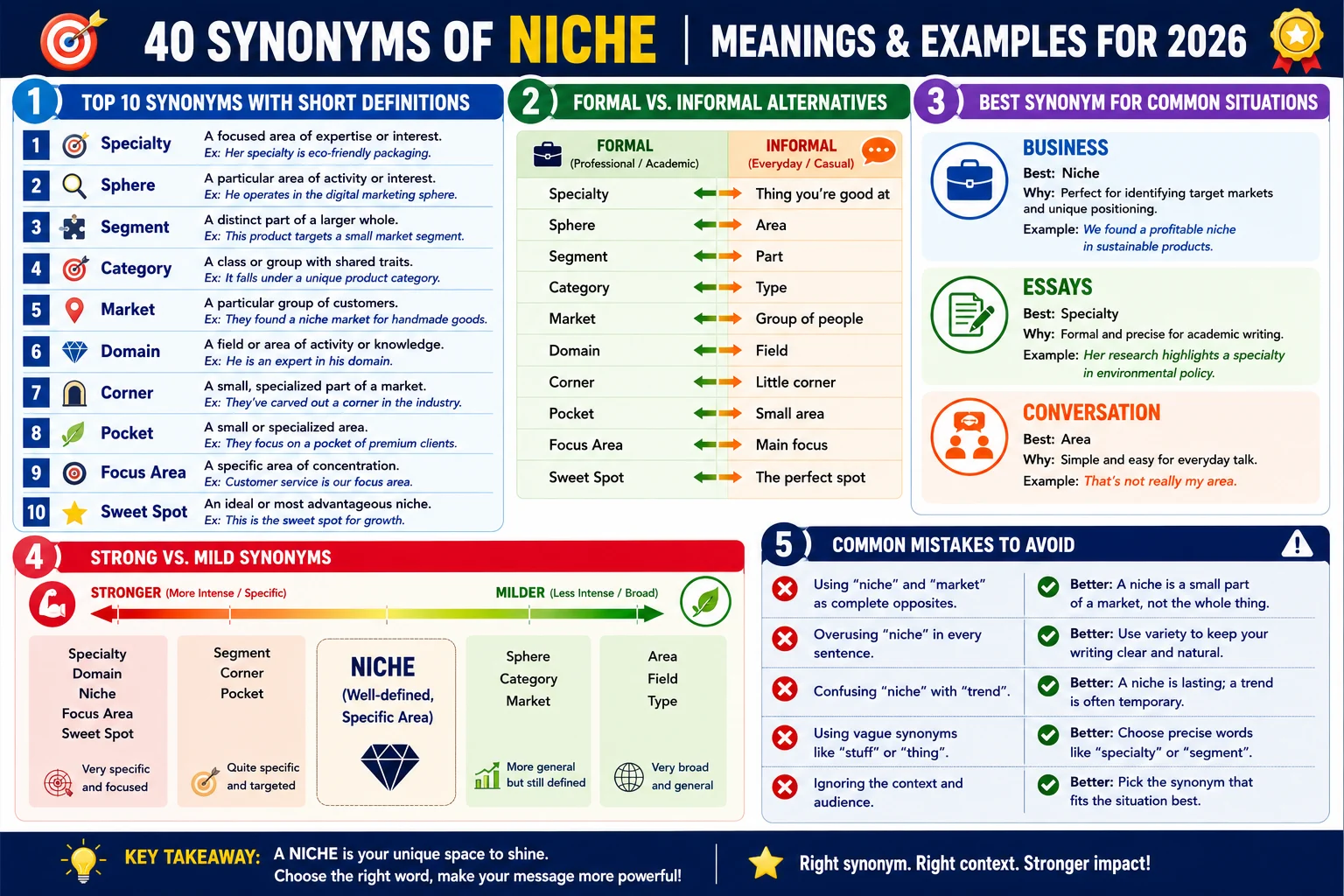
“Niche” means a specialized position, role, or area of interest. The best synonyms are specialty, domain, field, realm, and corner. “Specialty” is the most common natural alternative. Each synonym has a slightly different meaning and context where it fits best.
Top 10 Synonyms
- Specialty
- Domain
- Field
- Realm
- Corner
- Area
- Department
- Province
- Sphere
- Slot
“Niche” is a word that has become very popular in modern English. We talk about niche markets, niche interests, and finding our niche. But using it too often can make your English feel trendy rather than natural.
Think about it. You can find your niche in life, a niche market for a product, or a niche interest in your hobby. Each situation might need a different word that captures the specific type of specialization.
In this guide, you’ll learn 35 powerful synonyms for “niche.” You’ll discover exactly when to use each one, how formal they are, and what common mistakes to avoid. Let’s begin!
What Does “Niche” Mean?
Definition
Niche” means a specialized position, role, or area that is perfect for someone or something. It can be a job, a market, a hobby, or any space where someone fits especially well. When something is your niche, it’s where you belong or where you excel.
Pronunciation
| Feature | Value |
|---|---|
| US IPA | /nɪtʃ/ or /niːʃ/ |
| UK IPA | /niːʃ/ |
| Syllables | 1 |
| Tip | It can be pronounced two ways: “nitch” (US) or “neesh” (UK/also US) |
Grammar
| Grammar Feature | Information |
|---|---|
| Part of Speech | Noun (and adjective) |
| Common Position | Subject or object |
| Typical Pattern | Niche + in/for + something |
Examples:
- “She found her niche in graphic design.”
- “There’s a niche market for vegan cheese.”
- “This is my niche area of expertise.”
Grammar Note: “Niche” can be used as an adjective when describing specialized markets or areas, as in “niche market.”
Word Family
| Word | Part of Speech | Meaning |
|---|---|---|
| Niche | Noun | A specialized position or area |
| Niched | Adjective | Having a niche |
| Niche (adj) | Adjective | Specialized, targeting a small group |
15 Synonyms of “Niche”
Specialty
Meaning: A particular area of expertise or interest that someone is especially good at.
Best Used For: Jobs, skills, professional expertise.
Formality: Neutral
Tone: Professional, Expert
Frequency: ⭐⭐⭐⭐⭐ (Very Common)
CEFR Level: B2
Example Sentence 1: “Her specialty is Italian cuisine.”
Example Sentence 2: “Marketing is his specialty.”
Usage Tip: “Specialty” is the most common and natural synonym. Use it for areas of expertise or skill.
Common Confusion: Specialty vs Niche. “Specialty” emphasizes skill and expertise. “Niche” emphasizes a specific, often small, position.
Domain
Meaning: An area of knowledge, activity, or influence.
Best Used For: Professional fields, areas of expertise.
Formality: Formal
Tone: Authoritative, Professional
Frequency: ⭐⭐⭐⭐ (Common)
CEFR Level: B2
Example Sentence 1: “This topic is outside my domain.”
Example Sentence 2: “Her domain is artificial intelligence.”
Usage Tip: “Domain” suggests a broad area of knowledge or control. It’s a formal, professional word.
Field
Meaning: A subject area or branch of activity.
Best Used For: Professions, academic areas, industries.
Formality: Neutral
Tone: Professional, Broad
Frequency: ⭐⭐⭐⭐⭐ (Very Common)
CEFR Level: B1
Example Sentence 1: “She’s a leader in her field.”
Example Sentence 2: “I work in the field of education.”
Usage Tip: “Field” is very common for professional and academic areas. It’s broader than “niche.”
Realm
Meaning: A particular area of activity, interest, or knowledge.
Best Used For: Intellectual topics, formal contexts.
Formality: Formal
Tone: Intellectual, Broad
Frequency: ⭐⭐⭐ (Moderate)
CEFR Level: B2
Example Sentence 1: “This is a question in the realm of philosophy.”
Example Sentence 2: “Science and the realm of imagination are different.”
Usage Tip: “Realm” suggests a broad, sometimes abstract area. It’s more formal than “field.”
Corner
Meaning: A specific area or position in a larger context.
Best Used For: Informal contexts, hobbies, interests.
Formality: Informal
Tone: Casual, Personal
Frequency: ⭐⭐⭐ (Moderate)
CEFR Level: B2
Example Sentence 1: “He’s carved out his own corner in the industry.”
Example Sentence 2: “This is my little corner of the world.”
Usage Tip: “Corner” is an informal, friendly word. Use it for personal spaces or positions.
Area
Meaning: A particular subject or activity.
Best Used For: General contexts, professional and personal.
Formality: Neutral
Tone: Practical, Broad
Frequency: ⭐⭐⭐⭐⭐ (Very Common)
CEFR Level: A2
Example Sentence 1: “This is an area I need to improve.
Example Sentence 2: “She works in the area of human resources.”
Usage Tip: “Area” is a very common, general word. Use it for any subject or activity.
Department
Meaning: A particular area of responsibility or activity.
Best Used For: Organizations, professional contexts.
Formality: Neutral
Tone: Professional, Organized
Frequency: ⭐⭐⭐⭐ (Common)
CEFR Level: B1
Example Sentence 1: “That’s not my department.”
Example Sentence 2: “She heads the marketing department.”
Usage Tip: “Department” can be literal (a company department) or figurative (an area of responsibility).
Province
Meaning: A particular area of responsibility, knowledge, or activity.
Best Used For: Formal writing, responsibility contexts.
Formality: Formal
Tone: Official, Responsible
Frequency: ⭐⭐⭐ (Moderate)
CEFR Level: C1
Example Sentence 1: “That’s the province of the legal department.”
Example Sentence 2: “This decision is not in my province.
Usage Tip: “Province” is formal and suggests official responsibility or authority.
Sphere
Meaning: A particular area of activity, interest, or influence.
Best Used For: Formal writing, intellectual contexts.
Formality: Formal
Tone: Intellectual, Broad
Frequency: ⭐⭐⭐ (Moderate)
CEFR Level: B2
Example Sentence 1: “She operates in the sphere of international relations.”
Example Sentence 2: “That’s outside my sphere of influence.”
Usage Tip: “Sphere” is formal and suggests a defined area of influence or activity.
Slot
Meaning: A specific position or place.
Best Used For: Jobs, schedules, informal contexts.
Formality: Informal
Tone: Practical, Direct
Frequency: ⭐⭐⭐ (Moderate)
CEFR Level: B2
Example Sentence 1: “I found my slot in the company.”
Example Sentence 2: “We need to fill that slot.”
Usage Tip: “Slot” is informal and suggests a specific place or position that fits perfectly.
Specialty (again)
Meaning: A unique area of expertise.
Best Used For: Professional contexts.
Formality: Neutral
Tone: Expert
Frequency: ⭐⭐⭐⭐⭐ (Very Common)
CEFR Level: B2
Example Sentence 1: “Italian food is her specialty.
Example Sentence 2: “His specialty is data analysis.”
Usage Tip: “Specialty” is the most direct synonym for a niche area of expertise.
Calling
Meaning: A strong feeling of being destined for a particular career or role.
Best Used For: Personal, emotional contexts.
Formality: Neutral
Tone: Passionate, Purposeful
Frequency: ⭐⭐⭐ (Moderate)
CEFR Level: B2
Example Sentence 1: “Teaching is her true calling.”
Example Sentence 2: “He found his calling in medicine.”
Usage Tip: “Calling” suggests a deep sense of purpose. It’s more emotional than “niche.”
Vocation
Meaning: A strong feeling of being suited for a particular career.
Best Used For: Careers, professional contexts.
Formality: Formal
Tone: Purposeful, Professional
Frequency: ⭐⭐⭐ (Moderate)
CEFR Level: B2
Example Sentence 1: “She found her vocation in nursing.”
Example Sentence 2: “His vocation is teaching.”
Usage Tip: “Vocation” is similar to “calling” but more formal. It suggests a career that suits you perfectly.
Forte
Meaning: A person’s strong point or area of expertise.
Best Used For: Skills, abilities, professional contexts.
Formality: Formal
Tone: Expert, Skilled
Frequency: ⭐⭐⭐ (Moderate)
CEFR Level: C1
Example Sentence 1: “Public speaking is his forte.”
Example Sentence 2: “Her forte is problem-solving.”
Usage Tip: “Forte” is a formal word for what you’re especially good at. It’s less common but elegant.
Metier
Meaning: A person’s particular area of work or expertise.
Best Used For: Formal contexts, careers.
Formality: Formal
Tone: Professional, Sophisticated
Frequency: ⭐ (Very Rare)
CEFR Level: C1
Example Sentence 1: “She found her metier in the film industry.”
Example Sentence 2: “His metier is classical music.”
Usage Tip: “Metier” is a very rare, sophisticated word. Use it only in formal writing.
Synonyms Comparison Table
| Synonym | Best Context | Formality | Tone | Frequency |
|---|---|---|---|---|
| Specialty | Expertise | Neutral | Expert | ⭐⭐⭐⭐⭐ |
| Field | Professional areas | Neutral | Professional | ⭐⭐⭐⭐⭐ |
| Area | General contexts | Neutral | Practical | ⭐⭐⭐⭐⭐ |
| Domain | Knowledge areas | Formal | Authoritative | ⭐⭐⭐⭐ |
| Department | Organizations | Neutral | Organized | ⭐⭐⭐⭐ |
| Realm | Intellectual topics | Formal | Intellectual | ⭐⭐⭐ |
| Sphere | Influence, activity | Formal | Broad | ⭐⭐⭐ |
| Corner | Personal spaces | Informal | Casual | ⭐⭐⭐ |
| Calling | Purpose, passion | Neutral | Passionate | ⭐⭐⭐ |
| Vocation | Career fit | Formal | Purposeful | ⭐⭐⭐ |
Best Synonyms by Situation
| Situation | Best Synonym | Why It Works |
|---|---|---|
| Daily Conversation | Area | Natural and common |
| Business Email | Specialty | Professional and clear |
| Academic Writing | Domain | Formal and precise |
| School Assignment | Field | Clear and appropriate |
| Professional Meeting | Expertise | Sounds confident |
| Presentation | Field | Professional and clear |
| Creative Writing | Realm | Adds literary depth |
| Social Media | Corner | Casual and relatable |
| Career Planning | Calling | Purposeful and personal |
Formal vs Informal Synonyms
Formal Alternatives
| Synonym | Best Used For |
|---|---|
| Domain | Areas of knowledge |
| Realm | Intellectual topics |
| Sphere | Influence, activity |
| Province | Responsibility |
| Metier | Career expertise |
Neutral Alternatives
| Synonym | Best Used For |
|---|---|
| Specialty | Expertise |
| Field | Professional areas |
| Area | General contexts |
| Department | Organizational roles |
| Vocation | Career fit |
Informal Alternatives
| Synonym | Best Used For |
|---|---|
| Corner | Personal spaces |
| Slot | Specific positions |
| Groove | Comfortable position |
Choosing the Right Level: Use “domain” and “realm” for formal writing. Use “specialty” and “field” for professional contexts. Use “corner” and “slot” for casual conversation.
Strong vs Mild Synonyms
Mild
Suitable for everyday situations with less intensity.
- Area
- Field
- Slot
Moderate
More specific or professional alternatives.
- Specialty
- Department
- Corner
- Vocation
Strong
High-intensity alternatives suggesting deep expertise or purpose.
- Domain (broad authority)
- Realm (intellectual depth)
- Calling (deep purpose)
- Metier (highly sophisticated)
How Intensity Changes Meaning: “I work in this area” is simple. “This is my domain” sounds authoritative. Choose stronger words when you want to emphasize expertise or purpose.
Real-Life Examples
School: “Teaching is her true calling.”
Office: “Data analysis is my specialty.”
Business Email: “This topic falls under her area of expertise.”
Meetings: “Marketing is not my department.”
Presentations: “She is a leader in her field.”
Daily Conversations: “I’ve found my corner in the team.”
Social Media: “This is my niche interest.”
Academic Writing: “This topic belongs to the realm of sociology.”
Common Collocations
| Common Phrase | Better Alternative |
|---|---|
| Find your niche | Find your calling |
| Niche market | Specialized market |
| Niche interest | Specific interest |
| Niche area | Specialty area |
| Niche role | Specific role |
Common Phrases
Find one’s place: To discover where you belong. (e.g., “She found her place in the company.”)
Carve out a niche: To create a specialized position. (e.g., “He carved out a niche for himself.”)
In one’s element: In the perfect position. (e.g., “She’s in her element as a teacher.”)
Jack of all trades: Someone who does many things (opposite of niche). (e.g., “He’s a jack of all trades.”)
Man of many talents: Someone skilled in many areas.
Context Guide
| Situation | Best Synonym | Reason |
|---|---|---|
| Essay | Domain | Academic and formal |
| Speech | Calling | Inspiring and personal |
| Business Email | Specialty | Professional and clear |
| Novel | Realm | Adds literary depth |
| Presentation | Field | Professional and clear |
| Conversation | Area | Natural and relatable |
| Academic Writing | Domain | Precise and formal |
| Marketing Copy | Niche | Trendy and specific |
Related Words
Near Synonyms
- Expertise: Specialized skill or knowledge.
- Proficiency: Being highly skilled.
- Acumen: Ability to make good judgments.
- Knack: A natural skill or talent.
- Gift: A natural ability.
Antonyms
- Generalization: Lack of specialization.
- Breadth: Wide range of knowledge.
- Versatility: Being able to do many things.
- Jack of all trades: Doing many things.
- Dabbler: Someone who does things superficially.
Related Adjectives
- Specialized: Focused on one area.
- Focused: Concentrated on one thing.
- Specific: Detailed and precise.
- Expert: Highly skilled.
- Tailored: Made for a specific purpose.
Related Nouns
- Expertise: Specialized knowledge.
- Specialization: Focus on one area.
- Expertise: Skill in a particular area.
- Mastery: Complete skill.
- Proficiency: Being skilled.
Related Verbs
- Specialize: To focus on one area.
- Focus: To concentrate on.
- Concentrate: To focus on one thing.
- Target: To aim at.
Frequently Asked Questions
What is another word for niche?
Common synonyms include specialty, domain, field, realm, and corner. “Specialty” is the most common and direct alternative.
Which synonym sounds the most professional?
Domain and specialty sound very professional. “Field” is also excellent for professional contexts.
What is the strongest synonym for niche?
Domain is one of the strongest synonyms. It suggests authority and control. “Calling” is strong for personal purpose.
Which synonym is best for essays?
Domain and realm are excellent for academic essays. They are formal and precise.
What’s the difference between niche and specialty?
“Specialty” emphasizes skill and expertise. “Niche” emphasizes a specific, often small, position or market.
Which synonym is most common in everyday English?
“Area” and “field” are the most common in everyday speech. “Specialty” is also frequently used.
What is the opposite of niche?
Common opposites are generalization, breadth, and versatility. These words describe a wide range rather than a specific focus.
Conclusion
“Niche” is a useful word, but now you have 35 fantastic alternatives. Each synonym adds a different shade of meaning to your language.
Remember, the key is understanding the context. Use “specialty” for areas of expertise. Use “field” for professional areas. Use “domain” for formal authority. Use “corner” for personal spaces. Use “calling” for deep purpose.
The best way to improve is practice. Try using one or two new synonyms each day. Listen for these words in conversations and books. Your vocabulary will become richer and more expressive with time.
