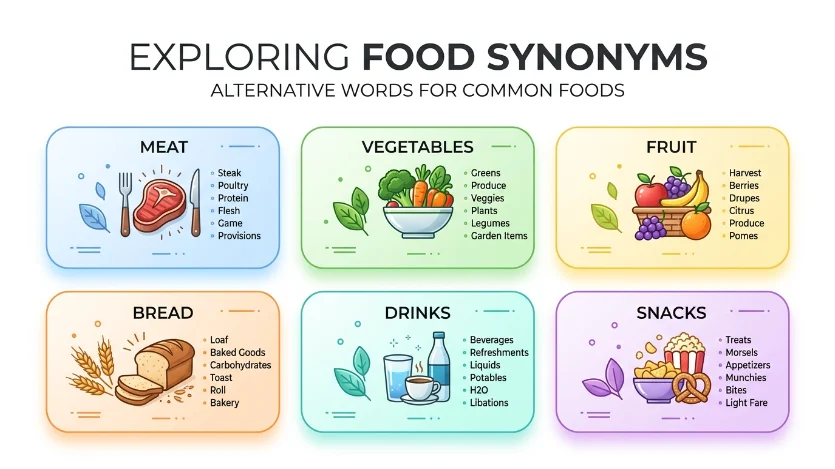
“Food” means anything you eat to nourish your body. The best synonyms are meal, cuisine, fare, grub, and sustenance. “Meal” is the most common alternative in everyday speech. Each synonym has a different tone, formality level, and context where it fits best.
Top 10 Synonyms
- Meal
- Cuisine
- Fare
- Sustenance
- Nourishment
- Grub
- Eats
- Vittles
- Provisions
- Chow
“Food” is one of the first words we learn in English. It’s simple. It’s useful. And we use it constantly. But here’s the interesting part: native speakers rarely rely on just one word for food.
Depending on the situation, they might talk about delicious cuisine, enjoy a satisfying meal, grab some quick eats, or buy essential provisions. Each word gives “food” a slightly different meaning and makes your English sound more natural.
In this guide, you’ll discover 35 food synonyms with clear meanings, examples, and usage tips. Whether you’re looking for another word for food, a synonym for food, or simply exploring other words for food, you’ll find practical options here. We’ll also explain the synonyms of food, another name for food, and when each synonym of food works best.
Let’s dig in and add more flavor to your vocabulary!
What Does “Food” Mean?
Definition
Food is any substance that people or animals eat to get energy, grow, and stay healthy. It includes everything from fruits and vegetables to meats, grains, and prepared dishes. Food is essential for life, but it’s also a source of pleasure, culture, and social connection.
Pronunciation
| Feature | Value |
|---|---|
| US IPA | /fud/ |
| UK IPA | /fuːd/ |
| Syllables | 1 |
| Tip | A short, simple sound. Say it like “foo-d” |
Grammar
| Grammar Feature | Information |
|---|---|
| Part of Speech | Noun (usually uncountable) |
| Common Position | Subject or object |
| Typical Pattern | Food + for + purpose / Food + from + source |
Examples:
- “There isn’t enough food for everyone.”
- “Fast food is not very healthy.”
- “She loves Italian food.”
Grammar Note: “Food” is usually uncountable. You say “some food” or “a lot of food,” not “a food.” However, you can say “foods” when referring to different types or categories of food.
Word Family
| Word | Part of Speech | Meaning |
|---|---|---|
| Food | Noun | What we eat |
| Feast | Noun | A large, special meal |
| Feed | Verb | To give food to |
| Foodie | Noun | Someone who loves food |
| Foodstuff | Noun | An item of food |
15 Synonyms of “Food”
Meal
Meaning: The food you eat at one time, like breakfast, lunch, or dinner.
Best Used For: Daily conversation, talking about eating times, restaurants.
Formality: Neutral
Tone: Practical, Everyday
Frequency: ⭐⭐⭐⭐⭐ (Very Common)
CEFR Level: A2
Example Sentence 1: “We had a wonderful meal at that new restaurant.”
Example Sentence 2: “I usually skip the evening meal when I’m busy.”
Usage Tip: “Meal” is one of the most common alternatives. Use it when you’re talking about a specific eating occasion.
Cuisine
Meaning: A style of cooking, especially related to a specific country or region.
Best Used For: Describing types of food, restaurants, cultural food.
Formality: Formal
Tone: Cultural, Refined
Frequency: ⭐⭐⭐⭐ (Common)
CEFR Level: B2
Example Sentence 1: “French cuisine is famous all over the world.”
Example Sentence 2: “We wanted to try authentic Thai cuisine.”
Usage Tip: “Cuisine” is the best word for describing food from a specific culture or region. It’s a sophisticated choice.
Common Confusion: Cuisine vs Food. “Cuisine” is about the style and culture of cooking. “Food” is more general.
Fare
Meaning: The food provided in a particular place or situation, especially at a restaurant or event.
Best Used For: Restaurants, events, travel contexts.
Formality: Formal
Tone: Traditional, Literary
Frequency: ⭐⭐⭐ (Moderate)
CEFR Level: B2
Example Sentence 1: “The restaurant serves traditional Italian fare.”
Example Sentence 2: “The wedding fare was absolutely delicious.”
Usage Tip: “Fare” is a more literary or formal word. It’s often used in descriptions of restaurant or event food.
Sustenance
Meaning: Food that gives you strength and energy to live.
Best Used For: Formal or serious contexts, survival, health.
Formality: Formal
Tone: Serious, Essential
Frequency: ⭐⭐ (Rare)
CEFR Level: C1
Example Sentence 1: “Without sustenance, humans cannot survive.”
Example Sentence 2: “The travelers carried enough sustenance for the journey.”
Usage Tip: “Sustenance” is a formal, serious word. Use it when you want to emphasize food as essential for survival.
Nourishment
Meaning: The food needed to grow, stay healthy, and live.
Best Used For: Health, nutrition, serious contexts.
Formality: Formal
Tone: Healthy, Vital
Frequency: ⭐⭐⭐ (Moderate)
CEFR Level: B2
Example Sentence 1: “Babies need proper nourishment to grow.”
Example Sentence 2: “Good nourishment is the key to a healthy life.”
Usage Tip: “Nourishment” focuses on the health benefits of food. Use it when talking about nutrition and well-being.
Grub
Meaning: A casual, informal word for food.
Best Used For: Casual conversation, slang, friendly contexts.
Formality: Informal
Tone: Casual, Fun
Frequency: ⭐⭐⭐ (Moderate)
CEFR Level: B1
Example Sentence 1: “Let’s grab some grub after work.”
Example Sentence 2: “I’m hungry. Where’s the grub?”
Usage Tip: “Grub” is a slang word for food. Only use it in very casual situations with friends or family.
Eats
Meaning: A casual word for food or snacks.
Best Used For: Social media, casual conversation, friendly contexts.
Formality: Informal
Tone: Casual, Modern
Frequency: ⭐⭐⭐ (Moderate)
CEFR Level: B1
Example Sentence 1: “We found some great eats at the food festival.”
Example Sentence 2: “He’s always looking for good eats.
Usage Tip: “Eats” is a modern, slang word for food. It’s often used in reviews or when talking about fun food experiences.
Vittles
Meaning: An old-fashioned, slightly humorous word for food.
Best Used For: Humorous contexts, old-fashioned stories, casual talk.
Formality: Informal
Tone: Playful, Rustic
Frequency: ⭐ (Very Rare)
CEFR Level: C1
Example Sentence 1: “The pioneers prepared their vittles over an open fire.
Example Sentence 2: “We have enough vittles to last the weekend.”
Usage Tip: “Vittles” is an old-fashioned word that’s now used mostly for humor or rustic contexts. It’s very rare in modern English.
Provisions
Meaning: A supply of food and other things needed, especially for travel or emergencies.
Best Used For: Travel, emergency supplies, formal contexts.
Formality: Formal
Tone: Prepared, Practical
Frequency: ⭐⭐⭐ (Moderate)
CEFR Level: B2
Example Sentence 1: “The expedition carried provisions for two months.”
Example Sentence 2: “We stocked up on provisions before the storm.”
Usage Tip: “Provisions” emphasizes food as a supply for later use. It’s great for travel or emergency contexts.
Chow
Meaning: A very casual, slang word for food.
Best Used For: Military slang, very casual contexts.
Formality: Informal
Tone: Casual, Rough
Frequency: ⭐⭐ (Rare)
CEFR Level: B2
Example Sentence 1: “It’s time for chow, soldiers.”
Example Sentence 2: “Let’s grab some chow at the diner.”
Usage Tip: “Chow” is slang often used in military contexts. It’s very informal and can sound a bit rough.
Edibles
Meaning: Things that can be eaten.
Best Used For: Scientific, medical, or legal contexts.
Formality: Formal
Tone: Scientific, Official
Frequency: ⭐⭐ (Rare)
CEFR Level: C1
Example Sentence 1: “Please label all edibles in the refrigerator.”
Example Sentence 2: “Many wild mushrooms are not safe edibles.”
Usage Tip: “Edibles” is more of a technical term. Use it in scientific or official contexts, not everyday conversation.
Refreshments
Meaning: Light food and drinks served at events.
Best Used For: Events, gatherings, parties.
Formality: Formal
Tone: Social, Light
Frequency: ⭐⭐⭐ (Moderate)
CEFR Level: B2
Example Sentence 1: “Refreshments will be served after the meeting.”
Example Sentence 2: “Light refreshments are available at the bar.”
Usage Tip: “Refreshments” usually means light food and drinks at events or functions. It’s a formal, polite word.
Delicacies
Meaning: Rare, expensive, or special foods considered delicious.
Best Used For: Luxury food, travel, special occasions.
Formality: Formal
Tone: Luxurious, Special
Frequency: ⭐⭐⭐ (Moderate)
CEFR Level: B2
Example Sentence 1: “The chef prepared local delicacies for the guests.”
Example Sentence 2: “Caviar is one of the world’s most famous delicacies.”
Usage Tip: “Delicacies” is for special, often rare or luxurious foods. Use it for something truly exceptional.
Rations
Meaning: A fixed amount of food given to a person, especially a soldier or in an emergency.
Best Used For: Military, emergency, survival contexts.
Formality: Formal
Tone: Practical, Serious
Frequency: ⭐⭐ (Rare)
CEFR Level: C1
Example Sentence 1: “The soldiers received their daily rations.”
Example Sentence 2: “We had to survive on emergency rations.”
Usage Tip: “Rations” is a specific word for measured portions of food. Use it in military or survival contexts.
Nosh
Meaning: A casual word for food or a meal, often a snack.
Best Used For: Casual conversation, friendly contexts.
Formality: Informal
Tone: Fun, Friendly
Frequency: ⭐⭐ (Rare)
CEFR Level: B2
Example Sentence 1: “We had a lovely nosh at the deli.”
Example Sentence 2: “Fancy a bit of nosh?”
Usage Tip: “Nosh” is a fun, informal word from Yiddish. Use it in very casual, friendly contexts.
Synonyms Comparison Table
| Synonym | Best Context | Formality | Tone | Frequency |
|---|---|---|---|---|
| Meal | Daily eating occasions | Neutral | Practical | ⭐⭐⭐⭐⭐ |
| Cuisine | Cultural food styles | Formal | Refined | ⭐⭐⭐⭐ |
| Fare | Restaurant/event food | Formal | Traditional | ⭐⭐⭐ |
| Sustenance | Survival, essential food | Formal | Serious | ⭐⭐ |
| Nourishment | Health, nutrition | Formal | Healthy | ⭐⭐⭐ |
| Grub | Casual slang | Informal | Casual | ⭐⭐⭐ |
| Eats | Social media, casual | Informal | Modern | ⭐⭐⭐ |
| Refreshments | Events, gatherings | Formal | Social | ⭐⭐⭐ |
| Delicacies | Luxury, special food | Formal | Luxurious | ⭐⭐⭐ |
Best Synonyms by Situation
| Situation | Best Synonym | Why It Works |
|---|---|---|
| Daily Conversation | Meal | Natural and common |
| Business Email | Refreshments | Professional and polite |
| Academic Writing | Nourishment | Scientific and precise |
| School Assignment | Cuisine | Shows cultural awareness |
| Professional Meeting | Refreshments | Professional and appropriate |
| Travel Blog | Local fare | Captures the experience |
| Creative Writing | Sustenance | Adds literary depth |
| Social Media | Eats / Grub | Casual and engaging |
| Restaurant Review | Cuisine | Shows sophistication |
Formal vs Informal Synonyms
Formal Alternatives
| Synonym | Best Used For |
|---|---|
| Cuisine | Cultural cooking styles |
| Sustenance | Survival and essential food |
| Nourishment | Nutrition and health |
| Provisions | Supplies for travel or emergencies |
| Delicacies | Luxury or special foods |
Neutral Alternatives
| Synonym | Best Used For |
|---|---|
| Meal | Eating occasions |
| Fare | Describing available food |
| Refreshments | Light food at events |
Informal Alternatives
| Synonym | Best Used For |
|---|---|
| Grub | Casual food talk |
| Eats | Modern slang |
| Chow | Slang, often military |
| Nosh | Friendly, casual context |
| Vittles | Humorous, old-fashioned |
Choosing the Right Level: In a formal restaurant review, use “cuisine.” In a business email, use “refreshments.” With friends, “grub” or “eats” sound much more natural.
Strong vs Mild Synonyms
Mild
Suitable for everyday food references.
- Food (itself)
- Meal
- Eats
- Grub
Moderate
More descriptive or specific alternatives.
- Fare
- Cuisine
- Nourishment
- Refreshments
Strong
High-intensity words with specific connotations.
- Sustenance (essential for life)
- Delicacies (luxurious, special)
- Provisions (essential supplies)
- Vittles (literary, old-fashioned)
How Intensity Changes Meaning: “I had food” is simple. “I had nourishment” suggests you’re thinking about health. “I had delicacies” suggests something luxurious and special.
Real-Life Examples
School: “The cafeteria serves decent food for students.”
Office: “Refreshments will be provided during the break.”
Business Email: “We’ll have light refreshments at the event.”
Meetings: “Let’s take a break and get some food.”
Presentations: “Our brand offers authentic Italian cuisine.”
Daily Conversations: “I’m craving some good comfort food.”
Social Media: “Found some amazing eats in the city today!”
Academic Writing: “Proper nourishment is essential for child development.”
Common Collocations
| Common Phrase | Better Alternative |
|---|---|
| Fast food | Quick eats |
| Healthy food | Nourishing food |
| Fancy food | Fine cuisine |
| Party food | Party refreshments |
| Travel food | Travel provisions |
Common Phrases
Food for thought: Something worth thinking about. (e.g., “That’s an interesting idea, gives me food for thought.”)
Comfort food: Food that makes you feel better. (e.g., “Soup is my favorite comfort food.”)
Junk food: Unhealthy food. (e.g., “We should cut down on junk food.”)
Soul food: Food associated with African American culture. (e.g., “She makes amazing soul food.”)
Home-cooked food: Food made at home. (e.g., “I miss my mother’s home-cooked food.”)
Context Guide
| Situation | Best Synonym | Reason |
|---|---|---|
| Essay | Nourishment / Sustenance | Formal and academic |
| Speech | Nourishment / Food | Clear and universal |
| Business Email | Refreshments | Professional and appropriate |
| Novel | Fare / Sustenance | Adds variety and depth |
| Presentation | Cuisine | Cultural and sophisticated |
| Conversation | Meal / Grub | Natural and casual |
| Academic Writing | Nourishment | Scientific and precise |
| Marketing Copy | Cuisine / Delicacies | Luxury and appeal |
Related Words
Near Synonyms
- Nutrition: The process of taking in food for health.
- Provisions: Supplies of food.
- Aliment: A formal word for food.
- Viands: An old-fashioned word for food.
Antonyms
- Starvation: Suffering from lack of food.
- Malnutrition: Poor nutrition from bad food.
- Hunger: The feeling of needing food.
- Famine: A severe shortage of food.
Related Adjectives
- Edible: Fit to be eaten.
- Nutritious: Full of nutrients.
- Delicious: Tasting very good.
- Savory: Tasty, not sweet.
- Spoiled: Not fresh anymore.
Related Nouns
- Appetite: The desire for food.
- Nutrition: The process of getting and using food.
- Diet: The food a person regularly eats.
- Ingredient: A part of a food dish.
Related Verbs
- Eat: To take in food.
- Dine: To eat formally.
- Feast: To eat a lot, a special meal.
- Munch: To eat, often making noise.
Frequently Asked Questions
What is another word for food?
Common synonyms include meal, cuisine, fare, grub, and sustenance. “Meal” is the most common in everyday English.
Which synonym sounds the most professional?
“Cuisine” and “refreshments” sound very professional. “Sustenance” is also formal and serious.
What is the strongest synonym for food?
Sustenance” is one of the strongest synonyms. It emphasizes food as essential for survival. “Nourishment” is also strong, focusing on health benefits.
Which synonym is best for essays?
“Nourishment” and “sustenance” are excellent for academic essays. “Cuisine” works for cultural studies.
What’s the difference between meal and food?
“Food” is the general substance you eat. “Meal” is the specific eating occasion, like breakfast or dinner, and the food eaten during it.
Which synonym is most common in everyday English?
“Meal” is the most common alternative in everyday speech. “Eats” and “grub” are popular in casual contexts.
What is the opposite of food?
Common opposites include starvation, hunger, and famine. These words describe a lack of food.
Conclusion
“Food” is one of the most basic words in English, but now you have 35 wonderful alternatives. Each synonym adds flavor and precision to your language.
Remember, the key is understanding the context. Use “meal” for eating occasions. Use “cuisine” for cultural food styles. Use “grub” and “eats” for casual conversation. Use “sustenance” and “nourishment” for formal and serious contexts.
The best way to improve is practice. Try using one or two new synonyms each day. Listen for these words in conversations, cooking shows, and restaurant reviews. Your vocabulary will become richer and more expressive with time.
