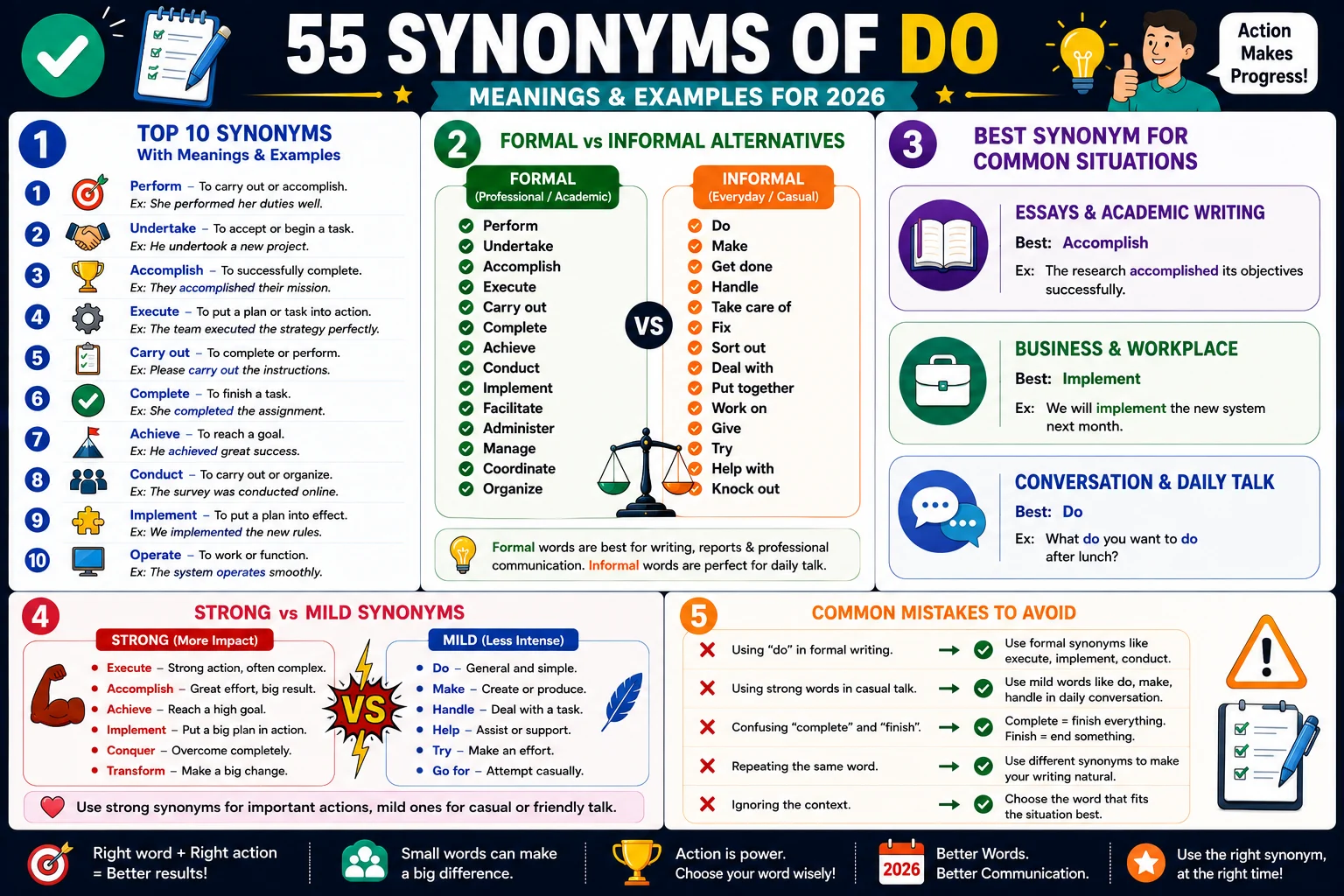
“Do” is one of the most common verbs in English. It means to perform, carry out, or complete an action. The best synonyms are perform, execute, complete, carry out, and achieve. “Perform” is the most common professional alternative. Each synonym has a slightly different meaning and context.
Top 10 Synonyms
- Perform
- Execute
- Complete
- Carry out
- Achieve
- Accomplish
- Fulfill
- Conduct
- Implement
- Produce
“Do” is everywhere in English. You do your homework, do the dishes, do your best, and do business. It’s useful, but using it too often can make your English sound basic and repetitive.
Think about it. Every situation has a more specific word. You perform a task, execute a plan, complete a project, or achieve a goal. Each of these captures the action much more clearly.
In this guide, you’ll learn 35 powerful synonyms for “do.” You’ll discover exactly when to use each one, how formal they are, and what common mistakes to avoid. Let’s begin!
What Does “Do” Mean?
Definition
Do” has many meanings. The main meaning is to perform, carry out, or complete an action. It can also mean to achieve something, to work on something, or to behave in a certain way. It’s a very flexible word that can replace many more specific verbs.
Pronunciation
| Feature | Value |
|---|---|
| US IPA | /duː/ |
| UK IPA | /duː/ |
| Syllables | 1 |
| Tip | Sounds like “too” or “blue” |
Grammar
| Grammar Feature | Information |
|---|---|
| Part of Speech | Verb (transitive and intransitive) |
| Common Position | After the subject |
| Typical Pattern | Subject + do + object |
Examples:
- “I need to do my laundry.” (complete)
- “She does her best every day.” (perform)
- “What are you doing this weekend?” (be doing)
Grammar Note: “Do” is used as both a main verb and an auxiliary verb. As an auxiliary, it’s used in questions and negatives (Do you like coffee? I don’t know.)
Word Family
| Word | Part of Speech | Meaning |
|---|---|---|
| Do | Verb | To perform or complete |
| Doing | Gerund | The act of doing |
| Done | Past Participle | Completed |
| Did | Past Verb | Past tense of do |
| Doer | Noun | A person who does things |
15 Synonyms of “Do”
Perform
Meaning: To carry out, execute, or present an action, task, or activity.
Best Used For: Tasks, duties, shows, responsibilities.
Formality: Formal
Tone: Professional, Skilled
Frequency: ⭐⭐⭐⭐⭐ (Very Common)
CEFR Level: A2
Example Sentence 1: “The surgeon performed the operation successfully.”
Example Sentence 2: “She performed her duties with great care.”
Usage Tip: “Perform” is the most common professional synonym. Use it for tasks, duties, and actions that require skill.
Common Confusion: Do vs Perform. “Do” is general. “Perform” implies a specific, often skilled action.
Execute
Meaning: To carry out or put into effect a plan, order, or action.
Best Used For: Plans, strategies, commands, projects.
Formality: Formal
Tone: Strategic, Precise
Frequency: ⭐⭐⭐⭐ (Common)
CEFR Level: B2
Example Sentence 1: “The team executed the plan flawlessly.”
Example Sentence 2: “He executed his duties as manager perfectly.
Usage Tip: “Execute” emphasizes carrying out something planned or ordered. It’s a strong, formal word.
Complete
Meaning: To finish doing or making something.
Best Used For: Tasks, projects, assignments, forms.
Formality: Neutral
Tone: Achieved, Finished
Frequency: ⭐⭐⭐⭐⭐ (Very Common)
CEFR Level: A2
Example Sentence 1: “I need to complete this report by Friday.
Example Sentence 2: “She completed her degree in three years.
Usage Tip: “Complete” focuses on finishing something. Use it when the emphasis is on getting to the end.
Carry out
Meaning: To perform or complete a task, order, or instruction.
Best Used For: Instructions, commands, experiments, investigations.
Formality: Formal
Tone: Practical, Professional
Frequency: ⭐⭐⭐⭐ (Common)
CEFR Level: B1
Example Sentence 1: “The researchers carried out a series of experiments.”
Example Sentence 2: “We need to carry out the director’s instructions.
Usage Tip: “Carry out” is a professional phrasal verb. Use it for following through on plans or instructions.
Achieve
Meaning: To successfully complete something or reach a goal through effort.
Best Used For: Goals, targets, successes, accomplishments.
Formality: Formal
Tone: Positive, Ambitious
Frequency: ⭐⭐⭐⭐⭐ (Very Common)
CEFR Level: B1
Example Sentence 1: “She achieved her dream of becoming a doctor.”
Example Sentence 2: “The team achieved all their quarterly targets.”
Usage Tip: “Achieve” emphasizes success and reaching goals. It’s a positive, inspiring word.
Accomplish
Meaning: To succeed in doing something, especially something difficult.
Best Used For: Difficult tasks, goals, missions.
Formality: Formal
Tone: Impressive, Determined
Frequency: ⭐⭐⭐ (Moderate)
CEFR Level: B2
Example Sentence 1: “He accomplished more in one year than most do in five.”
Example Sentence 2: “The mission was successfully accomplished.”
Usage Tip: “Accomplish” suggests completing something difficult or impressive. It’s stronger than “do.”
Fulfill
Meaning: To do what is required, expected, or promised.
Best Used For: Promises, duties, responsibilities, requirements.
Formality: Formal
Tone: Responsible, Obligated
Frequency: ⭐⭐⭐ (Moderate)
CEFR Level: B2
Example Sentence 1: “She fulfilled all the requirements for the job.”
Example Sentence 2: “He fulfilled his promise to his parents.”
Usage Tip: “Fulfill” is about meeting obligations and expectations. Use it for promises and responsibilities.
Conduct
Meaning: To organize and carry out an activity, especially a formal one.
Best Used For: Research, surveys, meetings, experiments.
Formality: Formal
Tone: Organized, Official
Frequency: ⭐⭐⭐⭐ (Common)
CEFR Level: B2
Example Sentence 1: “They conducted a survey about customer satisfaction.
Example Sentence 2: “The teacher conducted the class with authority.”
Usage Tip: “Conduct” is formal and often used for research, surveys, and official activities.
Implement
Meaning: To put a plan, decision, or system into action.
Best Used For: Plans, policies, changes, systems.
Formality: Formal
Tone: Strategic, Practical
Frequency: ⭐⭐⭐ (Moderate)
CEFR Level: C1
Example Sentence 1: “The company implemented new safety procedures.
Example Sentence 2: “We need to implement the changes quickly.”
Usage Tip: “Implement” is about putting plans into action. It’s a formal business word.
Produce
Meaning: To make, create, or bring something into existence.
Best Used For: Goods, art, results, effects.
Formality: Neutral
Tone: Creative, Productive
Frequency: ⭐⭐⭐⭐ (Common)
CEFR Level: B1
Example Sentence 1: “The factory produces thousands of cars each year.”
Example Sentence 2: “Her work produced excellent results.
Usage Tip: “Produce” emphasizes creating or making something. Use it for tangible and intangible results.
Engage in
Meaning: To take part in or be involved in an activity.
Best Used For: Activities, hobbies, discussions, debates.
Formality: Formal
Tone: Active, Involved
Frequency: ⭐⭐⭐ (Moderate)
CEFR Level: B2
Example Sentence 1: “She engages in volunteer work every weekend.”
Example Sentence 2: “We need to engage in constructive dialogue.”
Usage Tip: “Engage in” is formal. It implies active participation in an activity.
Undertake
Meaning: To begin and commit to doing a task or project.
Best Used For: Projects, responsibilities, challenges.
Formality: Formal
Tone: Committed, Serious
Frequency: ⭐⭐⭐ (Moderate)
CEFR Level: C1
Example Sentence 1: “He undertook the difficult task of reorganizing the office.”
Example Sentence 2: “The government undertook major reforms.”
Usage Tip: “Undertake” suggests starting a project or responsibility with commitment.
Execute
Meaning: To carry out or perform a planned action.
Best Used For: Plans, strategies, designs.
Formality: Formal
Tone: Strategic, Precise
Frequency: ⭐⭐⭐⭐ (Common)
CEFR Level: B2
Example Sentence 1: “She executed the design perfectly.”
Example Sentence 2: “The plan was executed without problems.”
Usage Tip: “Execute” is formal and often used in professional contexts. It implies precision.
Dispatch
Meaning: To deal with or complete a task quickly and efficiently.
Best Used For: Tasks, jobs, business.
Formality: Formal
Tone: Efficient, Quick
Frequency: ⭐⭐ (Rare)
CEFR Level: C1
Example Sentence 1: “He dispatched his duties with impressive speed.
Example Sentence 2: “The team dispatched the project ahead of schedule.”
Usage Tip: “Dispatch” suggests completing something quickly and efficiently. It’s quite formal.
Enact
Meaning: To put a law or plan into action.
Best Used For: Laws, policies, regulations.
Formality: Very Formal
Tone: Official, Legal
Frequency: ⭐⭐ (Rare)
CEFR Level: C1
Example Sentence 1: “The government enacted new environmental laws.”
Example Sentence 2: “They enacted a plan to improve the economy.
Usage Tip: “Enact” is very formal and primarily used for laws and official policies.
Synonyms Comparison Table
| Synonym | Best Context | Formality | Tone | Frequency |
|---|---|---|---|---|
| Perform | Tasks, duties | Formal | Professional | ⭐⭐⭐⭐⭐ |
| Complete | Finishing tasks | Neutral | Achieved | ⭐⭐⭐⭐⭐ |
| Achieve | Goals | Formal | Positive | ⭐⭐⭐⭐⭐ |
| Carry out | Instructions | Formal | Practical | ⭐⭐⭐⭐ |
| Conduct | Research, surveys | Formal | Organized | ⭐⭐⭐⭐ |
| Execute | Plans, strategies | Formal | Strategic | ⭐⭐⭐⭐ |
| Produce | Creating | Neutral | Productive | ⭐⭐⭐⭐ |
| Accomplish | Difficult tasks | Formal | Impressive | ⭐⭐⭐ |
| Fulfill | Promises, duties | Formal | Responsible | ⭐⭐⭐ |
| Implement | Plans, policies | Formal | Strategic | ⭐⭐⭐ |
Best Synonyms by Situation
| Situation | Best Synonym | Why It Works |
|---|---|---|
| Daily Conversation | Do / Complete | Natural and simple |
| Business Email | Perform / Implement | Professional and clear |
| Academic Writing | Conduct / Undertake | Formal and precise |
| School Assignment | Complete / Achieve | Shows effort and success |
| Professional Meeting | Execute / Implement | Sounds strategic |
| Presentation | Achieve / Perform | Clear and impressive |
| Creative Writing | Produce / Create | Adds creativity |
| Social Media | Do / Complete | Casual and relatable |
Formal vs Informal Synonyms
Formal Alternatives
| Synonym | Best Used For |
|---|---|
| Perform | Tasks, duties, responsibilities |
| Execute | Plans, strategies, actions |
| Conduct | Research, surveys, meetings |
| Implement | Policies, changes, plans |
| Undertake | Projects, challenges |
Neutral Alternatives
| Synonym | Best Used For |
|---|---|
| Complete | Finishing tasks |
| Achieve | Goals and targets |
| Produce | Creating results |
Informal Alternatives
| Synonym | Best Used For |
|---|---|
| Do | General use |
| Carry out | Following instructions |
| Get done | Casual completion |
Choosing the Right Level: In academic writing, use “conduct” or “undertake.” In business, use “perform” or “execute.” In casual conversation, “do” and “complete” are fine.
Strong vs Mild Synonyms
Mild
Suitable for everyday situations.
- Do
- Complete
- Carry out
Moderate
More professional or specific alternatives.
- Perform
- Conduct
- Produce
- Achieve
Strong
High-intensity alternatives suggesting precision or power.
- Execute (precise execution)
- Implement (putting into action)
- Accomplish (difficult achievement)
- Enact (official action)
How Intensity Changes Meaning: “I did the work” is simple. “I executed the plan perfectly” sounds much more impressive. Choose stronger words when you want to emphasize skill or importance.
Real-Life Examples
School: “The students need to complete their assignments on time.”
Office: “We need to perform our duties with excellence.”
Business Email: “Please implement these changes by Monday.”
Meetings: “The team executed the strategy successfully.”
Presentations: “We achieved all our goals this year.”
Daily Conversations: “I need to do my laundry today.”
Social Media: “Just completed my 5K run!”
Academic Writing: “The researchers conducted a comprehensive study.”
Common Collocations
| Common Phrase | Better Alternative |
|---|---|
| Do a job | Perform a job |
| Do a task | Complete a task |
| Do a project | Execute a project |
| Do research | Conduct research |
| Do an experiment | Conduct an experiment |
| Do a plan | Implement a plan |
Common Phrases
Do your best: To try as hard as possible. (e.g., “Always do your best.”)
Do the trick: To achieve the desired result. (e.g., “This tool should do the trick.”)
Do justice: To represent fairly. (e.g., “The photo doesn’t do her justice.”)
Do away with: To get rid of. (e.g., “They did away with the old system.”)
Make do: To manage with limited resources. (e.g., “We’ll have to make do with what we have.”)
Context Guide
| Situation | Best Synonym | Reason |
|---|---|---|
| Essay | Undertake / Conduct | Formal and academic |
| Speech | Achieve / Accomplish | Inspiring and positive |
| Business Email | Implement / Execute | Professional and clear |
| Novel | Perform / Create | Adds literary variety |
| Presentation | Achieve / Execute | Clear and impressive |
| Conversation | Do / Complete | Natural and relatable |
| Academic Writing | Conduct / Undertake | Precise and formal |
| Marketing Copy | Achieve / Create | Positive and engaging |
Related Words
Near Synonyms
- Transact: To carry out business. (e.g., “They transacted business quickly.”)
- Proceed: To go forward with an action. (e.g., “Let’s proceed with the plan.”)
- Operate: To function or work. (e.g., “The machine operates smoothly.”)
- Function: To work in a certain way.
Antonyms
- Neglect: To fail to do.
- Ignore: To not pay attention to.
- Abandon: To give up on.
- Forget: To fail to remember.
- Overlook: To miss or ignore.
Related Adjectives
- Done: Completed.
- Finished: Completed.
- Complete: All done.
- Achieved: Successfully done.
- Accomplished: Successfully completed.
Related Nouns
- Action: Something done.
- Deed: An act or action.
- Task: A piece of work.
- Project: A planned undertaking.
- Activity: Something done.
Related Verbs
- Perform: To do an action.
- Complete: To finish.
- Execute: To carry out.
- Achieve: To reach a goal.
- Implement: To put into action.
Frequently Asked Questions
What is another word for do?
Common synonyms include perform, execute, complete, carry out, and achieve. “Perform” is the most common professional alternative.
Which synonym sounds the most professional?
Perform and execute sound the most professional. “Conduct” is excellent for research and surveys.
What is the strongest synonym for do?
Execute is one of the strongest synonyms. It suggests precise carrying out of plans. “Accomplish” is also strong, suggesting difficult achievement.
Which synonym is best for essays?
Conduct and undertake are excellent for academic essays. They are formal and precise.
What’s the difference between do and perform?
“Do” is more general and informal. “Perform” suggests a specific action, often requiring skill.
Which synonym is most common in everyday English?
“Complete” and “do” are the most common. “Achieve” is also frequently used for goals.
What is the opposite of do?
Common opposites are neglect, ignore, and abandon. These words mean to not do something.
Conclusion
“Do” is a small word with a big job. But now you have 35 fantastic alternatives. Each synonym adds a different shade of meaning to your language.
Remember, the key is understanding the context. Use “perform” for skilled tasks. Use “execute” for plans and strategies. Use “complete” for finishing things. Use “achieve” for reaching goals. Use “conduct” for research and surveys.
The best way to improve is practice. Try using one or two new synonyms each day. Listen for these words in conversations, books, and movies. Your vocabulary will become richer and more impressive with time.
